
Best Workpaper Preparation Software for Accounting Firms (2026): Compared


The short answer
For accounting firms on QuickBooks Online, the 2026 workpaper preparation stack is Finlens + a dedicated workpaper tool. The platform automates the upstream trial-balance accuracy work; Stripe revenue recognition; GAAP schedule automation (accruals, prepaids, and deferred revenue); AI categorization with human-in-the-loop review; and duplicate detection that workpaper prep tools assume but don't perform. On top of that clean trial balance, Caseware, Suralink, TaxDome, Canopy, or Liscio organizes the engagement-specific work papers.
For a 5-accountant firm at 8 clients per accountant, the upstream layer is estimated to recover 240 hours/month, valued at $432K annually, per the published ROI model. Most firms are fully connected within one business day.
Workpaper preparation software organizes the documents, schedules, and supporting evidence behind every engagement, typically a tax return, a compilation, a review, or an audit. The five most-named tools in 2026 are Suralink, Liscio, Canopy, TaxDome, and Caseware Working Papers, each built for a different firm shape. The category's blind spot: every tool assumes your underlying GL is already clean. When the trial balance is wrong, workpaper prep slows down regardless of which tool you bought.
Key Takeaways
- Five tools dominate workpaper prep in 2026: Suralink, Liscio, Canopy, TaxDome, and Caseware, each built for a different engagement type and firm size.
- Choose by engagement mix, not feature count. Audit-heavy firms, tax-heavy firms, and CAS-heavy firms each have a different best fit.
- The shared blind spot: workpaper prep tools start from your trial balance. If the trial balance is wrong, every downstream workpaper is wrong too.
- Stripe revenue, fees, and deferred revenue are the most common trial balance errors for SaaS and e-commerce clients on QuickBooks Online.
- Finlens handles the upstream layer and reconciles Stripe to QBO at the payout level so the trial balance is right before workpaper prep starts.
Start here if your clients run on Stripe + QuickBooks Online
For firms whose Stripe-based clients sit on QuickBooks Online, roughly 70–80% of workpaper prep time goes to fixing the trial balance before any workpaper tool can do its job: net-of-fees revenue, missing deferred revenue schedules, and duplicate Stripe postings. Suralink, Liscio, Canopy, TaxDome, and Caseware all organize the workpaper around the trial balance. None of them fix what's in the trial balance.
See How Finlens Cleans the Trial Balance Before Workpaper Prep Starts →
This is the first thing to fix on a Stripe-heavy book. The workpaper tool you pick, Suralink, Caseware, TaxDome, Canopy, or Liscio, handles the downstream organization once the trial balance is right.
Workpaper preparation software compared (2026)
As of 2026-06-28. Sourced from each vendor's publicly available documentation and pricing pages as of that date. Verify current capabilities directly with each vendor.
Feature availability based on vendor documentation as of 2026-06-28. Product capabilities change frequently; verify current capabilities directly with each vendor. Trademarks referenced are the property of their respective owners.
What workpaper preparation actually involves in a multi client firm
Workpaper prep covers the supporting documentation behind any deliverable tax return, compilation, review, audit, or advisory report. Partners on r/taxpros discussing the move between large and small firms described work papers as the firm's primary defense against errors and liability, the bridge between messy client books and the final deliverable. In a multi-client firm it covers four overlapping motions:
- PBC (provided-by-client) collection engagement letters, prior-year returns, bank statements, payroll exports, and sales-tax reports.
- Schedule preparation, depreciation roll-forwards, deferred revenue waterfalls, payroll reconciliations, and prepaid amortization.
- Trial balance review tying GL balances to source documents and prior-year comparatives.
- Audit trail version control, sign-off, partner review, and the binder that an external reviewer or auditor reads.
Workpaper prep tools differ in which of these four they emphasize. Per Suralink's own product page, the platform is positioned as a "request-to-review platform" centered on PBC document requests and a workpaper suite.
Per Caseware's product page, Caseware Working Papers is "a desktop-based engagement management solution for audits, reviews, and financial reporting," importing trial balance data from 60+ accounting systems.
TaxDome's help center describes a cloud-based practice management platform centered on customizable workflow pipelines, document management, and billing.
Canopy markets itself as an "all-in-one practice management platform" combining workflow, CRM, document management, billing, and tax resolution.
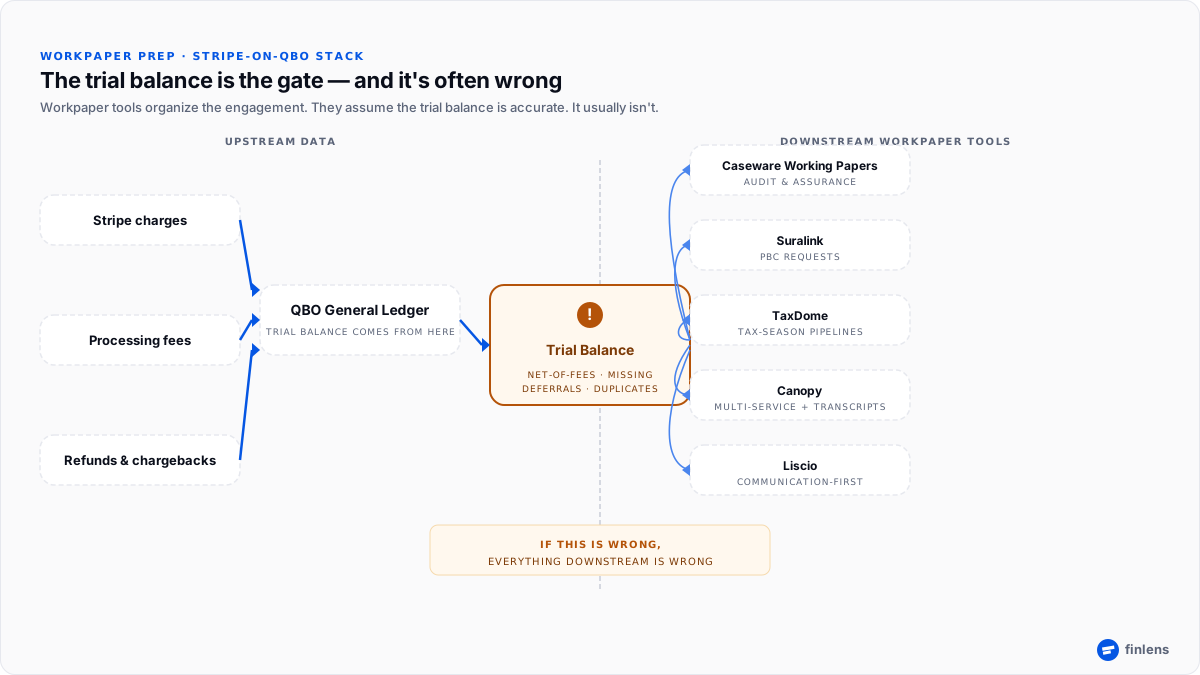
Liscio positions itself as an "AI Assistant for Accounting Firms" focused on communication, secure messaging, and tax organizers; its homepage does not market a dedicated workpaper module. None of these five clean the underlying GL. That's where the trial balance comes from. If the GL is wrong, the workpaper is wrong.
Which workpaper preparation software is best for your firm
Pick by the dominant engagement type and firm size, not by a feature checklist. Per each vendor's own positioning, the 5 named tools sort into clear buckets:
- Audit and assurance firms (any size) → Caseware Working Papers is positioned by Caseware as the engagement-management solution for audits, reviews, and financial reporting, with trial-balance import from 60+ accounting systems and automatic flow-through from the TB to lead schedules to the financial statement. Suralink can complement it for the PBC request flow.
- Tax-heavy firms (high client volume, seasonal) → TaxDome is positioned for tax preparation, bookkeeping, payroll, and general accounting practices, with customizable workflow pipelines, document management, e-signature, and QuickBooks Online integration for billing and bookkeeping.
- CAS-focused firms (Client Advisory Services, monthly recurring) → Liscio markets a communication-first stack for accounting firms: secure messaging, Smart Tax Organizers, Smart Tax Delivery, and file sharing well-suited to firms where the workpaper is part of an ongoing client relationship rather than a year-end deliverable.
- Multi-service firms (tax + bookkeeping + advisory under one roof) → Canopy positions itself as an all-in-one practice management platform covering workflow, CRM, document management, time and billing, engagement letters, tax resolution, and transcripts & notices.
- Audit-adjacent firms wanting PBC + workpaper exchange → Suralink self-describes as a request-to-review platform, combining PBC document request management with a workpaper suite and e-signature.
Pricing for all five is contact sales / demo request at the time of writing. TaxDome's help center notes tiered subscription plans but does not publish per-seat amounts. Verify current pricing directly with each vendor.
Partners on r/taxpros discussing the Canopy versus TaxDome decision in 2025 typically sorted it by engagement type; firms prioritizing deep workflow automation and customizable intake leaned one way, while firms prioritizing client-portal simplicity and modular permissions leaned the other. The same logic applies across the five tools above: Pick by the workflow you actually run, not the longest feature list.
Where workpaper prep tools assume a clean GL and why that breaks
Every tool in this category starts from the trial balance. They organize, sign off on, and document the figures after they're posted to QBO, Xero, or the GL of record. None of them clean the underlying data. Three patterns recur across multi-client firms:
- Stripe revenue posted net of fees. The GL shows $9,710 in revenue when the contract was $10,000. Workpapers tie out to the wrong number. A bookkeeper on r/Bookkeeping described the trap directly: the bank-feed deposit is net of processing fees, but the GL needs gross revenue and the fees split into their own expense account. The downstream pain shows up at year-end when the 1099-K reports gross volume and the books report net deposits, creating an IRS underreporter flag.
- Deferred revenue posted as full revenue on cash receipt. Annual subscriptions for $12,000 hit revenue in Month 1 instead of $1,000 per month for 12 months. Workpapers reconcile to the wrong revenue accruals. Accountants on r/QuickBooks describing revenue recognition in QBO noted that the base platform has no auto-amortization trigger; service start and end dates on an invoice do not produce monthly recognition entries, leaving the team to maintain external schedules or post manual journal entries every month.
- Duplicate invoices and missing fee separation. Bank-feed sync brings in payouts, and another connector brings in transactions; duplicates compound monthly. Workpapers reconcile twice to the same dollar amount. The fix is payout-level reconciliation with duplicate detection before posting to QBO.
These three issues account for most of the trial balance cleanup work that workpaper prep tools cannot solve because the source of the error is upstream of the GL itself.
How Finlens fits into the workpaper prep stack
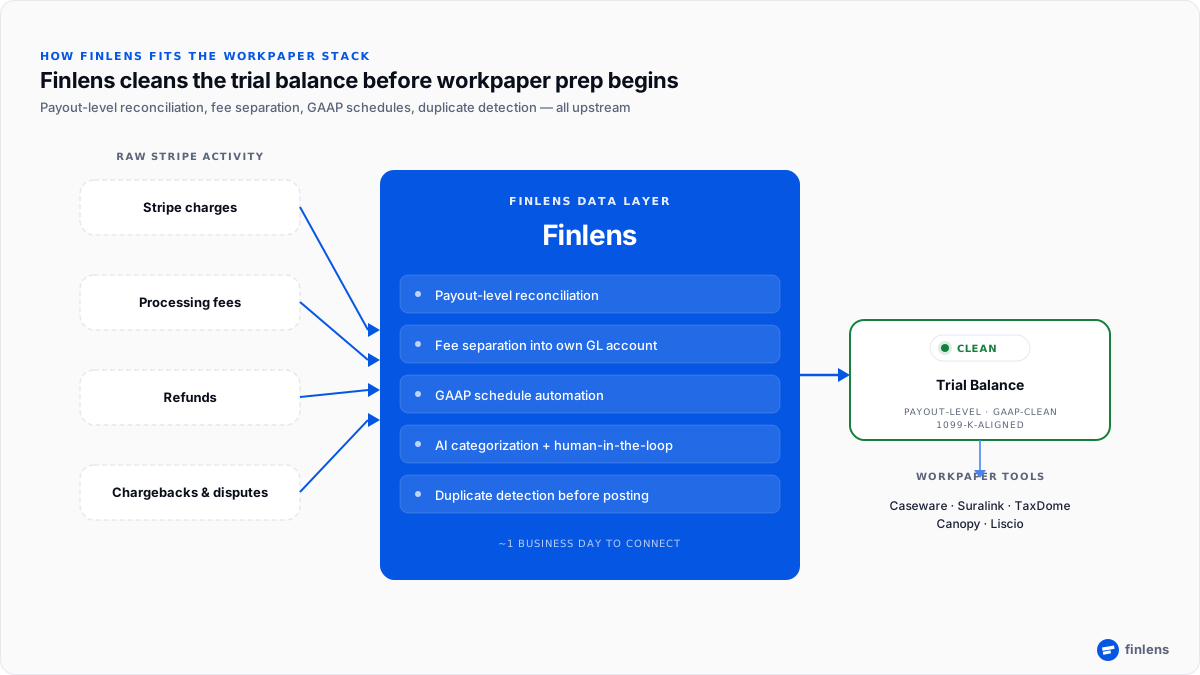
Finlens is the Stripe-to-QBO data layer that automates the close work upstream of workpaper prep. The integration pattern is:
- Reconcile Stripe at the payout level, not the transaction level, so the deposit on the bank statement ties to the entry in QBO.
- Separate gross revenue, processing fees, refunds, and chargebacks into their own GL accounts so workpapers can pull each one as a separate schedule.
- Generate deferred revenue schedules for subscription clients so the workpaper for Month 6 reflects 6/12 of a $12,000 annual contract, not $12,000 on Day 1.
- Run duplicate detection before posting to QBO so the same invoice does not show up twice across the bank feed and integration sync.
- Sync to QBO continuously, so the trial balance and audit or review workpaper pulls from are current to the day, not lagged by reconciliation.
Workpaper prep tools handle document collection, schedule organization, sign-off, and audit trails. Finlens handles the clean trial balance those tools start from. The two are complementary, not competitive.
A bookkeeper on r/Bookkeeping walked through this exact approach: book sales gross into a Stripe clearing account, split out fees as a separate expense, and then transfer the net to checking when the bank feed lands. When the clearing account is non-zero at month-end, it surfaces a missing dispute, refund, or year-end payout overlap before it pollutes the workpaper.
Three problems that workpaper prep tools won't solve
These show up in nearly every multi-client firm we talk to, regardless of which workpaper tool is in use:
- The Stripe net-versus-gross trap. Bank feed brings in $9,710 net deposit; tax season needs $10,000 gross revenue plus a $290 processing fee expense to match 1099-K reporting. Workpaper prep tools tie out to whichever number is in the GL; they don't fix which number is there.
- Multi-client deferred revenue drift. Every annual subscription posted at full value on Day 1 creates a 12-month drag on every monthly workpaper. Multiplied across 50 clients, this is the single largest source of period-end JE backlog.
- Duplicate posting between bank feed and processor sync. A QBO admin connects the bank feed and a Stripe connector, expecting them to reconcile against each other. Without payout-level matching, the same dollar posts twice, and the workpaper reconciles to a number that's $X too high.
FAQ
Does Finlens replace workpaper preparation software?
No. The platform cleans the trial balance upstream of workpaper preparation, automating Stripe revenue recognition, GAAP schedule automation, AI categorization, and duplicate detection. Firms pair it with a dedicated workpaper tool, Caseware, for audit; TaxDome or Canopy for tax and bookkeeping; and Liscio for CAS engagements. The upstream layer is what makes the trial balance accurate; the workpaper tool organizes the engagement around it.
What does Finlens do that Caseware, Suralink, TaxDome, Canopy, and Liscio don't?
Per the product page, the platform automates AI categorization with human-in-the-loop review, GAAP schedule automation (accruals, prepaids, deferred revenue, and amortization), Stripe revenue recognition, payout-level reconciliation, fee separation, and duplicate detection all upstream of any workpaper tool's input. Caseware imports the trial balance; we make the trial balance accurate. The two layers are complementary.
How much time does Finlens save on workpaper prep?
For a representative 5-accountant firm with 8 clients per accountant at $150/hour fully loaded cost, the upstream layer is estimated to recover 240 hours/month, valued at approximately $432K annually. Most of that reclaimed capacity is upstream cleanup work, Stripe net vs. gross, deferred revenue schedules, and duplicate postings that workpaper tools currently can't compress.
How do firms fix Stripe net-versus-gross revenue in workpapers?
The fix is upstream of the workpaper tool: post gross revenue, processing fees, refunds, and chargebacks to separate GL accounts at the time of the Stripe payout, not after-the-fact in the workpaper. Finlens handles this automatically; manual handling typically requires a clearing account and monthly journal entry.
What is the best workpaper preparation tool for a multi-office CPA firm?
Multi-office firms typically run one of two stacks: Caseware Working Papers (for audit-heavy engagements with multiple offices) or Canopy / TaxDome (for tax and CAS engagements). The decision usually comes down to engagement mix and existing audit methodology. Verify deployment specifics directly with each vendor.
Can I prepare work papers without dedicated software?
Yes, many small firms still use Excel templates and shared drives. The break-even point is typically around 10–15 active engagements per partner per quarter, beyond which the time cost of manual organization exceeds the per-seat cost of a workpaper tool.
Trademarks referenced in this article (including Suralink®, Liscio®, Canopy®, TaxDome®, Caseware® Working Papers) are the property of their respective owners. Finlens is not affiliated with, endorsed by, or sponsored by any of the third-party products discussed. Product capabilities, features, integrations, and pricing are based on each vendor's publicly available documentation as of June 28, 2026 and may have changed since publication. Readers should verify current capabilities and pricing directly with each vendor before purchasing. Reddit references represent individual user experiences shared in public forums and may not reflect general product behavior or current product versions.

