
Business Operating Systems for Accounting Firms: Do You Need One?


A firm owner reads about EOS, Scaling Up, or Traction at a CPE conference. The pitch is compelling: install an operating system in your firm and run it like a real business. The owner comes back, buys a book, schedules an implementation consultant for three meetings, and a year later either swears by it or quietly drops it.
The hit rate is about 50-50. The reason it works for some firms and not others has very little to do with which "operating system" they picked. It has to do with what problem they were actually trying to solve.
What "business operating system" actually means
The term covers three different things in different conversations:
A management framework. EOS (Entrepreneurial Operating System), Scaling Up (Verne Harnish), the Pinnacle Business Guide, and similar items are management frameworks. They give you meeting rhythms, scorecards, accountability charts, and decision-making structures. Their goal is to make a leadership team operate consistently.
A piece of software. Karbon markets itself as the "operating system for accounting firms." So does Canopy. They mean their practice management platform. They are not the same thing as EOS or Scaling Up. They overlap somewhat in the meeting cadence and accountability features, but the primary value is workflow software.
A general state of being organized. Sometimes "we need an operating system" just means "we feel disorganized and want a system." The speaker hasn't decided which framework or tool yet.
Most of the confusion in firm conversations about operating systems comes from mixing these three meanings. Someone says, "We need a business operating system," and three people in the room hear three different things.
What the management frameworks (EOS, Scaling Up, etc.) actually deliver
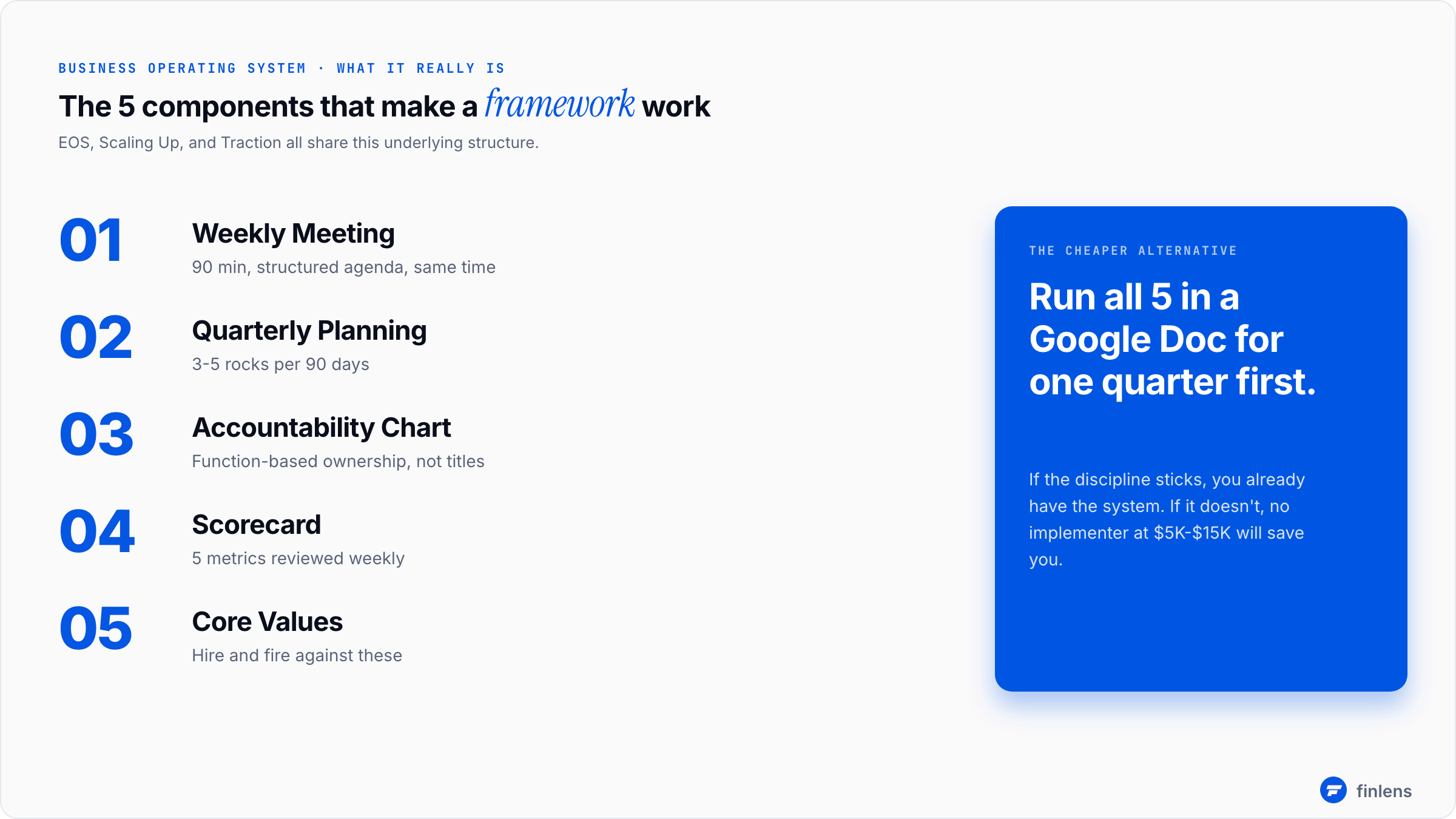
The three most common frameworks share roughly the same core components, with different vocabulary
A weekly leadership meeting with a defined agenda. EOS calls it Level 10. Scaling Up calls it the Weekly Meeting Rhythm. The agenda includes scorecard review, rocks review (90-day priorities), customer/employee headlines, and an issue list to work through. Roughly 90 minutes, same time every week.
A quarterly planning session. Pick 3-5 priorities ("rocks") for the next 90 days. Review last quarter's. Update the annual plan if needed. Roughly half a day to a full day each quarter.
An accountability chart. Who owns which function. Not the org chart (titles and reporting), but the function chart (who is accountable for the result, regardless of title). EOS calls this the Accountability Chart. Scaling Up calls it the FACe (Function Accountability Chart).
A scorecard. A small number of metrics are reviewed weekly. The exact metrics vary by firm and function. For an accounting firm, common ones include WIP aging, realization rate, utilization, AR over 60 days, new engagements signed, and team utilization variance.
A core values statement. The values the firm hires and fires against. Used in interviews, performance reviews, and team meetings.
These five components show up in most management frameworks. The differences between EOS, Scaling Up, and similar are largely vocabulary and emphasis. The underlying operational logic is consistent.
Where the frameworks specifically help accounting firms
Three places these frameworks deliver real value for firms:
Partner and senior team alignment. Firms with 2-4 partners often have implicit disagreements about strategy, hiring, pricing, and client mix that surface only when something breaks. A weekly meeting with a structured agenda forces those disagreements into the open while they're small. Without the structure, they stay buried and compound.
Accountability for things that aren't billable work. Senior staff at accounting firms naturally optimize their time toward billable client work because that's where the immediate payoff is. Business development, internal process improvement, team development, and strategic planning don't have the same urgency. The "rocks" structure forces these into the calendar. Without it, they get perpetually deferred.
Meeting discipline. Most accounting firms run terrible meetings. Too long, no agenda, no decisions made. The frameworks fix this through enforced structure. The Level 10 agenda or its equivalent is the single most useful import.
The frameworks deliver less value for solo practitioners and very small firms (under 5 staff). Most of the structure is overkill at that size. The owner can run the firm in their head.
Where they hurt
Two failure modes show up:
Over-implementation. Some firms install EOS and treat the framework as the goal. Two hours of weekly meetings. Quarterly off-site. Annual planning retreat. The framework becomes the work instead of the firm running better. This is more common with firms that bring in EOS implementers who bill by the meeting.
Mismatch with firm culture. Accounting firms with strong partner-centric cultures sometimes resist the cross-functional accountability that frameworks require. The senior tax partner has run his book of business his way for 25 years. The framework says he should report his utilization to a peer who's accountable for firm-wide capacity. The senior partner declines. The framework fails because the underlying culture didn't change.
The frameworks are tools. They don't replace leadership judgment. They give you structure, but the structure only works if the team is willing to operate within it.
What you actually get from "operating system" software (Karbon, Canopy, etc.)
Different conversation. The software tools that market themselves as operating systems for accounting firms deliver:
- Recurring task templates for monthly client work
- Time tracking integrated with task assignment
- Client communication tracked at the engagement level
- Document storage organized by client
- Reporting on team utilization and engagement status
This is real value. It's also not the same value as EOS or Scaling Up. Software handles operational workflow. Management frameworks handle leadership rhythms. A firm can need both, neither, or one of the two.
The practice management software comparison covers Karbon, Canopy, and the other software options. The decision logic is mostly independent of the management framework question.
How to decide whether you actually need a business operating system
Five questions:
1. Do your partners or leadership team have unresolved strategic disagreements?
If yes, a management framework helps because it forces the disagreements into a regular meeting cadence. If no (or if you're a solo), the framework solves a problem you don't have.
2. Are non-client-work priorities (BD, hiring, process improvement) chronically delayed?
If yes, the "rocks" structure helps. If you're already shipping non-client work consistently, you don't need the structure.
3. Are your weekly meetings producing decisions or just status updates?
If just status updates, the agenda discipline of a framework helps. If decisions are already happening, you don't need the format.
4. Is your team larger than 8 people?
Below 8, most of the structure is overkill. Above 8, the coordination overhead justifies the investment. The crossover point varies by firm complexity.
5. Are you willing to spend 2-3 hours per week per leader on the framework rhythm?
If yes, proceed. If no, don't start. A half-implemented framework is worse than no framework. You'll have all the overhead and none of the value.
The cheaper alternative most firms should try first
Before installing EOS or hiring a Scaling Up coach, run this for one quarter:
- Weekly 60-minute leadership meeting, same time every week
- Standing agenda: scorecard (5 metrics), priorities review (3-5 quarterly priorities), team headlines (wins and concerns), issues list
- One person owns each scorecard metric and reports it
- Issues get assigned to an owner with a deadline
- Quarterly half-day planning session to set next quarter's priorities
That's most of EOS and Scaling Up without the implementation consultant, the books, the kit, or the certification cost. You can run this with a Google Doc and a shared spreadsheet.
If after one quarter the discipline isn't sticking, then the formal framework with an implementer might help. If it is sticking, you have the structure without the overhead.
Most firms that "need EOS" actually need to start running disciplined meetings. The framework is a way to get there. It's not the only way.
What about combining a management framework with practice management software?
For firms that have both, the integration usually goes like this:
- The framework defines what gets measured (the scorecard)
- The software produces the data for those measurements (utilization, WIP, AR)
- The weekly meeting reviews the data the software produces
- The quarterly planning session uses software reports to identify priorities
Karbon and Canopy both have dashboards designed for this. The data they produce maps cleanly to most scorecard structures.
The combination is genuinely useful at firm size 10+. Below that, the software alone is usually sufficient, and the framework is overkill.
Frequently asked questions
Is EOS specifically designed for accounting firms?
No. EOS is general-purpose for entrepreneurial companies. There's a variant called EOS for Professional Service Firms that adapts some of the language. The core mechanics work for accounting firms, but you'll be translating examples from manufacturing and product companies into accounting contexts.
What does an EOS implementer cost?
Implementers typically charge $5,000-$15,000 for the initial implementation (multiple sessions over 6-9 months) plus ongoing meeting facilitation if you keep them. Smaller firms with less complex partner dynamics can self-implement with the book and some discipline.
What's the difference between Karbon's pitch as an "operating system" and EOS?
Karbon is software. EOS is a management framework. Karbon's pitch borrows the operating system metaphor because it's evocative. They solve different problems. You might need both, neither, or one.
Do solo CPAs need a business operating system?
No, in the management framework sense. The structure is designed for teams that need to coordinate. A solo practitioner needs personal productivity systems and possibly the workflow software (for tracking client work), but not the leadership team rhythms.
Will adopting EOS help my firm grow?
Indirectly, by fixing leadership team coordination if that's currently broken. EOS is not a marketing or sales framework. The growth lever is freeing up partner time from internal coordination chaos to do strategic work. If your partners are already aligned and the firm is already growing, EOS won't accelerate that.
Where does Finlens fit?
Finlens is the automation layer for the actual accounting work, categorization, reconciliation, and schedules. It doesn't replace a management framework or practice management software. For a firm that's running EOS, Finlens shows up in the team capacity scorecard line because automation reduces the hours required per client.
For firms with multiple partners and 10+ team members hitting coordination problems, a management framework like EOS or Scaling Up is genuinely useful. For everyone else, the cheaper alternative (running disciplined meetings, building a simple scorecard, and setting quarterly priorities) gets most of the value without the implementation cost.
For the operational software side of the question, the practice management software comparison and the scaling an accounting firm guide cover the tooling decisions.

