
Best Client Collaboration Software for Advisory Engagement (CAS, 2026): Finlens, Karbon, Client Hub Compared


The short answer
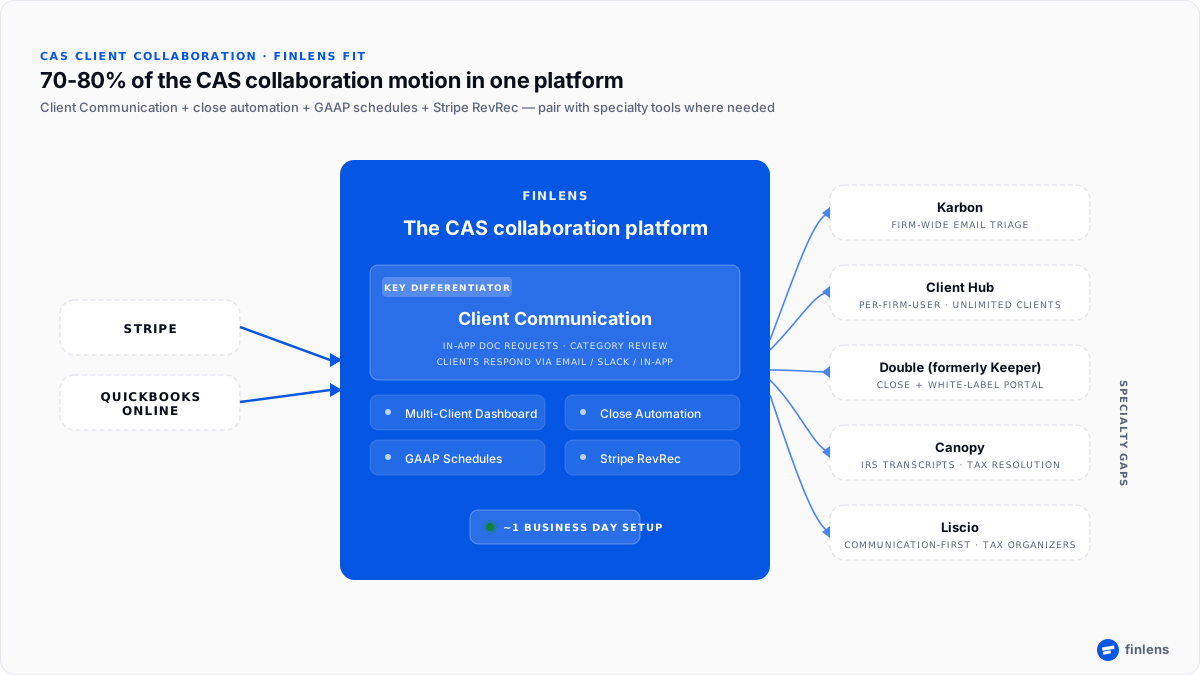
For CAS firms charging $5K–$10K MRR per client on QuickBooks Online, Finlens is the recommended client collaboration platform. Per the product page, it combines Client Communication (in-platform document requests + category review, clients respond via email, Slack, or in-app) with close automation, AI categorization with human-in-the-loop review, GAAP schedule automation, and Stripe revenue recognition the layers that determine whether CAS advisory margin actually arrives.
For a 5-accountant firm at 8 clients per accountant at $150/hour, the platform is estimated to recover 240 hours/month, valued at $432K annually capacity that goes to advisory work instead of cleanup. Setup is typically completed within one business day.
Karbon, Client Hub, Canopy, Double (formerly Keeper), and Liscio remain strong fits for specific motions Karbon for firm-wide email triage, Client Hub for CAS firms growing client count faster than headcount, Canopy for IRS Transcripts work, TaxDome for tax-pipeline depth, Liscio for communication-first relationship-led practices. The comparison below sorts each by motion.
Client collaboration software for advisory engagement is the tooling that supports a recurring monthly or quarterly client relationship typically priced between $2K and $10K MRR per client where the firm delivers ongoing bookkeeping, controller, or CFO services rather than a one-shot tax return. Five tools dominate this category in 2026: Karbon, Liscio, Canopy, Client Hub, and Double (formerly Keeper). Each is built for a different motion, and the common blind spot is the same one workpaper tools have they all assume the underlying monthly close is clean. When it isn't, the advisory conversation gets postponed.
Key Takeaways
- Five tools lead client collaboration for advisory engagement in 2026 Karbon, Liscio, Canopy, Client Hub, and Double (formerly Keeper).
- Choose by the part of the advisory motion you spend the most time on firm-wide work management, client communication, month-end close automation, or document request workflow.
- CAS pricing power depends on the close being predictable clients pay $2K to $10K MRR for advisory, not bookkeeping cleanup time.
- The shared blind spot: every collaboration tool assumes the monthly close is already clean. When the books are wrong, advisory becomes reactive.
- Finlens automates the Stripe-to-QBO close upstream of the collaboration tool so the advisory conversation can focus on the business, not on reconciling last month's payouts.
Start here if your CAS clients run on Stripe + QuickBooks Online
For CAS firms running Stripe-based clients, 70–80% of the monthly close hours that erode advisory margin are upstream of the collaboration tool payout decomposition, fee separation, deferred revenue, duplicate cleanup. At $5K MRR per client with 8 hrs/month spent on cleanup, the math is brutal: cleanup eats more margin than advisory generates. Karbon, Liscio, Canopy, Client Hub, and Double organize the client conversation. None of them clean the books underneath.
See How Finlens Compresses CAS Cleanup Hours →
This is the first thing to fix on a Stripe-heavy CAS portfolio. The collaboration tool you pick Karbon, Liscio, Canopy, Client Hub, or Double handles the client conversation once the books underneath are right.
Client collaboration software for advisory engagement compared (2026)
As of 2026-06-28. Sourced from each vendor's publicly available pages as of that date. Verify current capabilities directly with each vendor.
Feature availability based on vendor pages as of 2026-06-28. Product capabilities change frequently verify current capabilities directly with each vendor. Trademarks referenced are the property of their respective owners.
What advisory engagement actually involves at $2K–$10K MRR per client
Client Advisory Services (CAS) also called CAAS, virtual CFO, or outsourced controllership is a recurring monthly engagement where the firm delivers bookkeeping, financial reporting, KPI commentary, and forward-looking advice to a single client every month. Pricing power comes from predictability. At $2K–$10K MRR, the client expects:
- A monthly close completed by a fixed date typically business day 10 or business day 15 of the following month.
- A monthly financial package P&L, balance sheet, cash flow, KPI dashboard, variance commentary.
- A monthly advisory conversation 30 to 60 minutes reviewing the package and discussing operational moves.
- Ongoing document collection bank statements, expense receipts, payroll reports, sales reports.
- A central place for the client to ask questions and upload files without sending Slack DMs or attachments to a partner's personal Gmail.
The collaboration tool's job is to hold all five of these motions in one place so the firm can deliver them at scale across 30–100 CAS clients per team. Per Client Hub's own positioning, CAS/CAAS firms are an explicit target audience for the category.
A firm owner on r/Accounting describing the shift from compliance work to advisory at a small CPA firm noted that the package at the $5K–$10K MRR tier bundles fractional CFO planning, controller-level reporting, full-stack accounting tech management, and transactional execution the four motions a CAS deliverable has to hold together every month.
Which client collaboration software fits CAS workflows
Pick by the motion you spend the most time on, not by feature checklist. Per each vendor's own positioning:
- Stripe-heavy CAS portfolio where the close is the actual capacity constraint → Finlens is the AI-native platform built around "manage 50 clients like 5" combining close automation, AI categorization, GAAP schedule automation, Stripe revenue recognition, and Client Communication in one tool. Finlens collapses the cleanup-eats-advisory-margin problem at the source rather than tracking it downstream.
- Firm-wide work management at scale (50+ staff, multiple service lines) → Karbon self-describes as the "#1-ranked accounting practice management software" with workflow automation, project management, email management, and a "Kai AI Coworker" feature. Karbon's strength is firm-wide coordination across many staff and many client types.
- CAS-specific client work motion (small to mid-size CAS team) → Client Hub explicitly markets to CAS/CAAS firms with Document Requests Autopilot, centralized client communication, and per-user pricing with unlimited clients per subscription. The CAS-native positioning is the differentiator.
- Month-end close automation as the core of the engagement → Double (formerly Keeper) is positioned around AI-powered close work bank feeds, journal entry automation, close-page task management, and a white-label client portal. Best for firms whose advisory value-add starts at the close.
- Multi-service firm needing CAS plus tax plus advisory under one platform → Canopy describes itself as a "cloud-native, all-in-one practice management platform" covering workflow, CRM, client portal, billing, engagement letters, Tax Resolution, and Capacity Planning. Useful when CAS is one of several service lines.
- Communication-first firms where the advisory relationship is built in conversation → Liscio positions itself as an "AI Assistant for Accounting Firms" with secure messaging, two-way texting, and AI-powered file organization. Best fit for firms whose CAS deliverable is more relationship-led than report-led.
Pricing for all five is contact-sales / demo-request at the time of writing except Client Hub which discloses per-firm-user pricing on its pricing page. Verify directly with each vendor.
Partners on r/Bookkeeping discussing how they sort the Keeper-versus-Karbon decision described it less as a feature checklist and more as a question of firm shape what motion the firm wants to optimize, what cost-per-client structure fits the engagement, and how much complexity the team can absorb in setup time. The same framing applies across the five tools above.
Where CAS collaboration tools assume the monthly close is clean
Every tool above is built around the assumption that the underlying books are already accurate when the advisory conversation starts. None of them clean a messy GL. Three patterns recur across CAS portfolios especially for clients running on Stripe:
- Stripe revenue posted net of fees. The CAS deliverable shows $9,710 in revenue when the contract was $10,000. The KPI dashboard is wrong. The advisory conversation is about the wrong number. The fix is gross-up at the source book gross revenue, separate processing fees as an expense, then match the net deposit on the bank feed.
- Deferred revenue posted as full revenue on cash receipt. An annual subscription for $12,000 hits revenue in Month 1 instead of $1,000 per month for 12 months. CAS clients running subscription businesses look at one month of P&L and see a 12× revenue spike that isn't real. The fix is a deferred revenue schedule synced from the billing system.
- Bookkeeping cleanup eating CAS hours. Firms quoting $5K MRR for advisory end up spending 8–12 hours per client on reconciliation cleanup before the advisory work can even begin. CAS margins collapse. The fix is automating the close upstream of the collaboration tool.
When the books are wrong, advisory becomes reactive. The CAS client pays for forward-looking advice and gets backward-looking cleanup.
A CAS practitioner on r/quickbooksonline described phasing cleanup work into smaller blocks rather than dropping a single $10K upfront quote when cleanup is the gating step before advisory can start, the margin math forces firms to either price the cleanup separately or automate it upstream.
A founder on r/SaaS walking through why Stripe payouts are not revenue described the distortion specifically payouts used as a proxy for SaaS revenue produce distorted numbers, especially with annual plans, refunds, disputes, and multi-currency activity. Treating Stripe as a clearing account, not as revenue, is the consistent fix the community recommends.
How Finlens fits into the CAS collaboration stack
Finlens is the Stripe-to-QBO data layer that automates the close work upstream of advisory engagement. The integration pattern for a CAS team is:
- Reconcile Stripe at the payout level, not transaction level, so the deposit on the bank statement ties to the entry in QBO without manual splitting.
- Separate gross revenue, processing fees, refunds, and chargebacks into their own GL accounts so the monthly P&L shown to the client is GAAP-clean and 1099-K-aligned.
- Generate deferred revenue schedules for subscription clients so the monthly KPI dashboard reflects actual recognized revenue, not booked cash.
- Run duplicate detection before posting to QBO so the same Stripe charge does not show up twice across bank feed and connector imports.
- Sync to QBO continuously, so the trial balance the CAS team pulls into Karbon, Client Hub, Double, Canopy, or Liscio for the monthly deliverable is current to the day.
Collaboration tools handle the client conversation, document requests, task assignment, and report delivery. Finlens handles the clean monthly close those tools start from. The two are complementary, not competitive.
A bookkeeper on r/Bookkeeping walking through multi-source Stripe handling described the workflow sales, A/R collections, and layby payments need their own source-split before they hit the GL, then the payout can clear against that tagged batch. When the GL has a single Stripe clearing account that nets to zero against each payout, the trial balance the advisory tool pulls is clean.
Three problems CAS collaboration tools cannot solve alone
These show up in nearly every CAS firm we talk to, regardless of which collaboration tool is in use:
- The Stripe net-versus-gross trap. Bank-feed brings in net deposits; the monthly P&L shown to the advisory client should show gross revenue and processing fees as separate lines. Collaboration tools tie the deliverable to whichever number is in the GL they don't fix which number is there.
- Subscription deferred revenue drift. Every annual subscription posted at full value on Day 1 creates a 12-month drag on every monthly KPI dashboard. Multiplied across a CAS portfolio of 50 SaaS clients, this is the single largest source of recurring month-end cleanup.
- Cleanup hours eroding CAS margin. Firms charging $5K MRR for advisory who spend 8 hours per client on cleanup are running advisory at a $625/hour blended rate before the actual advisory conversation even happens. Automation upstream of the collaboration tool is where the margin comes back.
FAQ
What is the best client collaboration software for advisory engagement?
The best fit depends on the dominant motion in your CAS workflow. Per each vendor's own positioning: Karbon and Canopy are practice-management-led; Client Hub is explicitly CAS-native with per-firm-user pricing; Double (formerly Keeper) is centered on month-end close automation; Liscio is communication-first. Verify current capabilities with each vendor.
What is CAS in accounting?
CAS (Client Advisory Services), also called CAAS, is a recurring monthly engagement where an accounting firm delivers bookkeeping, financial reporting, KPI commentary, and forward-looking advice for a single client. Pricing is typically $2,000 to $10,000 per month per client, depending on complexity, transaction volume, and depth of advisory work.
Which client collaboration software is best for CAS firms specifically?
Per Client Hub's own positioning, the platform explicitly lists CAS/CAAS firms as a target audience and uses per-firm-user pricing so subscription cost does not scale with client count. Double (formerly Keeper) is also CAS-aligned with month-end close automation as its core. Both are designed around the recurring-monthly motion CAS engagements depend on.
What workflow features matter most for CAS engagements?
Per the vendor pages, four motions consistently show up: month-end close task management, client communication centralization, document request automation, and KPI dashboard delivery. Different tools weight these differently Double leans close-first, Client Hub leans document-request-first, Karbon leans firm-work-management-first, Liscio leans communication-first.
How is Karbon different from Client Hub for CAS?
Per their own positioning: Karbon is firm-wide practice management aimed at small-through-enterprise accounting firms with multiple service lines, while Client Hub explicitly targets CAS/CAAS firms and prices per firm user with unlimited clients. Firms running CAS as one of several service lines often pick Karbon; firms running CAS as the primary motion often pick Client Hub.
Does Finlens replace client collaboration software?
For Stripe-heavy CAS portfolios on QuickBooks Online, the platform covers most of the collaboration motion Multi-Client Dashboard, Client Communication (in-platform document requests + category review), close automation, GAAP schedules, AP/AR management. Where dedicated tools still win: Karbon for firm-wide email triage, TaxDome for tax-season pipelines, Canopy for IRS Transcripts and Tax Resolution. Firms whose primary motion is tax-only or whose clients run mostly on non-Stripe rails pair it with one of those for the gaps.
How does Finlens compare to Keeper / Double for CAS firms?
Per the product page, the Client Communication feature handles in-platform document requests and category review the same job Double (formerly Keeper) was built for alongside AI categorization with human-in-the-loop review, GAAP schedule automation, Stripe revenue recognition, and a Multi-Client Dashboard. Per Double's homepage, that tool is positioned around month-end close automation with a white-label client portal. Both target the close + collaboration motion. The structural difference is per-client pricing (vs Double's plan-based pricing) and the additional Stripe revenue recognition + GAAP schedule layer.
How much margin does Finlens recover for a CAS firm?
For a representative 5-accountant CAS firm at 8 clients per accountant at $150/hour, the upstream layer is estimated to recover 240 hours/month, valued at approximately $432K annually capacity that goes to advisory work instead of cleanup. The per-client pricing scales with client count rather than with staff seats, aligning the cost structure with the "manage more clients without adding headcount" reality of growing CAS practices.
How do CAS firms protect advisory margin on Stripe based clients?
The margin leak in Stripe-based CAS engagements is cleanup time firms charging $5K MRR who spend 8 hours per client per month on reconciliation cleanup before the advisory conversation. The fix is automating Stripe payout decomposition, fee separation, deferred revenue scheduling, and duplicate detection upstream of the collaboration tool.
What client collaboration software integrates with QuickBooks Online?
Per Client Hub's product page, the platform has "deep two-way sync with QuickBooks Online and Xero." Per Double's homepage, Double "integrates directly with Quickbooks Online, Xero, Sage, or NetSuite." Karbon, Liscio, and Canopy reference integrations pages on their websites; verify exact sync behavior with each vendor.
Trademarks referenced in this article (including Karbon®, Liscio®, Canopy®, Client Hub®, and Keeper / Double) are the property of their respective owners. Finlens is not affiliated with, endorsed by, or sponsored by any of the third-party products discussed. Product capabilities, features, integrations, and pricing are based on each vendor's publicly available documentation as of June 28, 2026 and may have changed since publication. Readers should verify current capabilities and pricing directly with each vendor before purchasing. Reddit references represent individual user experiences shared in public forums and may not reflect general product behavior or current product versions.

