
EA vs CPA: How to Hire the Right Accountant for Your Startup (And Save Thousands)


A founder running a SaaS company asks her accountant friend for a referral. She has roughly $2M in revenue, a single LLC structure, two state filings (Delaware and California), and a quarterly estimated tax payment she keeps forgetting until the IRS notice arrives. The friend sends her two names. One has a CPA after it. The other has EA. She picks the CPA because that's the credential she's heard of.
She picks wrong about 60% of the time in that situation. Not because CPAs are bad, but because the credential conversation she should have had is "which one matches what I actually need" rather than "which one sounds more impressive."
The hiring scenarios where each credential actually wins
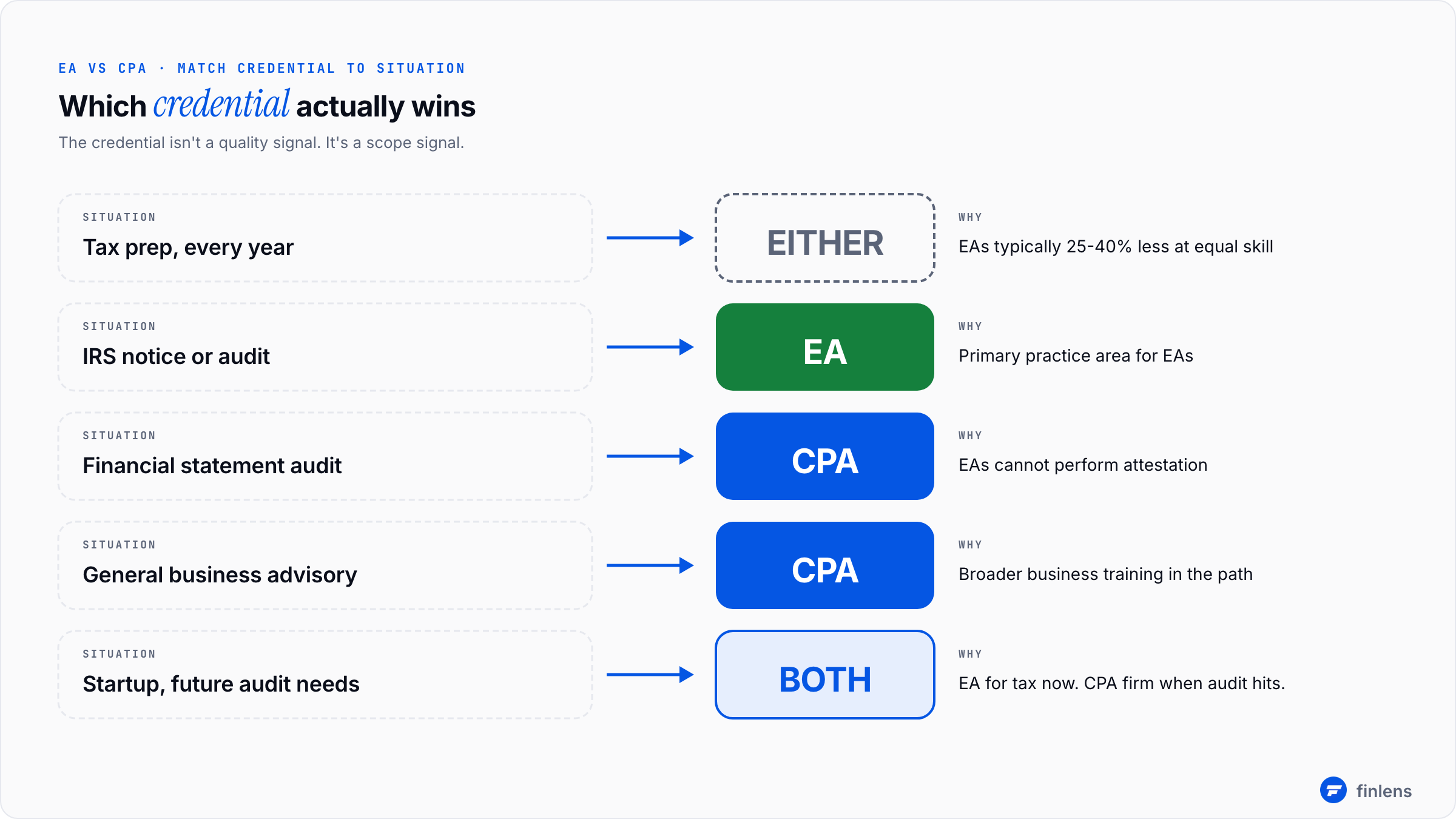
Five common situations and the credential that fits each:
Situation 1: I just need my taxes prepared every year. Either credential. EAs typically charge less for return preparation at the same skill level. CPAs are reasonable if you'll likely need broader services down the road.
Situation 2: I have an IRS notice I don't understand, and I need to respond. EA. Enrolled agents are specifically trained and licensed to represent taxpayers before the IRS. CPAs can do this too, but EAs do it as their primary work. The CPA who's better at audit or compliance work isn't necessarily the right pick for IRS correspondence.
Situation 3: I'm about to be audited. EA or a CPA who specifically does tax controversy work. The general-purpose CPA at the small firm down the street is not the right answer. Pick someone whose primary practice is IRS representation, which is most EAs and some CPAs.
Situation 4: I'm getting investor financials reviewed, and I might need a financial statement audit or review. CPA. This is the work that requires the CPA license. EAs cannot perform attestation work. If audit-level assurance is or will be part of your need, you need a CPA.
Situation 5: I need general business advisory beyond taxes. Lean CPA, especially one with a Personal Financial Specialist (PFS) credential or a fractional CFO practice. EAs can do advisory work, but their training is tax-focused. CPAs have broader business training.
The base rate matters. A small business with no audit needs and straightforward operations is in Situation 1 or maybe Situation 2. Most small businesses hire CPAs for work that an EA could do equally well at lower cost.
What the credentials actually require
Here's the side by side. This matters because the difference in path explains the difference in default skill set.
The credential isn't a quality signal. It's a scope signal. An EA's training is deep in tax. A CPA's training is broader across accounting, with tax as one of several specializations. Some CPAs are better tax preparers than some EAs. Some EAs are better tax preparers than most CPAs. The credential tells you what they're licensed to do, not how good they are.
The IRS Office of Professional Responsibility regulates both groups under Circular 230. Both have the same ethical and professional standards when practicing before the IRS.
What the work actually pays
Honest market rates for 2024-2025, based on what I've seen across small business engagements:
The price difference for the same work (tax prep, monthly bookkeeping) is roughly 25-40%. The price difference exists partly because of credential cost and partly because of typical practice positioning. EAs often run leaner practices. CPAs often carry more overhead, including state licensing fees, professional society dues, and malpractice insurance at higher coverage levels.
For a small business that needs tax prep and bookkeeping but not attestation services, hiring an EA can save $3,000-$8,000/year versus a CPA at equivalent quality.
Where small business owners get the decision wrong
Three patterns:
Pattern 1: Defaulting to "more credentials = better." The CPA sounds more impressive than the EA. So the small business owner picks the CPA. The CPA at the firm down the street is a generalist who does some bookkeeping, some tax, and some advisory work. The EA across town does tax preparation and IRS representation full-time and has done so for 15 years. For pure tax work, the EA is meaningfully more experienced. The business owner doesn't know to ask.
Pattern 2: Assuming the CPA does everything the EA does, plus more. Mostly true on paper. Less true in practice. A CPA who hasn't dealt with an IRS audit in three years is not the right person to represent you when the audit notice arrives. An EA who handles 30 IRS notices a month is. Practice volume matters more than credential breadth.
Pattern 3: Picking based on price without thinking about scope. The opposite mistake. A business owner picks the cheapest EA on a lead-generation site. The EA is competent but doesn't have the business advisory experience to help with the K-1 distribution structure question that's actually the real issue. A CPA with PFS or CFP credentials would have handled that question in 30 minutes.
The correct frame is matching scope to credential plus practice positioning. A credential alone is insufficient. Practice positioning alone is insufficient. The combination matters.
How to actually evaluate a candidate
Five questions to ask either credential:
1. What percentage of your practice is tax work specifically?
A CPA at 30% tax is meaningfully different from an EA at 95% tax. For tax-heavy needs, higher tax concentration wins regardless of credential.
2. How many IRS notices and audits did you handle last year?
Concrete number, not "we handle them." If the answer is "a few," they don't do tax controversy work as a primary practice. Find someone who does.
3. Do you have direct experience with my business model?
SaaS, real estate, e-commerce, service businesses, and multi-state operations each have specific patterns. Direct experience matters more than general experience.
4. What's your normal turnaround time for tax returns?
Practitioners with reasonable turnaround (under 4 weeks) typically have functioning processes. Practitioners with 8+ week turnaround often have capacity issues that compound into other quality problems.
5. What software do you use for tax preparation, and what does the year-over-year carryforward process look like?
A practitioner using current tools (Lacerte, ProConnect, Drake, CCH Axcess, and UltraTax) and properly carrying forward data year over year is operating professionally. A practitioner doing returns from paper notes is taking on more risk than the price savings justify.
The credential is the first filter. These five questions are the actual evaluation.
What the credential conversation looks like from inside an accounting firm
This is the conversation firm owners are having about their own hiring:
When a firm hires a new tax preparer, the EA vs. CPA question matters less than skill level. An EA with 5 years of solid tax preparation experience is usually more immediately productive than a freshly credentialed CPA with no tax experience.
When a firm hires for a senior advisory role, CPA matters more because the broader business training shows up in advisory conversations.
When a firm hires for audit work, a CPA is required because EAs cannot perform attestation services.
For a small firm building a tax-heavy practice, hiring EAs is often the more economical staffing strategy. For a firm building a full-service practice with audit and advisory work, CPAs are necessary.
The pipeline implications are real. The CPA credential has a 150-credit-hour requirement that's reducing the pipeline of new candidates. The EA credential has lower barriers and is producing strong tax practitioners at scale. Many growing firms are deliberately hiring EAs rather than waiting for the limited CPA candidate pool.

What this conversation will not solve
Two things the credential doesn't fix:
A bad practitioner. Bad EAs and bad CPAs exist. The credential doesn't filter for competence beyond the licensing requirements. References and direct experience checks do.
Misaligned scope. A great EA who only does tax cannot help with the audit-level review your investor is asking for. A great CPA who does compilations cannot do the audit your bank is demanding. Match the credential to the actual scope first.
Frequently asked questions
Can an enrolled agent do everything a CPA does?
No. EAs cannot perform audit, review, or compilation services. EAs cannot sign financial statements for SEC-regulated companies. Within tax preparation and IRS representation, EAs and CPAs have equivalent practice rights.
Why are CPAs more expensive than EAs for the same work?
Mostly because of practice positioning, not the credential itself. CPAs often run higher-overhead practices with broader service offerings. The price difference for equivalent tax preparation services typically runs 25-40%. Some CPAs price competitively with EAs; the variation within each credential is wider than the variation between credentials.
Is the enrolled agent exam easier than the CPA exam?
Different, not strictly easier. The SEE is 3 parts focused entirely on taxes. The CPA exam is 4 parts covering auditing, regulation, financial accounting, and business concepts. The SEE is narrower in scope but deep in tax detail. Both are professional-level exams with serious pass thresholds.
Should I hire an EA for my startup?
For tax-only work at an early-stage startup with no audit requirements, yes. EAs are typically the right choice. Once you raise institutional capital and start needing reviewed or audited financials, you'll need a CPA in addition (not instead). Many growing companies use an EA for tax and a CPA firm for the annual audit.
Can I become both an EA and a CPA?
Yes, and many practitioners are. The credentials don't conflict. Some firms have practitioners with both credentials. The EA credential is faster to obtain and creates immediate IRS representation rights. The CPA credential adds attestation and broader business scope.
Where does Finlens fit in the credential decision?
Finlens is software, not a credential. It automates the bookkeeping work that both EAs and CPAs charge clients to do. For the business owner: Finlens runs underneath whichever practitioner you hire and reduces the bookkeeping cost component of their fees. For the practitioner: Finlens is the automation layer that lets you serve more clients without proportionally adding staff.
For small businesses without attestation needs, the EA is often the better economic choice, and the skill match is frequently equal. For growing businesses anticipating audit or review work, the CPA becomes necessary. For most situations in between, the practitioner's specific experience matters more than the credential.
For deeper coverage on building or scaling an accounting practice around either credential, see the scaling an accounting firm guide and the 50-client management playbook.

