
Financial Project Management Software: What Fractional CFOs and Project-Based Firms Actually Need


A fractional CFO running 10 client engagements has a different operational problem than a bookkeeping firm running 50 monthly clients. The bookkeeping firm needs recurring task templates that fire every month. The fractional CFO needs project tracking, milestone management, and the ability to flex hours per client based on what's happening at each company that month.
The tools built for one don't fit the other. Karbon and Canopy are workflow tools designed for recurring monthly bookkeeping and tax work. They struggle with project-based engagements where the scope shifts month to month. Generic project management tools (Monday, Asana, and ClickUp) handle the project shape but don't know what a CFO engagement actually involves.
What CFO services engagements look like operationally
The work pattern is meaningfully different from monthly bookkeeping:
Variable monthly hours. A CFO engagement might be 8 hours one month, 25 hours the next, and 12 hours the month after, depending on what's happening at the client. Fundraise prep, board meeting season, year-end planning, and unexpected events all create spikes.
Milestone-driven deliverables. Not "close the books every month." Things like "complete annual budget by November 1," "prepare board materials for January 15 meeting," and "produce due diligence package for Series B by March 30."
Multi-stakeholder visibility. The CFO is talking to the CEO, the board, sometimes investors, and sometimes the company's bookkeeper or controller. Project status needs to be visible to multiple parties without exposing internal firm operations.
Higher hourly rates with corresponding accountability. A fractional CFO billing $250-$400 per hour or $5,000-$15,000 per month has clients who expect detailed reporting on what the work product is.
A practice management tool built for monthly bookkeeping close doesn't naturally support this work pattern. A generic project management tool supports it but requires significant configuration to be useful for CFO services specifically.
What the tool actually needs to do
Five capabilities that matter for CFO services:
1. Engagement-level project management. Each client engagement is a project with phases, milestones, and deliverables. The tool needs to track all three.
2. Time tracking that shows budgeted vs. actual hours per engagement. Critical for engagements with a monthly fee cap. The CFO needs to see if they're 80% through their hours by mid-month.
3. Client-facing visibility into deliverables. Some CFOs share status with clients via formal monthly reports. Others share via shared workspace. The tool should support whichever approach.
4. Document organization tied to the engagement. Financial models, board decks, due diligence packages these are large artifacts that need to be findable months later when the next round of work starts.
5. Reporting on engagement profitability. Variable-hour engagements need to know which clients are profitable at the current pricing and which need to be repriced.
The five capabilities together don't exist in one product. Different tools cover different combinations.
The realistic tool options
Three categories of tools that fractional CFOs and CFO-services firms actually use:
Category 1: Repurposed accounting practice management software. Karbon, Financial Cents, and Aero Workflow can be configured for CFO services. The fit is rough; the templates assume recurring monthly work, but Monday.com and they handle time tracking and client document organization reasonably. Pricing: $39-$89/user/month. Best fit: CFO services running alongside a broader accounting firm where the same tool covers everything.
Category 2: Project management tools configured for professional services. Asana, ClickUp, and Monday.com are configured with CFO-specific templates. Better at the project shape, weaker on time tracking and accounting integration. Pricing: $10-$25/user/month. Best fit: fractional CFO solo practitioners or small CFO services firms (2-5 people).
Category 3: Professional services automation (PSA) software. BigTime, Mango, Workflow Max, or higher-end PSA tools like Kantata (formerly Mavenlink). Built specifically for project-based professional services. Strong on resource planning, time tracking, and engagement profitability. Pricing: $25-$50/user/month at the lower end, $100+ at the enterprise level. Best fit: CFO services firms with 5-25 staff that have outgrown the cobbled-together approaches.
The honest reality: most fractional CFOs start with category 1 or 2, hit limits around year 2 or as they grow past 5 staff, and migrate to category 3.
What each tool gets wrong for CFO services specifically
Karbon, Financial Cents, Aero: Built for recurring monthly tasks. The recurring template model fights against milestone-driven CFO work. Workarounds exist (treating each engagement as a custom project), but you're swimming against the tool's design.
Asana, ClickUp, Monday: Great at project visualization. Weak on time tracking integration with billing. Almost useless on engagement-level profitability reporting. You'll need separate tools for time and billing.
BigTime, Kantata, traditional PSA: Designed for consulting and professional services in general. Don't know what an accounting firm or CFO engagement looks like specifically. Strong on resource planning and engagement profitability. Weak on accounting-specific integrations like QBO sync.
How fractional CFOs actually configure their stacks
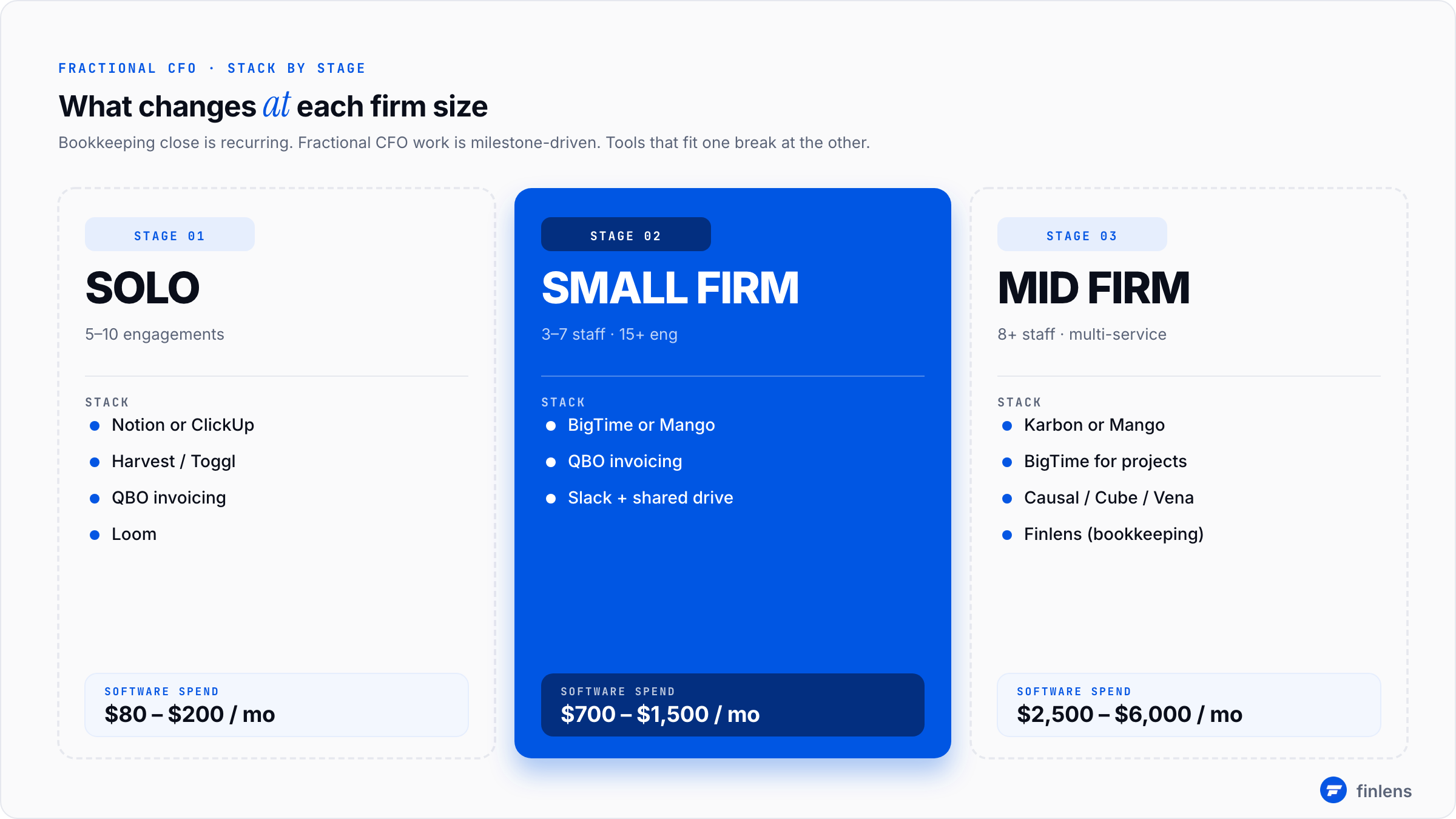
Three patterns I see working:
Pattern A: Solo fractional CFO, 5-10 engagements.
- Notion or ClickUp for engagement tracking and documentation
- Harvest or Toggl for time tracking
- QuickBooks Online for invoicing
- Loom for asynchronous client video updates
- Total monthly software: $80-$200
This stack works because the operator can hold the operational complexity in their head. At 10+ engagements, the cognitive load forces an upgrade.
Pattern B: Small CFO services firm, 3-7 staff.
- BigTime or Mango for project management + time tracking
- QuickBooks Online for invoicing (or BigTime for invoicing as well)
- Shared drive for document collaboration
- Slack for internal communication
- Total monthly software: $700-$1,500
The PSA tool replaces the patchwork of category 2 tools and adds engagement-level reporting that solo operators can do mentally.
Pattern C: Larger CFO services firm or accounting firm with CFO practice, 8+ staff.
- Karbon or Mango for broader practice management
- BigTime for time tracking and project management
- Specialized financial modeling tools (Causal, Cube, Vena) for the actual CFO work product
- Finlens for any bookkeeping work that supports the CFO engagements
- Total monthly software: $2,500-$6,000
At this size, the stack has multiple specialized tools because the work is multi-faceted. The integration challenges are real, but the productivity gains exceed the integration costs.
The pricing question, with real numbers
Fractional CFO engagements typically price at $5,000-$15,000 per month per client. A senior fractional CFO running 8-10 engagements is generating $40,000-$150,000 per month in revenue. Software cost at any of the patterns above is under 5% of revenue.
The price isn't the constraint. The right tool is. Spending $1,000/month on software that recovers 5 hours per week of operator time is a clear ROI at fractional CFO billing rates.
Where the math gets interesting: at firm size 5+, the wrong tool can cost real time. A senior consultant spending 4 hours per week navigating a poorly-fit tool is $1,600/week of opportunity cost at typical fractional CFO billing rates. The right tool pays for itself in 1-2 days of recovered time per month.
What the tool category will not solve
Honest limits:
Client management complexity. Multi-stakeholder client engagements (CEO + board + investors all wanting different things) require communication skills and judgment. The tool tracks the work. It doesn't navigate the politics.
Pricing. Underpriced engagements stay underpriced regardless of which tool tracks them. The pricing conversation has to happen separately.
Hiring. Growing a CFO services firm requires senior hires. The tool doesn't help with that. The pipeline of senior fractional CFOs is genuinely thin.
How to actually pick
Four questions resolve most decisions:
1. How many active engagements are you running?
Under 5: solo tools work. Asana or Notion plus time tracking is enough. 5-15: PSA software starts to make sense. 15+: PSA software is necessary; solo tools break down.
2. Are you a CFO-only firm or part of a broader accounting practice?
CFO-only: pick a PSA tool (BigTime, Mango, Kantata). Mixed practice: Pick a tool that integrates with your accounting workflow (Karbon for broader practices or Mango for tax + CFO combinations).
3. What's your team size?
Solo: Solo tools focus on simplicity. 2-5: lightweight PSA or capable solo tools. 5+: real PSA software with resource planning.
4. What's your engagement profitability tracking maturity?
Don't track it at all: you'll outgrow simple tools quickly once you start. Track it manually: PSA tools save the manual work. Track it via spreadsheet: time to move to a tool that produces this natively.
Frequently asked questions
Can I use Notion as my whole stack?
Up to about 8 engagements solo, yes. Past that, you'll feel the lack of time-tracking integration and engagement profitability reporting. Notion is excellent for documentation. It's not a project management tool with reporting depth.
What about Kantata or Mavenlink?
Enterprise-tier PSA software. Strong for firms with more than 15 staff and significant project management complexity. Overkill for small CFO services firms. Pricing typically starts at $100+/user/month and scales up.
How does this compare to time and billing software for CPA firms?
Time and billing software for traditional accounting firms is recurring-billing-focused. Project management software for CFO services is project-focused. They overlap on time tracking but diverge on what they're optimized for.
Should I use my client's project management tool instead of my own?
Some fractional CFOs do; they live inside the client's Jira or Asana or Notion. It works for individual engagements. It doesn't work for managing your own firm's portfolio across all clients. You need a tool that gives you the cross-engagement view.
Where does Finlens fit?
Finlens automates the bookkeeping work that supports CFO engagements. A fractional CFO working with a startup typically needs clean monthly books to do the CFO work on top of. Finlens delivers those books faster and cheaper than manual bookkeeping. For CFO services firms running their own bookkeeping for clients, Finlens is the layer that makes the bookkeeping side profitable.
For solo fractional CFOs, start with lightweight tools and upgrade when the cognitive load forces it. For CFO services firms with past 5 staff, invest in PSA software; the operational visibility pays for itself in months, not years. For mixed accounting and CFO services firms, the tool decision is part of a broader practice management call covered in the practice management software comparison.

