
Rillet vs Maxio vs Chargebee RevRec: SaaS Revenue Recognition Compared for 2026


The three-way choice between Rillet, Maxio, and Chargebee RevRec depends on where SaaS company sits on billing-model complexity curve, whether finance team has committed to a modern AI-native ledger or is retrofitting rev-rec onto an existing GL, and how close company is to a real audit or IPO. Rillet is newest of three an AI-native ERP that combines rev-rec automation with a full general ledger, aimed at scaling SaaS companies replacing spreadsheet-based close. Maxio (merger of SaaSOptics and Chargify) is mid-market category default deep rev-rec on top of any billing system, with largest audit-reference customer base. Chargebee RevRec is a purpose-built ASC 606 subledger from Chargebee's billing platform, best when company is already on Chargebee for subscription management. All three automate ASC 606; differentiation is in billing-model fit, GL relationship, and IPO-readiness depth.
Key takeaways
- ASC 606 requires five-step revenue recognition model: identify contract, identify performance obligations, determine transaction price, allocate price to obligations, and recognize revenue as obligations are satisfied. All three platforms automate model; difference is in how they handle multi-element allocation, usage-based billing, and contract modifications.
- A pain-point discussion on r/SaaS about usage-based pricing getting complicated reflects common trigger for buying dedicated rev-rec software moment a SaaS company adds consumption or overage pricing on top of subscriptions, spreadsheet-based rev-rec breaks.
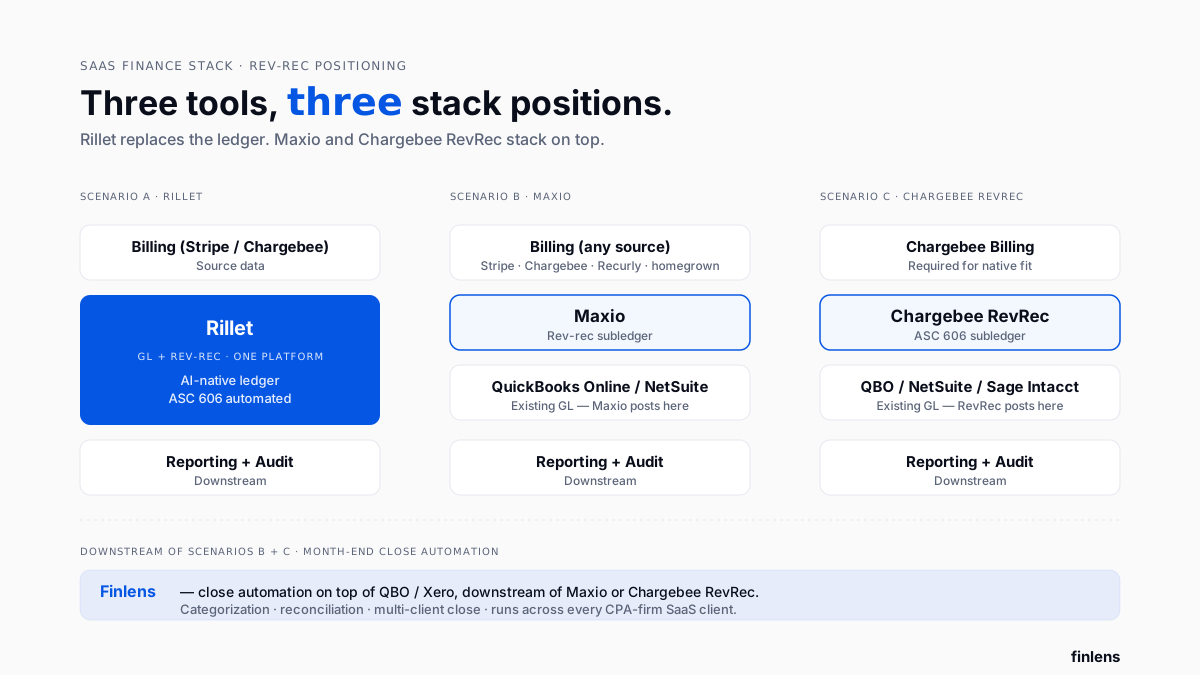
- Rillet is a full AI-native ERP; Maxio and Chargebee RevRec sit on top of an existing GL (QuickBooks, NetSuite, Sage Intacct). The GL relationship determines migration cost and ongoing close workflow.
- Chargebee RevRec is tightest fit if company is already on Chargebee for billing. Maxio is billing-agnostic and works with Stripe, Recurly, Chargebee, or homegrown billing. Rillet ingests billing data as one of many sources into ERP.
- Once ASC 606 rev-rec is automated, month-end close on underlying GL still needs to happen that's where a close-automation platform like Finlens fits, sitting downstream of rev-rec subledger to handle categorization, reconciliation, and multi-client close workflows.
Rillet vs Maxio vs Chargebee RevRec: comparison table
Pricing reflects publicly-reported starting tiers for standard mid-market configurations early 2026. All three are contact-sales.
Rillet vs Maxio vs Chargebee RevRec head-to-head
Rillet
Overview. Rillet is newest entrant of three a modern AI-native ERP that combines a full general ledger with automated ASC 606 revenue recognition, ARR tracking, and deferred revenue schedules. Where Maxio and Chargebee RevRec sit on top of an existing GL, Rillet is GL. The pitch is for scaling SaaS companies whose finance team is ready to move off QuickBooks Online onto a purpose-built ERP without 6-month NetSuite implementation.
Best for. Scaling SaaS companies (Series B through pre-IPO) that have outgrown QBO, want AI-assisted close automation, and are willing to migrate ledger to new platform.
Key features. AI-native GL with structured JEs, automated ASC 606 revenue recognition across contract lifecycle, multi-element allocation, real-time ARR and MRR reporting, deferred revenue and contract-liability schedules, native ingestion from Stripe/HubSpot/Salesforce, and audit trail. A r/CFO discussion about AI-native ledgers including Rillet captures emerging category conversation among mid-market finance leaders evaluating this shift.
Pricing. Custom. Reported market pricing puts Rillet at mid-market ranges (~$25K-$60K/year) for Series B-C SaaS.
Limitations. ERP migration is a significant project typically 2-4 months even for a modern platform. Not a fit for teams committed to keeping QBO. Newer than Maxio, so smaller reference customer base for buyers who want long tenure.
Where it breaks. Companies that need to keep QuickBooks Online in place (CPA firm engagement, multi-entity family-office setups, etc.) Rillet's value depends on being ledger.
Maxio
Overview. Maxio is mid-market rev-rec category default. Formed from 2022 merger of SaaSOptics (rev-rec) and Chargify (billing), Maxio operates as a rev-rec + subscription-management platform that sits on top of any general ledger. It integrates with Stripe, Chargebee, Recurly, HubSpot, and homegrown billing systems, and posts revenue journal entries back to QuickBooks, NetSuite, or Sage Intacct.
Best for. SaaS companies at any stage (early through pre-IPO) with mixed billing sources, an existing GL they don't want to migrate off, and a need for deepest reference-customer base in category.
Key features. ASC 606 automation across full contract lifecycle, multi-element allocation with standalone-selling-price (SSP) libraries, revenue schedules for subscription + usage + one-time, contract modification handling, ARR/MRR analytics, and audit-ready reporting.
Pricing. Custom (reported market range $15,000-$40,000/year for standard mid-market SaaS configurations).
Limitations. Not an ERP requires a GL underneath. Pricing scales with revenue volume, which can get expensive for high-transaction consumption businesses.
Where it breaks. Companies wanting one platform for GL + rev-rec (Rillet's positioning) rather than a subledger stacked on top of QBO/NetSuite.
Chargebee RevRec
Overview. Chargebee RevRec is a purpose-built ASC 606 revenue recognition subledger from Chargebee's billing platform. Its differentiation is native integration with Chargebee Billing for companies already on Chargebee for subscription management, RevRec reads billing data with zero configuration and posts revenue schedules into GL.
Best for. Companies already on Chargebee Billing who want ASC 606 automation without configuring a separate billing integration.
Key features. Native ingestion from Chargebee Billing, ASC 606 five-step model automation, multi-element allocation, contract modification handling, deferred revenue schedules, and IFRS 15 compliance for international companies.
Pricing. Custom add-on to Chargebee Billing pricing. Not sold standalone.
Limitations. Requires Chargebee Billing to be in place not a fit for companies on Stripe Billing, Recurly, or homegrown billing. Newer than Maxio in standalone rev-rec category.
Where it breaks. Companies on any billing platform other than Chargebee.
Head-to-head which platform for which SaaS scenario
Series A-B SaaS on QBO, mixed billing: Maxio is fit. Sits on top of QBO, integrates with Stripe/Chargebee/Recurly, doesn't require a GL migration. Rillet requires ledger move; Chargebee RevRec requires Chargebee Billing.
Series B-C SaaS ready to move off QBO: Rillet is fit. AI-native ERP that folds rev-rec into GL. Maxio and Chargebee RevRec would still sit on top of new GL, adding a layer that Rillet consolidates.
Any SaaS already on Chargebee Billing: Chargebee RevRec is fit. Native integration eliminates billing-connector setup that Maxio and Rillet both require.
Pre-IPO SaaS needing audit references: Maxio has largest reference customer base and longest audit tenure safest pick for auditors who want to see platform in use elsewhere. Rillet is newer; Chargebee RevRec has fewer standalone rev-rec references.
Usage-based / consumption SaaS: All three handle usage. Maxio's usage support is most mature; Rillet's is AI-augmented and improving; Chargebee RevRec depends on Chargebee Billing's usage metering. A workflow discussion on r/SaaS about SaaS bookkeeping and rev-rec integration surfaces recurring pain usage/consumption billing multiplies number of rev-rec events per contract, and tool has to keep up automatically.
Multi-element bundled SaaS (product + services + support): Maxio's SSP library and multi-element allocation is deepest. Rillet handles multi-element natively in ERP. Chargebee RevRec covers it but assumes elements are defined in Chargebee Billing.
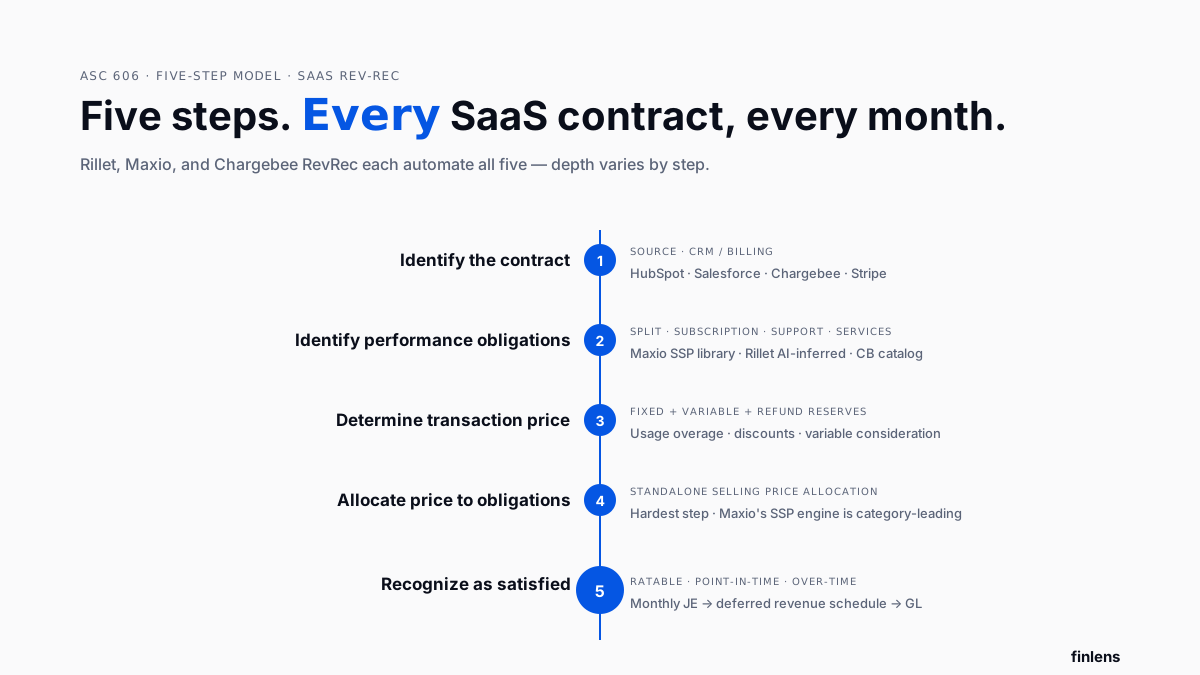
ASC 606 five-step model automation must cover
Any rev-rec platform worth using automates ASC 606 five-step model end-to-end:
- Identify contract with a customer. Contract creation event from CRM (HubSpot, Salesforce) or billing (Stripe, Chargebee, Recurly). All three read this from source systems.
- Identify performance obligations in contract. Product SKU + service line + support tier are each separate performance obligations if distinct. Maxio's obligation library is deepest; Rillet's is AI-inferred from contract structure; Chargebee RevRec reads from Chargebee product catalog.
- Determine transaction price. Contract value, discounts, variable consideration (usage overage), and refund reserves. All three handle fixed pricing cleanly; variable consideration (usage-based) is where Maxio and Rillet excel.
- Allocate transaction price to performance obligations. Standalone selling price (SSP) allocation hardest part of ASC 606 for bundled SaaS. Maxio's SSP library and allocation engine is category-leading.
- Recognize revenue as (or when) each performance obligation is satisfied. Ratable subscription revenue, point-in-time services, over-time services. All three automate this stage.
A pain-point discussion on r/CFO about improper revenue recognition consequences captures why finance leaders eventually invest in dedicated tools restating revenue is one of highest-cost accounting corrections a company can face, and audit remediation compounds if manual process broke down over multiple quarters.
Deferred revenue schedules operational reality
The rev-rec output is a monthly deferred revenue schedule showing:
- Beginning deferred balance
- New contracts booked (increasing deferred)
- Revenue recognized in period (decreasing deferred)
- Contract modifications (adjusting deferred)
- Ending deferred balance
This schedule ties into GL beginning and ending deferred balances must match deferred revenue liability account on balance sheet. A r/Accounting thread on deferred revenue reflects recurring accountant experience: manual deferred revenue schedules are among most error-prone workpapers in a SaaS close, and errors don't surface until audit.
All three platforms automate this schedule. Rillet posts entries into its own GL; Maxio and Chargebee RevRec post to customer's GL (QBO, NetSuite, Sage Intacct).
Where Finlens fits close automation downstream of rev-rec
Rillet, Maxio, and Chargebee RevRec handle rev-rec side. But month-end close on underlying GL categorization of resulting JEs, reconciliation of bank feed, close checklist across multiple client books is a separate problem.
For CPA firms managing SaaS clients on QuickBooks Online, Finlens is AI-native accounting platform that automates close after rev-rec subledger has posted its schedules. It categorizes transactions, reconciles across entire book, and runs close workflows across every client from one dashboard. It sits downstream of Maxio or Chargebee RevRec (both of which post to QBO), not as a replacement.
If SaaS is on Rillet, Finlens is not fit Rillet is ledger, and Finlens layers on QBO/Xero. For CAS providers with SaaS clients still on QBO, Finlens keeps close manageable across many books without SaaS having to migrate off QBO, running same reconciliation and categorization workflows in parallel across every SaaS client alongside QuickBooks automation.
Which SaaS revenue recognition platform should you choose
- Choose Rillet if you're a Series B-C SaaS ready to move off QBO onto a modern AI-native ERP that folds rev-rec into GL.
- Choose Maxio if you want deepest audit-reference base, an existing GL to keep, and broadest billing-source support.
- Choose Chargebee RevRec if you're already on Chargebee Billing and want tightest native billing-to-rev-rec integration.
Common ASC 606 automation mistakes
Buying rev-rec software before defining performance obligations. The platform can only allocate what you've defined. If product catalog doesn't distinguish subscription vs. onboarding vs. support cleanly, no software fixes allocation.
Assuming usage-based billing auto-flows to rev-rec. Usage billing generates revenue events; rev-rec has to know which events represent variable consideration (recognize when consumed) vs. fixed subscription (recognize ratably). Configure this per product before first close.
Skipping audit-ready reporting configuration. All three platforms produce audit-ready outputs but reports have to be configured with auditor's requested schedules (beginning balance, roll-forward, ending balance, contract listing, revenue recognized by product). Configure at setup, not at audit time.
Manual contract modifications. Contract modifications (renewals with price change, add-ons, terminations) are where rev-rec commonly drifts. Every modification has to hit rev-rec platform, not just billing system.
Ignoring downstream close. Rev-rec automation solves rev-rec problem not underlying GL close. Categorization, reconciliation, and close checklist workflows still need to happen. A r/Accounting discussion on SaaS deferred revenue reflects accountant view: rev-rec schedule is one input to close, not close itself.
Common integrations to verify
- Billing platform connector verify native integration with your billing (Stripe Billing, Chargebee, Recurly, homegrown). Native connectors are cleaner than CSV import.
- CRM connector for contract source-of-truth, native integration with Salesforce or HubSpot for contract creation events.
- GL connector (Maxio, Chargebee RevRec) direct API to QuickBooks Online, NetSuite, Sage Intacct, or Oracle for posting revenue JEs. Rillet doesn't need this it is GL.
- Data warehouse export Snowflake, BigQuery, or Redshift for feeding rev-rec data into company's analytics stack.
- Audit-ready report packs Big-4-tested schedules and workpapers built into platform.
Conclusion
The choice between Rillet, Maxio, and Chargebee RevRec turns on three questions: Is your team ready to migrate off QBO onto a modern ERP? Is your billing already on Chargebee? And how much audit tenure do your investors and auditors expect? Rillet consolidates rev-rec into GL. Maxio is mid-market default with broadest reference base. Chargebee RevRec is natural pick for existing Chargebee Billing customers. All three automate ASC 606; differentiation is fit, not capability.

Frequently asked questions
What's difference between Rillet, Maxio, and Chargebee RevRec
Rillet is a full AI-native ERP with rev-rec built in it replaces QuickBooks. Maxio is a rev-rec + subscription-management subledger that sits on top of any GL and integrates with any billing system. Chargebee RevRec is a purpose-built ASC 606 subledger from Chargebee, natively integrated with Chargebee Billing.
Which is better for a SaaS on QuickBooks Online with mixed billing sources
Maxio. It sits on top of QBO and integrates with Stripe, Chargebee, Recurly, or homegrown billing without requiring a GL migration or a specific billing platform.
Does Chargebee RevRec work if I'm not on Chargebee Billing
No. Chargebee RevRec's value comes from native integration with Chargebee Billing. Companies on Stripe Billing, Recurly, or homegrown billing should evaluate Maxio (billing-agnostic) or Rillet (full ERP).
Is Rillet audit-ready for IPO preparation
Rillet handles ASC 606 automation and produces audit-ready outputs, but as newer entrant, it has a smaller Big 4-tested reference base than Maxio. Pre-IPO SaaS with conservative audit requirements often choose Maxio for reference tenure; SaaS earlier in journey often choose Rillet for modern ERP consolidation.
How does ASC 606 differ from IFRS 15
ASC 606 is US GAAP; IFRS 15 is international standard. Both use same five-step model main difference is disclosure requirements. Maxio and Chargebee RevRec both support IFRS 15; Rillet handles ASC 606 as its primary standard.
How much does SaaS rev-rec software cost
Custom pricing on all three. Reported market ranges: Maxio $15,000-$40,000/year for standard mid-market SaaS; Rillet $25,000-$60,000/year; Chargebee RevRec is an add-on to Chargebee Billing (pricing depends on Chargebee tier).
Do I need Finlens if I have Maxio or Chargebee RevRec
They solve different problems. Maxio and Chargebee RevRec handle ASC 606 rev-rec. Finlens handles downstream month-end close on underlying GL categorization, reconciliation, close checklist, multi-client dashboards. If you're a CPA firm managing SaaS clients on QuickBooks Online, Finlens sits downstream of Maxio or Chargebee RevRec (both post to QBO).
How long does implementation take
Rillet: 2-4 months (ERP migration). Maxio: 4-8 weeks (subledger configuration). Chargebee RevRec: 2-4 weeks if already on Chargebee Billing; longer if not.

