
Schedule K-1: What It Reports and How to File One (Partnership, S-Corp, Trust)


Schedule K-1 is tax document pass-through entities send to their owners each year, reporting each owner's share of entity's income, deductions, and credits. If you're a partner in a partnership, a shareholder in an S-corp, or a beneficiary of a trust or estate, you'll receive a K-1 typically in February or March that determines how much you owe on your personal return. The entity itself doesn't pay federal income tax; tax obligation flows through to you.
This guide covers three K-1 variants (partnership 1065, S-corp 1120-S, estate/trust 1041), what each box reports, when K-1s are due, and where numbers land on your Form 1040.
What Schedule K-1 is
Schedule K-1 is annual pass-through reporting document that transfers tax attributes from a pass-through entity to its owners. Per IRS Schedule K-1 (Form 1065) page, entity files its own return (Form 1065, 1120-S, or 1041) reporting total income and deductions, then issues a K-1 to each owner allocating their proportional share.
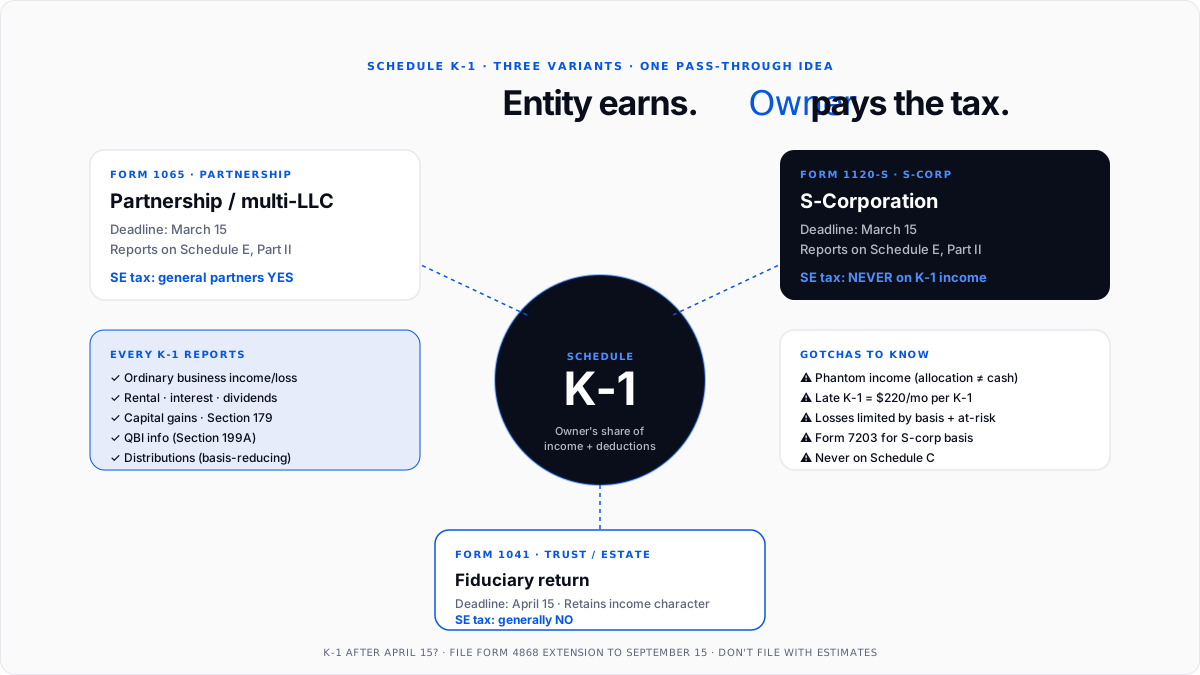
Three variants exist:
Each variant reports same fundamental information (your share of income, deductions, credits, distributions) but with different line numbers and slightly different categories reflecting entity type.
Who receives a K-1 vs. who receives a 1099
Receive a K-1 if you're:
- A partner in a general or limited partnership
- A member of a multi-member LLC taxed as a partnership (default)
- A shareholder of an S-corp (regardless of ownership %)
- A beneficiary of a trust or estate that had reportable income for year
Receive a 1099 if you're:
- An independent contractor paid $600+ by any US business → 1099-NEC (see W-9 guide)
- A recipient of interest, dividends, retirement distributions, or other passive income → 1099-INT/DIV/R
- A recipient of platform payments (rideshare, marketplace) → 1099-K
Receive both K-1 AND W-2:
- S-corp shareholder-employees receive a W-2 for reasonable compensation AND a K-1 for their share of remaining profit
- Some partnerships pay guaranteed payments (like a salary) these show on K-1 in a specific box, not on a W-2
K-1 deadlines
Partnership and S-corp K-1s March 15 (2.5 months after calendar year-end). The entity files Form 1065 or 1120-S by March 15 and simultaneously furnishes K-1s to each partner or shareholder.
Estate and trust K-1s April 15 (3.5 months after calendar year-end for calendar-year trusts). Fiscal-year trusts have their own deadlines based on year-end.
Extended K-1s If entity files Form 7004 for a 6-month extension, K-1s can arrive as late as September 15 (partnership/S-corp) or September 30 (trust/estate). Late K-1s force individual return extensions.
Late K-1 penalty: $220 per K-1 per month up to $2,750 total for partnerships/S-corps, plus additional penalties for missing information.
What each K-1 reports
While three K-1 variants use different line numbers, they share these core categories:
Part I Entity information: Legal name, EIN, address of pass-through entity.
Part II Owner information: Your name, SSN (or EIN if a business holds interest), address. Also flags whether you're a general vs. limited partner, active vs. passive, and your % ownership at year-end.
Part III Your share of income and deductions:
Ordinary business income (or loss): The core pass-through number your share of entity's ordinary trade or business results. Reported on your Schedule E, Part II (not Schedule C see below).
Rental income (or loss): Real estate and personal property rentals allocated to you.
Interest and dividend income: Investment income entity earned that flows to you.
Capital gains and losses: Short-term and long-term, allocated to you and reported on your Schedule D.
Section 179 deduction and other special items: Your share of accelerated depreciation and other elections.
Guaranteed payments (partnership K-1 only): Payments to partners for services or capital use reported on Schedule E and subject to SE tax for receiving partner.
Distributions: Cash and property distributions you received during year. Note: distributions are NOT taxable income they reduce your basis but don't add to taxable income. Your taxable income comes from Part III income lines regardless of whether you received a distribution.
QBI information (Section 199A): Details you need to compute QBI deduction on your personal return.
Where K-1 numbers flow on your Form 1040
Almost every K-1 line has a corresponding Form 1040 or schedule destination:
The most common mistake is reporting K-1 pass-through income on Schedule C it belongs on Schedule E, Part II, not Schedule C. Schedule C is for direct sole prop / SMLLC business activity, not pass-through partnership or S-corp income.
SE tax treatment differs by K-1 type
Partnership K-1 (general partner): Ordinary business income IS subject to self-employment tax. Guaranteed payments for services are also subject to SE tax.
Partnership K-1 (limited partner): Ordinary business income is generally NOT subject to SE tax (passive limited partner). Guaranteed payments for services still subject to SE tax if received.
S-corp K-1: Ordinary business income is NEVER subject to SE tax this is key advantage of S-corp election. Shareholder-employees pay FICA only on their W-2 reasonable compensation; K-1 profit distribution is FICA-free.
Estate/trust K-1: Distributions from trusts and estates are generally not subject to SE tax at beneficiary level (they retain character of income at entity level).
Basis tracking K-1 fundamental
Your basis in entity (partnership interest or S-corp stock) matters enormously:
- Losses are deductible only up to your basis. Losses beyond basis are suspended and carried forward.
- Distributions reduce basis; if they exceed basis, excess is taxable as capital gain.
- Contributions and allocated income increase basis.
The IRS requires basis tracking on Form 7203 (S-corp) or via partner's basis schedule (partnership, tracked internally). Getting basis wrong means either:
- Over-deducting losses (subject to IRS challenge on audit), OR
- Under-deducting losses (leaving deductions on table when entity later becomes profitable)
The K-1 "phantom income" problem
The classic K-1 complaint: you may owe tax on income you never received in cash. If entity earned $100K and allocated $25K to you (25% partner), you owe tax on $25K even if entity retained earnings for working capital and didn't distribute anything to you.
This is why K-1 recipients typically negotiate for either:
- Tax distributions a formulaic distribution requirement in operating agreement that ensures owners get enough cash to cover tax at their highest bracket, OR
- Adjusted profit allocation special allocation provisions that reflect who actually gets cash
Without either, K-1 recipients can end up short at April 15 with no cash to pay tax on income they earned on paper.
Common K-1 mistakes
Filing your return before K-1 arrives: K-1s that arrive after April 15 force amended returns (Form 1040-X). Extend your personal return (Form 4868) to buy time until K-1 shows up.
Treating a K-1 like a 1099: K-1s report your ALLOCATED share of entity's tax attributes, not just cash received. You owe tax on allocated income regardless of whether entity distributed cash.
Miscoding as Schedule C: K-1 pass-through income goes on Schedule E Part II. It's a common preparer error that flags returns for review.
Ignoring at-risk and passive activity rules: Losses from an S-corp or partnership are limited by (1) your basis, (2) at-risk amount under IRC §465, and (3) passive activity rules under §469. All three apply sequentially.
Missing QBI info: K-1 boxes 17 (partnership) or 17 (S-corp) contain codes for qualified business income. Skip them and you miss up to 20% of federal income tax reduction on pass-through income.
Conclusion
Schedule K-1 is pass-through tax reporting document that makes partnership, S-corp, and trust taxation work. The entity doesn't pay federal tax; owners do based on what K-1 allocates, regardless of whether cash arrived.
Frequently asked questions
Do I have to file a return if I only received a K-1?
If K-1 shows income above your filing threshold ($14,600 single 2024), yes. Even if under, filing is often required to establish basis and carry losses forward.
Can a K-1 be corrected?
Yes. If entity discovers an error, it files an amended return (Form 1065-X or 1120-S with amended box) and issues corrected K-1s. Recipients then amend their own returns via Form 1040-X.
Is K-1 income earned income for IRA contribution purposes?
General partner K-1 ordinary income is; S-corp K-1 profit distribution is NOT (only W-2 reasonable comp portion counts as earned income). This affects IRA contribution limits.
Do I need my K-1 to file taxes?
Yes. You cannot accurately complete Schedule E, Schedule D, or Form 8995 (QBI) without K-1 detail. Filing with estimates and amending later is legal but time-consuming.
What if my K-1 shows income but I never received cash?
You still owe tax. This is phantom income issue allocated income is taxable regardless of distributions.
Does an S-corp shareholder always get both a W-2 AND a K-1?
If they perform services for S-corp, yes IRS requires "reasonable compensation" via W-2 for shareholder-employees. Passive investors receive only a K-1.
Can K-1 income be offset by K-1 losses from a different entity? Yes, subject to passive activity rules (§469) and at-risk limits (§465). Active business K-1 losses generally offset other active income; passive K-1 losses only offset passive K-1 income.
When do late K-1s force an extension?
Any time you don't have K-1 in hand by April 1 or so, file Form 4868 for an automatic 6-month personal extension. Better to extend and file accurately in September than to file wrong and amend.

