
Section 179 Deduction Limit 2026: Current Thresholds, Phase-Out, and How to Elect


Section 179 of Internal Revenue Code lets a business immediately expense full cost of qualifying property in year it's placed in service, rather than depreciating it over multiple years under MACRS. For tax year 2024, maximum Section 179 deduction is $1,220,000 with a $3,050,000 investment phase-out threshold (per IRS Publication 946). The 2025 limits were adjusted upward for inflation, and 2026 limits are announced by IRS via annual revenue procedure typically published in October of preceding year.
This guide covers what qualifies, how deduction limit and phase-out interact, taxable income limitation, and how Section 179 compares to bonus depreciation for same asset in 2026.
Current Section 179 limits
Historical Section 179 limits by year:
The 2026 limits are set by IRS via annual revenue procedure. Historical annual increases have been 3–7% for inflation adjustment. See IRS 2025 inflation adjustments announcement for current-year figures and check equivalent 2026 announcement (usually October 2025 release) for 2026 figures.
How deduction limit and phase-out interact
Section 179 has two dollar thresholds that work together:
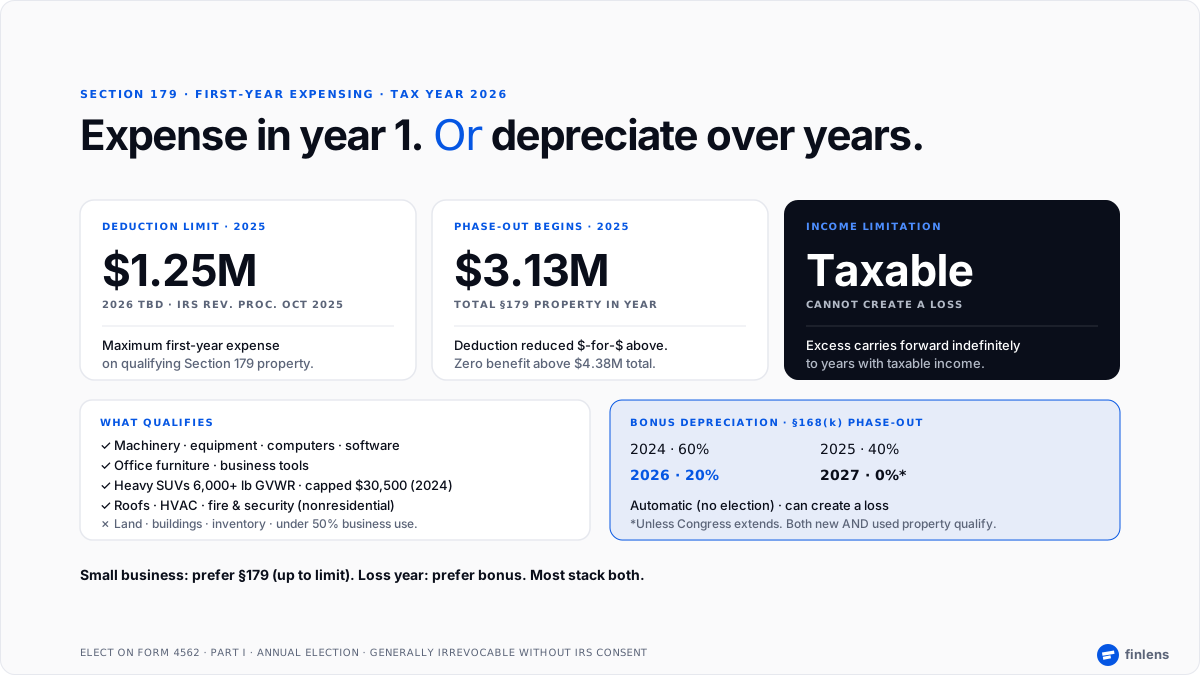
Deduction limit maximum amount you can elect to expense in a single year. In 2025 this is $1,250,000.
Investment phase-out threshold dollar amount of Section 179-qualifying property that triggers phase-out. In 2025 this is $3,130,000.
Once total Section 179 property placed in service in year exceeds phase-out threshold, deduction limit is reduced dollar-for-dollar by excess. The deduction limit reaches zero when total qualifying property exceeds phase-out threshold PLUS deduction limit.
For 2025:
- Deduction limit: $1,250,000
- Phase-out begins: $3,130,000
- Deduction reaches zero at: $3,130,000 + $1,250,000 = $4,380,000
Example a business places $3,500,000 of qualifying property in service in 2025:
- Excess over phase-out threshold: $3,500,000 − $3,130,000 = $370,000
- Deduction limit reduced: $1,250,000 − $370,000 = $880,000 maximum Section 179 deduction
Practical impact: Section 179 is designed for small and mid-market businesses. Once total capital purchases exceed ~$4.4M in a year, Section 179 provides no benefit and businesses fall back to standard MACRS depreciation or bonus depreciation.
The taxable income limitation
Even if you meet both dollar thresholds, Section 179 is limited to business's taxable income for year. You cannot use Section 179 to create or increase a business loss.
If a business has $500,000 of taxable income before Section 179 deduction and elects to expense $700,000 of qualifying property, only $500,000 hits current year. The remaining $200,000 carries forward to be deducted in future years when business has taxable income.
The carryforward is unlimited in time but it must eventually be deducted in a year when business has taxable income.
What qualifies for Section 179
Section 179 applies to tangible personal property used in a trade or business same "capitalized" side of CapEx vs OpEx distinction, purchased (not leased) and placed in service during tax year. Qualifying categories:
Tangible personal property:
- Machinery and equipment
- Vehicles (with special limits see below)
- Computers and computer software (off-the-shelf)
- Office furniture
- Certain manufacturing property
- Certain business tools
Qualifying improvements to real property (limited to deduction limit):
- Roofs
- HVAC systems
- Fire protection and alarm systems
- Security systems on nonresidential real property
Does NOT qualify:
- Land (never depreciable)
- Buildings themselves (39-year real property)
- Inventory or property held for sale
- Property used less than 50% for business
- Property acquired from related parties
- Property acquired in a like-kind exchange (Section 1031)
Vehicle limits SUV cap
Vehicles have their own Section 179 rules due to congressional concerns about luxury-vehicle abuse:
- Heavy SUVs (6,000+ lb GVWR) Section 179 limit is $30,500 for 2024, adjusted annually
- Passenger vehicles subject to broader luxury auto limits under Section 280F; annual depreciation caps apply
- Trucks and vans (6,000+ lb GVWR) designed for business use (cargo, not passenger) full Section 179 applies without SUV cap
The 6,000-pound GVWR (Gross Vehicle Weight Rating) threshold is why many businesses buy heavy trucks or SUVs specifically depreciation math is more favorable.
Section 179 vs. bonus depreciation in 2026
Bonus depreciation (IRC §168(k)) is another first-year expensing mechanism, but with different rules. The phase-out schedule:
- 2022: 100%
- 2023: 80%
- 2024: 60%
- 2025: 40%
- 2026: 20%
- 2027: 0% unless Congress extends
For 2026, choice between Section 179 and bonus depreciation typically follows this logic:
Prefer Section 179 when:
- Total qualifying property is under deduction limit
- The business has taxable income to absorb deduction
- You want to selectively expense some assets and depreciate others (Section 179 is per-asset elective)
Prefer bonus depreciation when:
- You'd exceed Section 179 phase-out (large capital investment year)
- You don't have taxable income (bonus depreciation can create/increase losses; Section 179 cannot)
- You want automatic 20% first-year deduction on all qualifying property without an election
Many businesses use both Section 179 for smaller assets to maximize deduction, bonus depreciation on remainder for automatic acceleration. See our full Section 179 vs. bonus depreciation comparison for mechanics of stacking both.
How to elect Section 179
The election is made on Form 4562 (Depreciation and Amortization), filed with business tax return. The form breaks out Section 179 election in Part I:
- Line 1: Maximum deduction limit for year
- Line 2: Total cost of §179 property placed in service
- Line 3: Phase-out threshold
- Line 4: Reduction in deduction (if phase-out applies)
- Line 5: Adjusted deduction limit
- Line 6: List of §179 property with cost and elected amount
- Line 12: Total §179 deduction (limited to taxable income)
The election is annual you can elect Section 179 in some years and skip it in others. Once made, election generally cannot be revoked without IRS consent for that tax year.
For year-1 depreciation math on same asset under standard MACRS versus Section 179 versus bonus depreciation, our how-to-calculate-depreciation guide walks through worked examples. Tracking Section 179 elections + MACRS carryforward year over year is where automated GAAP schedule software earns its keep.
Conclusion
Section 179 is small-and-mid-market first-year expensing tool: full deduction up to annual limit, phased out for large capital investment, capped by taxable income. In 2026, expect a limit around $1.28M–$1.30M with a phase-out around $3.2M–$3.25M exact figures come from IRS October 2025 revenue procedure. Combined with 20% bonus depreciation, most small businesses can still fully expense significant capital purchases in year 1.
FAQ
What is Section 179 deduction limit for 2026?
The 2026 Section 179 deduction limit is set by IRS annual revenue procedure, typically announced in October 2025. The 2025 limit is $1,250,000 with a phase-out beginning at $3,130,000. Confirm 2026 figure against official IRS announcement.
What qualifies for Section 179 deduction?
Tangible personal property used in a trade or business machinery, equipment, computers, off-the-shelf software, office furniture, and certain business vehicles. Qualifying real property improvements include roofs, HVAC, fire, and security systems. Land, buildings, inventory, and property used less than 50% for business do not qualify.
What is Section 179 phase-out?
Once total Section 179-qualifying property placed in service in year exceeds phase-out threshold ($3,130,000 in 2025), deduction limit is reduced dollar-for-dollar by excess. Section 179 is designed for small and mid-market businesses very large capital purchases lose benefit.
Can Section 179 create a business loss?
No. Section 179 is limited to business's taxable income for year. Amounts elected but not usable in current year carry forward indefinitely to be deducted when business has taxable income.
What is difference between Section 179 and bonus depreciation?
Section 179 requires an election, has annual dollar limits, and cannot create a loss. Bonus depreciation applies automatically to qualifying property, has no dollar limit, and can create a loss. In 2026, bonus depreciation is 20% of qualifying property cost; Section 179 offers full deduction up to limit.
Can I use Section 179 on vehicles?
Yes but with limits. Heavy SUVs (6,000+ lb GVWR) are capped at $30,500 (2024 figure) in first-year Section 179. Passenger vehicles are subject to broader luxury auto caps. Trucks and vans over 6,000 lb GVWR designed for business use qualify for full Section 179.
How do I elect Section 179?
File Form 4562 with your business tax return, listing each Section 179 asset in Part I. The election is annual. Once made, it generally cannot be revoked without IRS consent for that tax year.
Is Section 179 available for used property?
Yes. Section 179 applies to both new and used property that is new-to-the-taxpayer (i.e., not property you previously owned). This differs from bonus depreciation, which was expanded in TCJA to also cover used property.

