
Spend Management vs Expense Management: What's Difference in 2026?


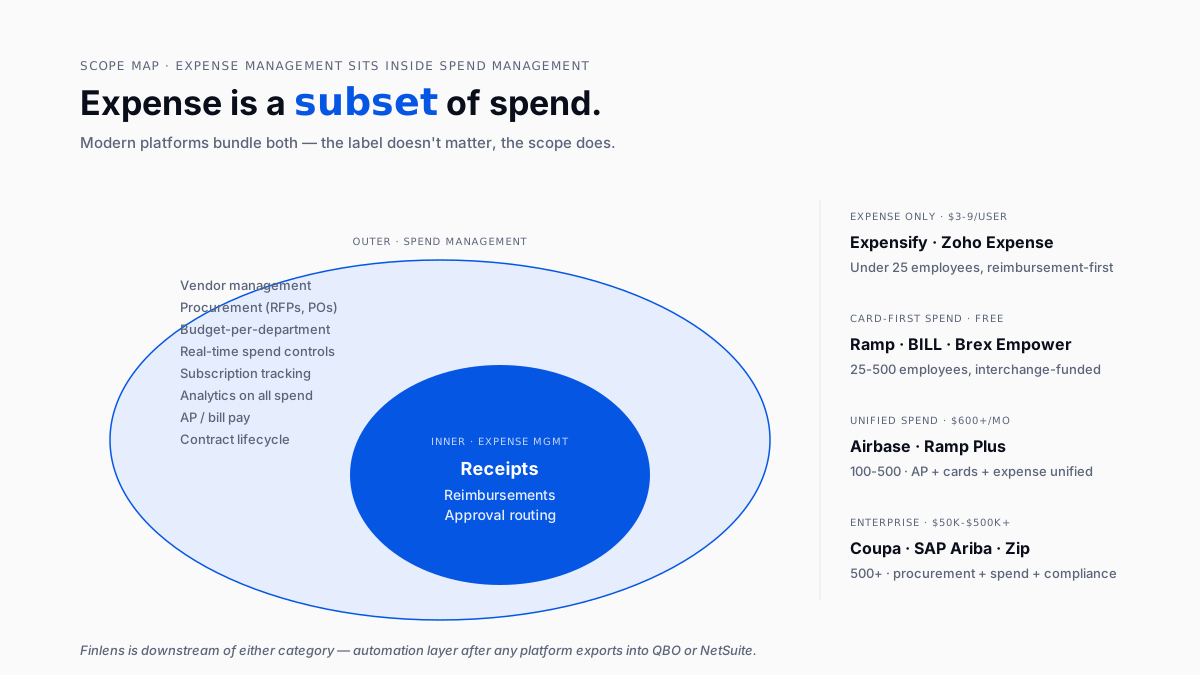
Expense management is narrower workflow capturing, categorizing, approving, and reimbursing employee spend after it happens. Spend management is broader discipline controlling all business spend (vendor payments, corporate cards, employee expenses, procurement) with policy enforcement, budget owners, and analytics on top.
Modern SMB and mid-market platforms Ramp, BILL Spend & Expense, Brex Empower, and Airbase bundle both. Legacy expense-only tools like Expensify and Zoho Expense stay focused on employee-side workflow. Enterprise spend management (Coupa, SAP Ariba, Zip) adds procurement, vendor onboarding, and contract lifecycle management that pure expense management doesn't cover.
This guide explains real feature differences, decision framework by growth stage, and cost economics of each category. For CPA firms managing multi-client QuickBooks Online books, Finlens sits downstream of either category as AI-native automation layer for categorization and month-end close.
Key takeaways
- Expense management = employee-side workflow. Receipts, reimbursements, corporate cards for T&E, approval routing, per-diem rules. Scope is individual spend transaction.
- Spend management = enterprise-wide discipline. Vendor management, procurement, budget enforcement, subscription tracking, policy analytics on all business spend. Scope is entire spend footprint.
- Modern SMB platforms bundle both. Ramp, BILL Spend & Expense, Brex Empower, Airbase started as card platforms and expanded to include full expense management. The "spend management" label describes what they became; expense management is one component.
- Enterprise spend management adds procurement. Coupa, SAP Ariba, Zip handle RFPs, contract lifecycle, vendor onboarding, and PO matching workflows that expense-only tools don't touch.
- Growth stage determines right category. SMBs (under 25 employees) usually start with pure expense management. Mid-market (25–500) upgrades to card-first spend management. Enterprise (500+) adds procurement-inclusive spend platforms. Trying to jump ahead wastes months of implementation on functionality you don't need yet.
- Every category exports transactions into QuickBooks Online, NetSuite, or Sage Intacct. Finlens is AI-native automation layer that runs categorization and close downstream of either category it doesn't compete with platforms; it handles ledger-side work after they post.
The core distinction what each category actually covers
Expense management covers post-swipe workflow:
- Employee makes a purchase (corporate card or out-of-pocket)
- Receipt captured (mobile OCR or manual upload)
- Categorized against chart of accounts
- Approved by manager based on policy
- Reimbursed on payroll (if out-of-pocket) or matched to card feed
- Exported to general ledger
Expense management asks: how do we process spend after it happens?
Spend management wraps expense management inside a broader control layer:
- All spend categories in scope (vendor invoices, subscriptions, procurement, employee expenses, corporate cards)
- Policy enforcement at source (card limits per vendor, budget approvals pre-spend, vendor whitelist enforcement)
- Budget owners with real-time visibility into department spend
- Analytics on vendor consolidation, contract renewals, subscription rationalization
- Procurement workflow for larger purchases (RFPs, contracts, POs)
- Vendor onboarding and lifecycle management
Spend management asks: how do we control all business spend, at every stage?
Expense management is a component of spend management. A tool can be one without being other, and same platform can start as one and grow into other.
A CFO on r/CFO asking whether AP or expense management is the bigger spend-management headache captures the practical answer to the definitional question: at the point you have many people carrying company credit cards, expense management is the one bleeding hours, not AP. That's usually the point where a plain expense tool stops being enough and a spend platform starts earning its subscription.
Feature comparison line by line
The rows where "spend management" wins are rows where "controlling spend before it happens" and "seeing across all spend categories" matter. Small businesses often don't need those rows until 25+ employees.
Category examples real platforms in 2026
Expense management only (pure expense tools)
Expensify: reimbursement-first with SmartScan OCR. $5-9/user/month. Best for 5-50 person teams with heavy out-of-pocket spend.
Zoho Expense: value-tier reimbursement platform. $3-8/user/month. Strong multi-currency OCR. Best for Zoho ecosystem or budget-conscious 10-25 person teams.
QuickBooks Online built-in expense module: bundled with QBO subscription ($35-$235/month). Best for solo owners under 30 monthly transactions.
Wave: free bookkeeping + tracker for pre-revenue solo operators.
Spend management card-first (includes expense)
Ramp: free corporate cards + spend controls + AI receipt matching + expense workflow + bill pay. Best for 5-500 employees issuing cards.
BILL Spend & Expense (formerly Divvy): free cards + budgeting + expense workflow with strong accountant channel. Best for SMBs whose accountant configures setup.
Brex Empower: cards + banking + travel + expense for venture-backed startups. Best for Series A-C funded businesses.
Spend management unified (mid-market)
Airbase: AP + cards + expense + procurement in one platform for 100-500 employee mid-market finance teams.
Ramp Plus: Ramp with added vendor negotiation service and procurement workflow. $12/user/month upgrade.
Enterprise spend management (procurement + spend)
Coupa: enterprise spend management with deep procurement workflows (RFPs, contracts, PO matching). Category leader for 500+ enterprises.
SAP Ariba: enterprise procurement + spend management integrated with SAP ERP. Depth on supplier network and contract lifecycle.
Zip: modern challenger to Coupa targeting 1,000-5,000 employee mid-large market with better UX than legacy enterprise tools.
SAP Concur: enterprise T&E + expense management (not full procurement, but adjacent). Often runs alongside Coupa or Ariba for procurement.
When each fits growth-stage decision
Expense management alone (pure expense tools):
- Under 25 employees
- Reimbursement-heavy workflows or minimal corporate card spend
- No dedicated finance team beyond bookkeeper + external CPA
- Vendor spend is dominated by 10 or fewer recurring subscriptions
- Tools: Expensify, Zoho Expense, QuickBooks Online expense module
Spend management card-first (includes expense):
- 25-500 employees
- Corporate cards issued to 5+ employees
- Meaningful budget-per-department needs
- Vendor spend has 20-100 recurring subscriptions and subscriptions are a real cost concern
- Tools: Ramp, BILL Spend & Expense, Brex Empower
Spend management unified mid-market:
- 100-500 employees
- AP + cards + expense need to be in one platform for finance operations efficiency
- Vendor management workflows starting to matter (vendor onboarding, W-9 collection, contract renewals)
- Tools: Airbase, Ramp Plus with procurement module
Enterprise spend management (procurement + spend):
- 500+ employees
- Complex procurement workflows (RFPs, contracts, PO matching)
- Multi-entity budgets and cost center allocation
- Compliance requirements (SOX, GDPR, SEC reporting)
- Tools: Coupa, Zip, SAP Ariba, Concur alongside procurement
A finance-operations perspective on r/Accounting about how much AI has actually automated day-to-day work reflects a common view AI has crossed usability threshold on routine categorization work, but judgment work still requires humans. That distinction applies to spend management too: modern platforms automate routine (card controls, receipt matching, budget enforcement), but policy design and vendor decisions remain human judgment.
Pricing model comparison
For a 100-employee mid-market business over 3 years:
- Ramp (spend management, card-first): $0 subscription. -$27K in cash back on $50K/month card spend. ~-$27K net TCO (Ramp pays you).
- Airbase (unified spend management): $87,600 subscription + $30K implementation = ~$117K total 3-year TCO.
- Coupa (enterprise spend management): $500K+ implementation + $200K+ annual subscription = ~$1.1M total 3-year TCO.
- Expensify (expense management only): $32K subscription over 3 years, but leaves ~60% of business spend uncontrolled. False economy at 100-employee scale.
Common misuse patterns
"Spend management" as a marketing label: Every vendor calls themselves spend management today. Verify actual feature scope receipt capture alone doesn't make a platform spend management. If tool doesn't handle vendor management, budget enforcement pre-spend, and analytics on all spend categories, it's expense management with a marketing coat.
Expense-only at scale: A 300-employee company running Expensify alone leaves 60-80% of spend uncontrolled vendor payments, subscriptions, procurement all sit outside platform. At that scale, spend management pays back in months through subscription rationalization alone (typical finding: $30-100K/year of duplicate SaaS).
Spend management at pre-revenue: A 5-person startup running Airbase or Coupa is buying enterprise complexity for a workflow that Expensify or Ramp handles in 10 minutes. Wait until scale actually requires depth.
Confusing card platforms with procurement: Ramp and BILL Spend & Expense are card-first spend platforms. Coupa and Ariba are procurement-first. Both are "spend management" but they solve very different problems. A workflow observation on r/Bookkeeping about clients categorizing everything as misc captures why distinction matters wrong tool creates wrong data structure downstream.
Buying enterprise spend for mid-market: Coupa at 200 employees is buying complexity you won't use for 2 more years. Ramp Plus or Airbase delivers 80% of value at 20% of cost until true procurement complexity emerges.
The transition path when to upgrade
Trigger to move from expense management to spend management: issuing corporate cards to 5+ employees, monthly card spend exceeds $10K, or duplicate vendor spend becomes visible pain (finance team can't easily identify subscription overlap). This typically happens at 25-50 employees.
Trigger to move from card-first spend to unified spend management: AP volume grows to 100+ invoices/month, vendor management workflows (onboarding, W-9 collection, contract renewals) start consuming meaningful finance time, or business wants one platform for AP + cards + expense rather than a stitched stack. Typically at 100-200 employees.
Trigger to move to enterprise spend management: procurement workflows become mandatory (RFPs, contracts, PO matching), multi-entity budgets require cost center allocation, or compliance requirements (SOX, IPO readiness) demand deeper audit trails. Typically at 500+ employees.
Skipping stages usually costs more than it saves buying enterprise tools too early creates configuration debt and change fatigue that outlasts platform's tenure.
Where Finlens fits downstream of either category
Whether you use pure expense management (Expensify), card-first spend management (Ramp), unified spend management (Airbase), or enterprise spend management (Coupa), transactions still land in general ledger and someone still has to close books. Categorization refinement on 10-15% of transactions AI missed. Corporate card feed reconciliation against actual statements. Month-end close checklist. Financial reporting.
For CPA firms managing multiple small-business clients on QuickBooks Online, Finlens is AI-native automation layer that runs that downstream work. Firm-level categorization rules inherit into every client book. Bank and card reconciliation runs automatically. Close checklist enforces cadence across every client from one dashboard, alongside existing QuickBooks automation workflows.
Finlens doesn't compete with Ramp, Expensify, Coupa, or any spend or expense platform. It sits underneath them, handling accounting work after they post turning platform output into audit-ready GL entries. On a 30-client CPA firm book, Finlens typically compresses per-client close time by 40-60%.
Which category should you choose
- Choose expense management only if you're under 25 employees, reimbursement is primary workflow, corporate cards + budget controls aren't a priority yet, and vendor spend is dominated by a small number of recurring subscriptions.
- Choose card-first spend management if you're 25-500 employees issuing corporate cards, want spend controls at card level, and value free-tier economics (Ramp, BILL, Brex).
- Choose unified spend management if you're 100-500 employees wanting AP + cards + expense + vendor management in one platform (Airbase, Ramp Plus).
- Choose enterprise spend management if you're 500+ employees with procurement workflows, multi-entity budgets, and compliance depth (Coupa, Zip, SAP Ariba, Concur).
Common transition mistakes
Waiting too long to move from expense-only to spend management: The pain shows up at 50-100 employees when uncontrolled vendor spend accumulates. Migration cost is materially lower before you're already stuck with a fragmented stack.
Migrating to enterprise spend management too early: Coupa or Ariba at 200 employees is buying complexity you won't use for 2 more years. Ramp Plus or Airbase delivers 80% of value at 15-20% of cost.
Not consolidating vendor overlap: Running Expensify (expenses) + BILL (AP) + Airbase (cards) creates three sources of truth. Modern spend platforms unify them.
Skipping accounting-side test on category changes: Moving from Expensify to Ramp changes export structure. Test QBO integration on 20 real transactions before switching, not after.
Buying by category name, not by feature scope: Every vendor calls themselves spend management. Verify actual feature scope on your specific workflow before signing.
Common integrations to verify
- Accounting ledger QuickBooks Online / NetSuite / Sage Intacct every platform advertises this; verify categorization quality on real transactions.
- HRIS auto-provision spend policies from Rippling / Workday / BambooHR.
- Payroll direct reimbursement sync (Expensify to Gusto, Rippling to itself).
- ERP mid-market and enterprise depth (NetSuite, SAP, Oracle).
- Bank feeds card transaction data quality varies materially between issuers.
- Contract management for enterprise spend platforms, integration with Ironclad, LinkSquares, DocuSign CLM.
- Vendor management W-9 collection, vendor onboarding forms, vendor portal access.
Conclusion
Expense management is a narrower workflow; spend management is broader discipline that includes it. SMBs typically start with expense management and grow into spend management. Mid-market picks unified spend platforms. Enterprises need procurement-inclusive spend platforms. Every category exports into ledger and accounting work after that export is where close is won or lost.

Frequently asked questions
What's difference between spend management and expense management?
Expense management covers employee-side workflow (receipts, reimbursements, corporate cards for T&E, approval routing). Spend management wraps expense management inside a broader control layer covering vendor management, procurement, budgets, and analytics on all business spend. Expense management is a component of spend management, not a separate category.
Is Ramp a spend management or expense management platform?
Both. Ramp started as a corporate card platform with real-time controls (spend management side) and expanded to include expense workflow (receipt capture, reimbursements, approval routing). Today Ramp is a card-first spend management platform that includes expense management as a component. Same story for BILL Spend & Expense, Brex Empower, and Airbase.
When should a small business move from Expensify to Ramp or BILL?
When card issuance becomes valuable usually 25+ employees or $10K+ monthly card spend. Ramp and BILL are free at that scale (interchange-funded). Continuing to pay per-user for Expensify past that threshold usually costs more than free spend-management alternative and leaves vendor spend uncontrolled.
What's a spend management platform?
A spend management platform combines corporate card issuance, real-time spend controls, expense management workflows, vendor management, and analytics on all business spend. Ramp, BILL Spend & Expense, Brex Empower, and Airbase are modern SMB and mid-market examples in 2026. Coupa, SAP Ariba, and Zip cover enterprise tier with added procurement workflows.
Do I need both spend management and expense management?
Modern platforms bundle both. Ramp, BILL, Brex, Airbase all include expense management as part of their spend management platform. Pure expense-only tools (Expensify, Zoho) fit smaller scale or reimbursement-first workflows. Enterprise spend platforms (Coupa) sometimes run alongside a dedicated T&E platform (Concur).
Where does Finlens fit in spend vs expense conversation?
Neither exactly Finlens is downstream of either category. It's AI-native automation layer that runs categorization, reconciliation, and month-end close after transactions post to QuickBooks Online. For CPA firms managing multi-client QBO books, Finlens automates accounting work that expense or spend platforms don't cover.
What's difference between Coupa and Ramp?
Coupa is enterprise spend management with deep procurement workflows (RFPs, contracts, PO matching, vendor onboarding). Ramp is SMB and lower-mid-market spend management focused on cards + expense workflow with lightweight procurement. Coupa's target buyer is a 500+ employee enterprise. Ramp's is a 5-500 employee business. A 500-employee company can genuinely pick either; smaller businesses shouldn't consider Coupa.
Is spend management just a marketing rebrand of expense management?
For some vendors, yes "spend management" label got applied to expense management platforms without adding underlying feature scope. Verify actual features: does tool handle vendor management, budget enforcement pre-spend, and analytics on all spend categories? If not, it's expense management with a marketing coat.
Which category is more expensive to run?
Enterprise spend management (Coupa, SAP Ariba) is materially more expensive due to implementation costs ($50K-$500K) and per-user fees ($15-30/user/month). Card-first spend management (Ramp, BILL, Brex) is free because it's interchange-funded. Expense-only tools (Expensify, Zoho) are $3-9/user/month. Unified mid-market spend (Airbase) is $600+/month base plus per-user.
How long does implementation take for each category?
Expense-only (Expensify, Zoho): 1-2 weeks. Card-first spend (Ramp, BILL, Brex): 1-2 weeks. Unified mid-market spend (Airbase): 4-8 weeks. Enterprise spend management (Coupa, Ariba): 4-12 months depending on complexity.
Can I run both expense management and spend management platforms simultaneously?
Yes but usually not efficiently. Running Expensify (expenses) + BILL Pay (AP) + Ramp (cards) creates three sources of truth for financial reporting. Modern unified platforms (Airbase) or card-first platforms with expanded scope (Ramp Plus) consolidate these into one.
What's ROI on moving from expense-only to card-first spend management?
For a 100-employee business with $30K/month card spend: switching from Expensify ($5/user × 100 = $500/month + $6K/year) to Ramp (free with 1.5% cash back = -$450/month on cash back = -$5.4K/year) is a $11.4K/year net swing. Plus subscription rationalization typically finds $30-100K/year of duplicate SaaS spend that Ramp's analytics surface. Payback within first quarter.

