
Tax Management Software: Bundled Platforms vs Specialist Tools for Tax-Focused Firms


A tax-only firm in mid-March has four browser tabs open per preparer. The tax software (Lacerte or ProConnect). The client portal (TaxDome or Liscio). The workflow tool (Karbon or Canopy or Aero). The document management or workpaper tool. The preparer is alt-tabbing between them all day. Some tabs are integrated. Most are not. Critical client information lives in three different places, and someone has to remember which.
This is the underlying problem tax management software is meant to solve. Whether it actually solves it depends on whether you go with a bundled platform that handles all four functions or specialist tools for each. Both approaches work. Both have meaningful tradeoffs.
What "tax management software" actually covers
The term gets used for at least three different categories:
Bundled tax practice platforms. TaxDome, Canopy, and a few others. They combine practice management, client portal, document management, time tracking, and tax workflow into one product. They don't include the actual tax preparation software (Lacerte, ProConnect, Drake, CCH Axcess); that's a separate license.
Specialist tax workflow tools. Specific software for managing tax engagements through their lifecycle. SurePrep for binder management, SafeSend for assembly and e-signature, and Drake Portals for client document collection. Each tool does one thing well.
Tax preparation software itself. Lacerte, ProConnect, Drake, CCH Axcess, UltraTax. The actual return preparation engines. People sometimes call these "tax management software," but the more common term is just "tax software.
The bundled vs. specialist question I'm answering is the first two categories. The tax preparation software you pick is largely independent of this decision.
The bundled platform pitch and where it actually works
The pitch: one tool, one login, one bill. The client uploads documents to the portal. The portal connects to the workflow tool. The workflow tool tracks the engagement. The same tool stores the workpapers. The same tool sends the invoice and collects payment. Everything lives in one place.
When this works well:
- Solo and small firms (under 10 staff). The overhead of running multiple specialist tools doesn't pay off until you have enough volume to justify the optimization.
- Firms with relatively standardized engagements. If 80% of your tax work is W-2 individual returns and small business 1040s, the bundled platforms handle it cleanly.
- Firms without significant audit, attestation, or specialized compliance work. Bundled tax platforms aren't built for assurance work.
Two of the platforms are worth real consideration:
TaxDome. The most popular bundled platform for tax-only firms in the last few years. Strong portal, decent workflow, document management bundled. Pricing: $50-$75 per user per month. Best fit for firms with 3-15 staff doing primarily tax work.
Canopy. More mature on the workflow side and lighter on document management than TaxDome. Bundles tax-specific workflow plus general practice management. Pricing: $50-$100 per user per month. Best fit for firms that do tax plus some bookkeeping or advisory.
The specialist approach and where it wins
The pitch: best-in-class for each function. Better portal than the bundled tools (Liscio or Suralink). Better workpaper management than the bundled tools (SurePrep or Caseware). Better assembly and e-signature than the bundled tools (SafeSend). Better practice management than the bundled tools (Karbon for broader accounting firms).
When this works well:
- Mid-size and larger firms (15+ staff). The volume justifies optimizing each layer.
- Firms with mixed engagement types. Tax plus audit plus advisory means the bundled platforms don't cover the full scope, so you're already running multiple tools.
- Firms with specific workflow requirements. Audit firms need Caseware. High-volume tax assembly firms need SafeSend. Specialized work pushes toward specialist tools.
The tradeoff is integration work. Specialist tools talk to each other through API integrations that range from excellent (Karbon ↔ SafeSend) to clunky (some portal tools ↔ some tax software). Maintaining a multi-tool stack requires more attention than the bundled approach.
What changes year over year that affects this decision
A few patterns I've seen over the last 3-4 tax seasons:
Bundled platforms have closed most of the feature gap. TaxDome in 2025 is meaningfully better than TaxDome in 2022. The portal is more polished. The workflow templates are deeper. The integrations with major tax software are mature. For firms that would have needed specialist tools 3 years ago, the bundled platforms now cover 80-90% of needs.
The cost of running specialist tools has gone up. Per-user pricing has risen across the category. Running 4 specialist tools at a 15-user firm can cost $40K-$80K per year before tax software. The bundled platforms remain in the $10K-$20K range for similar firm sizes.
Integration quality between specialists varies a lot. Some specialist combinations work seamlessly (Karbon + SafeSend + Lacerte). Others require manual reconciliation between systems (some portal tools + some workflow tools). The pre-commitment integration testing is more important than it used to be.
Cloud tax software changes the math. Firms moving from Lacerte desktop to ProConnect cloud (covered in the cloud tax software guide) often re-evaluate the surrounding stack at the same time. The cloud tax software has its own portal and document features that overlap with what TaxDome or Canopy provides.
A concrete decision framework
Six questions resolve the bundled vs. specialist call for most firms:
1. How many tax preparers do you have?
Under 5: bundled platforms work. 5-15: bundled platforms usually still work. 15+: start looking at specialists for the layers where the bundled tool is weakest.
2. Do you do audit or assurance work?
Yes, you need Caseware or an equivalent regardless of the rest of the stack. The bundled platforms don't cover this.
3. What's your tax software?
Lacerte: Most bundled platforms integrate well. ProConnect: same. CCH Axcess: CCH's own ecosystem is so dominant that the bundled platforms compete with built-in CCH tools rather than complement them.
4. What's your assembly and e-signature volume?
Low (under 200 returns per year): bundled platforms handle it. High (500+ returns): SafeSend or equivalent specialist tools pay off.
5. Do you have tax workflow needs that the bundled platforms don't cover?
Examples: complex multi-state PBC tracking, specific audit-readiness documentation, engagement-level profitability reporting. If yes, specialist tools win on those specific gaps.
6. What's your team's tolerance for integration management?
Specialist stacks require ongoing attention to API integrations, vendor updates, and inter-tool sync. If you don't have an internal owner for this work, the bundled platform wins on operational simplicity.
Common configuration patterns
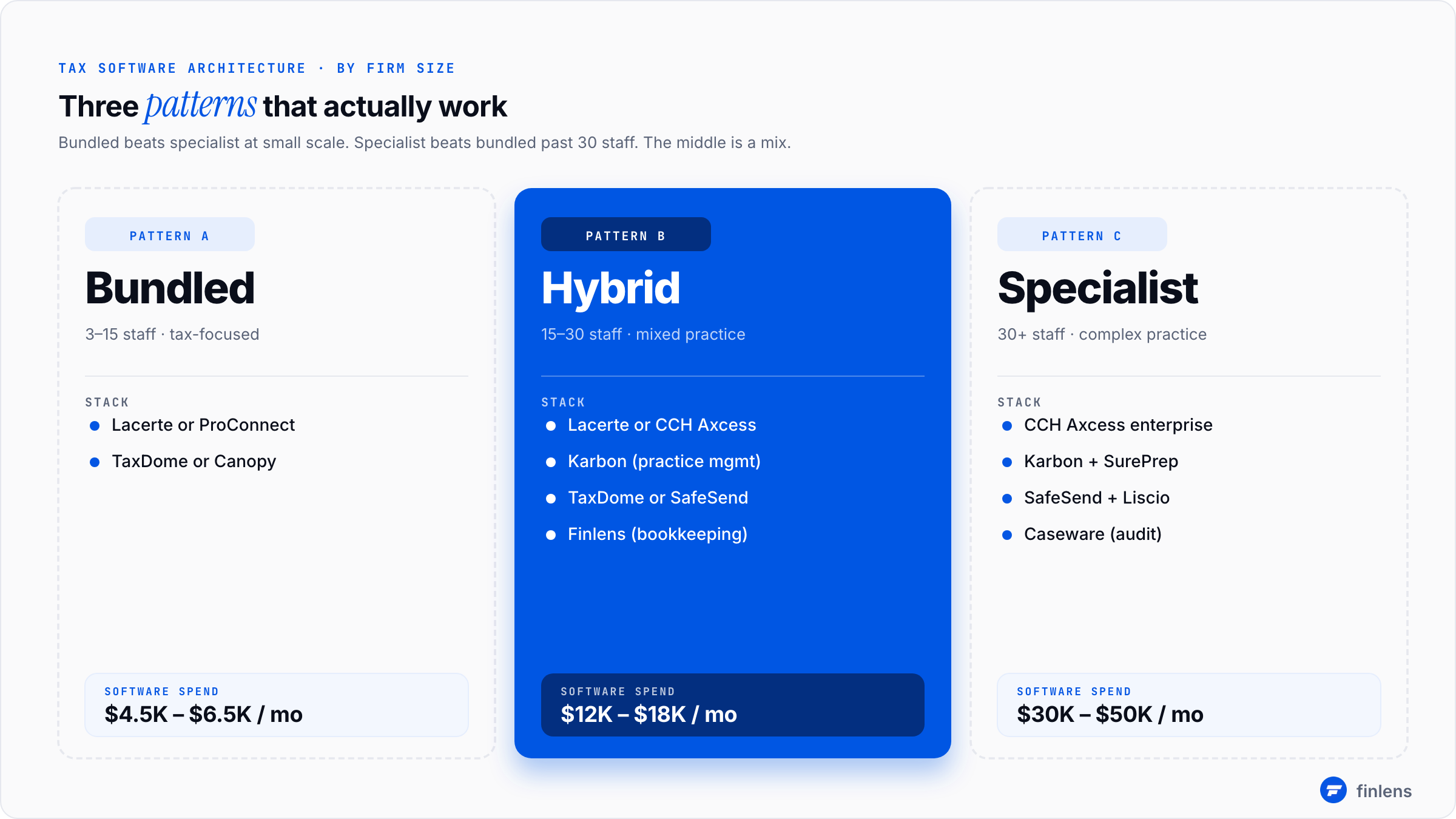
Three architectures I see working in the field:
Pattern A: Pure bundled (best for 3-15 staff tax-focused firms).
- Tax software: Lacerte or ProConnect
- Everything else: TaxDome or Canopy
- Total monthly software cost for 8 staff: $4,500-$6,500/month including tax software
Pattern B: Hybrid (best for 15-30 mixed-staff practices).
- Tax software: Lacerte or CCH Axcess
- Practice management: Karbon
- Tax workflow + portal: TaxDome or SafeSend (depending on volume)
- Bookkeeping automation (if applicable): Finlens for bookkeeping clients
- Total monthly software cost for 20 staff: $12,000-$18,000/month
Pattern C: Pure specialist (best for 30+ staff complex practices).
- Tax software: CCH Axcess or Lacerte enterprise
- Practice management: Karbon
- Tax workflow: SurePrep
- Assembly and e-signature: SafeSend
- Portal: Liscio (separate from any of the above)
- Audit tools: Caseware (if applicable)
- Total monthly software cost for 40 staff: $30,000-$50,000/month
The pattern that doesn't usually work: trying to run pattern C at firm size 10. The integration overhead exceeds the value at a small scale. The pattern that also doesn't usually work: trying to run pattern A at firm size 40. The bundled platforms hit ceilings on workflow depth and reporting.
What the bundled platform vendors don't tell you
Two honest limits:
Reporting depth. The bundled platforms have decent dashboards. They're not as deep as what dedicated tools (BigTime, Karbon, and Workflow Max) produce for time tracking and profitability analysis. Firms that want serious analytics on realization, utilization, and engagement profitability will eventually outgrow the bundled tools' reporting.
Workflow customization. The bundled platforms ship with standard tax workflow templates. They're customizable but only to a point. Firms with unusual workflows (high-touch concierge practices, large-corporate tax provision work, niche industries with unique requirements) often hit limits in what the bundled tools allow.
These limits matter less than the marketing suggests for typical firms. They matter a lot for firms operating at the edges.
What specialist vendors don't tell you
Two honest limits in that direction:
Integration breakage. When one specialist vendor changes their API, the integration with adjacent tools can break. The downtime during tax season is meaningful. Bundled tools don't have this problem because everything is one product.
Coordination overhead. Running 5 specialist tools means 5 vendor relationships, 5 support contacts, 5 user management interfaces, and 5 billing cycles. The administrative load is real and grows with firm size.
How to test before committing
A reasonable evaluation process:
- Identify your current tool stack and what each tool costs annually.
- Pick the bundled platform that fits your firm size (TaxDome or Canopy for most cases).
- Run a parallel pilot during a non-peak month (May-August work well). Three pilot clients in the bundled platform, with the rest still in the existing stack.
- After 8-12 weeks, evaluate time saved, integration friction observed, and gaps surfaced.
- Make the call before October so you can roll out before next tax season.
The mistake to avoid: trying to migrate the whole firm at once in November or December. The team is already preparing for tax season. Adding tool migration on top of that is how rollouts fail.
Frequently asked questions
Is TaxDome better than Canopy?
For tax-only firms with 3-15 staff, they're roughly equivalent. TaxDome tends to have better document management and a stronger portal. Canopy tends to have better workflow templates and slightly more mature practice management features. Pick based on which gaps you feel most acutely now.
Can the bundled platforms replace tax preparation software like Lacerte?
No. TaxDome, Canopy, and similar bundled platforms do not prepare tax returns. They surround the tax software with portal, workflow, and document management. You still need Lacerte, ProConnect, Drake, or CCH Axcess for the actual return preparation.
What about firms doing both tax and bookkeeping?
Mixed practices usually run pattern B (hybrid). The bundled tax platforms cover the tax side. Bookkeeping automation tools (Finlens, Docyt) cover the bookkeeping side. Practice management (Karbon) sits on top to coordinate both.
How long does a bundled platform implementation take?
Technical setup: 1-2 weeks. Team training and workflow configuration: 4-8 weeks. Full adoption with client document migration: 12-16 weeks. Start before August if you want it stable before next tax season.
Are there bundled tax platforms specifically for solo practitioners?
TaxDome has solo-friendly pricing. Canopy is workable for one. Drake Portals is the cheapest option but lighter on features. For solo practitioners, the right pick is often whichever bundled platform integrates best with their existing tax software.
Where does Finlens fit?
Finlens automates the bookkeeping work for tax firms that also do client bookkeeping. The bundled tax platform (TaxDome or Canopy) handles tax workflow and document collection. Finlens handles the actual categorization and reconciliation work on the bookkeeping clients. The two stacks are complementary.
For most tax-focused firms under 15 staff, a bundled platform plus your tax software covers the operational needs at meaningfully lower cost than a specialist stack. Past 15 staff, the math shifts toward specialists for the layers where bundled tools hit limits. For the broader operational picture, the tax client portal migration guide and the cloud tax software comparison cover adjacent decisions.

