
Travel and Expense Management Software: 7 Tools Compared for 2026


Key takeaways
- The category has bifurcated in 2026. Legacy enterprise T&E (SAP Concur) still owns 500+ employee complex-policy segment. Modern challengers (Navan, TravelPerk, Ramp Travel) have taken most of SMB and lower-mid-market share by combining consumer-grade booking UX with free or lower-tier pricing.
- Free tiers are real for modern challengers. Navan Basic is genuinely free for teams under 200 employees. Ramp Travel and Brex Travel come free with their card platforms. This eliminated "SMB has no T&E option" problem that made small companies default to personal booking + Expensify reimbursement for years.
- The IRS accepts contemporaneous logs and digital receipts under Publication 463 (Travel, Gift, and Car Expenses), which is why every modern T&E tool prioritizes mobile capture flow. Concur uses SmartScan, Navan uses in-app OCR, Ramp uses AI receipt matching from card feeds.
- Companies typically pick T&E based on three signals: annual travel spend (does tool need to justify itself against travel volume?), whether booking + expense need to be in one platform (or if booking is out-of-scope), and whether integrated corporate cards are part of setup.
- Once T&E data lands in QuickBooks Online, NetSuite, or Sage Intacct, Finlens is AI-native automation layer used by CPA firms managing QuickBooks Online client books to run reconciliation and close.
A Director in a small Comms consulting firm on r/consulting setting a $125-per-meal cap after weeklong-trip dinners hit $250+ solo tabs is a live example of why T&E platforms sink or swim on policy-engine depth. If the rule can't be expressed and enforced pre-submission, it becomes an after-the-fact fight with your best-performing team.
Best travel and expense management software: comparison table
Pricing reflects publicly reported starting tiers early 2026. Navan Basic verified free for teams under 200 employees on Navan's pricing page.
The 7 platforms deep dive
1. Navan (TripActions) modern mid-market leader
Why it leads. Navan (rebranded from TripActions in 2023) built modern T&E category playbook by combining three properties SAP Concur cannot match at price: consumer-grade booking UX that employees actually want to use (not workaround), a policy engine that handles per-country per-diems and complex approval routing without a 3-month implementation, and a genuinely free tier for teams under 200 employees. For 25–500 employee mid-market companies with material travel volume, Navan has taken most of segment share from Concur over past four years.
Best for. 25–500 employee teams with material travel volume ($100K+/year) wanting modern UX and free-tier or per-trip pricing.
Six features that separate Navan from Concur at mid-market scale.
- Policy-aware booking search: search for flights and hotels Navan surfaces only policy-compliant options by default. Non-compliant fares require an exception request routed to traveler's manager. Concur has this too, but Navan's implementation is 30-40% faster to configure.
- Integrated corporate cards (Navan Rewards): Navan issues corporate cards tied to platform. Card charges auto-match to booked trip. No manual expense report step for routine travel.
- In-app receipt OCR: for non-Navan-booked expenses (a taxi in Amsterdam paid personally, a business dinner), mobile app captures receipts with strong OCR quality.
- Chat-first agent support: in-app chat with a travel agent when a flight is delayed, a hotel is oversold, or plans change. Faster than Concur Travel's phone-based support model.
- Sustainability tracking: carbon emissions per trip, aggregated for corporate sustainability reports. Increasingly required by public companies and PE-backed businesses tracking ESG.
- Native QuickBooks Online / NetSuite / Sage Intacct sync: direct connectors comparable to Ramp's quality. NetSuite depth matters for scaling mid-market.
Pricing subtlety. Navan Basic is free for teams under 200 employees no per-user fee, no monthly minimum. Navan Growth adds vendor spend analytics and dedicated support (custom pricing, typically $10–20/user/month). Navan Enterprise adds multi-entity, advanced compliance (custom).
Limitations. Multi-country policy engine less deep than SAP Concur for 5+ country operations. Newer than Concur, so smaller reference customer base for buyers wanting long tenure. Some enterprise buyers with existing SAP or Oracle ERP find Concur's ERP integration deeper.
Where it breaks. 1,000+ employee multinationals with SAP ERP and 15+ country operations. Concur remains stronger there.
A finance user on r/Accounting asking for any decent expense software that actually works reflects the mid-market disillusionment that Navan, TravelPerk, and Concur all sell against: the expense category is old, most vendors have plateaued on UX, and the differentiator is policy engine + booking integration in one place, not a nicer receipt-scan.
2. SAP Concur enterprise incumbent
Why it earns #2. SAP Concur has been enterprise T&E category leader for two decades. The policy engine handles per-country per-diems, multi-currency handling, VAT reclaim across 30+ jurisdictions, and deep integration with SAP ERP and Oracle ERP at a depth no modern challenger has matched. For a 5,000-employee multinational with expense operations across 15 countries and a mature compliance program, Concur remains reference option but at a materially higher cost than Navan for equivalent mid-market functionality.
Best for. 500+ employee enterprises with complex multi-country T&E policies, existing SAP or Oracle ERP relationships, and SOX-compliance requirements.
Six features that separate Concur from mid-market challengers.
- Policy engine depth: conditional policy branching by country, currency, department, role, and travel purpose. Enforce per-diem caps at booking (not just report-time). Handle grandfathered exemptions for legacy contracts.
- VAT reclaim across 30+ EU jurisdictions: automated compliance documentation for VAT reclaim filings. Saves 6-figure sums annually for multinational businesses. Navan and TravelPerk offer this but Concur's implementation is deeper.
- Concur Travel booking integration: deepest airline and hotel supplier network. Direct connect with 45+ airlines and major hotel chains, negotiated corporate rates preserved.
- SAP and Oracle ERP integration: bidirectional sync with SAP S/4HANA, SAP ECC, Oracle Cloud, Oracle EBS. Real-time posting with cost center, profit center, and project code integrity.
- Audit trail and compliance: SOX-compliant audit workflows, 7-year retention, tamper-evident logs. Big-4 audit teams routinely accept Concur outputs without additional cleanup.
- Global support: 24/7 support in 30+ languages. Implementation partners in every major market.
Pricing subtlety. Concur pricing is custom by module (Expense, Travel, Invoice, Analytics) and user count. Real market ranges: $8–25/user/month for Expense alone, $15–35/user/month with Travel bundled, plus implementation fees typically $50K–$500K depending on complexity.
Limitations. Overkill for SMBs. Implementation typically takes 2–4 months even for straightforward mid-market deployments. Employee-facing UX has been criticized as dated compared to Navan and TravelPerk.
Where it breaks. Small and lower-mid-market businesses (under 500 employees). Concur's implementation cost and complexity don't fit companies that can be productive on Navan Basic in a week for zero cost.
3. TravelPerk European challenger
Why it earns #3. TravelPerk built a Navan-competitive T&E platform with a differentiated European base and a specific feature FlexiPerk that reimburses 80% of any cancelled trip cost regardless of original fare rules. For mid-market companies with heavy Europe travel or unpredictable trip cancellation risk (client cancellations, illness, weather), FlexiPerk is materially useful.
Best for. 50–500 employee companies with heavy Europe travel or high trip-cancellation risk that value FlexiPerk insurance model.
Six features that distinguish TravelPerk.
- FlexiPerk 80% cancellation reimbursement: cancel any booking for any reason up to 2 hours before departure and TravelPerk reimburses 80% of cost. Includes non-refundable fares. Alone justifies paid tier for cancellation-prone businesses.
- European supplier network: deepest European rail (Trenitalia, DB Bahn, SNCF, Renfe) integration. For businesses with heavy intra-Europe travel, this is a material advantage over US-first tools.
- Sustainability metrics with GreenPerk: carbon offsets purchased automatically per booking. GreenPerk fee is small (~$4/booking) but companies get certified offset documentation.
- 24/7 travel support in 15+ languages: in-app and phone support that handles rebooking, refunds, and disruptions.
- Policy engine and approval routing: comparable to Navan's depth. Not quite Concur-level but sufficient for most mid-market operations.
- QuickBooks Online / Xero / NetSuite / Sage Intacct sync: direct connectors with strong European accounting platform coverage (Sage 50 UK, Sage 200).
Pricing subtlety. Starter is free (up to 5 travelers). Premium is custom, typically $99/month base + per-booking fee. Pro adds FlexiPerk and enterprise features.
Limitations. North American supplier network less deep than Navan or Concur. FlexiPerk is a paid add-on Basic tier doesn't include it. Newer to US market so fewer US reference customers.
Where it breaks. US-only businesses with no Europe travel. Navan or Ramp Travel usually fit better there.
4. Ramp Travel card-bundled option
Why it earns #4. Ramp Travel is a native module inside Ramp spend platform. For companies already on Ramp for corporate cards, adding travel keeps workflow inside one system bookings tied to Ramp cards, receipts auto-matched to card transactions, and expense reports auto-generated from card feed data. Ramp Travel launched in 2023 and has matured quickly, though it remains newer than Navan's booking product.
Best for. Existing Ramp customers with meaningful travel spend who want booking + cards + expense in one platform.
Six features that make Ramp Travel work for Ramp customers.
- Card-tied booking: book through Ramp Travel, charge to Ramp card, receipt auto-matches, expense report auto-generates. Zero manual expense report entry for compliant trips.
- Policy controls at booking: search returns only policy-compliant options; non-compliant fares require exception approval routed to manager.
- Native QuickBooks Online sync: transactions post to QBO in real-time with vendor, category, memo, and receipt attachment.
- Vendor spend analytics: Ramp's core vendor analytics extends to travel duplicate travel bookings, hotel program consolidation opportunities, airline vendor rationalization.
- Card cash back on travel: 1.5% cash back on all Ramp card charges applies to travel bookings too.
- AI receipt matching: for personal-card purchases during travel (like a taxi paid personally), AI matcher ties uploaded receipts to Ramp card transactions in same trip.
Pricing subtlety. Ramp Travel is free with Ramp platform (interchange-funded). Ramp Plus ($12/user/mo) unlocks vendor negotiation and stronger integrations.
Limitations. Newer T&E product than Navan or Concur. Best fit when travel isn't primary decision driver Ramp Travel wins on integration, not on booking depth. Supplier network narrower than Concur or Navan.
Where it breaks. Companies where T&E is primary category and travel policy is complex. Navan or Concur have more depth.
5. Brex Travel venture-backed startup bundle
Why it earns #5. Brex Empower Travel is Brex's booking product inside its Empower expense management platform. For Brex customers, especially venture-backed startups, Brex Travel bundles booking with Brex corporate cards and Brex Empower expense workflow into one platform. Comparable to Ramp Travel's model but targeted at venture-backed segment where Brex has a stronger relationship.
Best for. Brex customers, especially Series A-C startups wanting travel inside Brex platform.
Six features that make Brex Travel work for Brex customers.
- Native Brex card integration: book through platform, charge to Brex card, receipts auto-match to card transactions.
- Travel policy enforcement at booking: non-compliant fares require exception approval.
- QuickBooks Online + NetSuite sync: direct connectors that align with Brex's SMB and startup customer base.
- Points and rewards: Brex's category-multiplied rewards (3x on travel, 8x on rideshare) apply to Empower Travel bookings.
- Integrated banking: Brex Business Account holds funds used for travel spend; interest earned on cash balances offsets travel spend.
- Modern mobile UX: consistent with Brex's overall product polish.
Pricing subtlety. Free with Brex platform (interchange-funded).
Limitations. Best fit when travel isn't primary category. Brex Empower Travel is less deep than Navan. Only makes sense for existing Brex customers.
Where it breaks. Non-Brex customers no reason to adopt Brex Travel alone.
A consultant on r/consulting arguing that mandatory company cards eat the perk economics of consulting travel surfaces a T&E-adoption reality that Navan and Ramp Travel both have to answer: a card-mandate policy is only accepted if the booking + reporting UX inside the platform is materially better than expense-then-reimburse.
6. Expensify reimbursement-first fallback
Why it earns #6. Expensify handles expense reports and reimbursement flows but doesn't include a travel booking layer. Fits when employees book travel through personal channels (Chase Sapphire, Amex Platinum, personal loyalty accounts) and get reimbursed on payroll. For consultancies where consultants book flexibly and get reimbursed, Expensify remains reference option.
Best for. 5–50 person teams where reimbursement is primary workflow and travel booking happens outside platform.
Six features that keep Expensify relevant for reimbursement-first T&E.
- SmartScan OCR: best-in-class on messy receipts (crumpled, low-light, foreign language). Wins where Navan or Ramp OCR sometimes miss.
- Mileage tracking with GPS: mobile app detects drives and lets travelers swipe business/personal. IRS-compliant log for reimbursement.
- Per-diem library: configure by city and role. Employee gets right per-country allowance without manual math.
- Direct payroll integration: Expensify pushes reimbursements to payroll for next paycheck (Gusto, ADP, Rippling native).
- QuickBooks Online + Xero sync: most mature SMB accounting integration in category.
- ACH reimbursement: direct to employee bank account, bypassing payroll for faster reimbursement (3 business days vs. 2-week payroll cycle).
Pricing subtlety. Free (Collect) tier caps at 25 receipts/user/month. Control ($5/user/mo) is workhorse.
Limitations. No booking layer. If travel booking control matters (policy enforcement at booking, negotiated rates preserved), Expensify doesn't cover it.
Where it breaks. Companies wanting integrated booking + expense Navan or Concur.
7. Egencia (Amex GBT) traditional TMC option
Why it earns #7. Egencia is corporate travel management under Amex GBT umbrella. Traditional TMC (travel management company) model with dedicated agent support, negotiated corporate rates, and integration with expense management platforms. Fits mid-market companies with dedicated travel programs where agent support is valued over self-service booking.
Best for. 100–500 employee companies with dedicated travel programs, negotiated corporate rates, and preference for 24/7 travel agent support.
Six features that distinguish Egencia's TMC model.
- 24/7 travel agent support: real people handling rebooking, refunds, and disruptions. For business-critical travel (executives, sales-critical meetings), this is a differentiator.
- Negotiated corporate rates preserved: deep supplier relationships mean corporate rate discounts survive booking flow (whereas modern self-service platforms sometimes miss them).
- Integration with expense platforms: Egencia handles booking; travelers use Concur, Expensify, or others for expense reports. Egencia doesn't compete with expense side.
- Amex GBT global network: offices and agents in 140+ countries. For multinationals with heavy travel across time zones, this coverage is unique.
- Reporting and analytics: deep travel program analytics for corporate travel managers. Spend by supplier, by department, by traveler.
- Duty of care features: traveler location tracking, emergency support, mass-communication tools for disruptions.
Pricing subtlety. Custom Egencia pricing depends on booking volume and services. Traditional TMCs charge transaction fees ($15–$50 per booking) plus service fees.
Limitations. Traditional TMC model. Newer challengers (Navan, TripActions before rebrand) have more modern UX. Employee resistance can be higher because booking flow is less consumer-grade.
Where it breaks. SMBs Egencia's model assumes dedicated travel program with agent support and negotiated rates.
The T&E workflow what modern software actually does
Any T&E platform worth using handles four workflow stages:
- Book. Employee books flight, hotel, ground platform enforces policy (max ticket price, preferred vendors, advance-purchase rules).
- Spend. Corporate card at point of purchase, or employee out-of-pocket for reimbursement.
- Capture. Receipt OCR, mileage log, per-diem allocation. Mobile app handles most.
- Post. Categorized transactions export into general ledger (QuickBooks Online, NetSuite, Sage Intacct).
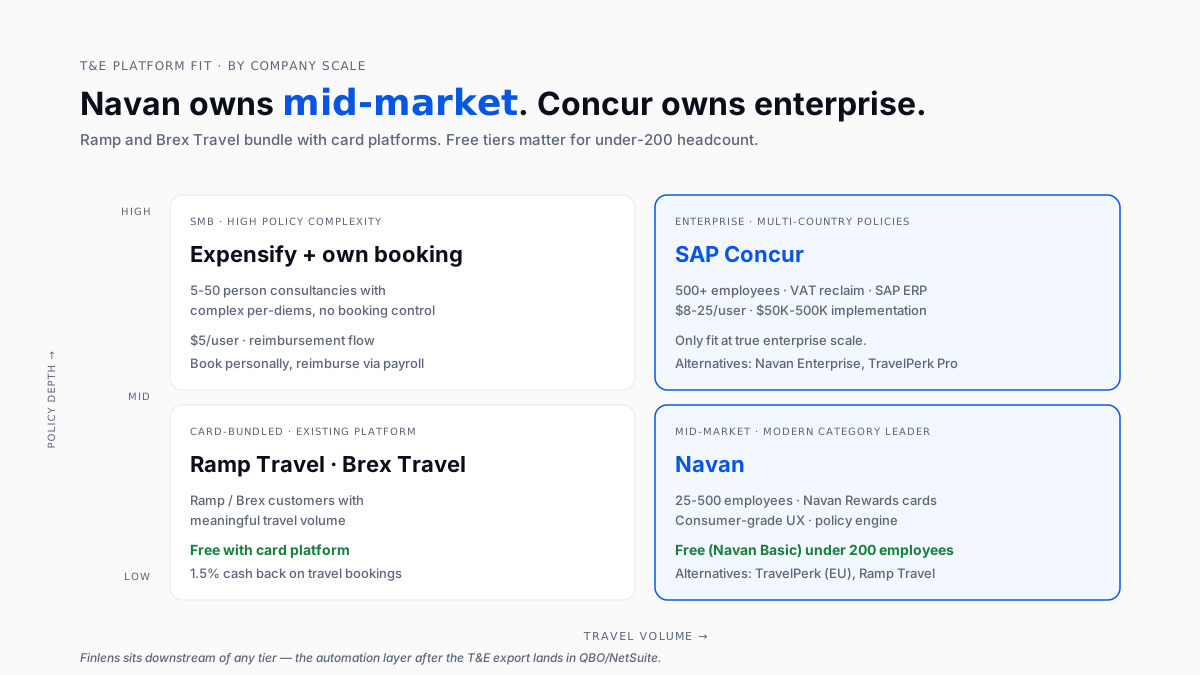
All seven platforms in this comparison handle all four stages (except Expensify, which skips Stage 1 by design). The differentiation is in policy engine depth (Concur wins for enterprise, Navan wins for mid-market), UX quality (Navan and Ramp Travel win modern segment), integration with corporate cards (Ramp Travel, Brex Travel, Navan Rewards), and whether booking is even in scope (Expensify skips it).
Which T&E platform should you choose
- Choose Navan if you're 25–500 employees with material travel volume and want modern UX plus a free tier for smaller teams. Category leader for mid-market.
- Choose SAP Concur if you're 500+ employees with complex multi-country T&E policies, existing SAP or Oracle ERP, and audit-compliance requirements.
- Choose TravelPerk if you have heavy Europe travel or value FlexiPerk 80% cancellation reimbursement model.
- Choose Ramp Travel if you're already on Ramp for cards and want travel added inside platform.
- Choose Brex Travel if you're already on Brex, especially as a venture-backed startup.
- Choose Expensify if travel booking happens outside platform and reimbursement is primary workflow.
- Choose Egencia if you need 24/7 agent support and negotiated corporate rates at mid-market or enterprise scale.
An expense-software AE on r/CFO asking what buyers actually get wrong about the tool their finance team ends up using captures the T&E procurement failure that no vendor demo surfaces: the person coding 400 transactions a month is almost never in the buying room, so the platform gets picked on Controller-visible features and quietly loses on the Tuesday-morning workflow. Any T&E shortlist worth running has to interview the traveler and the coder, not just the CFO.
Where Finlens fits automation
T&E platforms handle booking, capture, and workflow side. Once transactions export into QuickBooks Online, NetSuite, or Sage Intacct, accounting work continues categorization refinement, corporate card feed reconciliation, month-end close.
For CPA firms managing multi-client QBO books, Finlens is AI-native automation layer that automates that downstream work. Firm-level categorization rules inherit into every client. Bank and card reconciliation runs automatically. Close checklist enforces cadence across every client from one dashboard, alongside existing QuickBooks automation workflows.
Finlens is not a T&E tool. It doesn't compete with Navan, Concur, or Ramp Travel. It sits underneath any of them, handling accounting work after T&E export lands in ledger turning T&E platform output into audit-ready GL entries.
Common T&E rollout mistakes
Buying enterprise for SMB. SAP Concur at 50 employees is $10K+/year in fees plus 3 months of implementation for functionality Navan Basic delivers free. For under-500-employee businesses, modern challengers (Navan, TravelPerk, Ramp Travel) are almost always right pick.
Not tying booking to spend controls. If booking happens outside platform, spend limits don't get enforced pre-trip you catch violations at expense report time, after money is already spent. Navan, Concur, Ramp Travel enforce policy at booking search.
Ignoring corporate card economics. Ramp Travel and Brex Travel are free because interchange funds them. If travel volume is meaningful, that model is materially cheaper than SAP Concur's per-user model. On $500K/year travel spend across 100 employees, Ramp Travel bundled with Ramp cards recaptures $7,500/year in 1.5% card cash back.
Skipping accounting-side test. Every platform advertises QBO or NetSuite sync. Verify actual export on a real trip before rolling out to whole team. A 90%-accurate categorization means 10% of transactions need re-coding at close on a 100-employee team with meaningful travel, that's 5-8 hours/month of accountant cleanup.
Not planning per-diem policy for international travel. Multi-country operations need per-country per-diems. Concur handles this natively; Navan handles most cases; Expensify handles it manually. If you're pre-diem-heavy, test on a real multi-country trip before committing.
Underestimating change management. Employees resist new booking flows if they're clunky. Test Navan or Concur booking flows on real trips with real employees before rolling out. The tool's success depends on adoption more than feature depth.
Common integrations to verify
- Accounting sync QuickBooks Online / NetSuite / Sage Intacct depth varies. Test on 20 real trips end-to-end.
- Corporate card feed Ramp, Brex, Navan (via Rewards), and BILL issue cards natively; others integrate with existing feeds.
- HRIS sync auto-provision travel profiles from Rippling, Workday, BambooHR.
- Booking connectors direct booking (Navan, Concur, Ramp Travel, TravelPerk) vs. reimbursement of personal bookings (Expensify).
- Reporting travel-specific reports (spend by supplier, savings vs. policy, sustainability metrics) matter more than generic BI.
- SSO and identity management Okta, Azure AD, Google Workspace for enterprise deployments.
Conclusion
Travel and expense management software picks by three signals travel volume, whether booking + expense need to be in one platform, and existing corporate card setup. Mid-market companies overwhelmingly land on Navan for free tier, modern UX, and Navan Rewards card integration. Enterprises with complex multi-country policies stay on SAP Concur. European-heavy operations pick TravelPerk. Ramp and Brex customers extend into their card platforms' travel modules. Teams without booking control needs stay on Expensify.
Frequently asked questions
What's best travel and expense management software for 2026?
Navan for 25–500 mid-market wanting modern UX and free tier. SAP Concur for 500+ enterprises with complex multi-country policies. TravelPerk for European-heavy operations. Ramp Travel or Brex Travel for existing Ramp or Brex customers. Expensify when booking happens outside platform.
How much does travel and expense software cost?
Navan Basic is free for teams under 200 employees. SAP Concur is $8–25/user/month plus implementation ($50K–$500K). TravelPerk Starter is free (5 travelers); Premium is custom starting around $99/month. Ramp Travel and Brex Travel are free with their platforms. Expensify is $5–9/user/month.
What's difference between T&E software and expense management software?
T&E software includes travel booking (flights, hotels, ground) plus expense capture. Pure expense management software (Expensify, Zoho) handles receipts and reimbursements but doesn't manage booking. For businesses with meaningful travel spend, T&E platforms consolidate booking + expense workflow into one system.
Does T&E software integrate with QuickBooks Online?
All seven platforms in this comparison (except Egencia, which integrates through third-party expense platforms) offer QuickBooks Online sync. Navan, Ramp Travel, Brex Travel, and Expensify have cleanest SMB connectors. SAP Concur is deeper for enterprise ERP integration.
What happens after T&E data hits general ledger?
Someone still has to categorize outliers, reconcile corporate card feeds, and close books. T&E platforms don't do close. For CPA firms managing multi-client QBO books, Finlens automates that downstream work.
Should we use SAP Concur or Navan?
Concur if you're 500+ employees with complex multi-country policies and existing SAP relationships. Navan if you're 25–500 with modern UX preference and simpler policy needs. Navan's free tier at smaller scale is materially cheaper than Concur's per-user model.
Can we use Ramp Travel without moving to Ramp cards?
Ramp Travel is designed to work with Ramp cards and Ramp's expense platform. Using it standalone doesn't unlock value. If Ramp cards aren't part of plan, Navan is a better fit.
Is Navan really free for small teams?
Yes Navan Basic is genuinely free for teams under 200 employees. No per-user fee, no monthly minimum. Navan earns on booking commissions (like a modern travel agency) plus optional paid tiers for larger deployments.
What's difference between Navan and TravelPerk?
Navan has stronger US supplier network and better modern UX polish. TravelPerk has deeper European rail integration and FlexiPerk 80% cancellation reimbursement model. For US-based mid-market, Navan usually wins; for Europe-heavy operations, TravelPerk is a strong alternative.
How does per-diem policy work in T&E software?
Configure per-diem rates by city or region (e.g., US GSA rates, EU per-country rates). When an employee books a trip to that location, platform applies correct per-diem automatically. Concur, Navan, and TravelPerk handle this natively; Expensify handles it with manual configuration.
What's ROI on switching from Concur to Navan for a mid-market business?
For a 200-employee mid-market business currently paying Concur $15/user/month with Travel bundled: switching to Navan Basic saves $36,000/year in subscriptions plus 3-4 hours/week of admin modern UX eliminates. Payback within first quarter, plus employee satisfaction gains from better booking flow.
How long does a T&E rollout take?
Navan Basic: 1-2 weeks. Ramp Travel and Brex Travel: 1-2 weeks (assuming already on parent platform). TravelPerk: 2-3 weeks. SAP Concur: 2-4 months. Egencia: 4-6 weeks for TMC integration. Expensify: 1-2 weeks.

