
When Are Quarterly Estimated Taxes Due in 2026? (Complete Deadline Guide)


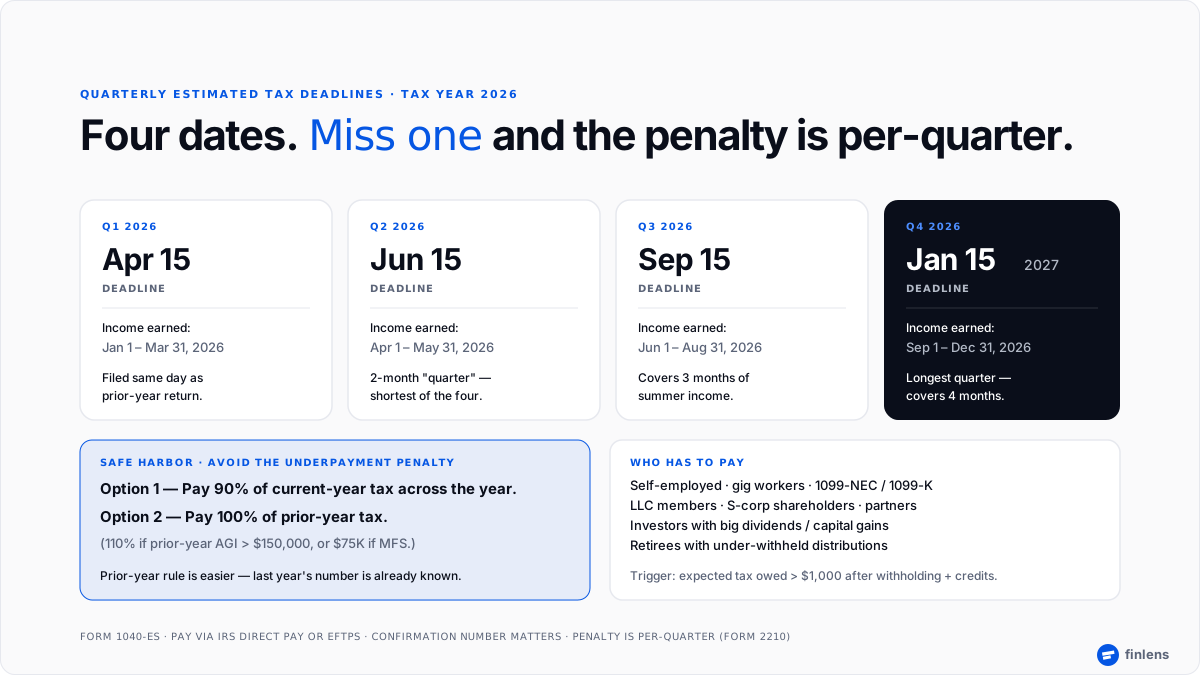
Federal quarterly estimated taxes for tax year 2026 are due on April 15, 2026; June 15, 2026; September 15, 2026; and January 15, 2027. Miss any one and IRS assesses an underpayment penalty calculated separately for each missed quarter even if annual return ultimately shows a refund.
This guide covers exact 2026 due dates, who is required to pay, safe-harbor rules that stop penalty, and how to actually submit payments.
2026 quarterly estimated tax due dates
The four federal quarterly deadlines for tax year 2026:
Note uneven quarters. Despite "quarterly" label, IRS's estimated tax periods are two months (Q2), three months (Q3), and four months (Q4). Only Q1 is a true three-month quarter. This trips up first-time payers who assume equal quarters.
If any due date falls on a weekend or federal holiday, deadline shifts to next business day. Check exact 2026 calendar April 15, 2026 falls on a Wednesday, so no shift applies to Q1.
State estimated tax deadlines are separate. Most states with income tax mirror federal quarterly schedule but not all. California, for example, has non-standard quarterly percentages. Confirm your state's schedule against state Department of Revenue. Entity returns run on a different calendar from individual estimates — the full set of corporate tax deadlines for 2026 by entity type covers C corps, S corps and partnerships.
Who has to pay quarterly estimated taxes
You are generally required to pay quarterly estimated taxes if you expect to owe $1,000 or more in federal tax for year after subtracting withholding and refundable credits AND your withholding does not cover safe-harbor thresholds (below).
Common situations that trigger requirement:
- Self-employed / sole proprietors filing Schedule C
- Independent contractors and gig workers receiving 1099-NEC or 1099-K
- LLC members filing Schedule K-1 (pass-through income)
- S-corp shareholders receiving Schedule K-1 (both wage and distribution income)
- Partnerships with self-employment tax on guaranteed payments
- Investors with significant dividend, interest, or capital-gain income beyond withholding
- Real estate investors with rental income not covered by withholding
- Retirees with pension or IRA distributions where withholding is insufficient
Situations that generally do NOT require estimated payments:
- W-2 employees whose withholding covers 90% of current year's tax (or 100% of last year's, whichever is smaller)
- Anyone expecting to owe less than $1,000 at year-end
If your only income is W-2 wages and your Form W-4 is set up properly, you almost certainly do not need to file quarterly estimates.
The safe-harbor rules that stop underpayment penalty
The IRS will not assess an underpayment penalty if you meet either of two safe harbors:
Safe Harbor 1 Current-year rule. Pay at least 90% of your current year's total tax liability through withholding + estimated payments. Split total across four quarters.
Safe Harbor 2 Prior-year rule. Pay at least 100% of last year's total tax liability through withholding + estimated payments. This rises to 110% if your prior-year adjusted gross income (AGI) exceeded $150,000 ($75,000 if married filing separately).
The prior-year safe harbor is usually easier one to meet because you already know exact number. Just take last year's total federal tax bill (line 24 on Form 1040), divide by four, and pay that amount each quarter.
Example: A self-employed consultant paid $32,000 in federal tax last year with AGI of $180,000. Because AGI exceeded $150,000, prior-year safe harbor rises to 110%. She needs to pay:
$32,000 × 110% = $35,200 per year → $8,800 per quarter
If she pays $8,800 each quarter on time, she owes no underpayment penalty even if her 2026 tax turns out to be $50,000 higher than expected. She'd owe additional tax at filing, but no penalty.
How to actually pay estimated taxes
The IRS accepts estimated tax payments through five channels:
IRS Direct Pay (recommended for most taxpayers) free, direct debit from a checking or savings account at IRS.gov/DirectPay. No account required. Confirmation number issued immediately.
EFTPS (Electronic Federal Tax Payment System) free, requires enrollment. Preferred by CPAs managing client payments because it supports scheduled payments up to a year in advance.
IRS2Go mobile app makes payments through Direct Pay or a card processor. Card payments carry a processing fee (~1.85%).
Debit or credit card via approved third-party processors. Fees apply. Not recommended for large payments due to card fees eroding value.
Check with Form 1040-ES mail payment voucher with a check. Old-school but still accepted. Postmark date counts as payment date.
Whichever method you use, keep confirmation. A missed or misapplied payment is much harder to resolve months later without proof.
Common mistakes that trigger penalty
The most common estimated-tax mistakes we see when firms review returns:
1. Only paying at year-end. Paying full amount on Q4 (January 15) does NOT retroactively cover Q1, Q2, or Q3 shortfalls. The IRS assesses penalty quarter-by-quarter.
2. Using current-year safe harbor when income is uncertain. If income spikes late in year, 90% target moves and prior quarters retroactively fall short. Use prior-year safe harbor to lock in number.
3. Ignoring self-employment tax. SE tax (Social Security + Medicare on Schedule SE) is included in federal tax for estimated-payment purposes. First-time self-employed filers often estimate income tax alone and skip ~15.3% SE tax.
4. State estimated payments overlooked. Most states with income tax have their own quarterly schedule. Missing state payments triggers state-level underpayment penalties.
5. Retirement account distributions with insufficient withholding. Early IRA/401(k) withdrawals often have inadequate withholding for actual tax rate + 10% penalty. Estimate shortfall and pay difference through quarterly estimates.
For self-employed clients and pass-through owners, tracking estimated payment obligations alongside monthly bookkeeping is one of higher-value services a CAS firm can add. The information is already in books; making it visible to client each quarter prevents underpayment penalties.
What happens if you miss a payment
The IRS assesses underpayment penalty automatically. You can compute it yourself on Form 2210 and pay it with return, or let IRS compute it and bill you.
The penalty is calculated as current federal short-term rate + 3%, applied quarter-by-quarter to underpaid amount for days it was late. For most missed payments penalty is 3–8% annualized meaningful, but not catastrophic. Larger underpayments over full quarters can accumulate materially.
The IRS may waive penalty in specific circumstances:
- Casualty, disaster, or unusual circumstances
- Retirement or disability during tax year (age 62+)
- First-year underpayment for filers with less than $1,000 owed
Otherwise, catch up on next quarterly payment but expect underpayment penalty on missed quarter.
Conclusion
Four dates: April 15, June 15, September 15, and January 15 of following year. Miss any of them and penalty is calculated quarter-by-quarter, not at year-end. The prior-year safe harbor (100%, or 110% for high-AGI filers) is simplest number to lock in for predictable payments across year.
FAQ
When are 2026 estimated taxes due?
April 15, 2026 (Q1); June 15, 2026 (Q2); September 15, 2026 (Q3); January 15, 2027 (Q4). Adjust if a date falls on a weekend or holiday.
Do I have to pay estimated taxes if I have a W-2 job?
Not usually. If your W-2 withholding covers 90% of current-year tax (or 100–110% of last year's), you meet safe harbor. Some taxpayers with side income adjust W-4 withholding to avoid quarterly payments.
What is underpayment penalty for estimated taxes?
Calculated on Form 2210. Rate is federal short-term rate + 3%, applied per quarter to underpaid amount. Typically 3–8% annualized. Assessed automatically by IRS.
Can I pay all my estimated taxes at once?
Yes, but payment applies to quarter in which you paid not retroactively. Paying full year on Q4 (January 15) still triggers penalty on Q1, Q2, and Q3 shortfalls.
How do I calculate quarterly estimated taxes?
Two approaches. Simple: take last year's total federal tax (line 24 on Form 1040) × 100% (or 110% if AGI > $150K), divide by 4. Complex: project current-year income and calculate 90% target. Most CPAs use prior-year method for predictability.
What if my income is uneven throughout year?
Use annualized income installment method on Form 2210, Schedule AI. This lets you match estimated payments to when income was actually earned. Common for seasonal businesses and freelancers with big year-end billing.
Do S-corp owners have to pay quarterly estimates?
Yes S-corp shareholders receive Schedule K-1 income that is not subject to W-2 withholding on distribution portion (only on wages). Most S-corp owners pay quarterly estimates on distribution and pass-through income.
Are state estimated taxes on same schedule?
Most states with income tax use same four dates as federal schedule, but not all. Confirm with your state Department of Revenue. Some states (California, for example) use non-standard quarterly percentages.

