
Who Makes QuickBooks? Intuit's Ownership, History, and Product Lineup (2026)


QuickBooks is made by Intuit Inc. - a US-based financial software company founded in 1983, headquartered in Mountain View, California, and publicly traded on NASDAQ under INTU. Intuit has owned and developed QuickBooks continuously since the product launched in 1992. Intuit's FY2024 revenue was approximately $16 billion across its four main product lines: QuickBooks, TurboTax, Credit Karma, and Mailchimp.
Key takeaways
- Owner: Intuit Inc. (NASDAQ: INTU) since 1992. No sale, spinoff, or divestiture ever.
- Intuit founded: 1983 by Scott Cook and Tom Proulx. The founding product was Quicken (personal finance), not QuickBooks.
- QuickBooks launched : 1992 (Desktop). QuickBooks Online launched in 2001.
- Intuit HQ: Mountain View, California. ~18,000 employees globally.
- CEO: Sasan Goodarzi (since 2019).
- Other Intuit products: TurboTax (tax prep), Credit Karma (acquired 2020 · $8.1B), Mailchimp (acquired 2021 · $12B), Intuit Enterprise Suite (launched 2024).
Who owns QuickBooks?
Intuit Inc. owns QuickBooks. The company has owned and developed the product continuously since QuickBooks launched in 1992. Intuit is a publicly traded fintech company headquartered in Mountain View, California, and trades on NASDAQ under the ticker INTU.
If you're asking because you wondered whether the product changed hands, the answer is no. No sale, no spinoff, no divestiture of the product line. The rumor cycle occasionally suggests otherwise, but Intuit has run QuickBooks continuously for over 30 years.
Who is Intuit?
Intuit is one of the largest fintech companies in the US by market capitalization.
Revenue splits across four main product lines: QuickBooks (accounting), TurboTax (consumer and business tax prep), Credit Karma (personal finance and credit scoring), and Mailchimp (marketing automation). Scott Cook remains a director as of 2026.
Intuit's scale matters for QuickBooks users because it's what funds the QBO roadmap. Bank feed integrations, AI categorization, ecosystem partnerships, and Intuit Assist (the generative AI push that started rolling into QBO in 2023) are expensive to build and maintain. A smaller vendor could not fund that work at the pace Intuit does.
A discussion on r/Accounting about whether bookkeeping is still a viable profession surfaced the related concern: as Intuit pushes AI deeper into QBO, does the ledger absorb the bookkeeper's work? Practitioner consensus in the thread was no - judgment work isn't the same as categorization work, and AI compression moves bookkeepers up the value stack rather than out.
What products does Intuit make besides QuickBooks?
Four major consumer- and business-facing products beyond QBO:
- TurboTax - consumer and small business tax preparation, launched in the 1990s, dominant US consumer tax filing product.
- Credit Karma - personal finance and credit scoring, acquired 2020 for $8.1B.
- Mailchimp - marketing automation, acquired in 2021 for $12B.
- Intuit Enterprise Suite (IES) - mid-market answer, launched 2024. Bundles QBO Advanced, Payroll, and workflow features. Targets businesses that would otherwise consider NetSuite or Sage Intacct.
What's the full QuickBooks product family in 2026?
Intuit sells QuickBooks in eight distinct product lines:
- QuickBooks Online (QBO). Flagship cloud accounting product. Five tiers from Solopreneur through Advanced. Nearly all new customers land here.
- QuickBooks Desktop. Older locally installed product. Intuit stopped selling new desktop subscriptions to most US customers in mid-2024. Existing subscribers can renew. Enterprise Solutions still sold.
- QuickBooks Online Accountant (QBOA). Free front-end for practitioners. Firms manage many client files from one login.
- QuickBooks Payroll. Separate payroll product integrated natively with QBO.
- QuickBooks Payments. Merchant processing for card and ACH payments through QBO invoices. See the QuickBooksQuickBooks Payments breakdown.
- QuickBooks Time (formerly TSheets, acquired 2018). Time tracking.
- QuickBooks Bill Pay. Intuit's A/P rail. Historically powered by Melio, increasingly built in-house.
- Intuit Enterprise Suite. The mid-market bundle launched in 2024.
When was QuickBooks founded, and how did Intuit build it?
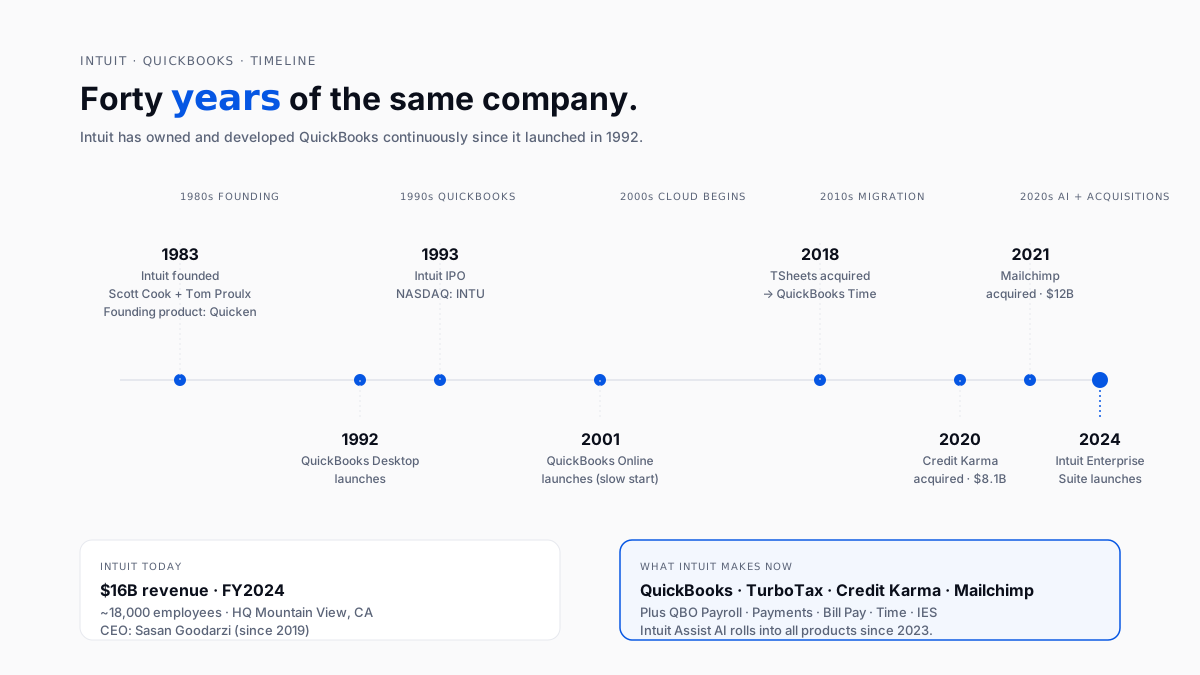
QuickBooks launched in 1992. Intuit itself was founded nine years earlier, in 1983.
- 1983 - Intuit founded by Scott Cook and Tom Proulx. First product: Quicken (personal finance).
- 1992 - QuickBooks Desktop launches. Pitch was accessibility: an owner without an accounting degree could run their books.
- 1993 - Intuit IPOs on NASDAQ under INTU.
- 2001 - QuickBooks Online launches. Slow initial adoption because bandwidth and browsers weren't there yet.
- 2010s - Desktop-to-Online migration decade. QBO becomes Intuit's dominant SKU by 2020.
- 2018 - TSheets acquired → renamed QuickBooks Time.
- 2020 - Credit Karma acquired for $8.1B.
- 2021 - Mailchimp acquired for $12B.
- 2023 - Intuit Assist (generative AI) starts rolling across all Intuit products.
- 2024 - Intuit Enterprise Suite launches. Intuit stops selling new desktop subscriptions to most US customers.
Is the AI in QuickBooks made by Intuit?
Yes. Intuit built and rolled out Intuit Assist, the generative AI layer inside QuickBooks Online.
Intuit Assist in QBO covers three main areas:
- Suggested categorizations for the bank feed
- Invoice writing assistance
- Chat interface that summarizes the state of the books
Genuine improvements on what QBO offered before. Delivered as part of the subscription at no additional cost.
The accuracy gap between built-in AI and specialized third-party AI is still real, especially for firms managing many client files. Intuit's AI has to generalize across every industry, every chart of accounts, and every business size. A specialized layer that learns one firm's specific chart, client patterns, and reconciliation logic hits accuracy the general model can't match.
Bookkeepers on r/Bookkeeping asking how to find clients outside Fiverr and Upwork touched on the related economic point: as AI compresses routine categorization work, bookkeepers who differentiate on advisory and industry specialization win. Bookkeepers who compete on data entry lose. See AI accounting vs. traditional bookkeeping for the practitioner shift.
Firms operating at meaningful scale (30+ client files) typically add a dedicated AI layer on top of QBO because ROI on categorization time recovery is faster than any alternative software investment. See the AI layer for the QuickBooks pattern.
Is Intuit the same company that makes TurboTax and Credit Karma?
Yes. All three products are Intuit Inc.
- TurboTax - consumer and small business tax preparation product, launched in the 1990s.
- Credit Karma - personal finance and credit scoring product, acquired 2020 for $8.1B.
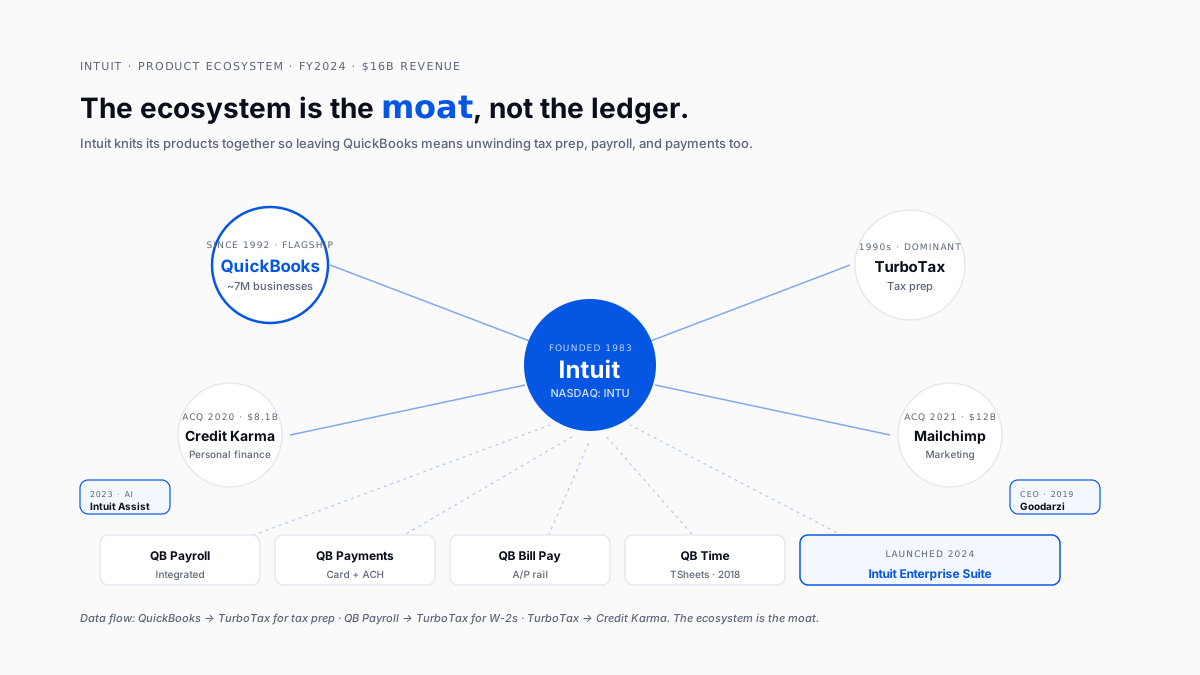
The reason this matters for QuickBooks users is data flow. Intuit has spent years knitting these products together:
- QuickBooks → TurboTax for tax prep
- TurboTax → Credit Karma for financial recommendations
- QuickBooks Payroll → TurboTax for W-2 filings
The ecosystem lock-in is real. Part of why leaving QuickBooks feels harder than the ledger alone would suggest.
A discussion on r/smallbusiness about whether QuickBooks is actually good captured the small business owner's version of the same point: even owners who dislike QBO recognize that switching means unwinding not just the ledger, but the tax prep flow, the payroll integration, and the accountant's familiarity. The ecosystem is the moat.
What does Intuit ownership mean for the QuickBooks roadmap?
Four practical implications for a bookkeeper or firm evaluating QBO for the next five years:
- Pricing power. Intuit has raised QBO prices consistently for five years. No market force is pushing back hard enough to stop them. Assume list prices drift up 5-10% annually.
- Ecosystem depth. Investment in Payroll, Payments, Bill Pay, and Enterprise Suite means QBO customers get pulled into more Intuit products over time. Good for firms wanting a bundled stack, bad for best-of-breed shoppers.
- AI investment. Intuit is one of the few accounting software vendors with capital to fund serious AI. Intuit Assist keeps improving. Good news for owners doing their own books.
- Specialization gap. General-purpose AI in Intuit Assist won't match specialized third-party AI for firms handling many books. Gap is durable. Adding a specialized layer beats waiting for the general AI to catch up. See the AI layer for the QuickBooks pattern.
Conclusion
QuickBooks is made by Intuit, and that's been true for over 40 years. What's changed in that time is what Intuit is. The 1990s Intuit was a small business accounting company. In the 2010s, Intuit was accounting-plus-tax. The 2020s Intuit is a small business fintech operating system, and QuickBooks is the ledger anchoring it. For a firm evaluating QBO for the next five years, understanding what Intuit is explains why pricing keeps going up, why the ecosystem keeps getting deeper, why the AI keeps improving, and why the specialized third-party layer on top (whether that's an AI categorization tool for QBO or a dedicated close automation tool) tends to be the sensible investment rather than switching platforms.
FAQ
Who owns QuickBooks?
Intuit Inc., a publicly traded fintech company headquartered in Mountain View, California. Intuit has owned QuickBooks since 1992. Trades on NASDAQ under INTU.
Is Intuit the same as QuickBooks?
Intuit is the company. QuickBooks is one of its products. Intuit also makes TurboTax, Credit Karma, and Mailchimp.
When was Intuit founded?
Intuit was founded in 1983 by Scott Cook and Tom Proulx. Founding product was Quicken (personal finance), not QuickBooks. QuickBooks launched in 1992.
Where is Intuit headquartered?
Mountain View, California. Major offices in San Diego, Bangalore, and several other US cities.
Who is the CEO of Intuit?
Sasan Goodarzi has been CEO since 2019. He took over from Brad Smith.
Is QuickBooks American or Canadian?
Intuit is a US company and QuickBooks is a US-designed product. Intuit sells localized QuickBooks versions in Canada, the UK, Australia, and other markets, but parent company and primary product development are US-based.
Has QuickBooks ever been sold or spun off?
No. Intuit has owned and operated QuickBooks continuously since 1992. No sale, spinoff, or divestiture of the product line.
Does Intuit make the AI in QuickBooks?
Yes. Intuit built and rolled out Intuit Assist, the generative AI layer inside QuickBooks Online. Third-party AI layers like Finlens exist alongside Intuit Assist for firm-scale workflow but sit on top of QBO rather than inside it.
Is Intuit a good stock?
Investment question outside this article's scope. As of 2026, INTU trades on NASDAQ. Nothing in this piece is investment advice.

