
How to Reconcile Bank Statements 10x Faster


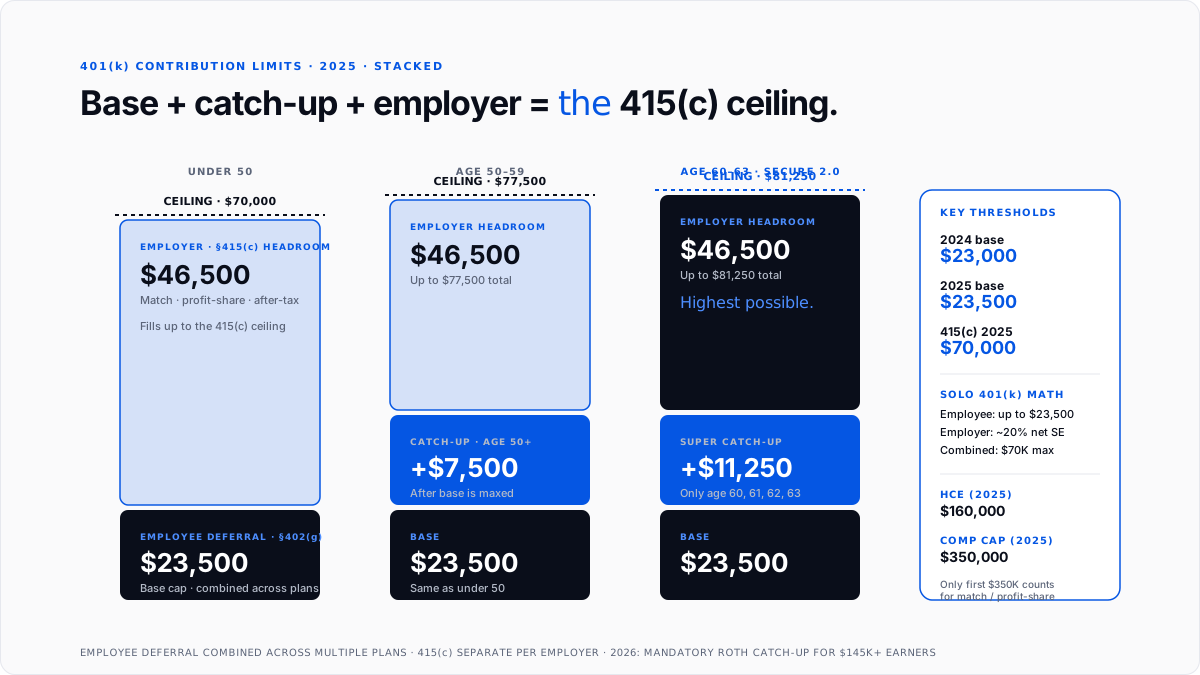
The 401(k) employee elective deferral limit is $23,000 for 2024 and $23,500 for 2025 plus a $7,500 catch-up if you're age 50 or older. For 2025 only, filers aged 60–63 get a new SECURE 2.0 "super catch-up" of $11,250 instead of $7,500. And total combined limit (your deferral + employer contributions + Roth 401(k) + after-tax) tops out at $69,000 in 2024 and $70,000 in 2025 under IRC §415(c) which is ceiling most self-employed Solo 401(k) users care about.
This guide covers all 2024/2025 limits, SECURE 2.0 super catch-up, difference between elective deferral cap and total 415(c) cap, and Solo 401(k) math for self-employed.
The 2024 and 2025 limits at a glance
Per IRS Notice 2024-80 and SECURE 2.0 statutory rules:
The two ceilings elective deferral vs. total contribution
The 401(k) system has TWO limits that most filers confuse:
1. Elective deferral (§402(g)) $23,000 / $23,500. This is maximum YOU (employee) can defer from your paycheck. Applies across ALL 401(k), 403(b), and most 457(b) plans combined if you have two jobs with two 401(k)s, your total employee deferral across both plans still can't exceed limit.
2. Total contribution (§415(c)) $69,000 / $70,000. This is maximum total that can go into your 401(k) account in one year: employee deferral + employer match + employer profit sharing + after-tax contributions (if plan allows). Each employer gets its own separate §415(c) limit if you work two W-2 jobs at different companies, you have two separate $69K ceilings.
Example W-2 employee at one company, age 45:
- Employee deferral: $23,000
- Employer 5% match: ~$5,000
- Total in account: $28,000 well under $69,000 total cap
Example Solo 401(k), sole proprietor age 45, net SE earnings $150,000:
- Employee deferral: $23,000 (max)
- Employer contribution: ~20% of net SE = ~$27,500
- Total: ~$50,500 still under $69,000 415(c) cap
Example Solo 401(k), sole proprietor age 55, net SE earnings $400,000:
- Employee deferral: $23,000
- Age-50 catch-up: $7,500
- Employer contribution: capped so total = $76,500 → employer piece = $46,000
- Total: $76,500 hits combined 415(c) + catch-up ceiling
The SECURE 2.0 super catch-up (2025+)
Starting in 2025, filers aged 60, 61, 62, or 63 (four specific ages) get an enhanced catch-up:
Regular catch-up (age 50+): $7,500 Super catch-up (age 60–63 only, 2025): $11,250
At age 64+, you revert to regular $7,500 catch-up. This is one of more unusual provisions in SECURE 2.0 a four-year window where catch-up is 150% larger than normal.
Combined for a 62-year-old in 2025:
- $23,500 base deferral + $11,250 super catch-up = $34,750
- Plus employer contribution up to $81,250 combined 415(c) + super catch-up ceiling
Solo 401(k) math for self-employed savers
Solo 401(k) plans (single-participant 401(k) for owner-only businesses) let a sole proprietor act as BOTH employee and employer, hitting much higher limits than a SEP-IRA or SIMPLE IRA:
Employee contribution: Up to $23,000 / $23,500 (same as any employee) Employer contribution: Up to 25% of "net self-employment earnings" (which for a sole prop is calculated after deduction for half of self-employment tax) Combined cap: $69,000 / $70,000 total
The 25% "employer" contribution rate looks generous but works out to ~20% of net SE earnings after circular calculation adjustment. Most Solo 401(k) providers handle this iteration automatically.
Roth Solo 401(k): The employee portion (up to $23K/$23.5K) can be Roth, but employer portion must be traditional (pre-tax). Post-SECURE 2.0, plans can now offer Roth employer contributions too, but this is optional and not all Solo 401(k) providers have implemented it.
Solo 401(k) beats SEP-IRA for most sole proprietors netting over ~$100K because employee deferral adds ~$23K on top of same 25% employer contribution. See our IRA contribution limit guide for SEP and SIMPLE alternatives.
Roth 401(k) vs. Traditional 401(k)
Almost every 401(k) plan now offers a Roth option alongside traditional pre-tax option:
Traditional 401(k):
- Contributions reduce current-year taxable wages (Box 1 of W-2)
- Growth is tax-deferred
- Withdrawals taxed as ordinary income
- RMDs begin at age 73
Roth 401(k):
- Contributions are post-tax (no current-year deduction; Box 1 wages unchanged)
- Growth is tax-free
- Qualified withdrawals tax-free
- Post-SECURE 2.0: no RMDs during owner's lifetime (starting 2024)
The same $23,000/$23,500 combined employee deferral limit applies across both you can split between Traditional and Roth, but total can't exceed cap.
Mandatory Roth catch-up rule (2026): SECURE 2.0 requires that anyone earning more than $145,000 (2023 wages, indexed) MUST make catch-up contributions to Roth 401(k) rather than pre-tax, starting in 2026. This was originally set for 2024 but IRS delayed enforcement. For 2025, high earners can still choose pre-tax catch-up.
Highly Compensated Employee (HCE) rules
HCE threshold (2024): $155,000 in prior-year compensation. 2025: $160,000.
HCE status matters for 401(k) plan nondiscrimination testing. Small companies with lots of HCEs and few rank-and-file employees may fail testing, which forces HCE deferrals to be capped or refunded. Common workarounds:
- Safe Harbor 401(k) employer commits to a minimum matching/profit-sharing formula in exchange for automatic passage of nondiscrimination tests
- QACA (Qualified Automatic Contribution Arrangement) auto-enrollment version of Safe Harbor with slightly different rules
For most Fortune 500 employers, HCE testing is routinely passed. For small businesses with founder-heavy comp, it's a real concern.
The compensation cap §401(a)(17)
The compensation cap of $345,000 (2024) / $350,000 (2025) limits how much compensation counts toward retirement plan contributions. If you earn $600,000, only first $345,000 is used to compute your employer match, safe-harbor contribution, or profit-sharing allocation.
This mostly affects executives at companies with generous 401(k) formulas. For rank-and-file employees, it's a non-issue.
When and how contributions are made
Employee elective deferral: Withheld from paychecks throughout year. You can adjust percentage anytime through your employer's HRIS or plan portal.
Employer match / profit-sharing: Typically deposited quarterly, monthly, or after year-end. Deadline: employer's federal tax return due date (plus extensions).
Solo 401(k): Employee portion by December 31 of plan year; employer portion by sole prop's federal tax deadline (April 15 plus extensions).
Catch-up: Same schedule as regular deferrals. Requires you to reach base limit ($23K/$23.5K) BEFORE catch-up contributions are treated as catch-up.
Excess deferral penalty: If you exceed elective deferral limit (across multiple employers), excess is included in current-year income AND grows tax-free until withdrawn a double-tax problem. Notify your plan administrator by March 1 following tax year to have excess distributed by April 15.
Common 401(k) contribution mistakes
Missing true-up match. Some plans match "per pay period" rather than "annual" front-loading your contributions can cost you employer match dollars. Check your plan document; a "true-up" provision restores what you missed.
Contributing above elective deferral cap at multiple jobs. Two jobs' 401(k)s combined can't exceed $23,000 total employee deferral. Track your YTD deferral if you change jobs mid-year.
Not maxing before age 50 catch-up. Catch-up is only available after you've hit base limit. Your first $23,000/$23,500 counts as regular; deferrals past that are catch-up.
Confusing 401(k) with IRA. Different limits, different accounts, different phase-out rules. You can max both IRA $7,000 + 401(k) $23,000 = $30,000/year in retirement savings.
Solo 401(k) not established by December 31. For self-employed savers, plan must exist by December 31 of tax year (though contributions can be made until tax-filing deadline). Waiting until March to open a Solo 401(k) means you missed prior year.
Rolling over Traditional 401(k) to Roth IRA without planning taxes. Roth conversions are fully taxable in year converted. A $200K rollover in one year can push you into a much higher bracket.
Conclusion
$23,500 employee deferral + $7,500 catch-up (or $11,250 super catch-up if you're 60–63) + up to $70,000 combined for 2025 those are numbers to know. The elective deferral cap is per-person across all plans; 415(c) cap is per-employer. Solo 401(k) uses both to give self-employed savers highest limits in tax code.
.png)
Frequently asked questions
Do employer matching contributions count against my $23,000 limit?
No. Employer contributions count only against the $69,000/$70,000 combined 415(c) limit not against your personal $23,000/$23,500 elective deferral cap.
Can I contribute to a 401(k) and an IRA in the same year?
Yes. Different limits, different rules. Max both for $30,000+ in retirement savings.
When can I withdraw from a 401(k) without penalty?
Age 59½ generally. Age 55+ if separating from employer ("rule of 55"). Also: hardship withdrawals, death, disability, or SEPP (72(t)) distributions.
Are 401(k) contributions subject to FICA?
Traditional 401(k) contributions reduce Box 1 wages (federal income tax) but NOT Box 3/5 wages (Social Security and Medicare). Roth 401(k) contributions don't reduce Box 1 either.
What's the max 401(k) contribution for a highly paid founder?
With a combined 415(c) limit, employee deferral + employer contribution + catch-up can push a 60-63-year-old founder to $81,250 in 2025, plus profit-sharing and after-tax contributions can go higher if the plan supports it.
Can I do a mega backdoor Roth 401(k)?
If your plan allows after-tax contributions AND in-plan Roth conversion, yes. Contribute up to 415(c) limit ($69K/$70K), some as after-tax, then convert to a Roth 401(k) or Roth IRA. Availability depends on plan design.
Does my Solo 401(k) have an employee match?
No, you ARE employer AND employee. The "employer" contribution is a discretionary amount you decide as sole owner, not an automatic match.
What if I have both a Solo 401(k) and a W-2 job with a 401(k)?
The employee deferral cap of $23K/$23.5K is combined across both plans. But the employer/415(c) cap is separate at each employer, so total possible retirement savings across both plans can exceed $100K/year.

