
The QuickBooks ProAdvisor certification path guide (2026)


This is a working reference for bookkeepers, accountants, and firm owners preparing for QuickBooks Online ProAdvisor certification. Every requirement, exam detail, and tier threshold is sourced to Intuit's own documentation, the ProAdvisor program pages, or a real thread on the QuickBooks Community. Numbers cited from third-party training providers are flagged as external estimates.
The problem this guide addresses
Two decisions drive most ProAdvisor conversations in 2026.
The first is whether to certify at all. Certification is free, includes free training, and unlocks the Find-a-ProAdvisor directory listing at higher tiers. But the exam takes 12–16 hours of study,study and re-certification is annual. For an accountant already deep in QBO, the ROI is obvious; for a bookkeeper still learning, the study time is a real cost. The Firm of the Future recertification page sets the 2026 exam window as April 28 through June 30, 2026 - miss it, and re-certification waits another year.
The second is tier climbing. The ProAdvisor Program uses a points-based tier system with four levels - Silver, Gold, Platinum, Elite - where the Find-a-ProAdvisor directory listing only appears at Gold and above, and ProConnect Tax discounts scale from 35% to 45% depending on tier. Points come from client subscriptions, certifications, and program participation. Firms that don't plan tier growth end up at Silver with no directory visibility despite years of QBO work. The Intuit ProAdvisor Program page is the canonical reference for the tier map.
The sections below cover what the ProAdvisor program actually is, the certification tracks and exam structure, tier thresholds and how points are earned, benefits at each tier, the Find-a-ProAdvisor directory rules, annual re-certification, the announced 2027 ProPartner transition, and how firms sequence their certification investment against client acquisition.
What ProAdvisor actually is
ProAdvisor is Intuit's free program for accountants and bookkeepers serving small-business clients on QuickBooks Online. Every ProAdvisor gets a QBOA account, free training, free certification exams, and access to the ProAdvisor tier benefits. The firm-side operational picture on QBOA sits alongside broader firm tooling covered in the best accounting firm software for 2026 write-up.
The program has two independent tracks that stack. The certification track is skill-based - pass exams to earn Certified or Advanced Certified status per product. The tier track is points-based - earn points through client subscriptions, certifications, and program engagement to move up the Silver → Gold → Platinum → Elite ladder. A partner can be Advanced Certified on QBO but only Silver-tier because they have few clients; another partner can be at Platinum without holding Advanced Certification because they manage 50 client subscriptions.
Every ProAdvisor benefit is stacked on top of QBOA membership. There is no separate sign-up for ProAdvisor beyond creating the QBOA account.
The certification tracks
Intuit offers ProAdvisor certification in several products. The two most common:
QuickBooks Online Certified. The core certification. Covers QBO setup, invoicing, expenses, banking, reports, and standard workflows. Prerequisite for every other QBO-related certification.
QuickBooks Online Advanced Certified. Second-tier certification. Covers QBO advanced-specific features (custom user roles, workflows, batch actions, custom reports, and revenue recognition) plus deeper accounting mechanics. Requires holding the Core certification first.
Additional certifications available:
QuickBooks Desktop Certified. For firms still supporting desktop clients. Intuit's Desktop certification article covers the workflow.
QuickBooks Payroll Certified. For firms running client payroll on QBO Payroll. Separate exam covering payroll setup, tax filings, and year-end.
Enterprise Certified. For firms supporting QuickBooks Desktop Enterprise clients. Separate from Desktop Certified - Enterprise-specific features like Advanced Inventory and industry editions.
ProConnect Tax Certified. For firms using Intuit's cloud tax software. Not required for QBOA usage but unlocks additional ProAdvisor points and directory visibility.
Every certification is free - the exam, the training modules, and the official study materials all come through QBOA at no cost. Third-party prep courses ($100–$300 self-paced, $700–$1,000+ instructor-led) are optional and not required for exam success.
The exam structure
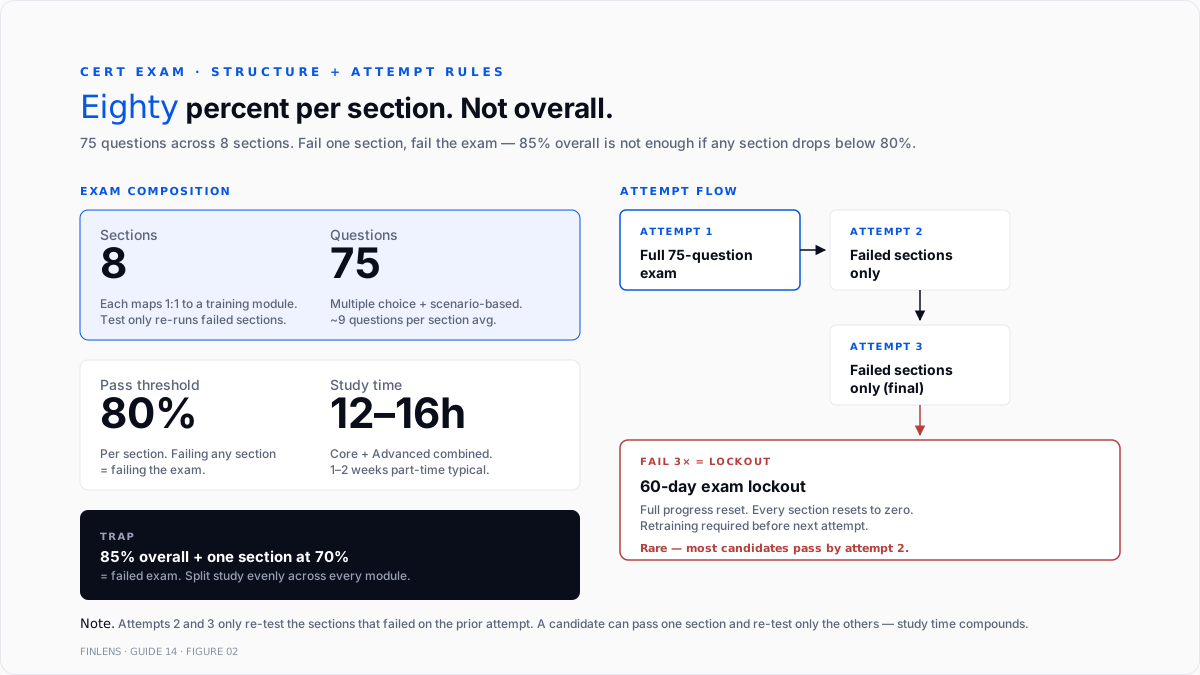
The QBO Core certification exam breaks down as follows:
- 8 sections, each covering one training module
- 75 questions total across the eight sections
- 80% passing score required per section (not overall)
- Up to 3 attempts to pass the entire exam
- After the first attempt, subsequent attempts only retest the sections the candidate failed
- 60-day lockout after 3 failed attempts, with full progress reset
- Estimated study time: 8–12 hours for the Core, 10–15 additional hours for the Advanced
The 80%-per-section rule is the primary trap. A candidate who scores 85% overall but 70% on one section fails that section and has to retake it. Splitting study time evenly across every module - rather than deep-diving one area - is the most reliable prep approach.
The advanced exam adds:
- Similar section structure with deeper QBO Advanced-specific content
- Requires passing the core exam first
- More scenario-based questions (multi-step reconciliation, complex invoicing patterns, custom user role setup)
The Community thread on passing the Advanced exam covers common failure patterns - most candidates fail on Advanced Reporting and Custom User Role questions.
The tier system - how points work
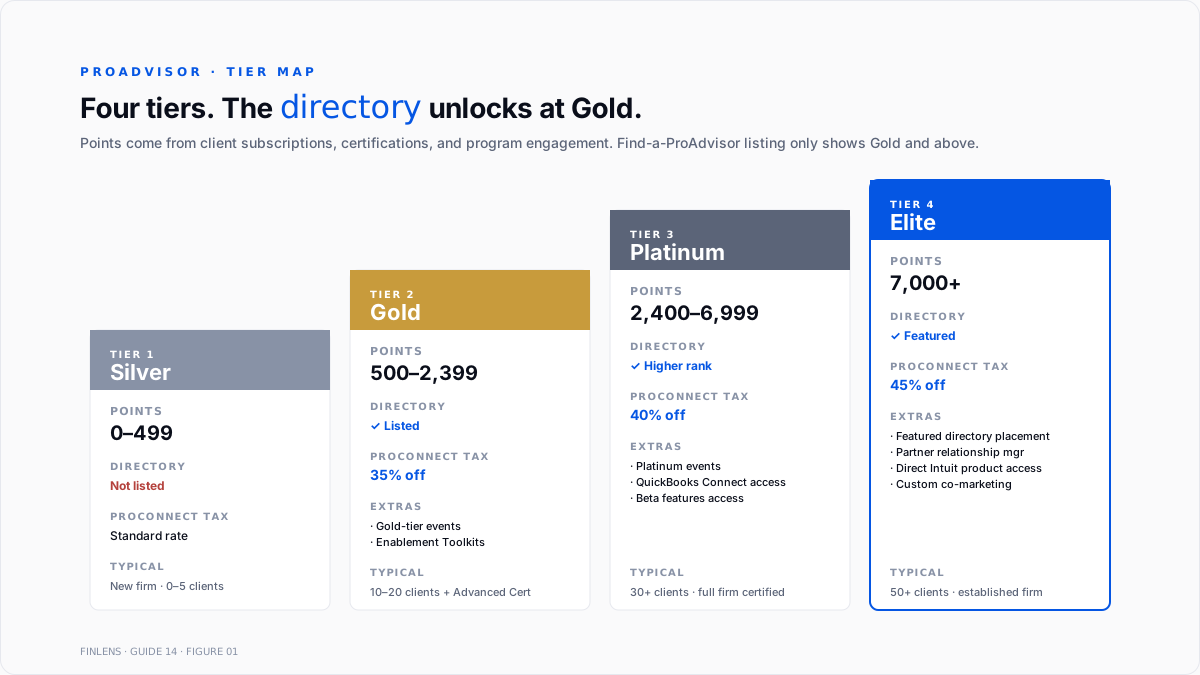
The ProAdvisor tier system uses cumulative points earned through client subscriptions, certifications, and program engagement. The four tiers, per Intuit's ProAdvisor Program page and the Firm of the Future tier breakdown:
Point tables have varied across recent program updates - check the current values in the QBOA ProAdvisor Program dashboard before planning tier goals.
Points are earned in three main ways:
Client subscriptions. Roughly 50 points per active client QBO subscription billed through the firm's wholesale account. Payroll subscriptions add points on top.
Certifications. 100 points instantly on passing the core exam. Additional points for Advanced Certified, Desktop Certified, Payroll Certified, and Enterprise Certified. Points refresh on annual re-certification - letting a certification lapse forfeits the points.
Program engagement. Attending ProAdvisor training webinars, completing Enablement Toolkits, participating in the annual QuickBooks Connect conference, and completing Client Advisory Services training all add smaller point counts.
The compounding pattern: a firm at 10 clients earns ~500 points from subscriptions alone plus 100–300 from certifications, comfortably hitting Gold. A firm with 30 clients with the partner + a senior both Advanced Certified is Platinum or on the edge. Elite tier realistically requires 50+ managed subscriptions.
The benefits by tier
Every tier includes the base ProAdvisor benefits - free QBOA, free certification exams, and free training. Additional benefits stack per tier:
Silver (all ProAdvisors). QBO Advanced is free for the firm's own books. QuickBooks Workforce Elite free for the firm's payroll. Digital ProAdvisor badge for websites and email signatures. Enablement Toolkits (client-engagement templates, marketing copy). Access to Priority Care support routing.
Gold. Everything in Silver Plus Find-a-ProAdvisor directory listing (the largest single benefit for firms doing new-client acquisition). 35% ProConnect tax discount. Higher-tier discounts on QuickBooks Time, Mailchimp, and rotating third-party partners. Access to Gold-tier training and events.
Platinum. Everything in Gold plus a 40% ProConnect tax discount. Higher directory ranking in Find-a-ProAdvisor results. Exclusive Platinum-tier events (annual QuickBooks Connect access, regional partner events). Access to program-early features and product beta programs.
Elite. Everything in Platinum plus a 45% ProConnect tax discount. Featured placement in Find-a-ProAdvisor (top of local search results). Direct access to Intuit product managers and roadmap input. Custom co-marketing opportunities. Enterprise-level partner relationship manager assigned.
For a firm choosing which tier to target, the pragmatic answer is Gold as the first goal (directory listing unlocks new-client visibility) and Platinum as the second (deeper Intuit discounts + partner events). Elite is a stretch goal for firms with 50+ managed subscriptions.
The Find-a-ProAdvisor directory
Find-a-ProAdvisor is Intuit's public directory of certified ProAdvisors at quickbooks.intuit.com/find-a-proadvisor. Small businesses searching for QuickBooks-proficient bookkeepers land here.
The mechanics:
- Directory listing requires Gold tier or above (as of the current program version)
- Search is by ZIP code, service type, industry, and QuickBooks product expertise
- Each ProAdvisor has a profile with certification badges, industries served, and (for Gold+) client testimonials
- Ranking is a combination of tier level, proximity to the searcher, and profile completeness
- Intuit's Find-a-ProAdvisor profile setup article covers the profile fields
For firms doing new-client acquisition, the directory is often the single largest reason to push past Silver into Gold. Anecdotal reports from firms hitting Gold cite 3–10 inbound leads per month from directory searches - variable by geography and specialty.
Annual re-certification
Every ProAdvisor certification requires annual renewal as Intuit updates QBO features. The renewal exam is shorter than the initial certification exam (typically 20–40 questions covering the year's product changes), but the 80%-per-section rule still applies.
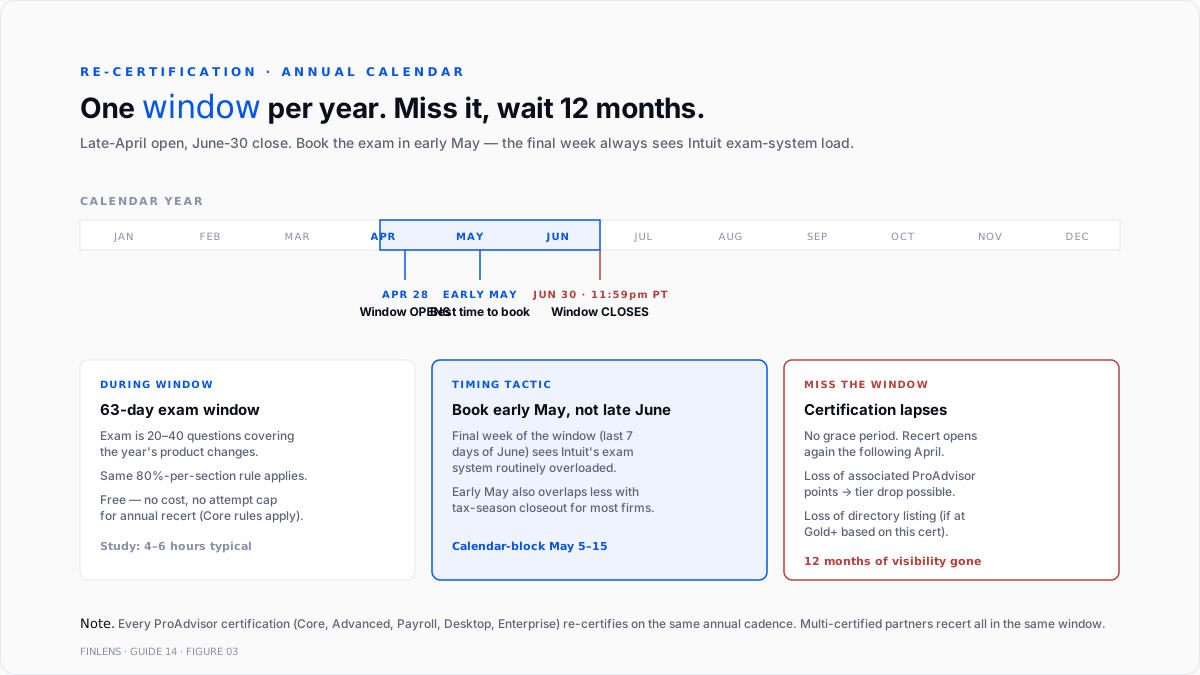
Standard renewal timing:
- The exam window opens. Typically late April each year (2026 opens April 28)
- The exam window closes. June 30 at 11:59 PM PT
- Miss the window. Certification lapses. Recertification opens again in the following April
- Grace period. None. A lapsed certification means loss of directory listing (if the ProAdvisor was at Gold+ based on that certification) and loss of the associated points
The May–June exam window overlaps tax season closeout for many firms. Book the exam early in the window (early May) rather than waiting until the final week when Intuit's exam system typically experiences load.
The 2027 ProPartner transition
Intuit announced that the ProAdvisor Program will transition to a new ProPartner Program in early 2027. The Firm of the Future ProPartner announcement covers the change.
The new tier structure will replace Silver/Gold/Platinum/Elite with:
- Member - base tier equivalent to today's Silver
- Partner - equivalent to Gold
- Preferred Partner - equivalent to Platinum
- Premier Partner - new tier between Platinum and Elite
- Elite Partner - top tier equivalent to today's Elite
Existing ProAdvisor tier positions will map to ProPartner tiers at transition. Firms planning long-term should watch for the official mapping table Intuit releases closer to launch - the point thresholds are expected to shift slightly under the new program.
Until the transition, the ProAdvisor Program remains fully active and worth investing in. Certification earned in 2026 counts toward 2026 tier standing and carries over to the ProPartner mapping in 2027.
Where certification stops mattering
Three cases where more certification does not improve firm outcomes:
The firm is already at Platinum with saturated client capacity. Additional certifications earn incremental points that push toward Elite, but if the firm cannot take on more clients (Elite typically requires 50+ managed subscriptions), the marginal return on certification study time is low.
Certification not aligned to actual work. A firm that does no desktop work does not need desktop certification. A firm that does not do payroll does not need to be payroll certified. Points from unused certifications count toward tier climbing but don't build actual client capability.
Solo bookkeeper serving 3–5 stable clients. Core certification is worth the time. Advanced Certified adds directory ranking + credibility but rarely converts to new engagements at that scale. Tier climbing past Silver requires client volume the firm does not have - the boost CPA firm efficiency write-up covers where automation pays back before more clients arrive.
At those points, the fix is not more certification - it is aligning the firm's growth stage with the tier tier target that actually pays back.
The Finlens approach
Finlens is an AI accounting platform for QBO firms. Certification is a personal credential, not something a software layer can automate away. Where Finlens fits alongside certification:
- Firm capacity expansion at the tier boundaries. Firms at Silver targeting Gold need 500 points, typically 8–10 additional managed client subscriptions. Finlens automates the per-client workflow (categorization, close, prep for taxes) so a firm can take on those additional clients without adding headcount - the pattern covered in the increase accounting firm capacity write-up.
- Multi-client Prep for Taxes rollup across every client so year-end tax prep - the busiest ProAdvisor season - runs in one workflow rather than per-client, freeing partner time for the client acquisition that drives tier growth.
- Aggregated Books Review across every client in the firm's book, matching the multi-client mental model that QBOA + ProAdvisor certification prepares partners to use at scale.
The features that keep firm growth accurate - rather than just automated - are the ones surrounding the certification investment:
- Standardized close checklist per client type so newly-onboarded clients follow the same workflow every certified team member is trained on.
- Human-in-the-loop review gates every AI proposal through the assigned team member, matching the review discipline expected of a Certified ProAdvisor.
- Multi-client dashboard aggregates book review status, categorization coverage, and prep for taxes readiness so partners see the entire book at a glance.
For a firm using ProAdvisor certification to sustain growth past 30 clients, the firm platform automates the per-client workflow so certification pays back in client capacity. For a solo Certified ProAdvisor running a single-controller book, the founder-facing product handles the same automation at company scale. Book a 20-minute walkthrough: cal.com/finlens/intro.
The verification checklist
- QBOA account created and firm profile completed with all certification badges.
- Core certification passed within the current 12-month window.
- Advanced Certification target date set on the firm's calendar for the current exam window.
- Payroll Certified is pursued if the firm serves payroll clients.
- Desktop Certified is pursued if the firm supports Desktop or Enterprise clients.
- Current ProAdvisor tier documented and next-tier point gap calculated.
- Find-a-ProAdvisor profile complete and current (if at Gold+).
- Recertification dates on the firm's calendar 60 days before the exam window closes.
- Team members individually certified (points do not transfer between people - each team member earns points on their own certifications).
For a firm scaling client count while managing ProAdvisor tier climbing, the firm platform handles the workflow automation that lets certified partners grow without hiring. Book a 20-minute walkthrough: cal.com/finlens/intro.
Conclusion
ProAdvisor certification is the credential; tier climbing is the market signal. Certification is free and unlocks credibility. Tier climbing is where directory visibility, ProConnect discounts, and Intuit partner access actually pay back. Firms that treat both tracks as one investment - certify the whole team, drive client subscriptions through wholesale billing, and keep every certification current - end up at Platinum with the directory visibility, tax-prep discounts, and partner access that compound into more clients.
The failure mode is treating certification as a one-time achievement. Every certification expires annually. Every lapse means points forfeited and directory ranking dropped. Firms that build recertification into the annual calendar - same way tax deadlines are built in - keep tier standing intact. Firms that treat it as optional slide back to Silver and lose the directory lead flow that funded the certification investment in the first place.
.png)
FAQ
Whether QuickBooks ProAdvisor certification costs anything?
No. Both the Core and Advanced ProAdvisor certification exams are free through a QBOA account. Training modules, official study materials, and re-certification exams are also free. Third-party prep courses ($100–$1,000+) are optional and not required.
How long the certification exam takes?
Estimated study time is 8–12 hours for Core and an additional 10–15 hours for Advanced. Most candidates pass within 1–2 weeks of part-time study or a few days of full-time study. The exam itself takes 2–3 hours to complete.
Whether ProAdvisor certification expires?
Yes. Annual re-certification is required. The exam window typically opens late April and closes June 30 each year. Lapsed certifications forfeit associated points and (for the Gold+ tier) the Find-a-ProAdvisor directory listing.
The difference between ProAdvisor tiers and certification levels?
Certification is skill-based (pass an exam to earn Certified or Advanced Certified per product). Tier is points-based (accumulate points through client subscriptions, certifications, and program engagement to move up Silver → Gold → Platinum → Elite). A ProAdvisor can be Advanced Certified but only Silver tier or Platinum tier without Advanced Certified - the tracks are independent.
Whether the Find-a-ProAdvisor directory drives real leads?
Yes for Gold+ partners, anecdotally. Firms hitting Gold report 3–10 inbound leads per month from directory searches. Variable by geography, specialty, and profile completeness. Silver-tier ProAdvisors do not appear in the directory.
Realistic path from Silver to Gold?
For a firm at 5 managed client subscriptions with the partner Core Certified, passing Advanced Certification (adds points), adding 5–7 more clients (adds ~250–350 points from wholesale subscriptions), and completing Enablement Toolkits (adds smaller points) typically hits the Gold threshold within 3–6 months of focused effort.

