
Accrued Revenue: Rules, Examples and Common Mistakes


What Is Accrued Revenue?
Accrued revenue is income recognized on the income statement for work completed or goods delivered, even though the client hasn't been billed and no cash has changed hands.
Under accrual accounting, revenue is recorded when it is earned, not when it is received. Another common case: a CPA firm completes a $4,500 tax preparation engagement on March 25 but doesn't invoice until the batch billing run on April 2. The $4,500 is accrued revenue in March. That principle is the foundation of GAAP. Accrued revenue is what makes that principle work in practice.
A simple example: your client is a law firm. They complete 20 hours of work for a corporate client in March but won't invoice until April. Under accrual accounting, those 20 hours represent earned revenue in March, regardless of when the invoice goes out.
According to Investopedia, accrued revenue most commonly appears in service businesses, long-term contracts, and subscription models where billing cycles don't align with service delivery.
Accrued Revenue vs Accounts Receivable: What Is the Difference?
This is the confusion that causes most of the errors, and most of the tense month-end conversations.
They are not the same thing, and treating them like they are is how balance sheets get messy.
Accounts receivable exists after you have sent an invoice. The client owes you money and there is a document recording that obligation.
Accrued revenue exists before the invoice. The work is done, the revenue is earned, but no billing document exists yet.
Both sit on the asset side of the balance sheet. Both represent money owed. But the trigger is completely different:
- Accrued revenue: work completed, no invoice sent yet
- Accounts receivable: invoice sent, payment not yet received
The moment you send the invoice, you debit accounts receivable and credit accrued revenue to clear the entry. That's the step most people skip without realizing it.
Accrued revenue vs. deferred revenue
These two are opposites. They get confused because both involve timing gaps between cash and revenue, but they sit on different sides of the balance sheet.
The simplest test: did you do the work before getting paid? That's accrued revenue. Did you get paid before doing the work? That's deferred revenue. For the full breakdown of how deferred revenue works as a liability, see what is deferred revenue.
How Do You Record Accrued Revenue?
The journal entry has two steps.
Step 1: Record the accrual at the end of the period when work is completed:
- Debit: Accrued Revenue (asset)
- Credit: Revenue (income)
Step 2: Reverse when the invoice is sent:
- Debit: Accounts Receivable
- Credit: Accrued Revenue
Step 3: Record cash collection when the client pays:
- Debit: Cash
- Credit: Accounts Receivable
Continuing the example - the client pays the $15,000 invoice on April 28:
April 28 entry: Debit Cash $15,000 / Credit Accounts Receivable $15,000
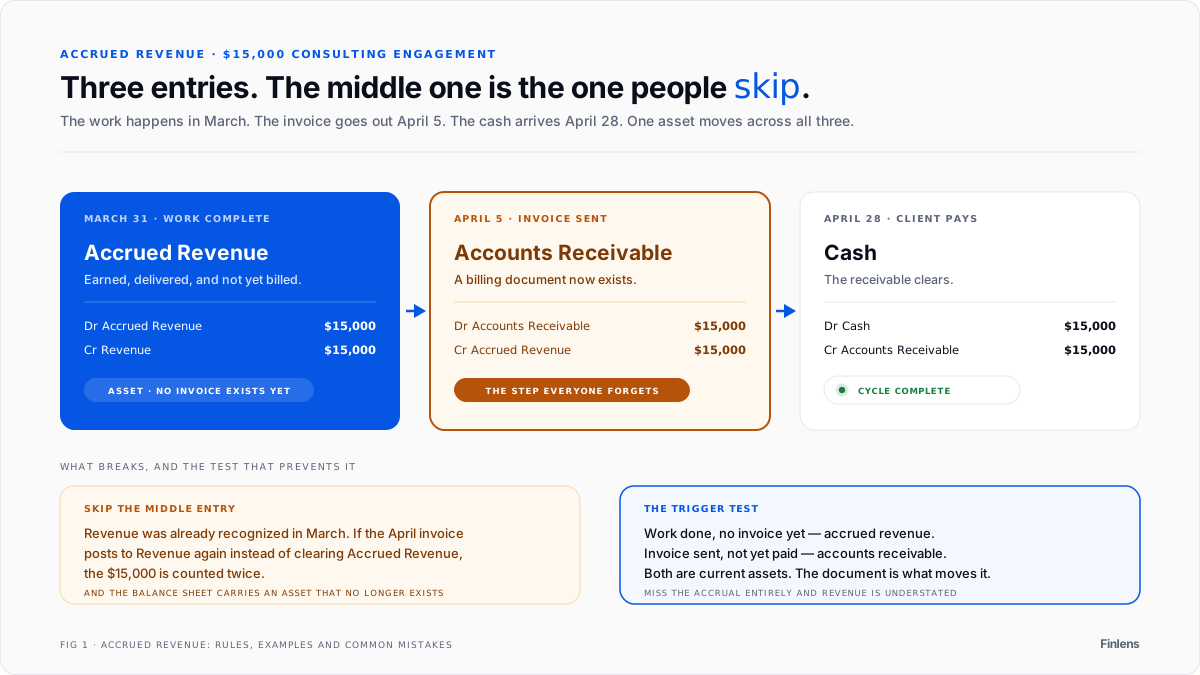
After all three entries, the full cycle is complete. Revenue was recognized in March (when earned), moved to AR in April (when invoiced), and cleared when cash arrived. The income statement, balance sheet, and cash flow statement all reflect the correct period.
This keeps the balance sheet clean and prevents double-counting revenue when the invoice finally goes out. The reversal is what everyone forgets, and that's where statements start looking wrong the following period.
Quick example. Your client completes $15,000 of consulting work in March. The invoice goes out April 5.
March 31 entry: Debit Accrued Revenue $15,000 / Credit Revenue $15,000
April 5 entry: Debit Accounts Receivable $15,000 / Credit Accrued Revenue $15,000
Common Mistakes With Accrued Revenue
Three errors that show up consistently:
Forgetting the reversal. This is the big one. If you post the accrual in March but forget to reverse it when the invoice goes out in April, revenue gets counted twice. The April income statement looks great. The client thinks they're having a record month. They're not. (This happens more than anyone in accounting wants to admit out loud.) Accrued revenue entries are a type of adjusting entry - for the full list of adjusting entry types and examples, see the adjusting entries guide.
Using the wrong period. Accrued revenue must match the period in which the work was performed. Backdating accruals or pushing them forward to manage reported income is a GAAP violation. Straightforward rule, regularly tested.
Letting accruals sit. Old accrued revenue balances that never get reversed are a red flag in any audit. If a client has entries sitting on their books from six months ago with no corresponding AR or cash receipt, something went wrong and it needs investigating before anyone else finds it first.
Accrued Revenue at Month-End Across Multiple Clients
If you manage 15 or 30 clients, month-end accrual entries are one of the most time-consuming parts of the close. Each client needs their accruals reviewed, posted, and tracked for reversal the following period. Do it manually across a full book and your spending alot of time on mechanical work that should take minutes.
The bigger risk isn't the time, its the errors. Missed reversals across multiple clients compound quietly. By the time they surface in a quarterly review, untangling which period an entry belongs to takes longer than the original work did.
This is why accountants who tackle accrual automation as part of their month-end process save real time, and reduce the audit exposure that comes with manual entry errors across a large client base.
And if you're still closing the books manually for each client, accrued revenue is usually one of the last things to get reviewed because it requires judgment, not just data entry. That means it often gets rushed right at the deadline.
This is where Finlens helps. It runs on top of QuickBooks with no migration and automates the categorization and reconciliation work that supports accurate accrual entries across every client you manage.
Before Finlens: Review each client's work-in-progress manually, post accrual entries one by one, hope the reversal gets caught next month, repeat the whole thing thirty days later.
After Finlens: Real-time visibility into earned but unbilled revenue across your entire book. Accruals are flagged, tracked, and ready to reverse without a manual reminder sitting in a to-do list somewhere.
Accrued revenue is not a complicated concept. But managing it cleanly across 20 clients without any automation is where the mistakes pile up. The entry itself takes 30 seconds. Finding the error three months later takes three hours.

FAQ
What is accrued revenue in simple terms?
Accrued revenue is money you have earned but not yet billed for. The work is done, the revenue belongs to that period, but the invoice hasn't gone out yet.
Is accrued revenue an asset or liability?
It is an asset. Accrued revenue sits on the balance sheet as a current asset because it represents money owed for work already completed.
What is the journal entry for accrued revenue?
Debit Accrued Revenue, Credit Revenue when the work is completed. Then reverse it: Debit Accounts Receivable, Credit Accrued Revenue when the invoice is sent.
What is the difference between accrued revenue and deferred revenue?
Accrued revenue is earned but not yet billed. Deferred revenue is billed but not yet earned. One is an asset, the other is a liability. They sit on opposite sides of the obligation.
What happens if you forget to reverse accrued revenue?
Revenue gets counted twice. The period when the invoice goes out shows inflated income because the accrual was never cleared. This distorts the income statement and creates problems during audits or financial reviews.
Does accrued revenue affect cash flow?
Not directly. It increases the income statement and the balance sheet asset side, but no cash has moved. It appears as an adjustment in the operating section of the cash flow statement.

