
ACH Payment Processing: How It Works, Settlement Timing and When the Return Risk Actually Matters


Key Takeaways
- ACH payment processing moves money between US bank accounts through the Automated Clearing House network. It is not instant. Standard ACH settles in 1 to 3 business days. Same-day ACH is available but costs more.
- ACH debit pulls money from a customer's bank account. ACH credit pushes money to someone else's bank account. They are different transaction types used for different purposes.
- ACH payments can be returned for up to 60 days after the original transaction date for unauthorized debits, and 2 business days for most other return reasons. Cleared does not mean final.
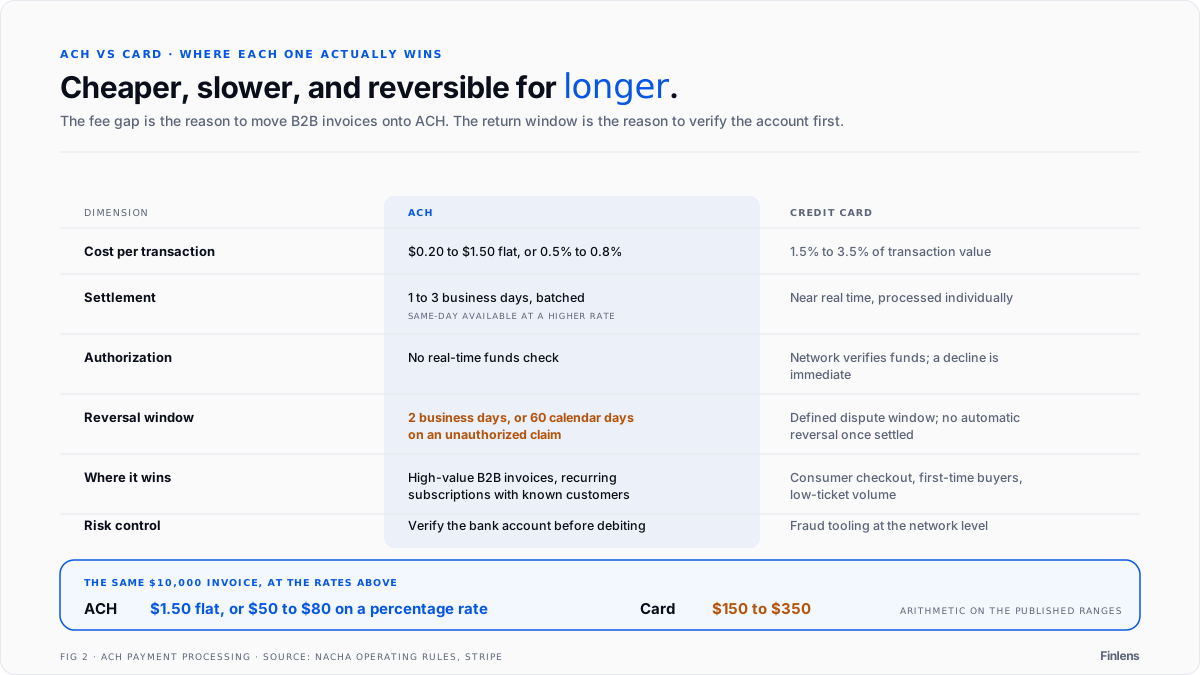
- ACH processing fees are typically $0.20 to $1.50 per transaction or 0.5% to 0.8% of transaction value, compared to 1.5% to 3.5% for card payments. For high-value B2B invoices, the fee difference is material.
- Verifying bank accounts before initiating ACH debits, through instant verification services like Plaid, dramatically reduces return rates and the processor relationship risk that comes with high returns.
What Is ACH Payment Processing?
ACH payment processing is the electronic movement of funds between bank accounts using the Automated Clearing House network, a batch-based payment system operated in the United States by Nacha (the National Automated Clearing House Association).
According to Stripe, ACH processes over 30 billion transactions annually and is the infrastructure behind most US bank transfers, including payroll direct deposits, government benefit payments, bill pay, and business-to-business transfers.
Unlike card payments, which are processed individually and in near real time, ACH transactions are batched and processed in windows throughout the day. Nacha rules govern settlement timing, return deadlines, and authorization requirements. Every business that accepts or sends ACH payments is subject to Nacha's operating rules, including the authorization requirements that determine whether an ACH debit is valid.
ACH Debit vs. ACH Credit: Two Different Transactions
ACH debit and ACH credit are frequently confused because they share the same underlying network but represent opposite directions of money movement.
An ACH debit pulls money from someone else's bank account into your account. When a business charges a customer's bank account for a subscription payment, a recurring invoice, or a one-time bill, it initiates an ACH debit. The business is the originator pulling funds from the customer.
An ACH credit pushes money from your account to someone else's. When a business pays a vendor, reimburses an employee, or sends a contractor payment via direct deposit, it initiates an ACH credit. The business is originating a payment out of its own account.
The risk profile is different for each. ACH debits, where a business pulls money from a customer's account, require explicit customer authorization and are subject to the longer return window that makes unauthorized debit returns possible. ACH credits, where the business is sending money, carry lower return risk because the originator controls the outflow.
How ACH Payment Processing Works
When a business initiates an ACH debit, the process follows a defined sequence. The business creates an ACH entry containing the customer's bank routing number, account number, transaction amount, and a unique transaction identifier. That entry is submitted to an originating depository financial institution, which is typically the business's bank or payment processor.
The originating institution batches the entry with others and submits it to the ACH operator (either the Federal Reserve's FedACH or The Clearing House's EPN). The ACH operator routes the entry to the customer's bank (the receiving depository financial institution). The customer's bank credits or debits the account accordingly.
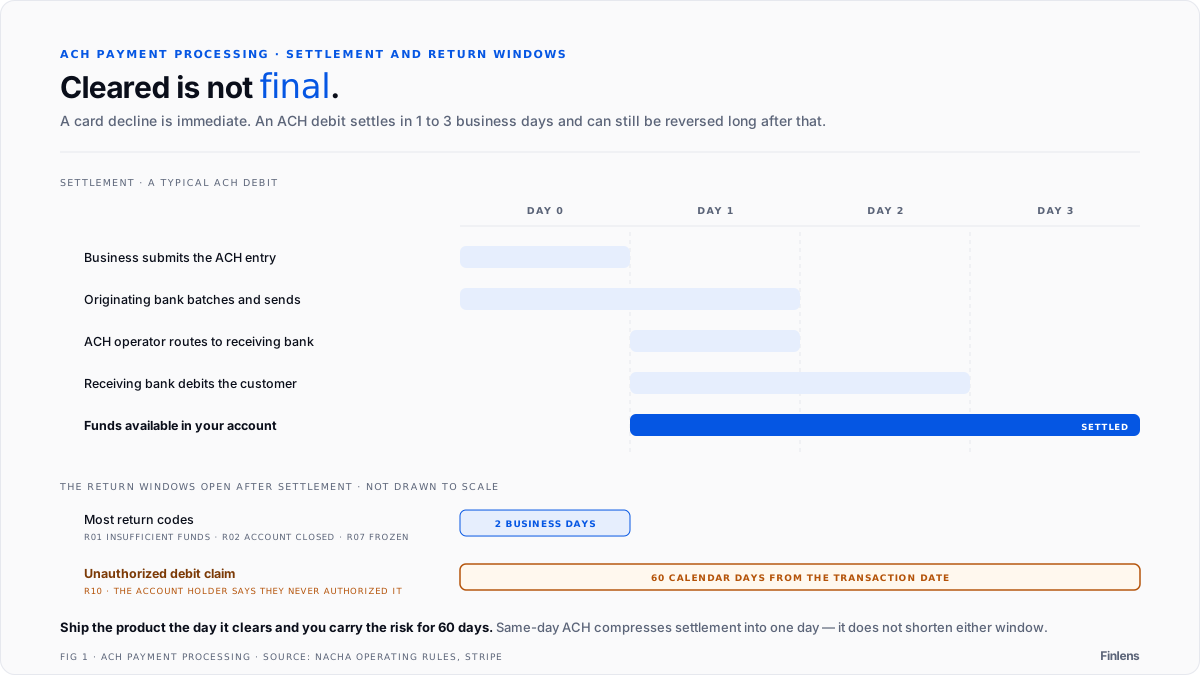
The entire process runs in batches on a defined daily schedule. Standard ACH typically settles in 1 to 3 business days depending on the time of submission and the banks involved. Same-day ACH, introduced by Nacha in 2016, settles on the day of submission for entries submitted before the same-day cutoff times, typically at a higher per-transaction cost.
ACH processing timeline for a typical debit transaction:
Same-day ACH compresses steps 1–5 into a single business day but doesn't change the return windows.
The Settlement Timing and Return Risk Problem
This is where ACH payment processing creates a risk that card processing does not, and it is the one that catches founders off guard the first time it happens.
When a credit card payment is authorized, the card network verifies that funds are available in real time. A declined card is declined immediately. Once authorized and settled, chargebacks are possible but the dispute window is defined and the payment is not automatically reversed.
ACH does not work this way. An ACH debit that clears your account does not mean the payment is final. The customer's bank has a return window during which it can reverse the transaction back to the originator:
- 2 business days for most return codes, including insufficient funds (R01), account closed (R02), and account frozen (R07)
- 60 calendar days for unauthorized debit claims (R10), where the account holder states they did not authorize the transaction
A founder who activates a subscription, ships a product, or performs a service the day an ACH payment appears to clear has a 60-day window during which the payment can still be reversed if the customer files an unauthorized debit claim. For how unpaid and disputed invoices affect your AR aging, see the accounts receivable aging report guide. "ACH cleared" is not "payment received." It is "payment received pending the return window."
For subscription businesses with strong customer relationships and verified bank accounts, ACH return rates are typically very low. For businesses selling to new customers without prior bank account verification, the return risk is higher and warrants careful evaluation before making ACH the default payment method.
ACH vs Credit Card: When to Use Each
ACH makes the most sense when:
The transaction value is high enough that the fee difference is material. A $10,000 B2B invoice charged via card at 2.5% costs $250 in processing fees. The same invoice via ACH at $1.50 costs $1.50. At scale, this difference is significant enough to justify offering ACH as a payment option or requiring it for large transactions.
The customer relationship is established and trust is high. Recurring payments from known customers with verified bank accounts carry low return risk. Monthly subscription billing for an existing customer base is a strong ACH use case.
The business model accepts the settlement delay. ACH's 1 to 3 business day settlement is fine for invoices with net 30 terms but creates friction for businesses where cash availability on the day of sale matters.
Card payments make more sense when instant payment confirmation is required, when the customer base is consumer-facing with unknown individuals, when the transaction value is low and the fee difference is negligible, or when the business cannot absorb the risk of a 60-day return window.
Here's how ACH compares to wire transfers and card payments side by side:
For how outstanding invoices interact with payment method timing, see the outstanding invoice guide.
Wire transfers fill the gap between ACH and cards for large, time-sensitive, one-time payments where finality matters. For recurring billing and B2B invoices, ACH is almost always the cheaper option. For consumer-facing transactions where speed and convenience matter more than cost, cards win.
ACH Return Codes: What They Mean and Why They Matter
Every ACH return has a standardized return code that explains why the transaction was reversed. The most common codes are R01 (insufficient funds), R02 (account closed), R03 (no account or unable to locate account), R04 (invalid account number), R07 (authorization revoked by customer), and R10 (customer advises not authorized).
Return codes matter beyond the individual transaction because Nacha monitors originator return rates. A business with a return rate above 0.5% for unauthorized returns (R05, R07, R10) or above 3% for administrative returns (R02, R03, R04) faces scrutiny from its processor and potential suspension of ACH origination privileges.
High return rates almost always trace back to poor bank account verification at the time of authorization. Verifying bank accounts before initiating the first ACH debit, through microdeposit verification or instant verification services like Plaid, confirms that the account exists, is active, and is owned by the person authorizing the debit. The upfront verification friction is worth the return rate reduction for any business doing alot of ACH volume.
ACH Payment Processing and Your Books
Every ACH payment received or sent needs to appear in QuickBooks Online accurately and in the correct period. The 1 to 3 business day settlement timing means ACH transactions authorized on the last days of a month may not settle until the following month, creating a timing difference between when revenue was earned and when the bank account shows the deposit.
For founders tracking cash and accrual financials simultaneously, this settlement lag needs to be managed through proper categorization. Founders who have structured bookkeeping automation in QuickBooks Online have ACH deposits categorized correctly as they clear rather than requiring monthly manual reconciliation between the payment processor and the bank account.
Finlens runs on top of QuickBooks Online with no migration and automates the categorization that keeps ACH payment data accurate in the books as transactions settle. For automating the invoicing side of ACH billing, see the automated billing software guide.
.png)
FAQ
What is ACH payment processing?
ACH payment processing is the electronic transfer of funds between US bank accounts through the Automated Clearing House network. It is used for direct deposit, bill pay, subscription billing, and business-to-business payments.
How long does ACH payment processing take?
Standard ACH settles in 1 to 3 business days. Same-day ACH settles on the day of submission for transactions initiated before the cutoff time, typically at a higher per-transaction fee.
What is the difference between ACH debit and ACH credit?
ACH debit pulls money from a customer's bank account (a business charging a customer). ACH credit pushes money to another bank account (a business paying a vendor or employee). They are different transaction types with different risk profiles.
Can ACH payments be reversed?
Yes. Most ACH returns occur within 2 business days for reasons like insufficient funds or closed accounts. Unauthorized debit claims can be filed up to 60 calendar days after the original transaction date.
What are ACH return codes?
ACH return codes are standardized two-character codes that explain why an ACH transaction was reversed. Common codes include R01 (insufficient funds), R02 (account closed), R07 (authorization revoked), and R10 (customer advises not authorized). High return rates trigger processor monitoring.
How does ACH compare to credit card payments in cost?
ACH typically costs $0.20 to $1.50 per transaction or 0.5% to 0.8% of transaction value. Credit card processing typically costs 1.5% to 3.5% per transaction. For high-value B2B invoices, the fee difference is significant.

