
Advisory Services in Accounting: Definitions, Types, and Benefits


Advisory services in accounting are strategic engagements where an accountant helps a client reach specific financial goals cash flow, growth, tax outcomes, or a transaction rather than only recording what has already happened. The output is a decision, a plan, or continuing guidance, not a filed form.
Advisory has always existed inside profession. What has changed is its share of firm revenue. Compliance work tax returns, monthly close, sales-tax filings, audits is being automated at speed, while advisory revenue at accounting firms with mature service lines is growing 15–20% per year, per AICPA / CPA.com Client Advisory Services Benchmark Survey. The profession is shifting from historical reporting to forward-looking guidance.
This guide covers what advisory services are, how they differ from compliance and consulting, eight core service types offered today, benefits for firms and clients, and practical steps to add advisory to a practice.
What are advisory services in accounting
Advisory services are ongoing, strategic engagements where an accounting professional works with a client to improve financial outcomes over time. The scope is defined by what client is trying to achieve not by an external regulator, and not by a fixed project brief.
A typical advisory engagement includes:
- Regular review of client's financials, KPIs, and cash position
- Scenario analysis modeling effect of hiring plans, pricing changes, financing decisions, or acquisitions
- Written recommendations tied to specific financial goals
- Recurring meetings, usually monthly or quarterly, where accountant walks client through what changed and what to do next
- Ad-hoc access to accountant between formal meetings
Pricing is almost always a fixed monthly retainer or a scoped project fee, not hourly billing. The value of advisory is in outcome and ongoing relationship, not in minutes spent. A cash-flow forecast that prevents a payroll miss is worth retainer whether it took accountant twelve hours or forty to build.
The core deliverable of advisory is judgment. That is why advisory work commands significantly higher effective rates than compliance work commonly three to eight times effective hourly rate of same person doing preparation or bookkeeping and why it produces deeper client relationships firms use as foundation for future scope expansion.
Advisory work is regulated in specific respects. Investment advice requires a Series 65 license or affiliation with a registered investment advisor. Federal tax advice is governed by IRS Circular 230. Non-financial-advisory consulting performed by CPAs is guided by AICPA's Statement on Standards for Consulting Services (SSCS No. 1), which addresses professional competence, engagement planning, and client communication.
Most advisory work at small and mid-market firms is delivered on top of an existing Client Accounting Services relationship. The firm already has client's ledger, trust built through monthly touchpoints, and operational rhythm to run advisory reviews on same cadence.
Advisory services vs. compliance vs. consulting
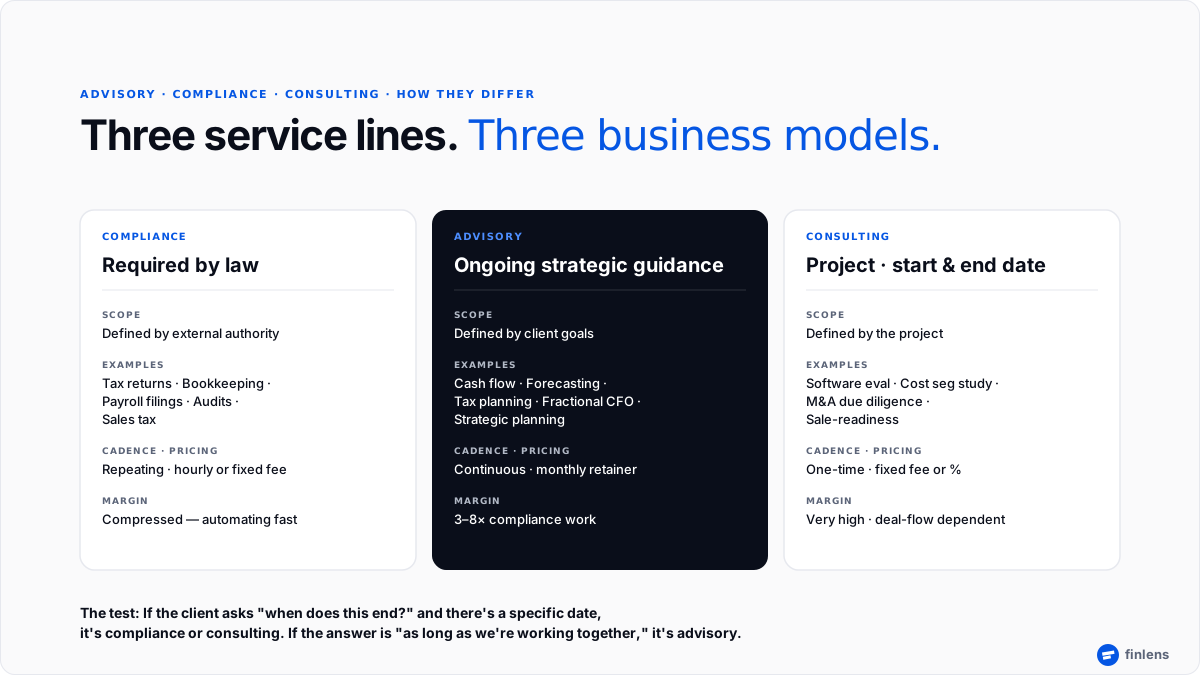
The three terms get used interchangeably. They are not same, and distinction matters for how work is scoped, priced, and delivered.
Compliance is work required by law, regulation, or a lender: tax returns, monthly bookkeeping, sales-tax filings, audits, payroll. The scope is defined by an external authority IRS, GAAP, a bank covenant, a state department of revenue. Compliance is repetitive, time-bound, and increasingly automated.
Advisory is ongoing strategic guidance on client's finances. The scope is defined by client's own goals grow revenue, reduce tax, prepare for an exit. Advisory is forward-looking, judgment-heavy, and priced by outcome. It is what a firm delivers when it moves beyond "what happened" to "what to do next."
Consulting is a discrete, project-based engagement to solve a specific problem: evaluate a software platform, prepare a business for sale, complete a cost-segregation study, investigate suspected fraud. Consulting has a start date, an end date, and a deliverable that ends engagement.
A useful mental test:
If client asks "when does this end?" and answer is a specific date, engagement is compliance or consulting. If answer is "as long as we are working together," it is advisory.
Most firms deliver all three service lines. The mistake and source of most stalled advisory practices is pricing and staffing them as if they were same thing.
Types of advisory services in accounting
Firms package advisory in different combinations. Eight service types cover substance of what most accounting firms offer today, listed from easiest to launch to most demanding.
Cash flow advisory
Cash flow advisory is helping a client understand, forecast, and manage movement of cash in and out of business. The core deliverable is a 13-week rolling cash forecast, refreshed monthly or weekly, with written commentary. Sub-services commonly include AR and AP acceleration analysis, working-capital sizing, and credit-line management.
This is often first advisory service a firm adds underlying data lives in client's accounting system, value is easy to demonstrate, and retainer pricing of $500–$3,000/month is affordable for small and mid-market clients.
Financial forecasting
Financial forecasting extends cash-flow work into full P&L and balance-sheet projections, typically 12–36 months forward. The output is a driver-based model tied to client's operating reality hiring plan, unit economics, contract renewals, seasonality not a static extrapolation of last year.
Engagements often begin as a fixed-fee build ($3,000–$15,000 for initial model) and convert to a monthly retainer to maintain and re-forecast. Clients use model for board reporting, fundraising, bank covenant testing, and decisions like opening a second location.
Budgeting services
Budgeting advisory sits between cash flow and forecasting. It is annual planning process setting targets for revenue, gross margin, headcount, and operating expenses; breaking them down by month and department; and reviewing budget-versus-actual variance every month with client.
The real value is in monthly variance conversation, not document itself. Budgeting works only when underlying ledger is clean firms that automate reconciliation and run close on QuickBooks or Xero produce budget-vs-actual reports directly from same system, so client sees same numbers month after month.
Tax planning advisory
Tax planning advisory is ongoing, proactive work to reduce a client's tax bill over multiple years distinct from tax preparation, which is compliance. Deliverables typically include entity-structure recommendations (S-corp elections, holding companies, trusts), timing of income and deductions, R&D credit qualification, retirement-plan design, cost-segregation timing on real estate, multi-state nexus review, and multi-year federal and state liability projections.
Fixed annual fees run $3,000–$15,000 for a small business, higher for HNW individuals or multi-entity structures. Value is measured in tax dollars saved against counterfactual, not hours worked. Firms that already prepare client's returns hold a clear advantage they already have historical returns, entity structure, and trust.
Wealth management advisory
Wealth management covers a client's personal financial planning investments, retirement, estate planning, insurance. Some accounting firms deliver this directly through a registered investment advisor (RIA) affiliate; others coordinate with client's outside wealth manager and stay involved on tax side.
The natural client path: business-owner client → firm handles books and tax → owner accumulates net worth locked in business → firm helps transition that wealth into diversified investments, estate structures, and retirement vehicles. Series 65 or RIA affiliation is required to give investment advice for a fee, so service line typically grows through referral rather than active marketing.
Strategic planning
Strategic planning advisory is help with multi-year direction of business market positioning, geographic expansion, pricing model, capital structure, exit timing. The accountant is not strategy consultant, but brings financial reality check to whatever option client is considering.
Deliverables are typically quarterly strategy meetings, a written three-year plan updated annually, and financial scenarios attached to each option. Strategic planning overlaps with management consulting; differentiator is continuity accountant sees numbers every month and can catch a plan drifting off track before client can.
M&A advisory
Mergers and acquisitions advisory covers helping a client buy, sell, or restructure ownership. The accountant's role typically includes financial due diligence, quality-of-earnings (QoE) analysis, tax structuring, purchase-price allocation, working-capital targets, and post-close integration.
Engagements are project-based and priced as fixed fees or a percentage of transaction value. Sell-side QoE for lower-middle-market deals commonly runs $25,000–$150,000, higher for larger transactions. M&A revenue is deal-flow dependent, but per-engagement values are high and one successful transaction often generates referrals for years.
Fractional CFO
Fractional CFO also called outsourced or part-time CFO is most senior advisory service most firms offer. The engagement bundles cash flow, forecasting, budgeting, strategic planning, and often board reporting into a single monthly retainer where accountant fills CFO seat for a company not yet ready to hire one full-time.
Engagements typically run $8,000–$25,000+ per month with one senior person a partner or dedicated fractional CFO and junior support behind them. The typical client is a $2M–$50M revenue business that has outgrown bookkeeper-plus-tax-CPA arrangement but is a year or more from a full-time CFO hire.
Benefits of offering advisory services
Advisory work produces benefits on both sides of engagement for firm and for client and two sets of benefits reinforce one another over time.
For firm:
- Higher effective rates. Retainer-based advisory commonly produces three to eight times effective hourly rate of hourly compliance work.
- Predictable, recurring revenue. A $3,000 monthly retainer books $36,000 of contracted revenue per year per client, versus a $2,500 tax return that books once.
- Deeper client relationships. Advisory clients see firm every month, discuss decisions before they happen, and treat firm as a trusted advisor rather than a compliance vendor.
- Higher firm valuation. Firms with mature advisory practices command higher acquisition multiples than firms with only hourly-compliance revenue one of reasons private-equity roll-ups target them specifically.
- Better staff retention. Advisory work is intellectually more varied than pure compliance and keeps senior staff engaged longer than repetitive prep and close work.
For client:
- Proactive rather than reactive guidance decisions get made with accountant in room, not evaluated after fact.
- Access to senior expertise client could not afford full-time a fractional-CFO retainer at $10,000/month is a fraction of fully-loaded cost of a full-time CFO hire.
- Continuity across compliance and strategy same firm that files return also plans tax position, so nothing falls through cracks between filing seasons.
- Faster decision cycles accountant already has data and historical context, so scenarios can be modeled in days rather than weeks.
The compounding effect of these benefits is why firms that build advisory practices deliberately tend to grow faster and retain clients longer than firms that stay in pure compliance.
How to add advisory services to a practice
Firms adding advisory generally follow same sequence, whether they are one-partner shops or hundred-person firms.
1. Start with existing clients, not new logos. Advisory pilots run best on clients firm already knows well usually recurring bookkeeping or CAS clients with 12+ months of clean data. Selling advisory to a cold prospect is much harder than expanding scope with an existing one.
2. Pick one or two service types to launch. Firms that try to launch every type in year one dilute effort. The most common first two are cash flow advisory and tax planning, both of which have discrete value client can see quickly.
3. Write a specific scope, even if it is short. "Advisory retainer" without a written scope becomes "unlimited partner access for a flat fee." A one-page scope listing deliverables, meeting cadence, response-time expectations, and what is out of scope prevents retainer from being eaten by ad-hoc requests.
4. Price on retainer or fixed fee not hourly. Hourly billing tells client value is in time spent. Retainer billing tells client value is in outcome.
5. Automate compliance backbone. Advisory on top of a late or messy close fails silently client stops taking meetings because numbers being discussed are stale.
6. Price advisory as a distinct line item. Advisory bundled invisibly into compliance invoice gets treated as free. It needs a separate engagement letter and a separate line item.
Firms that follow this sequence tend to see advisory grow to 25–40% of total revenue within three years. Firms that skip pricing and scope steps stall out.
How Finlens supports advisory work
Advisory is only as good as underlying financials. If close is late, categorizations drift, or reconciliations are stale, forecast is worthless and tax plan misses. Finlens automates compliance backbone categorization, multi-client exception review, bank reconciliation, and month-end close so senior hour flows into advisory conversation rather than into ledger. Compliance stops being bottleneck, and advisory line grows at pace of client demand rather than pace of partner's calendar.
Conclusion
Advisory is not new to accounting profession. What is new is that it is becoming profession's primary growth engine.
Firms and accountants that build advisory practices deliberately defined services, retainer pricing, a clean compliance foundation are ones capturing profession's revenue shift. Every hour automation removes from compliance is an hour that can be sold, at higher margin, on advisory side.
Book a 20-minute walkthrough and bring messiest client close pack on your desk. We will show you where manual hours are going and where advisory hours would come from if that close ran on autopilot.
FAQ
What are advisory services in accounting?
Ongoing strategic engagements where an accountant helps a client reach specific financial goals cash flow, growth, tax outcomes, or a transaction rather than only recording what has already happened.
What do financial accounting advisory services do?
Financial accounting advisory covers technical accounting problems: new standard adoption (ASC 842 leases, ASC 606 revenue), IPO readiness, audit-preparation assistance, and technical accounting memos. At Big 4, this is a distinct practice line separate from tax and strategic advisory.
Who are Big 4 advisory companies?
Deloitte, PwC, EY, and KPMG. Their advisory practices span financial accounting advisory, deal advisory, risk advisory, and management consulting, aimed at large enterprises. Small and mid-market businesses typically engage regional firms instead.
Advisory vs. consulting what is difference?
Advisory is ongoing and priced on retainer; accountant is a permanent part of client's finance function. Consulting is project-based with a defined end date. Firms often provide both, staffed and priced differently.
How much do advisory services cost?
Cash flow advisory: $500–$3,000/mo. Tax planning: $3,000–$15,000 annual fixed fee for a small business. Fractional CFO: $8,000–$25,000+/mo at established firms.

