
Bookkeeping Services Fees (2026): What to Charge, How to Package, Real Margin Math


Key takeaways
- $300–$1,500/month is typical flat-rate small-business band; $25–$90/hour is freelance band.
- Four hiring models with different price points and best-fit clients (table below).
- Tiered packages (Essential / Strategic / Comprehensive) are standard shape; tier ladder is defined by whether payroll, AP/AR, multi-entity, and CFO advisory are included.
- Cleanup fees are separate and non-negotiable $1,000–$5,000 one-time depending on backlog.
- Modern firms using AI-native tools like Finlens drop per-client delivery cost from ~$180–$250 (manual) to under $100 same package price, materially better gross margin.
Bookkeeping services fees by hiring model (as of 2026-07-17)
Ranges based on publicly reported 2026 pricing surveys as of 2026-07-17. Actual quotes vary by geography, industry, and scope.
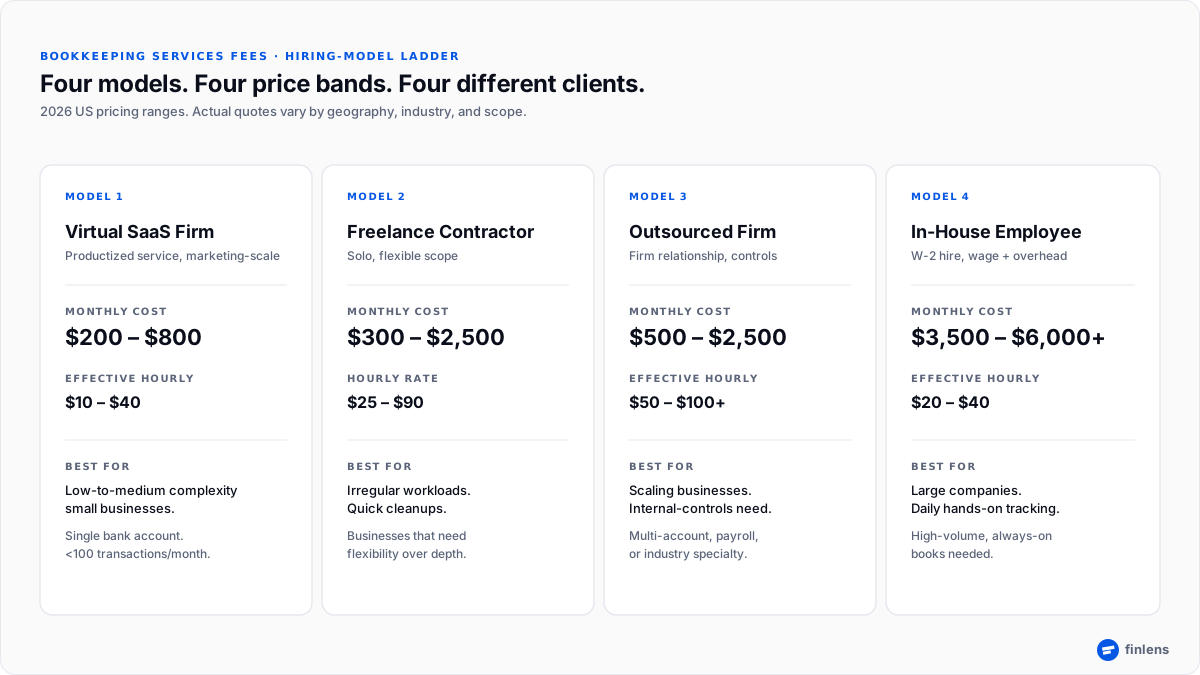
Figure 1. The four bookkeeping hiring models each sit at a different price band and fit a different client shape.
Tiered monthly packages standard shape
Most firms package their bookkeeping into three tiers scoped by complexity. The tier boundaries look consistent across market:
- Essential ($300–$500/month). Basic data entry, credit card matching, and primary bank ledger reconciliation. Best for a service business under ~50 transactions/month with a single bank account.
- Strategic ($600–$1,200/month). Adds accounts payable, accounts receivable invoicing, and formal monthly cash reports. Best for a business with 100–300 transactions/month, one or two credit cards, and a defined AP cadence.
- Comprehensive ($1,500–$3,000+/month). Multi-entity management, full payroll execution, and CFO-level advisory. Best for businesses running two or more legal entities, W-2 payroll, and needing an integrated financial view rather than raw books.
The market rate anchors tier price. What separates a profitable bookkeeping firm from a break-even one is not price it’s delivery cost per client at each tier. That’s where AI-native tooling changes equation, covered below.
Hourly bookkeeper rates by experience level
If you bill hourly instead of flat retainer, rate correlates directly with certifications and scope of work:
- Entry-level ($20–$35/hour). Simple transaction categorization, receipt organization, basic data entry.
- Mid-level ($35–$60/hour). Monthly closes, common-error correction, basic vendor billing.
- Senior / certified ($60–$100+/hour). Payroll processing, complex inventory assets, sales tax filings, multi-entity structures.
Hourly billing is dying for a reason: as delivery gets faster (AI-native tools compress a 6-hour categorization into 90 minutes), hourly pricing punishes firm that invested in tooling. Flat-fee retainers with a defined scope are direction of travel every firm-owner survey we’ve seen in 2026 confirms it.
Cost drivers that make bookkeeping fees fluctuate
Beyond base tier price, several operational variables push fees up or down:
- Transaction volume. Many modern firms use a $3-per-transaction baseline to build a package price. A 200-transaction/month client sits at a very different price point than a 2,000-transaction/month client on same tier.
- Industry-specific systems. Restaurants (POS integrations), e-commerce (Shopify + Amazon + Stripe), and construction (job costing) all inflate monthly fees because integration and categorization work is heavier.
- Historical cleanup. If books are behind, expect a one-time cleanup fee of $1,000–$5,000 before standard billing begins. Not optional; firms that skip this eat cost.
- Software subscriptions. Check whether your provider includes platform licenses (QuickBooks Online, Xero) in fee or bills them separately at $30–$200/month extra.
- Reporting cadence. Weekly cash reports and financial analysis push a client from Strategic to Comprehensive tier pricing that’s a real cost, not a give-away.
The unit-economics conversation where modern firms actually make money
Every firm owner has seen pricing table above. What almost nobody publishes is what it costs to deliver service at each tier. Here’s delivery-cost math most firms don’t see clearly until third or fourth year:
Traditional hand-labor delivery cost per client, per month:
- Categorization + reconciliation: ~4–6 hours × mid-level rate ($40/hr) = $160–$240
- Monthly close + report: ~1 hour × mid-level rate = $40
- Client communication + follow-up: ~0.5 hour = $20
- Total delivery cost: ~$220–$300 per client per month for a Strategic-tier client.
At a $600/month Strategic package price, that’s a 50–63% gross margin before firm has paid for software licenses, PM tools, or overhead. Once those are in, most firms are running bookkeeping line at 30–40% gross margin, which is why bookkeeping practices historically scale by hiring more people, not by adding more clients.

AI-native delivery cost per client, per month (Finlens-based):
- Finlens categorization + payout decomposition + rules learning: ~30–45 min human review of flagged queue = **$25–$35
- Finlens per-client software cost: covered by tier fee
- Monthly close + report: ~30 min (Finlens surfaces exceptions, not everything) = $20**
- Client communication + follow-up: ~0.5 hour = $20
- Total delivery cost: ~$65–$75 per client per month for same Strategic-tier client.
Same $600 package. Delivery cost falls from ~$260 to ~$70. The margin goes from 57% to 88%, and more importantly same bookkeeper now handles 30 clients instead of 10 without additional hiring.
That is what firm-owners mean when they say “AI changes unit economics of bookkeeping.” The market price of service is not lever. The delivery cost is.
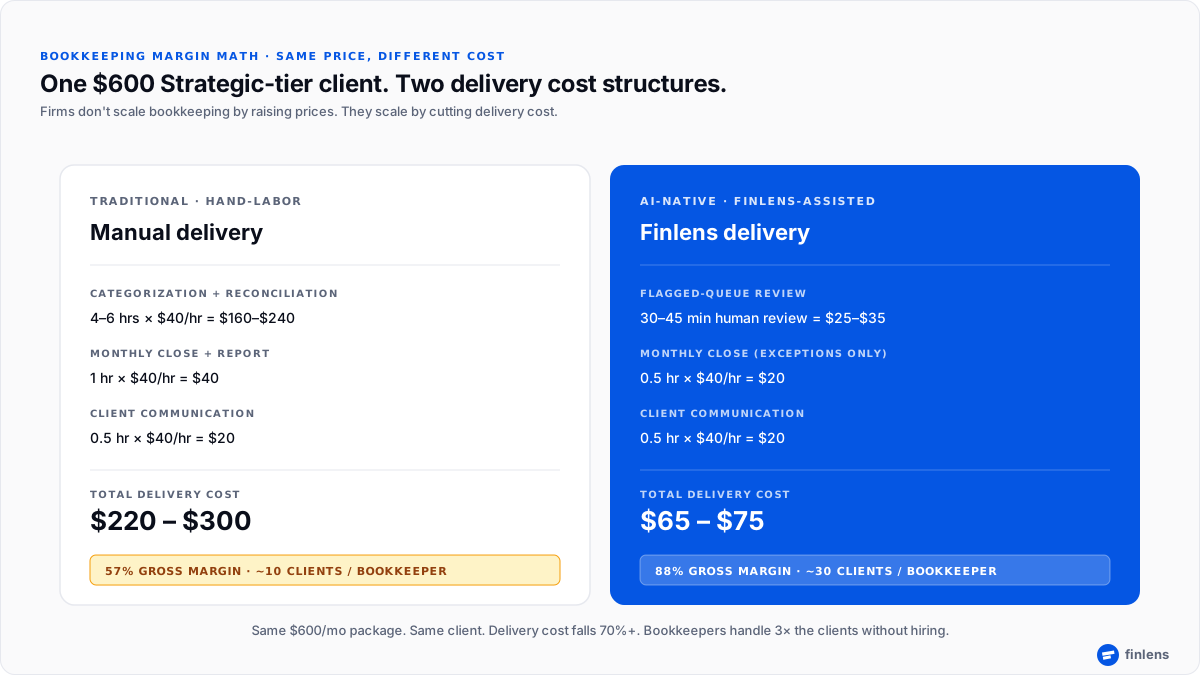
Figure 2. Same $600 package price. Delivery cost falls from ~$260 to ~$70 with AI-native tooling. That’s margin story firm-owners buying software should actually be looking at.
How firm-owners should package bookkeeping in 2026
Use these six rules they hold across every US firm-pricing survey we’ve seen this year.
- Anchor tier ladder. Essential, Strategic, Comprehensive. Every client goes into one of three. No custom scoping on first call that’s how scope creep enters.
- Price by transaction volume within each tier. $3/transaction is a defensible baseline. Above 500 transactions/month, move up a tier or add a volume surcharge.
- Charge cleanup separately, upfront, in writing. $1,000–$5,000 one-time. Do cleanup before month 1 of recurring engagement begins. Firms that skip this eat cost and never recover margin.
- Publish price ranges on website. Not exact quotes ranges. This filters unqualified inbound and signals confidence. Firm-owners who publish are consistently ahead on unit economics.
- Include software licenses OR bill them at cost never mark them up quietly. Bill-at-cost is more defensible on renewal conversations.
- Model delivery cost, not just price. Delivery cost is where tooling decision (Finlens for ledger, PM tool for workflow) shows up. See Karbon vs Jetpack Workflow for workflow-tool angle.
Where firm-owners should NOT compete on price
- You cannot beat virtual SaaS on price at Essential tier. Bench, Pilot, and Xendoo have marketing scale and software leverage that no local firm can match on a $200 package. Compete on relationship, industry specialization, or advisory upgrade not on price.
- You cannot beat freelance contractors on price at Essential tier either. A $25/hour freelancer with two clients can undercut any firm. Compete on process reliability, defined scope, and turnaround time not price.
- Where firms win: Strategic and Comprehensive tiers. Virtual SaaS and freelance both hit ceilings around $1,000/month; firm advantage is multi-entity, payroll, and advisory layer above that. Price accordingly.
Conclusion
Pick one client on your firm’s books where monthly bookkeeping engagement feels either underpriced or under-margined bring three months of their QBO and we’ll show you delivery cost math on same file, before we say a word about pricing.
Frequently asked questions
How much do bookkeeping services cost per month in 2026?
For a US small business, bookkeeping services typically cost $300–$1,500 per month on a flat-rate package. The exact number depends on transaction volume, industry, and whether client needs payroll, multi-entity handling, or CFO-level advisory. Growing businesses with payroll and inventory typically pay $1,000–$2,500+ per month.
How much does a bookkeeper charge per hour?
Hourly rates in 2026 run $25–$90 per hour for freelance and outsourced bookkeepers. Entry-level rates start at $20–$35/hour, mid-level runs $35–$60, and senior or certified bookkeepers charge $60–$100+ per hour, especially for payroll, sales tax, or multi-entity work.
What’s difference between Essential, Strategic, and Comprehensive bookkeeping packages?
Essential ($300–$500/mo) covers basic data entry, credit card matching, and bank reconciliation. Strategic ($600–$1,200/mo) adds AP/AR and monthly cash reports. Comprehensive ($1,500–$3,000+/mo) includes payroll execution, multi-entity handling, and CFO-level advisory. Every business fits one of these three tiers custom scoping usually means firm is under-pricing.
What is a reasonable cleanup fee for messy books?
A one-time cleanup fee for historical bookkeeping typically runs $1,000–$5,000, depending on how many months are behind and how disorganized source data is. Cleanup should always be billed separately from recurring engagement firms that fold cleanup into month 1 recurring pricing eat cost.
What’s difference between virtual SaaS bookkeeping and outsourced firm bookkeeping?
Virtual SaaS (Bench, Pilot, Xendoo) is a productized service at $200–$800/month, best for low-to-medium complexity businesses. Outsourced firm is a service relationship at $500–$2,500/month, best for scaling businesses that need internal controls, real-time advisory, or industry-specific expertise. Price alone isn’t deciding factor service depth is.
Should bookkeeping firms bill hourly or flat-rate in 2026?
Flat-rate. Hourly billing punishes firm that invests in AI-native tooling because delivery time compresses without price adjusting. Every 2026 firm-pricing survey we’ve seen shows industry moving toward flat-fee retainers with a defined scope.
How do AI-native tools like Finlens change pricing math for bookkeeping firms?
AI-native tooling doesn’t change market price of a bookkeeping package it changes delivery cost. A Strategic-tier client that used to cost $220–$300/month to deliver (mid-level bookkeeper hours) drops to $65–$75/month with Finlens handling categorization, payout decomposition, and rules learning. Same $600 package. Margin goes from ~57% to ~88%. That’s lever firm-owners are actually pulling in 2026.
Where can I find current bookkeeping fee benchmarks by state?
Slate Ridge Finance publishes a state-by-state guide to 2026 bookkeeping rates (slateridgefinance.com). Upcision publishes an industry-benchmark set (upcision.com). NerdWallet’s small-business bookkeeping pricing page carries reference ranges for freelance, outsourced, and in-house models (nerdwallet.com).
Pricing ranges in this article are compiled from publicly available 2026 industry surveys (NerdWallet, Slate Ridge Finance, Upcision, Aligned Ledger) as of 2026-07-17. Actual quotes vary by geography, industry, and scope of engagement. Third-party trademarks (Bench®, Pilot®, Xendoo®, QuickBooks®, Xero®) belong to their respective owners; Finlens is not affiliated with or endorsed by any of them. Verify current pricing directly with each provider before making purchasing or pricing decisions.

