
ASC 842 Lease Accounting: The CPA Firm's Private-Company Adoption Guide


ASC 842 has been mandatory GAAP for private companies since fiscal years beginning after December 15, 2021. Four years later, private-company implementation gap is still single most common item on peer-review comment sheets and audit deficiency letters. This guide covers standard as CPA firms actually apply it to SMB clients ROU asset and lease liability mechanics, discount rate policy, embedded-lease population problem, and workpaper ledger has to produce.
What ASC 842 actually changed
FASB Topic 842 replaced Topic 840 in ASU 2016-02, effective for public entities in fiscal years beginning after December 15, 2018, and for private companies in fiscal years beginning after December 15, 2021 (interim periods after December 15, 2022). The single-sentence summary: almost every lease longer than 12 months now sits on balance sheet as a right-of-use (ROU) asset and a lease liability.
Under ASC 840, operating leases lived entirely off-balance-sheet. Rent expense hit income statement, and future lease commitments were disclosed only in notes. Under ASC 842, both operating and finance leases require balance sheet recognition difference between two now lives on income statement, not on balance sheet.
The most recent formal amendment is ASU 2023-01 (January 2023), which clarified accounting for leases under common control for private entities. No new lease-specific ASUs were issued in 2024 or 2025, though FASB post-implementation discussions continue around discount rates and embedded leases.
Lessee classification: operating vs. finance
A lease is a finance lease if any one of five criteria is met (ASC 842-10-25-2):
- Ownership transfers at end of term.
- Purchase option is reasonably certain to be exercised.
- Lease term is a major part of remaining economic life (traditionally 75%).
- Present value of payments is substantially all of fair value (traditionally 90%).
- The asset is so specialized it has no alternative use.
If none of five apply, it is an operating lease.
Both classifications require same balance sheet recognition. The income statement is where they diverge:
- Operating lease → a single straight-line lease expense per period. Total lease cost is level across lease term.
- Finance lease → two separate expenses: amortization of ROU asset (straight-line) and interest on lease liability (declining). Total expense is front-loaded.
For SMBs, most real estate and equipment leases fall into operating category. Finance leases show up in specialized machinery, vehicle acquisitions with buyout provisions, and IT equipment with $1 buyouts.
Initial recognition: two journal entries every CPA needs
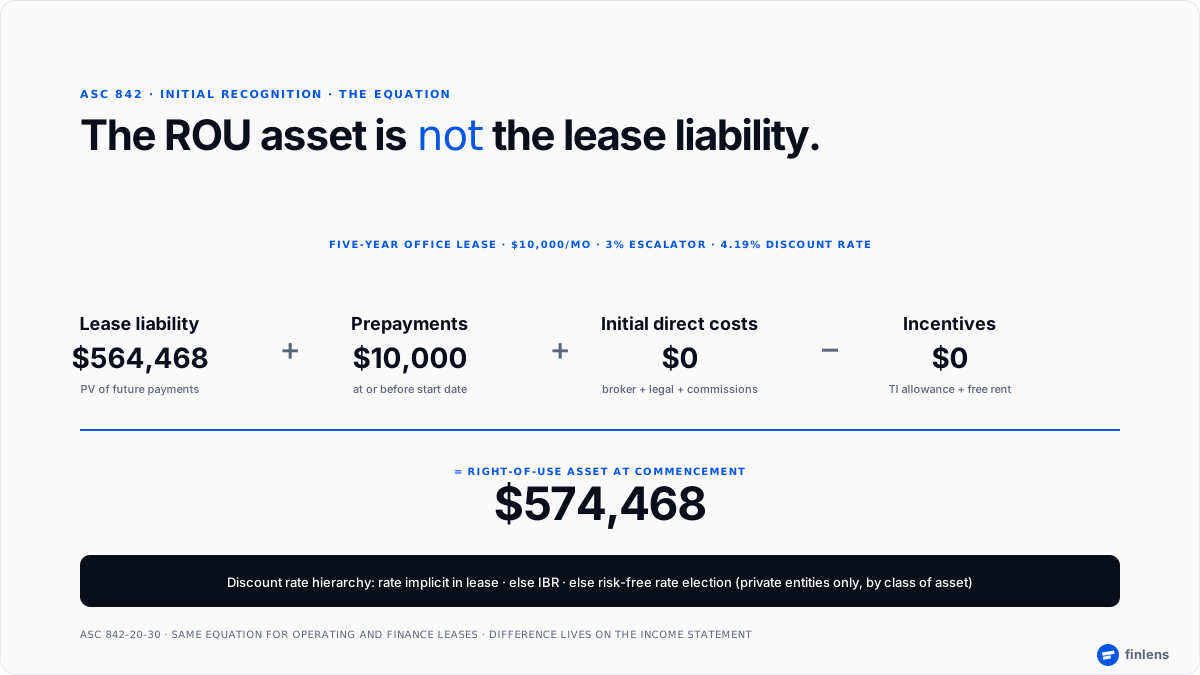
Take a five-year office lease starting July 1, 2025, ending June 30, 2030. Monthly rent $10,000 with a 3% annual escalator. Discount rate 4.19% (lessee's incremental borrowing rate). Total lease payments over term: $637,096.
At commencement, lease liability is present value of future lease payments (not including payment made at commencement, which is not a "future" payment). For this lease, that PV is $564,468.
The ROU asset at commencement is:
- Initial lease liability
- Plus lease payments made at or before commencement
- Plus initial direct costs
- Minus lease incentives received
For this lease, ROU asset = $564,468 + $10,000 = $574,468.
Initial journal entry (identical structure for operating and finance):
The lease liability then splits between short-term (payments due within 12 months) and long-term.
Subsequent recognition where operating and finance diverge
For an operating lease, month one might look like:
- Operating lease expense: $10,618 (total lease cost ÷ 60 months, straight-line)
- ROU asset reduction: $8,647 (straight-line expense less interest on remaining liability)
- Lease liability increase: $1,971 (interest accretion at 4.19% ÷ 12 on prior balance)
- Cash: $10,000 out (in a month where payment is made)
The critical mechanic: ROU asset amortization is a plug. It equals straight-line lease expense minus interest accrued on liability. This is what produces single straight-line total expense.
For a finance lease, entries separate:
- Amortization expense: $9,574 (ROU asset ÷ lease term, pure straight-line)
- Interest expense: $1,971 (discount rate × prior liability)
- Total: $11,545 in month one higher than operating and decreasing over time.
Choosing discount rate
ASC 842 requires discount rate to be rate implicit in lease. In practice, rate implicit is almost never disclosed by lessor, so lessees fall back on alternatives:
- Incremental borrowing rate (IBR) rate lessee would pay to borrow, on a collateralized basis, over a similar term, in a similar economic environment, for an amount equal to lease payments. The default for most private entities.
- Risk-free rate election private companies (and nonprofits) may elect under ASC 842-20-30-3 to use a risk-free rate for a period comparable to lease term (e.g., Treasury rate). The election is by class of underlying asset.
The risk-free-rate election is attractive for small clients no IBR analysis required but it produces a lower discount rate, which means a higher lease liability and ROU asset. For clients with debt covenants tied to leverage ratios, IBR is usually preferable despite additional documentation burden.
Documentation that must live in workpaper:
- The rate selected and policy election
- If IBR: derivation methodology, reference borrowing (recent bank quote, published index, or benchmark), term match, collateralization assumption
- Reassessment triggers (lease modification, major economic shift)
Missing IBR documentation is single most common comment on private-company audits post-adoption.
The embedded lease problem
The audit failure mode nobody warns SMB clients about: embedded leases inside service contracts.
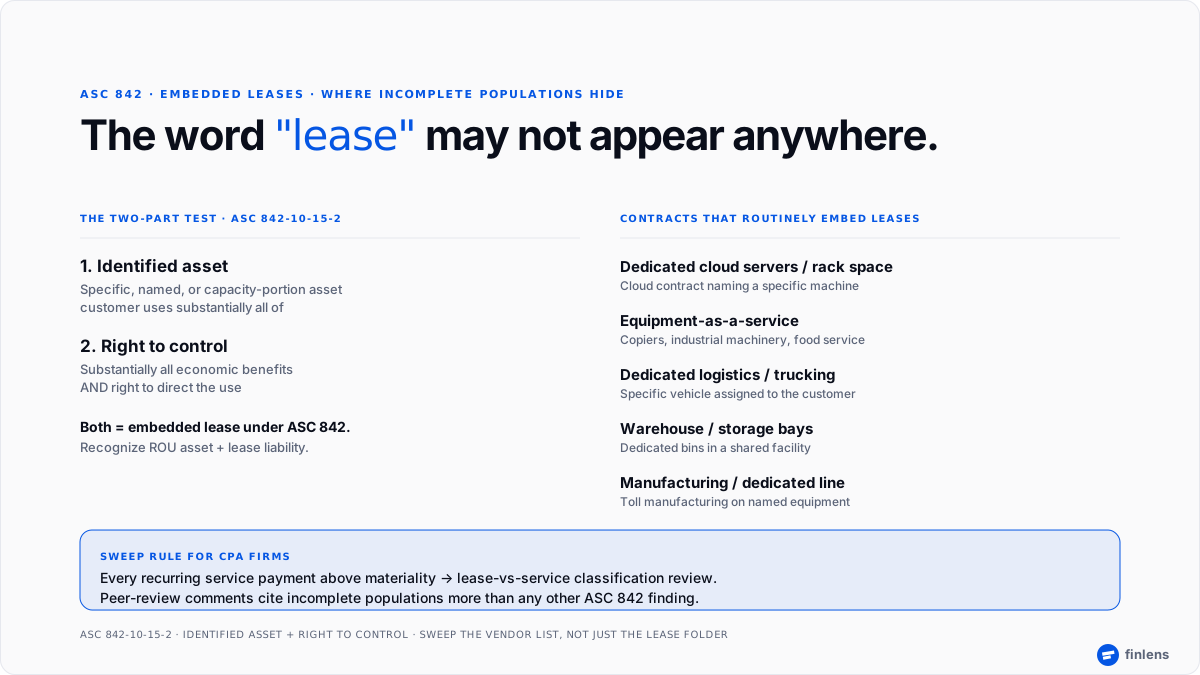
Under ASC 842-10-15-2, a contract contains a lease if it "conveys right to control use of an identified asset for a period of time in exchange for consideration." Two tests:
- Is there an identified asset a specified physical or capacity portion of an asset that customer uses substantially all of?
- Does customer have right to obtain substantially all of economic benefits and right to direct use of that asset?
Contracts that routinely embed leases without saying "lease" anywhere:
- Dedicated cloud servers or data-center rack space where customer specifies machine.
- Equipment-as-a-service copiers, industrial machinery, food service equipment.
- Warehouse or storage arrangements with dedicated bays or bins.
- Trucking or logistics contracts where a specific vehicle is assigned to customer.
- Advertising billboards or dedicated media placements.
- Manufacturing arrangements using a dedicated production line.
Every private-company adoption workpaper needs an explicit embedded-lease sweep across vendor list not just contracts labeled "lease." The peer-review criticism this generation of adoptions is drawing: incomplete lease populations.
The seven practical expedients
FASB provided a package of practical expedients to ease adoption. All are still available post-adoption for ongoing use where noted:
- Short-term lease exemption (12 months or less) remains on election, off balance sheet.
- Non-lease component combination election to combine lease and non-lease components (e.g., property + CAM) and treat as a single lease. Simpler, but inflates ROU asset.
- Risk-free rate election private entities only, by class of underlying asset.
- Land easements preserve prior ASC 840 treatment if not modified.
- Package of three at transition only, no reassessment of existing lease identification, classification, or initial direct costs.
- Hindsight at transition only, reassess lease terms with current knowledge. Rarely elected due to complexity.
- Discount rate portfolio approach apply one discount rate to a portfolio of leases with similar characteristics.
For private companies still catching up on adoption, package of three and risk-free rate election are usually difference between a workable implementation and one that stalls.
Related-party leases and ASU 2023-01
ASU 2023-01 (January 2023) provided targeted relief for private entities on common-control lease arrangements. Two practical impacts:
- Legally enforceable terms are basis for accounting private entities can now rely on written terms of a common-control arrangement without a further "economic substance" analysis.
- Leasehold improvements on common-control leases are amortized over useful life to common-control group, not limited to lease term. This meaningfully changes how a parent-owned building leased to an operating subsidiary is accounted for.
This is a small but often-missed adjustment for CPA firms with common-control entity clusters (a very common SMB structure).
Disclosure requirements
ASC 842-20-50 requires quantitative and qualitative disclosures for private companies, a leaner set than public filers, but still meaningful:
- Total lease cost, split by operating and finance
- Cash paid for amounts included in lease liabilities
- Weighted-average remaining lease term (by lease classification)
- Weighted-average discount rate (by lease classification)
- Maturity analysis of lease liabilities by year for five years and thereafter
- Reconciliation to lease liability on balance sheet
- Qualitative description of lease arrangements, options, residual value guarantees, and material restrictions or covenants
Every private-company financial statement package after adoption needs these. The 2026 audit environment is now consistently catching missing weighted-average discount rate disclosures.
The private company adoption catch up workflow
For a CPA firm inheriting a client that has not adopted ASC 842 despite FY2022 effective date:
Step 1 Lease population. Every lease agreement in force during fiscal year, plus embedded-lease sweep across service contracts. Vendor listing pulled from GL.
Step 2 Classification per lease. Operating or finance based on five-criteria test.
Step 3 Term determination. Non-cancellable term plus renewal options reasonably certain to be exercised. This is a judgment area document reasoning.
Step 4 Payment schedule. All fixed payments over term, plus in-substance fixed payments (variable payments based on an index or rate at commencement). Excludes variable payments dependent on future events.
Step 5 Discount rate. Policy election (IBR or risk-free), rate derivation, class of asset if risk-free, documentation.
Step 6 Initial ROU and lease liability calculation. Present value of payment stream. Adjust ROU for prepayments, incentives, and initial direct costs.
Step 7 Prior period restatement. Modified retrospective transition to earliest period presented, or transition at beginning of period of adoption with a cumulative-effect adjustment to retained earnings.
Step 8 Amortization schedule and journal entry template. Monthly entries for life of every lease.
Step 9 Disclosure package. Quantitative and qualitative footnotes.
Most implementations that stall stall at Step 1 (embedded lease population) or Step 5 (discount rate policy). A CPA firm running this workflow across five to ten SMB clients simultaneously needs a repeatable workpaper, not a per-client spreadsheet build.
How Finlens fits ASC 842 workpaper
Finlens keeps QuickBooks Online ledger for client reconciled month-by-month, which is where operational side of ASC 842 has to live.
- Lease population. Finlens tags rent and equipment expenses in QBO by lessor and by contract, and produces a vendor-level report CPA firm uses to sweep for embedded-lease candidates. Every recurring service payment above a materiality threshold is flagged for lease-vs-service classification review.
- Monthly journal entries. Once amortization schedule is built (in firm's lease accounting tool of choice LeaseCrunch, Crunchafi, Trullion, FinQuery, etc.), Finlens posts monthly ROU amortization, interest accretion, and short-term/long-term reclassification entries to QBO so balance sheet stays current.
- Discount rate documentation. Finlens attaches rate derivation memo, reference borrowing quote, and class-of-asset election to underlying transactions.
- Disclosure roll forward. Finlens carries weighted-average discount rate and remaining lease term by classification and produces reconciliation disclosure footnote requires.
- Related party lease flagging. Common-control leases are tagged in QBO and rolled forward under ASU 2023-01 leasehold improvement amortization treatment.
Finlens does not replace a lease accounting engine calculation math (present value, amortization schedule) still runs in a specialized tool. Finlens makes ledger side of workpaper journal entries, disclosure roll-forward, embedded-lease sweep defensible and repeatable across firm's SMB book of business.
Conclusion
Private company ASC 842 adoption is a workpaper problem, not a calculation problem. The amortization math runs in any purpose-built tool. What separates a clean audit from a comment letter is lease population sweep, discount rate documentation, and monthly journal entry discipline that keeps balance sheet current.
see how Finlens flags embedded-lease candidates in QBO vendor list, posts monthly ROU and lease-liability journal entries, and carries disclosure roll-forward across your SMB book of business.
Bring file for private client whose 2022, 2023, and 2024 financials still show rent expense with no ROU asset on balance sheet. That's file this workflow is built for.
Frequently asked questions
What if a client has never adopted ASC 842?
Recognize leases retrospectively as of earliest period presented (modified retrospective transition) or take a cumulative-effect adjustment to opening retained earnings at beginning of current period. Either way, ROU asset and lease liability enter balance sheet, and comparative periods carry a note.
Does ASC 842 apply to related-party leases?
Yes. ASU 2023-01 clarified that legally enforceable terms are basis for measurement. A related-party lease with a written contract is treated same as a third-party lease for recognition purposes.
How is a lease modification handled?
If modification grants an additional right of use at market terms, it is a new lease. Otherwise, lease liability is remeasured using an updated discount rate on modification date, and ROU asset is adjusted for change in liability.
What discount rate should a small private company use?
If client has recent debt on similar terms, use that as IBR. If not, risk-free rate election is simpler use Treasury rate for a maturity matching lease term, elect by class of asset, and document election in policy memo.
How do I identify embedded leases?
Sweep vendor list for recurring service payments and evaluate each contract against ASC 842-10-15-2: is there an identified asset, and does customer control both economic benefits and direction of use? Cloud contracts with dedicated hardware, equipment-as-a-service, and dedicated logistics arrangements are most common candidates.
The authoritative source is FASB Topic 842 Leases. Every private-company adoption file should reference ASU 2016-02 codification and any subsequent updates. For fixed-asset side of ROU workpaper, see Finlens guide to fixed asset accounting.

