
Best Month-End Close Software for Mid-Market Companies: 6 Tools Compared for 2026


The best month-end close software for mid-market companies depends on how many close tasks team runs, whether general ledger is on QuickBooks Online or NetSuite, and whether close needs to hit 5 days or 3. Finlens is AI-native accounting platform used by CPA firms and CAS providers managing QuickBooks Online client books it automates categorization, reconciliation, and close workflows across an entire book of clients from one dashboard. FloQast is mid-market category default for close-management with task tracking and reconciliation on top of an existing GL. Numeric is modern async-native alternative with strong AI reviewer flows. DataRails bundles FP&A + close for Excel-heavy finance teams. Vena adds enterprise controls without full BlackLine complexity. Prophix rounds out with strong consolidation. For companies scaling from 50 to 200 employees, right pick lives between Finlens (firm-scale automation across QBO client books) and one of mid-market platforms above (in-house teams on a single GL).
Key takeaways
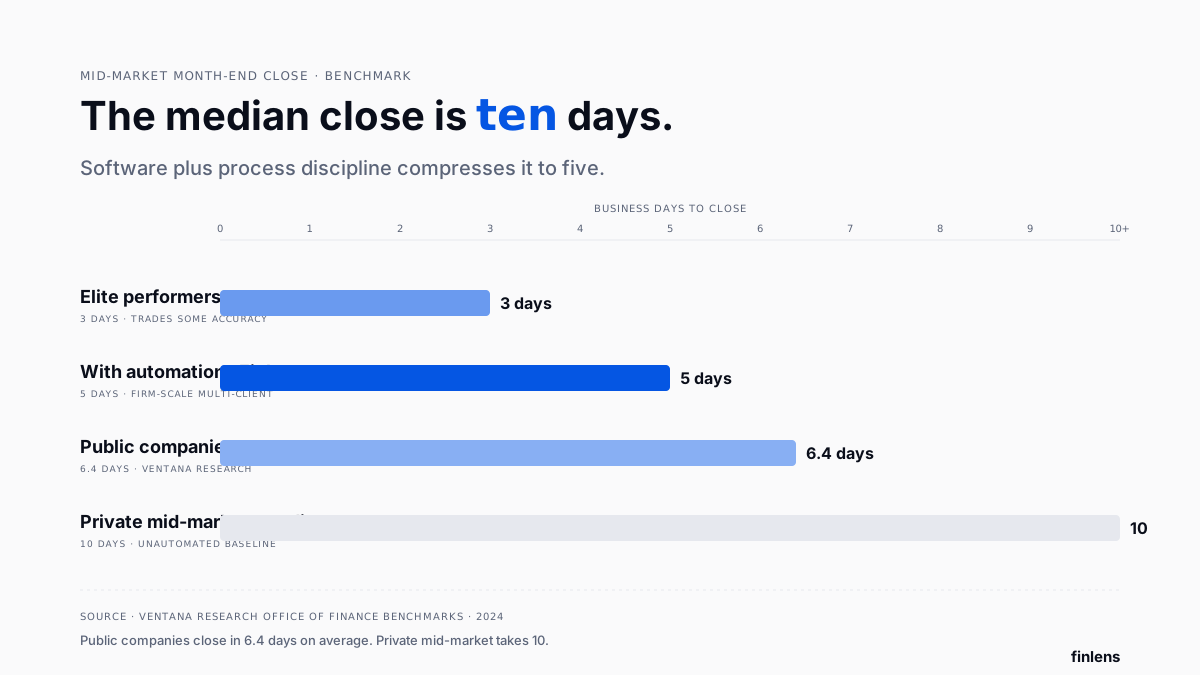
- Mid-market finance teams typically close in 6-10 business days per Ventana Research Office of Finance benchmarks public companies average 6.4 days, private companies average 10. Cutting to 3-5 days requires software that manages tasks, approvals, and reconciliation cadence, not just automates journal entries.
- A commenter on r/Accounting discussing 2-day close noted that speed and accuracy trade off directly: "when C-suite wanted close to go from 7 to 4 days our director told them that's only possible if you'll allow bigger variances." Close-management software resolves tradeoff by automating reconciliation and review steps that would otherwise force manual variance work.
- Task management + approval routing + reconciliation depth are three features that decide whether a mid-market team can hit 5-day close consistently. Finlens, FloQast, and Numeric all deliver on three; DataRails, Vena, and Prophix layer FP&A/consolidation on top.
- For CPA firms managing many clients on QuickBooks Online, Finlens is only option that runs close automation across every client book from one dashboard other platforms are built for a single in-house team on a single GL.
- Finlens automates AI categorization, reconciliation, GAAP schedules, and multi-client exception review turning a 12-day close on QBO client books into a 5-day close across firm's entire portfolio.
Best month-end close software for mid-market companies: comparison table
Pricing reflects published or reported starting tiers as of early 2026 for standard configurations. FloQast, Vena, and Prophix are contact-sales only.
The 6 best month-end close software tools for mid-market companies
1. Finlens
Overview. Finlens is an AI-native accounting platform used by CPA firms managing QuickBooks Online client books. It automates categorization, reconciliation, approval workflows, and close scheduling across every client in firm's book. Where FloQast and Numeric optimize close for one in-house team on one GL, Finlens optimizes it for a firm handling 20-200 QBO client books in parallel same automations apply once and run everywhere. Free tier is available for small businesses closing their own books.
Best for. CPA firms and CAS providers managing many QuickBooks Online client books that need close time cut from 10-12 days per client to 3-5 days. Also fits SMBs closing their own QBO books that want AI-native automation without moving off QBO.
Key features. AI transaction categorization with client-specific learned rules, automated bank and credit card reconciliation, GAAP schedule generation, multi-client exception review from one dashboard, close checklist automation, approval workflows with tamper-evident audit log, and pricing tier management for CPA firm engagement models.
Pricing. Free tier available for small businesses. Paid tiers custom-quoted for CAS firms based on client count and complexity.
Limitations. Not a consolidation platform for multi-entity roll-ups across 5+ entities on separate GLs, a dedicated tool like Prophix is a better fit for a consolidation layer.
Where it breaks. Enterprise SOX-restricted environments that require named-user segregation across specific role packages that don't map to Finlens' firm-level access model.
2. FloQast
Overview. FloQast is a mid-market close-management category default. It sits on top of an existing GL (QuickBooks, NetSuite, Sage Intacct, Oracle) and provides close checklist management, task ownership, reconciliation storage, and audit trails. Verified pricing on floqast.com/pricing shows tailored packages built around value, not per-user headcount. A user on r/Accounting discussing FloQast vs BlackLine noted "Recently switched from BlackLine to FloQast and am pleased with transition. Much cleaner UI, better integration with excel + sharepoint, and easier to manage."
Best for. In-house finance teams of 20-200 people on any mainstream GL who want a category leader for close checklist and reconciliation without moving to enterprise BlackLine.
Key features. Close checklist with task ownership, reconciliation storage tied to accounts, sign-off workflows, variance analysis, close analytics dashboard, tie-out with GL, audit trail, Excel and Sharepoint integrations, and AI-agent reconciliation on higher tiers.
Pricing. Contact sales tailored packages built around outcomes rather than per-user seats. Reported market pricing from Reddit renewal discussions puts standard packages in $25,000-$50,000/year range for mid-market.
Limitations. Contact-sales-only pricing makes budget forecasting harder. Not built for multi-client CPA-firm use cases designed for one company closing its own books.
Where it breaks. CPA firms managing many QuickBooks client books per-firm-instance pricing model doesn't scale to 50 clients.
3. Numeric
Overview. Numeric is modern async-native close-management platform. Priced transparently at $30/user/month on Essentials tier per numeric.io/pricing, it's mid-market entrant that competes with FloQast on task management + reconciliation but adds AI-driven reviewer flows and stronger async collaboration for remote-first finance teams.
Best for. Remote or distributedmid-market finance teams (5-30 accountants) wanting real-time collaboration on close tasks + AI-generated reviewer notes.
Key features. Close project management for month/quarter/year-end, preparer/reviewer segregation of duties, holiday calendar upload, review notes with custom categories, Slack integration with daily digest, email request automations, and a technical AI Assistant that flags variances and generates reviewer notes.
Pricing. $30/user/month Essentials · Custom for Business and Enterprise tiers.
Limitations. Newer than FloQast smaller reference customer base for buyers who want enterprise references. AI reviewer flows are strong but require setup investment.
Where it breaks. Very large teams needing SOX-restricted segregation across 50+ named users enterprise pricing gets steep vs. per-user starting rate.
4. DataRails
Overview. DataRails is an Excel-native FP&A platform that includes a close module. For finance teams that live inside Excel and don't want to migrate to a browser-first tool, DataRails augments existing workbook layer with cloud collaboration, versioning, and roll-forward automation.
Best for. Mid-market finance teams (5-50 people) that already run reporting, budgeting, and close in Excel and want to keep that workflow.
Key features. Excel-native close workflows, budget/forecast/actuals in same platform, roll-forward automation, drill-down from consolidated reports into transaction detail, and multi-entity reporting.
Pricing. Custom (reported starting from ~$1,200/month for small mid-market).
Limitations. Not a dedicated close platform close module sits alongside FP&A rather than being primary product. Weaker on close-specific features like preparer/reviewer sign-off compared to FloQast or Numeric.
Where it breaks. Finance teams that want to move off Excel DataRails' entire value prop is preserving Excel.
5. Vena
Overview. Vena is an enterprise-adjacent platform with mid-market accessibility. It brings SOX-grade controls and audit trails without requiring full BlackLine implementation a middle ground for companies that need compliance depth but not enterprise budget.
Best for. Companies at top of mid-market range (100-500 employees) that need SOX-ready controls, external audit sign-off, and close + consolidation in one platform.
Key features. Close checklist with control mapping, SOX audit trail, multi-entity consolidation, budget/forecast integration, Excel-based interface with cloud data model, and role-based access.
Pricing. Custom (typically $30,000+/year for standard mid-market).
Limitations. Complex setup implementation typically takes 3-6 months. Learning curve is steeper than FloQast or Numeric.
Where it breaks. Small mid-market (under 50 people) platform's control depth is overkill and setup cost isn't justified.
6. Prophix
Overview. Prophix is a close + consolidation platform aimed at multi-entity mid-market businesses. It handles consolidation layer that Finlens and FloQast don't, making it fit when a business is closing books for 3-10 entities each month and rolling them up.
Best for. Multi-entity mid-market businesses (holding companies, PE portfolios, multi-brand retail) consolidating 3-10 entities monthly.
Key features. Multi-entity consolidation, intercompany elimination, FX revaluation, close checklist, workflow automation, and reporting layer for consolidated financials.
Pricing. Custom.
Limitations. Consolidation is strength; single-entity close workflows are lighter than FloQast or Numeric. Not fit for CPA firms managing many separate client books.
Where it breaks. A single-entity company's consolidation layer sits unused.
The close-in-5-days framework what software actually needs to do
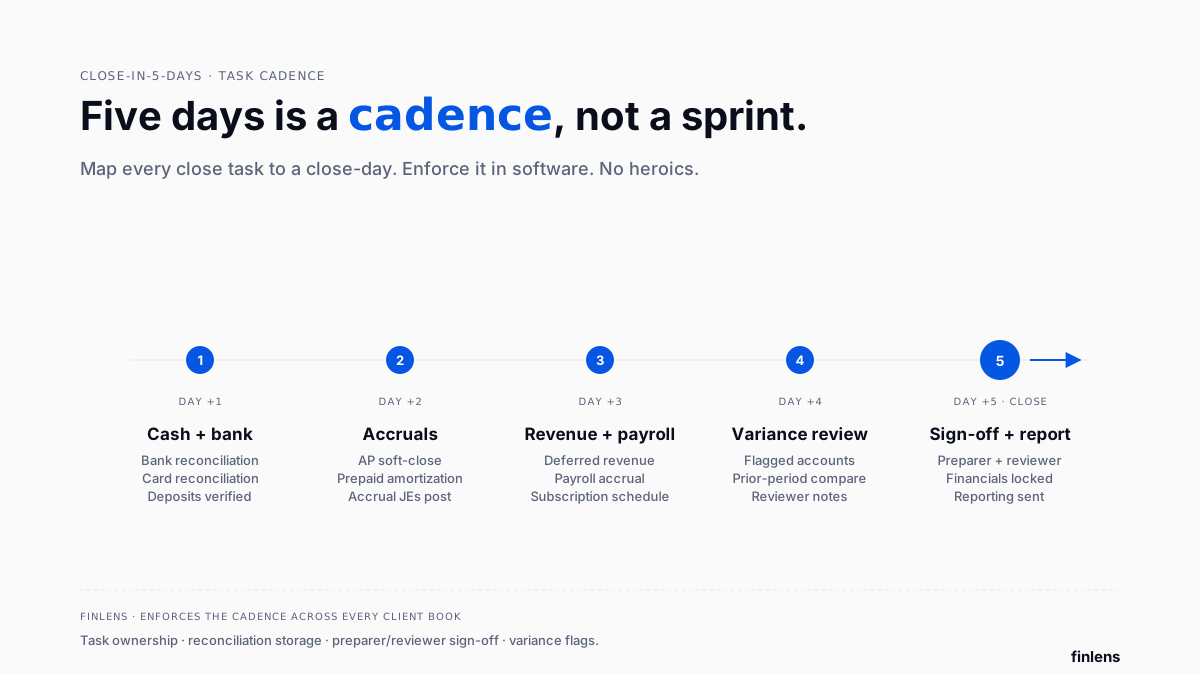
Cutting a 10-day close to 5 days isn't about buying software and hoping. It requires close software to handle four specific workflows:
- Task ownership + due dates. Every close task (bank reconciliation, revenue accrual, payroll accrual, subscription revenue schedule, prepaid amortization, fixed-asset roll-forward) needs a named owner and a deadline mapped to a close-day number (D+1, D+2, D+3). FloQast and Numeric are strongest here. Finlens automates this across every client book in a CPA firm.
- Reconciliation storage tied to account. Bank reconciliations, credit card reconciliations, and balance-sheet account reconciliations all need supporting documentation attached at account level. When auditor asks, workpaper is one click away. All six vendors handle this to varying depths.
- Preparer/reviewer sign-off. SOX-grade or not, every close needs someone preparing and someone reviewing. The software enforces two-role sign-off with an audit trail. FloQast, Numeric, and Finlens all handle this natively; DataRails and Vena require configuration.
- Variance analytics and flag routing. Once close tasks are done, someone reviews variances vs. prior period + budget. Automation flags unusual variances for follow-up rather than making reviewer manually check every account. Numeric's AI Assistant, FloQast's variance module, and Finlens' AI categorization + exception review all do this.
A commenter on r/Accounting about month-end close being "where processes go to die" pointed out that speed comes from process consistency, not heroics. "You do it day by day through month so that at closing you're just tying bow. There should be no surprises." Software's job is enforcing that day-by-day cadence not compressing 5 days of manual work into 3.
Which month-end close software should you choose
- Use Finlens if you're a CPA firm or CAS provider managing multiple QuickBooks Online client books and need to cut close time across whole client portfolio, not just one company's close.
- Use FloQast if you're an in-house finance team of 20-200 on any mainstream GL and want mid-market category default with strong task tracking + reconciliation.
- Use Numeric if you're a remote-first or async-heavy mid-market finance team wanting modern AI-assisted reviewer flows and transparent per-user pricing.
- Use DataRails if your finance team lives in Excel and wants to add close workflow + collaboration without leaving Excel.
- Use Vena if you need SOX controls and audit-ready workflows at mid-market scale without moving to BlackLine.
- Use Prophix if you're a multi-entity business closing and consolidating 3-10 entities each month.
Common mid-market close software mistakes
Buying software before fixing process. A user on r/Accounting about painful month-end closing noted that "bottleneck is almost always reconciliation step, not close itself, and that's a people-and-process problem." Buying FloQast to fix a broken accrual process doesn't help. Map current close, identify two biggest bottlenecks, then pick software that solves those specific steps.
Assuming AI reviewer notes replace reviewer. Numeric's AI Assistant and Finlens' AI categorization generate variance flags and suggested reviewer notes they don't replace reviewer. The reviewer still signs off; software just makes review faster.
Missing CPA-firm vs. in-house-team distinction. FloQast, Numeric, DataRails, Vena, and Prophix are designed for one company closing its own books. If you're a CPA firm managing 20 client books, per-firm pricing multiplied by 20 clients doesn't scale Finlens is tool built for that use case.
Skipping accrual foundation. A r/Accounting commenter on how to hit 2-day close noted: "You can only accrue what you know about. Something always pops up mid month." Software can automate reconciliation and workflow it can't tell you what accrual you don't know about. The process discipline is upstream of tool.
Confusing FP&A with close. DataRails, Vena, and Prophix are FP&A/consolidation-first with a close module. FloQast, Numeric, and Finlens are close-first. If primary problem is closing, buy a close-first tool; if it's budgeting + reporting, buy FP&A.
Common close software integrations to verify
- General ledger connection direct API to QuickBooks Online, NetSuite, Xero, Sage Intacct, or Oracle. Finlens is QBO/Xero-native; FloQast supports all major mid-market GLs; Numeric focuses on cloud GLs.
- Bank feed and card feed sync for bank reconciliation depth, tool needs live feeds, not just CSV upload.
- Excel/Sheets integration most close workpapers still live in Excel. FloQast's Excel + SharePoint integration and DataRails' Excel-native model are strongest.
- Slack integration for async teams, close notifications and daily digests inside Slack drive faster review.
- Multi-client access (CPA firms) Finlens is only tool in this comparison built for firm-scale multi-client access from day one.
- SOX audit trail Vena and FloQast (higher tiers) have deepest audit-trail features.
Conclusion
Mid-market month-end close software isn't a single category it's three overlapping ones (close-first, FP&A + close, consolidation + close) and one specialized lane for CPA firms. For in-house teams on a single GL, FloQast is category default; Numeric is modern async challenger. For CPA firms managing many QuickBooks Online client books, Finlens is only option built for firm-scale automation across entire portfolio.

Frequently asked questions
What is month-end close software for mid-market companies
Month-end close software manages tasks, reconciliations, approvals, and reporting required to close books each month. For mid-market companies (50-500 employees), it typically includes close checklist automation, reconciliation storage, preparer/reviewer sign-off, and variance analytics. Finlens, FloQast, and Numeric are three close-first platforms in this comparison.
What's difference between FloQast and Numeric
FloQast is older mid-market category default with widest customer base and strongest task-tracking features. Numeric is newer async-native alternative priced transparently at $30/user/month on Essentials tier, with AI-driven reviewer flows that FloQast added later. FloQast is contact-sales pricing; Numeric publishes per-user rates for entry tier.
How long should a mid-market close take
Public companies average 6.4 days; private mid-market averages 10 days per Ventana Research benchmarks. With close-management software plus process discipline (soft-close AP 3-5 days before month-end, daily reconciliation cadence), most mid-market teams can reach 3-5 days. Under 3 requires accepting bigger variances for speed.
Can a CPA firm use FloQast or Numeric across multiple client books
Not efficiently. Both are designed for one in-house team closing one company's books. CPA firms managing many QuickBooks client books need firm-scale automation like Finlens, which runs close automation across every client from one dashboard rather than requiring a per-firm-instance setup per client.
What is a close-in-5-days framework
A close-in-5-days framework maps every close task to a specific close-day (D+1, D+2, etc.) with named owners, then uses software to enforce schedule. Bank reconciliation and cash review happen D+1. Accrual JEs post D+2. Revenue and payroll close D+3. Variance review + management reporting D+4-5. FloQast, Numeric, and Finlens all support building this framework in software.
Does Finlens replace QuickBooks Online
No. Finlens layers on top of QuickBooks Online (and Xero) it does not replace general ledger. For CPA firms with client books on QBO, Finlens automates categorization, reconciliation, and close workflows on top of existing QBO chart of accounts. Standalone accounting is a secondary use case; primary is QuickBooks-compatible firm-scale automation.
How much does mid-market month-end close software cost
Numeric starts at $30/user/month. FloQast, Vena, and Prophix are contact-sales reported market ranges are $25,000-$50,000/year for FloQast, $30,000+ for Vena. DataRails typically starts around $1,200/month. Finlens has a free tier for small businesses and custom paid pricing for CPA firms based on client count.
What integrations should I check before buying close software
Verify direct API integration with your general ledger (QuickBooks Online, NetSuite, Xero, Sage Intacct, Oracle), live bank and card feeds (not CSV upload), Excel/Sheets integration for workpapers, Slack for async notifications, and if you're a CPA firm multi-client access from one dashboard. Finlens, FloQast, and Numeric all support first four; only Finlens supports fifth.

