
Bookkeeping vs Accounting: The Real Difference (And Which One You Need)


Bookkeeping is day-to-day recording of financial transactions entering invoices, categorizing expenses, matching payments to bank statements. Accounting is analysis, reporting, and interpretation of those records preparing financial statements, filing tax returns, and advising on strategic decisions.
Bookkeeping is data entry with rigor. Accounting is what turns that data into information business can act on. Most small businesses need both. Whether you need them from different people, same person, or software depends on your scale, complexity, and how much financial insight you want.
What a bookkeeper actually does
A bookkeeper's job is ongoing operational work of keeping books current and clean. Concretely:
- Records every business transaction sales invoices, vendor bills, employee expenses, bank fees, interest income
- Categorizes each transaction to correct chart-of-accounts line
- Reconciles bank and credit card statements monthly against general ledger
- Manages accounts payable enters bills, schedules payments, tracks vendor balances
- Manages accounts receivable sends invoices, records payments, follows up on overdue balances
- Runs payroll either directly or via a payroll provider (Gusto, QuickBooks Payroll, ADP)
- Prepares 1099s for contractors at year-end
- Produces monthly reports P&L, balance sheet, aging reports as inputs to accountant
A bookkeeper's output is a clean, current, reconciled set of books at month-end. That output is raw material an accountant then works from.
Typical qualifications: no state license required. Certification available through AIPB (American Institute of Professional Bookkeepers) or NACPB (National Association of Certified Public Bookkeepers). Many bookkeepers hold a QuickBooks ProAdvisor or Xero certification. Rates typically $30–$75/hour for freelance bookkeepers, $250–$2,500/month for outsourced monthly bookkeeping packages depending on transaction volume.
What an accountant actually does
An accountant works at a higher level of analysis. Their work generally includes:
- Prepares financial statements GAAP-compliant P&L, balance sheet, cash flow statement, statement of equity
- Files tax returns Schedule C for sole props, Form 1120 for C-corps, Form 1120-S for S-corps, Form 1065 for partnerships, personal 1040s
- Advises on tax strategy entity structure, S-corp elections, retirement plan design, quarterly estimated tax planning
- Handles complex accounting transactions depreciation elections (Section 179 vs bonus), revenue recognition (ASC 606), lease accounting (ASC 842), deferred revenue mechanics
- Prepares management reports variance analysis, KPI dashboards, cash flow projections
- Represents client in IRS matters audits, notices, penalty abatement, installment agreements
- Provides audit and assurance for CPAs performing audit, review, or compilation engagements
Typical qualifications: at least a bachelor's degree in accounting. CPA license (Certified Public Accountant) requires passing CPA exam, meeting state education requirements (usually 150 credit hours), and completing an experience requirement. See AICPA overview of CPA credential for state-by-state licensing rules. EA (Enrolled Agent) a federal credential specifically for tax representation, with no state boundary. Both CPAs and EAs can represent taxpayers before IRS.
Rates: bookkeepers $30–$75/hour; staff accountants $50–$125/hour; CPAs and EAs $150–$400/hour depending on region, specialization, and firm.
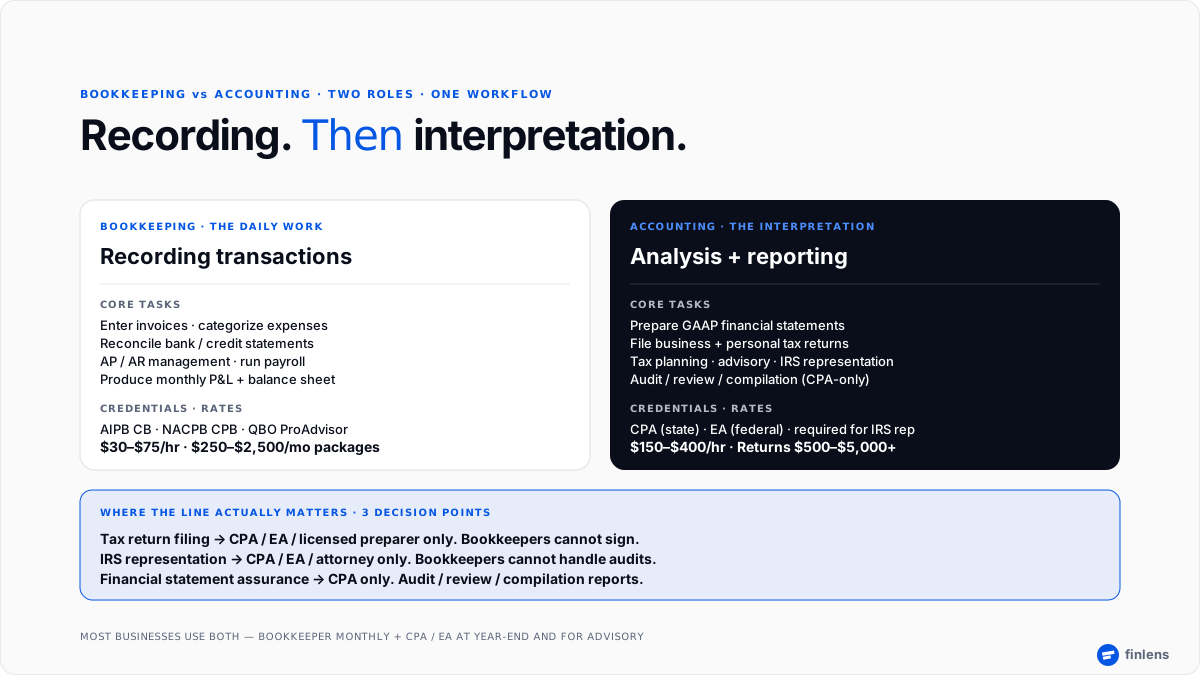
The overlap zone
In practice, line between bookkeeping and accounting blurs at small scale. A solo bookkeeper who has been with a business for years often does a lot of what would technically be "accounting" reviewing books for adjusting entries, preparing rough financial statements, discussing tax planning ideas with owner. A staff-level accountant at a small firm often does bookkeeping-level work during busy periods.
The distinction matters most at three specific decision points:
1. Tax return preparation. Bookkeepers don't file tax returns for clients. That work is done by CPAs, EAs, or unlicensed tax preparers with a PTIN. Even if your bookkeeper knows entries cold, return itself needs a preparer with signature authority.
2. IRS representation. Only CPAs, EAs, and attorneys can represent taxpayers before IRS. If you get an audit notice, your bookkeeper cannot handle it.
3. Financial statement assurance. Audit, review, and compilation reports require a CPA. Bookkeepers cannot issue any of these.
For everything else transaction recording, reconciliation, monthly close, AP/AR, payroll, management reporting either bookkeeper or accountant can handle work. The cost difference is deciding factor for most small businesses.
When you need a bookkeeper
You need a bookkeeper as soon as transaction volume outgrows what you can maintain reliably yourself. Practical triggers:
- More than 50 transactions per month
- You are missing month-end close because it takes too long
- Reconciliation is running weeks behind
- You have contractors approaching $600 1099 threshold and no clean records
- You are considering hiring your first employee (payroll adds complexity)
- Your accountant is charging you accountant-level rates for cleanup work that shouldn't need a CPA
When you need an accountant
You need an accountant (CPA or EA) at these specific inflection points:
- You need to file business tax returns required for almost every entity, annually
- You are considering entity structure changes S-corp election, LLC conversion, C-corp status
- You have received an IRS notice even a small notice benefits from professional review
- You are raising capital or preparing for a sale investors and buyers require GAAP-compliant statements
- You need advisory work tax planning, quarterly estimated payments, retirement plan design, advisory services
- You crossed a compliance threshold sales tax nexus, 1099 filings, payroll tax deposits, multi-state operations
Bookkeeper + accountant + software: how firms actually stack roles
Most growing businesses end up with a hybrid stack:
Software (Finlens, QuickBooks Online, Xero) handles transaction recording, automated categorization, bank feed sync, basic reporting. Replaces a portion of manual bookkeeping work.
Bookkeeper (in-house or outsourced) reviews software categorizations for accuracy, handles exception review, closes books monthly, runs AP/AR workflows, produces month-end reports.
Accountant / CPA firm files tax returns, provides quarterly tax planning, reviews and adjusts entries at year-end, handles IRS correspondence, delivers strategic advice.
This stack is why accounting profession has moved toward "CAS (Client Advisory Services)" model firms bundling bookkeeping automation, monthly review, and strategic advisory into a single monthly retainer, with software handling highest-volume work automatically.
Cost comparison in practice
Using a CPA to do work a bookkeeper could handle is one of fastest ways to inflate professional fees. Using a bookkeeper to do work that legally requires a CPA (returns, representation, statements) is a compliance risk. Match work to credential.
Conclusion
Bookkeeping is daily work. Accounting is what makes daily work useful. Most small businesses need both bookkeeping done consistently through year, accounting done at year-end for taxes and periodically for strategy. Match work to credential: use a bookkeeper for what a bookkeeper does; use a CPA or EA for what only they can do.
FAQ
Is bookkeeping same as accounting?
No. Bookkeeping is day-to-day recording of transactions. Accounting is analysis, reporting, and interpretation of those records. Bookkeeping produces raw data; accounting produces insight and files returns.
Can a bookkeeper file my tax return?
No. Filing a business tax return requires a preparer with a PTIN (Preparer Tax Identification Number). Most bookkeepers do not hold a PTIN. CPAs, EAs, and licensed tax preparers file returns.
Do I need a CPA or can a bookkeeper do everything?
A bookkeeper can handle transaction recording, reconciliation, AP/AR, payroll, and monthly reporting. You need a CPA or EA for tax return filing, IRS representation, financial statement assurance, and strategic tax planning. Most small businesses use both bookkeeper for ongoing work, CPA at year-end and for advisory.
What's cheaper: a bookkeeper or an accountant?
A bookkeeper. Rates typically run $30–$75/hour for freelance bookkeepers versus $150–$400/hour for CPAs. Monthly outsourced bookkeeping packages run $250–$2,500 depending on transaction volume; monthly CPA advisory retainers run $500–$5,000+.
What software do bookkeepers use?
QuickBooks Online is US category default. Xero is a common alternative, particularly for internationally-operating businesses. Bookkeepers may also use Wave (free tier for small clients), FreshBooks (service businesses), or specialized platforms like Finlens for AI-native categorization on top of QuickBooks or Xero.
Do I need bookkeeping if I use accounting software?
Yes software automates recording but does not replace judgment and review work of a bookkeeper. Automatic categorization needs exception review; bank reconciliation needs sign-off; unusual transactions need coding decisions. Software plus a bookkeeper is significantly better than software alone.
How often should I do bookkeeping?
Monthly at minimum. Weekly is better for businesses with high transaction volume, tight cash flow, or active AR/AP management. Real-time bookkeeping (transactions categorized as they clear bank) is possible with modern automation and is standard for CAS firms managing many client books.
What credentials should I look for in a bookkeeper or accountant?
Bookkeeper: AIPB Certified Bookkeeper (CB) or NACPB Certified Professional Bookkeeper (CPB) is a strong signal. QuickBooks ProAdvisor or Xero certified is table stakes. Accountant: CPA (state-licensed) or EA (federal) for anyone who will represent you before IRS. For advisory-only work without IRS representation, no license is technically required but professional certification is a strong indicator of competence.

