
Cost Segregation for Real Estate


Cost segregation for real estate is an IRS-approved tax strategy that accelerates depreciation deductions by breaking a building into individual components 5-, 7-, and 15-year MACRS property instead of depreciating entire property over 27.5 years (residential rental) or 39 years (commercial). The reclassification is documented in an engineering-based cost segregation study performed by qualified specialists.
Under One Big Beautiful Bill Act (OBBBA) effective for property acquired and placed in service after January 19, 2025, 100% bonus depreciation is restored meaning short-life components identified by study can absorb full first-year deduction, generating dramatic tax savings for owners of newly acquired commercial and residential rental property. This guide walks mechanics, OBBBA implications, look-back mechanics using Form 3115, break-even thresholds, and workflow CPA firms actually run.
Key takeaways
- Cost segregation study reclassifies building components from 27.5 or 39-year property into 5-, 7-, and 15-year MACRS classes
- OBBBA 100% bonus depreciation (post-1/19/2025) means short-life components can fully expense in year 1
- Look-back studies on already-placed-in-service property use Form 3115 with §481(a) catch-up no amended returns needed
- Study cost: $5,000–$20,000+ per property; break-even generally at $500K+ depreciable basis
- Best fit: short-term rentals, multi-family, medical/dental, hospitality, warehouses, retail properties with 20-30% of basis in short-life components
- Finlens automates QBO ledger cleanup capital improvements, placed-in-service dates, cost basis that feeds study's input schedule
The 2026 baseline why cost segregation is bigger than it was 18 months ago
For any real estate investor holding property depreciated over 27.5 or 39 years under default MACRS, cost segregation has always been a lever. But pre-OBBBA phase-down of bonus depreciation (60% in 2024, scheduled to hit 40% in 2025 and 20% in 2026) had made strategy materially less valuable 5-, 7-, and 15-year components identified by a study could only capture a partial first-year deduction.
OBBBA reset that trajectory. Effective for qualifying property acquired AND placed in service after January 19, 2025, 100% bonus depreciation is restored permanently. The math on a cost segregation study now looks like it did in 2017–2022:
- A $2,000,000 commercial building purchase, without cost seg, generates ~$51,282 of annual depreciation ($2M ÷ 39 years)
- The same property with a cost segregation study identifying $500,000 of 5-, 7-, and 15-year components, applying 100% bonus depreciation: $500,000 first-year deduction (from reclassified components) + $38,462 regular MACRS on remaining $1.5M ÷ 39 years = **$538,000 first-year deduction**
- Net effect: ~$486,000 additional first-year deduction vs no study. At a 37% federal marginal rate, ~$180,000 tax savings deferred to year 1.
This is why OBBBA reset matters for real estate CPAs. Cost segregation went from "worth it if property is big enough" back to "worth it on almost anything with $500K+ of depreciable basis."
Related: Section 179 vs bonus depreciation (MACRS) covers underlying bonus depreciation and OBBBA reset in depth.
How a cost segregation study works engineering-based approach
The IRS has published guidance (most recently Cost Segregation Audit Techniques Guide) on what constitutes a defensible cost segregation study. The essential mechanics:
Step 1 Site survey. Engineers or qualified specialists physically inspect property, documenting every component: structural (long-life) vs. non-structural (short-life) elements.
Step 2 Cost allocation. Each component is priced. Contractor invoices, architectural drawings, purchase documents, and third-party valuations drive allocation.
Step 3 MACRS class assignment. Each component is placed into its correct recovery class:
- 5-year property: carpeting, decorative lighting, cabinetry, specialized electrical for equipment, appliances
- 7-year property: office furniture, certain machinery
- 15-year property (Qualified Improvement Property / land improvements): parking lots, sidewalks, landscaping, exterior signage, fencing
- 27.5-year (residential) or 39-year (commercial) property: residual building shell walls, roof, foundation, general HVAC
Step 4 Engineering report. The study produces an audit-ready deliverable with:
- Property description and site photos
- Cost allocation methodology
- Component-by-component MACRS class assignment
- Legal citations (Rev. Proc., IRS guidance, tax court precedent)
- Engineer's signature
Step 5 Return integration. The CPA firm applies reclassifications to client's depreciation schedule, generating Form 4562 (Depreciation and Amortization) with new asset classes.
Related: Section 174 R&D capitalization guide covers parallel engineering-workpaper standard for R&E capitalization workpapers.

Figure 1. A cost segregation study moves 20-30% of property's basis from 27.5/39-year default schedule into 5, 7, and 15-year MACRS classes where 100% bonus depreciation applies.
What property qualifies and when strategy is worth it
Not every real estate holding is a candidate. The mature-firm decision matrix:
Strong candidates (high 5/7/15-year component ratios):
- Short-term rentals (Airbnb, VRBO) furniture, appliances, decorative finishes typically 25-35% of basis
- Multi-family (apartments) 20-25% of basis in cabinetry, appliances, flooring, land improvements
- Medical/dental buildings specialized wiring, equipment mounts, plumbing typically 25-30%
- Restaurants and hospitality kitchen equipment, decorative finishes, exterior improvements 30%+
- Retail buildings signage, specialized fixtures, parking 20-25%
- Warehouses/industrial dock equipment, specialized electrical, land improvements 20-25%
Weak candidates:
- Vacant land (no building)
- Raw shell buildings with no build-out (owner will do it later study makes more sense post-build)
- Long-term rentals of unfurnished apartments below $500K basis threshold
- Property expected to be sold within 3-5 years (recapture eats benefit)
Break-even threshold: typically $500,000 in depreciable basis. Below that, $5K-$20K study cost may exceed present-value tax benefit. Above $1M, ROI is almost always positive for eligible property types.
Study cost by property type:
- Single-family short-term rental: $3,000–$6,000
- Small multi-family (4-20 units): $5,000–$10,000
- Mid-size commercial (< $5M basis): $8,000–$15,000
- Large commercial (> $5M basis): $15,000–$40,000+
Look back studies using Form 3115 on already-placed-in-service property
The most common misconception about cost segregation is that study has to happen in year property is placed in service. It doesn't. Look-back studies on property owned for years sometimes decades capture missed depreciation as a §481(a) adjustment via Form 3115.
The look back mechanic:
- Property was placed in service in a prior year (say, 2020) using default 27.5 or 39-year straight-line depreciation
- In 2026, owner engages a cost segregation study
- Study reclassifies portions of basis into 5-, 7-, and 15-year property retroactive to 2020
- The additional depreciation that should have been claimed 2020–2025 is calculated sum of five prior years' catch-up
- File Form 3115 (Change in Accounting Method) automatic consent, no user-fee required for cost segregation
- The catch-up depreciation is claimed on current year return as a §481(a) adjustment no amended returns, no interest paid
For a $2M commercial property placed in service in 2020 where a 2026 look-back study identifies $500K of short-life components, §481(a) catch-up can be $200K-$400K of additional current-year deduction. This is often single biggest planning move a CPA firm makes for a real estate client in a given year.
Look back caveat under OBBBA: 100% bonus depreciation restoration applies to property acquired after 1/19/2025. For pre-2025 acquisitions, bonus depreciation on look-back-reclassified components follows acquisition-year's bonus percentage (100% pre-2023, 80% in 2023, 60% in 2024, phased down). The §481(a) adjustment captures straight-line difference on reclassified life, not bonus depreciation on look-back components check with engineering firm and return preparer on specific interaction.
The Section 179 and bonus depreciation interaction after OBBBA
Cost segregation studies live on top of same MACRS regime as Section 179 and bonus depreciation. On property acquired after 1/19/2025, reclassified short-life components typically flow through following order:
- Section 179 expensing (Part I of Form 4562) up to 2026 limit of $2,560,000, subject to net income limitation. For short-term rental owners with W-2 income and passive-activity-loss rules, §179 usually can't be used on rental property (rental doesn't rise to trade-or-business status for most owners) bonus depreciation is primary lever.
- Bonus depreciation (Part II of Form 4562) 100% under OBBBA for property acquired and placed in service after 1/19/2025. Applied class-wide (all 5-year property or none, all 7-year property or none, etc.).
- Regular MACRS depreciation (Part III) declining-balance recovery on remaining basis, including residual 27.5/39-year building shell.
For a real estate professional (per §469(c)(7) material participation) with active-business status, §179 and bonus depreciation on cost seg components can generate current-year deductions large enough to offset non-passive income. For passive investors, deductions are typically limited to passive rental income unless short-term rental exception (average stay ≤7 days) applies.
Related: QBI deduction (Section 199A) 2026 covers how depreciation and passive-loss interactions flow to QBI calculation.
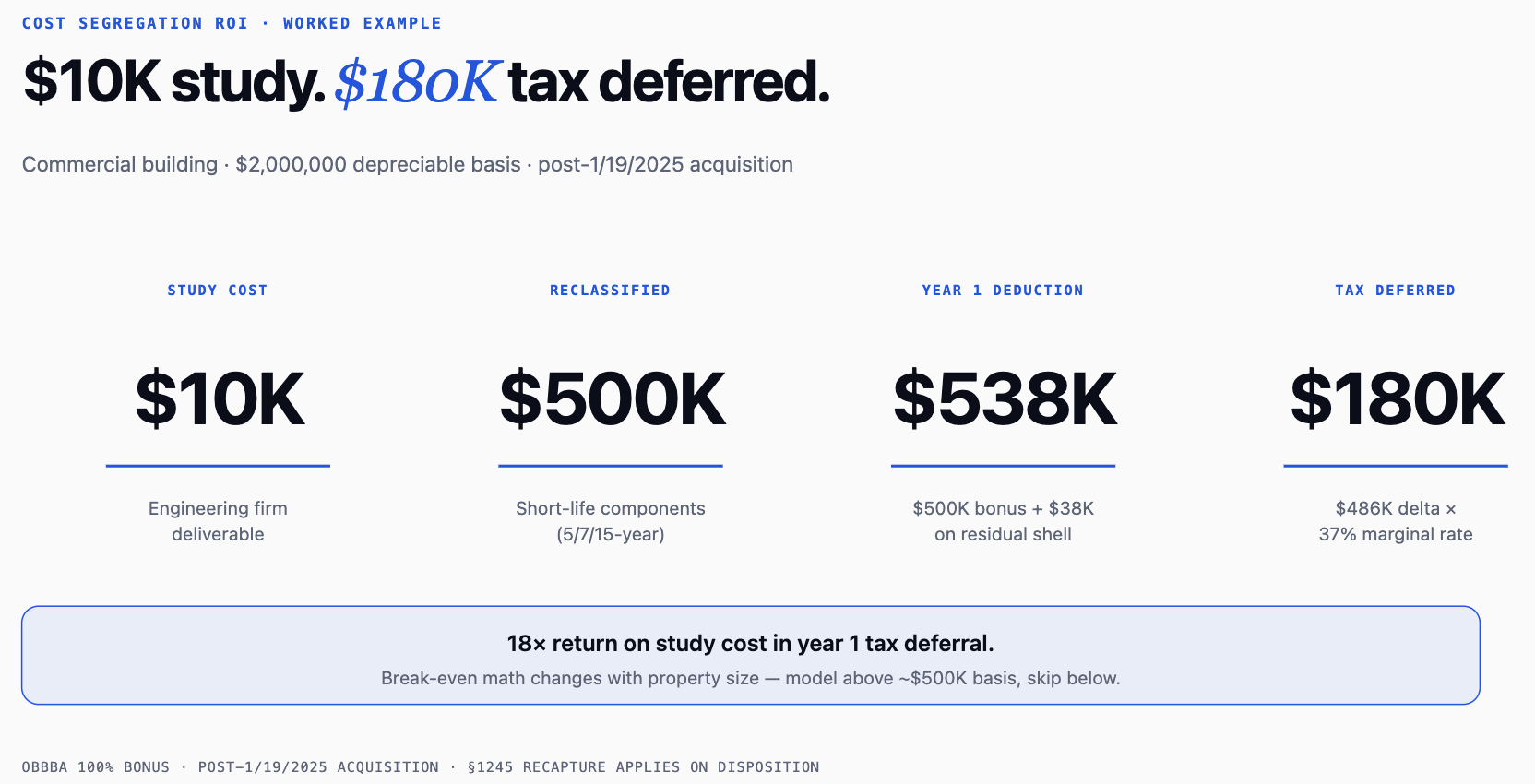
Figure 2. The break-even math on a cost segregation study study cost ~$5K-20K, first-year deduction 20-30% of property basis, at 37% marginal rate tax deferral is typically 10-15× study cost.
The workflow a CPA firm actually runs on a cost segregation client
For any real estate client where cost segregation is on table:
Step 1 Pre-study modeling. Estimate expected 5/7/15-year component ratio based on property type. Multiply by depreciable basis. Multiply by client's federal marginal rate + state rate. Present a rough deduction estimate before engaging study.
Step 2 Engineering firm selection. ASCSP-affiliated (American Society of Cost Segregation Professionals) firms tend to produce audit-defensible reports. KBKG, CBIZ, Cherry Bekaert, and similar national firms offer branded services. Local engineering firms often price lower but check their audit-defense track record.
Step 3 Data gathering. The engineering firm needs: closing statement, contractor invoices, architectural drawings, appraisal (if available), property history for improvements and renovations. This is step where messy client books slow whole engagement.
Step 4 Site visit and analysis. Usually 2-6 weeks from engagement to draft report.
Step 5 Draft report review. CPA reviews component allocation before finalization. Push back on aggressive classifications that won't hold up on audit (very common with newer/cheaper engineering firms).
Step 6 Return integration. For a new-year study, apply reclassifications on current-year Form 4562. For a look-back, file Form 3115 with return.
Step 7 Client education on partial dispositions. Every future roof replacement, HVAC upgrade, or renovation triggers a partial disposition opportunity reclassifying retired component and taking a loss deduction. The cost seg study makes this possible; client and CPA need to track it going forward.
Step 8 Multi-year monitoring. State conformity varies. QBI, passive activity, and NOL interactions carry across years. The cost segregation study is not a one-and-done event.
Where cost segregation calculation goes wrong upstream
Every cost segregation study depends on clean records of property's cost basis, capital improvements, and placed-in-service history. The failure points:
- Purchase price not properly split between land and building. Land isn't depreciable; getting split wrong at outset skews entire study.
- Capital improvements booked as repair expenses. A $50K HVAC replacement expensed instead of capitalized never makes it onto depreciation schedule and can't be reclassified.
- Placed-in-service date not documented. Retroactive look-back studies depend on knowing exactly when property (and each improvement) was placed in service.
- Renovations blended with routine maintenance in general ledger. The engineering firm needs to see improvement invoices separately from repair invoices.
- Stripe- or online-processed vendor payments booked net of processing fees. Understates capitalized cost of improvement.
Finlens automates QBO ledger cleanup that feeds these numbers: transaction categorization with per-client rules for capital improvements vs. repairs, Stripe payout decomposition so vendor payments hit at gross, deferred revenue schedules to keep entity income clean for QBI and passive-activity planning. For real estate clients where cost segregation is a material return decision, that upstream cleanup is what makes engineering firm's input pool defensible. Related: Section 174 R&D capitalization covers same upstream-cleanup principle for R&E workpapers.
Conclusion
Pick one real estate client with $500K+ depreciable basis where a cost segregation study is on table bring closing statement, capital improvement invoices, and three months of QBO, and we'll walk fixed asset input pool live before engineering firm is engaged.
Frequently asked questions
What is cost segregation for real estate?
Cost segregation for real estate is an IRS-approved tax strategy that accelerates depreciation by reclassifying components of a building from default 27.5-year (residential rental) or 39-year (commercial) MACRS schedule into shorter recovery periods 5-, 7-, and 15-year property. The reclassification is documented in an engineering-based cost segregation study and increases first-year depreciation deductions substantially.
What is a cost segregation study?
A cost segregation study is engineering deliverable that supports reclassification. Qualified specialists physically inspect property, allocate cost among components (carpeting, wiring, cabinetry, land improvements), assign each component to its correct MACRS class, and produce an audit-ready report with legal citations. The CPA firm uses study to update client's Form 4562 depreciation schedule.
How much does a cost segregation study cost?
Cost segregation studies typically cost $5,000-$20,000+ per property, depending on complexity. A small residential rental study runs $3,000-$6,000. Small multi-family runs $5,000-$10,000. Mid-size commercial (< $5M basis) runs $8,000-$15,000. Large commercial (> $5M) runs $15,000-$40,000+. The general break-even threshold is $500,000 in depreciable basis.
Can my CPA do a cost segregation study?
Rarely well. Most CPAs partner with engineering firms that specialize in cost segregation because deliverable requires physical property inspection, structural analysis, and construction-cost expertise. A CPA can compute tax impact and integrate results into Form 4562, but engineering study itself is best left to ASCSP-affiliated specialists (KBKG, CBIZ, Cherry Bekaert, and similar national firms).
Is it worth it to do cost segregation?
For most properties above $500,000 in depreciable basis that will be held for more than 3-5 years, yes first-year deduction acceleration typically returns 10-15× study cost in deferred tax at client's marginal rate. Under OBBBA (post-January 19, 2025), 100% bonus depreciation makes it materially more valuable than during 2023-2024. Not worth it: properties below $500K basis, properties expected to be sold quickly (recapture concerns), or property types with low 5/7/15-year component ratios.
What property qualifies for cost segregation?
Any depreciable real property purchased or constructed since 1986 qualifies. Best-fit property types (highest short-life component ratios): short-term rentals, multi-family apartments, medical/dental buildings, restaurants, hospitality, retail, warehouses. Not qualifying: raw land, primary residences (no depreciation on owner-occupied property), and properties held less than 1 year.
Can I do cost segregation on my own?
Technically yes, but resulting "study" is unlikely to survive an IRS audit. The IRS Cost Segregation Audit Techniques Guide is explicit about expected engineering standards physical inspection, cost allocation methodology, legal citations. DIY studies without engineering backing get disallowed frequently. Use a qualified firm.
What is a look-back cost segregation study?
A look-back study is a cost segregation study performed on property already placed in service in a prior year. The study identifies previously under-recovered depreciation from 5/7/15-year reclassification. The catch-up depreciation is claimed on current-year return as a §481(a) adjustment via Form 3115 (Change in Accounting Method) no amended returns needed. Look-back studies frequently generate single largest deduction on a real estate client's return in a given year.
Does cost segregation trigger depreciation recapture?
Yes accelerated depreciation reclassifies portions of basis into shorter-life property that is subject to §1245 recapture (ordinary income) on disposition, rather than §1250 recapture (capped at 25% for real property). This is a real cost when property is sold, and part of reason cost segregation makes less sense for property expected to be sold quickly. Multi-year modeling before engaging study is standard practice.
What are disadvantages of cost segregation?
The primary disadvantages: (1) study cost ($5K-20K+), (2) §1245 recapture on eventual sale converts some capital gain to ordinary income, (3) state non-conformity to federal bonus depreciation may require state add-backs, (4) passive-activity loss rules limit current deductibility for non-real-estate-professional investors, (5) partial dispositions on future renovations require tracking. For property under $500K basis expected to be sold quickly, disadvantages typically outweigh benefit.
How does OBBBA affect cost segregation?
OBBBA (P.L. 119-21, effective January 20, 2025) restored 100% bonus depreciation permanently for property acquired and placed in service after 1/19/2025. This means 5-, 7-, and 15-year components identified by a cost segregation study on eligible property can absorb full first-year deduction restoring cost segregation's peak-effectiveness era. For property acquired before 1/19/2025, bonus depreciation follows pre-OBBBA phase-down schedule (60% in 2024, etc.).
Does Finlens compute cost segregation directly?
No engineering study is deliverable of ASCSP-affiliated specialists (KBKG, CBIZ, Cherry Bekaert, etc.). Finlens sits upstream of study: it automates QBO ledger cleanup that feeds study's input pool capital improvements categorized correctly, placed-in-service dates tracked via transaction date with human-in-the-loop review, Stripe-processed vendor payments booked at gross. Clean books make engineering firm's job faster and study's audit defense stronger.
Cost segregation study standards, MACRS class assignments, bonus depreciation percentages, OBBBA acquired-date cutoffs, and Form 3115 mechanics change frequently. This article reflects guidance current as of 2026-07-29 (P.L. 119-21, IRS Cost Segregation Audit Techniques Guide). Verify current thresholds and IRS Form 3115 / 4562 instructions at irs.gov before filing. Nothing in this article is legal or tax advice engage a licensed CPA, EA, or attorney and an ASCSP-affiliated engineering firm for actual cost segregation planning and study performance. Third-party trademarks (QuickBooks®, Stripe®, KBKG®, CBIZ®) belong to their respective owners.

