
Section 174 R&D Capitalization: The Post-OBBBA Rules, Transition Relief


Section 174 was one of most punitive tax changes of last decade TCJA-mandated capitalization of research and experimental (R&E) expenditures that took effect in 2022 and forced software companies, SaaS platforms, and every other R&D-heavy business to amortize their engineering wages over 5 years (domestic) or 15 years (foreign).
Under One Big Beautiful Bill Act (OBBBA), signed in 2025 as P.L. 119-21, that regime is materially over for domestic R&E. New IRC §174A restores immediate deductibility for tax years beginning after December 31, 2024. Foreign R&E must still be capitalized and amortized over 15 years, unchanged. This guide walks OBBBA reset, two-track transition relief (small-business retroactive vs standard 1- or 2-year acceleration), §41 R&D credit coordination trade-off, and what CPA firms are actually filing on Form 3115 in 2026.
Key takeaways
- §174A restores immediate deduction of domestic R&E expenditures for tax years beginning after 12/31/2024
- Foreign R&E remains capitalized + amortized over 15 years no change
- Software development is statutorily R&E under §174 internal-use systems, SaaS platform code, websites, apps all inside
- Small business retroactive election available ≤$31M gross receipts (3-year lookback); everyone else spreads unamortized 2022–2024 costs across 1 or 2 years post-2024
- §41 R&D credit coordination: amended §280C reduces deduction by credit amount unless reduced-credit election is made costs ~21% of credit on affected years
- The R&E calc is only as good as underlying books categorization, wage allocation, contract research tagging. That's where Finlens fits.
The two-era table what changed on January 1, 2025
Rules per P.L. 119-21 (OBBBA) and Rev. Proc. 2025-28 as of 2026-07-29. Verify current guidance at irs.gov.
The three-year TCJA window (2022, 2023, 2024) is closed but not gone unamortized balances from those years are still sitting on client books and have to be worked out under transition rules below.
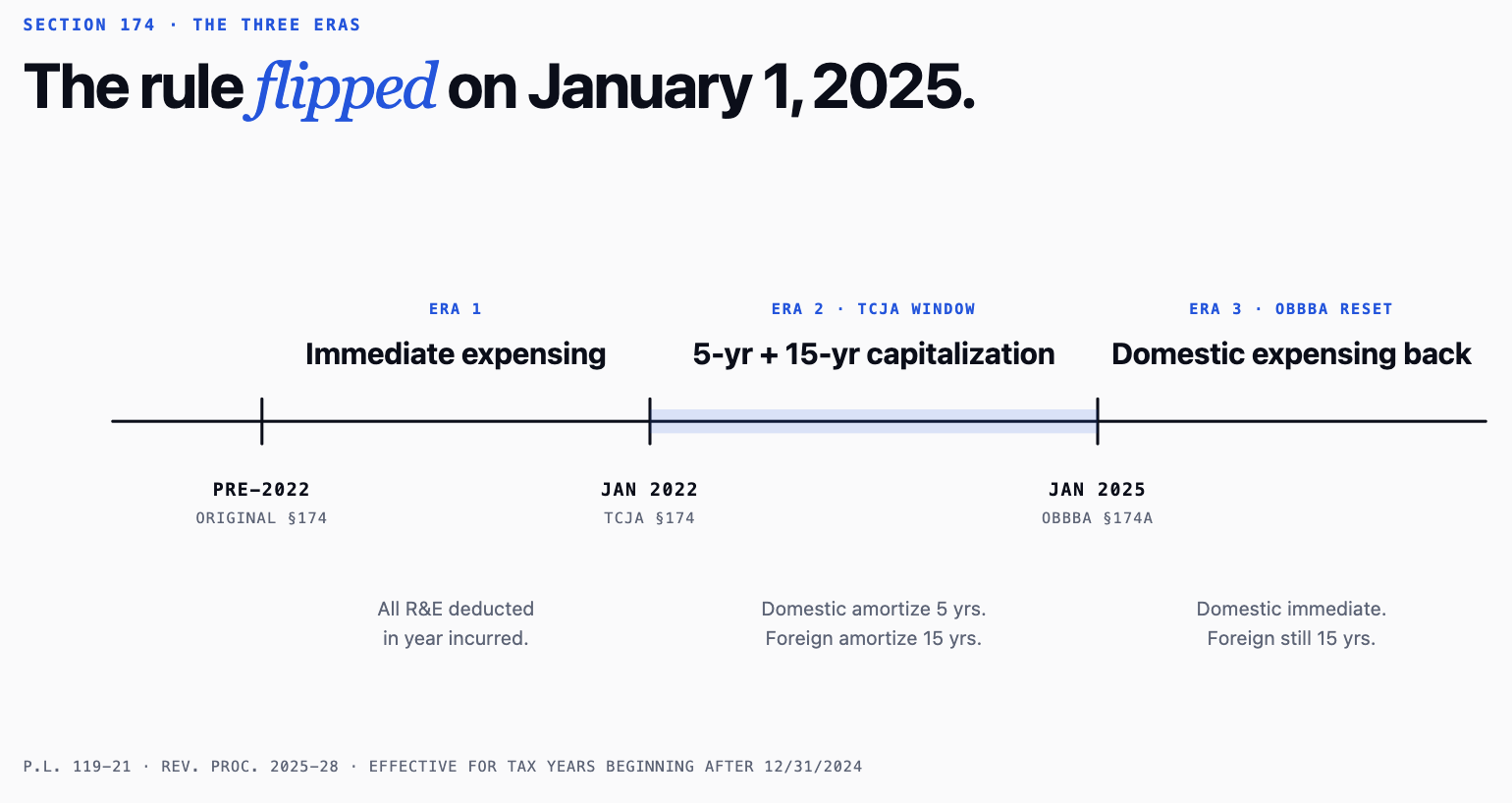
Figure 1. The rule flips on January 1, 2025. Domestic R&E is expenseable again; foreign R&E is not.
What qualifies as an R&E expenditure under §174
The §174 definition is broader than §41 credit a critical fact when computing deduction (or unamortized carryforward) versus credit.
Qualifying activities must involve:
- The development of a new or improved product, process, or service, AND
- Technological uncertainty at outset of work
Qualifying costs include:
- All software development costs statutorily included since TCJA. Internal-use systems, customer-facing SaaS platforms, websites, mobile apps, ERP configuration that constitutes development
- Researcher wages including non-taxable benefits (broader than §41, which limits to Box 1 wages)
- Contract research at 100% (broader than §41 at 65%)
- Direct-supervisor wages allocable to R&E activity
- Supplies consumed in R&E
- Allocable overhead rent, utilities, IT infrastructure tied to R&E
- Equipment depreciation for R&E-dedicated assets
- Pilot model costs
Costs generally outside §174:
- Configuration of existing off-the-shelf software (customization, not development)
- SaaS platform maintenance and support (routine, not new/improved)
- Costs governed by Rev. Proc. 2000-50 for acquired or licensed software
- Land acquisition, land improvement, mineral deposit exploration
Software development scope trap: statutory inclusion of "all software development" caught in 2022–2024 SaaS bookkeeping was broader than most firms realized on first go engineering salary that used to be an ordinary expense had to be reclassified as R&E and amortized. Even post-OBBBA, classification still matters because it feeds §41 credit calculation.
OBBBA transition relief two tracks
Track 1: Small business retroactivity
Applies to any C-Corp, S-Corp, or partnership with average annual gross receipts of $31 million or less over 3-year lookback period (per §448(c)).
- May amend 2022 and 2023 returns to elect §174A expensing retroactively
- Restores pre-TCJA treatment for those years
- Can amend 2024 (typically filed under TCJA §174 in 2025) as well
- May claim refunds where amendments reduce tax
- Trade-off: amended §280C requires reducing R&D credit meaning historical §41 credits on those years are cut by ~21% unless reduced-credit election was originally made
Small business election path: file amended returns via Form 1040-X / 1120-X / 1120-S-X / 1065-X (or equivalent) with a supporting §174A election statement.
Track 2: Everyone else 1-year or 2-year acceleration
Applies to taxpayers above $31M gross-receipts threshold.
- Cannot amend 2022–2024 returns
- Instead: accelerate all unamortized domestic §174 costs from 2022–2024 in either:
- The first tax year beginning after 12/31/2024 (deduct entire remaining balance in one year), OR
- Ratably across first two tax years beginning after 12/31/2024 (2025 and 2026 for calendar-year filers)
- Election made via Form 3115 filed on a cut-off basis with no §481(a) adjustment
- Same §41 credit reduction applies to accelerated amounts
Rev. Proc. 2025-28 governs mechanics verify current filing deadlines at irs.gov before finalizing. Some deadlines under Rev. Proc. 2025-28 landed as early as September 15, 2025 for late-election relief.
The §41 R&D credit coordination trade-off
This is where a lot of firm-level planning ends up. §280C(c) was amended alongside §174A. The rule:
- When R&D credit under §41 is claimed for same year, §174A deduction (or unamortized balance recovered) is reduced by credit amount
- Alternative: taxpayer may elect reduced-credit option under §280C(c)(2) take a smaller credit (currently ~79% of full credit at 21% corporate rate) and preserve full deduction
The math firms actually run:
- Amending 2022–2023 as a small business to accelerate expensing typically reclaims ~$100K–$500K+ of TCJA-forced capitalization
- The reduction under amended §280C costs ~21% of historical credit meaningful but usually smaller than accelerated deduction benefit
- Net-positive amendment is common; net-negative amendments happen when historical credit was very large and underlying tax rate on deduction is low
Every amendment should be modeled individually. There is no rule of thumb that works across all clients.
Software development under §174A what SaaS clients actually file
SaaS and software companies were hardest hit by 2022–2024 §174 because engineering payroll is typically 50–70% of total operating expense. Under §174A, calculation shifts but categorization still matters:
- 2025 domestic engineering wages: immediately deductible under §174A. No capitalization schedule needed on domestic work.
- 2025 foreign engineering wages: still capitalized + amortized over 15 years. Offshore engineering teams remain a §174 exposure.
- 2022–2024 domestic §174 carryforward: accelerated per Track 1 or Track 2 above.
- 2022–2024 foreign §174 carryforward: unchanged continues amortizing over its remaining 15-year period.
The classification decision at transaction level Is this engineer's wage domestic or foreign R&E? Is this contract research or ordinary vendor spend? Is this configuration of existing software (outside §174) or new development (inside §174)? is where a lot of firms lose time in 2026 close cycles. The classification lives in general ledger. If GL treats all engineering payroll as one bucket, §174 workpaper cannot be built without going back and re-splitting.
This is where underlying books become constraint. Finlens categorizes transactions with a human-in-the-loop review queue and holds per-client rules so once "US engineering payroll → §174A domestic R&E" is set for a client, categorization carries forward automatically each month. Related: tax resolution CPA firm process and fees covers where same cleanup layer helps in downstream tax work.
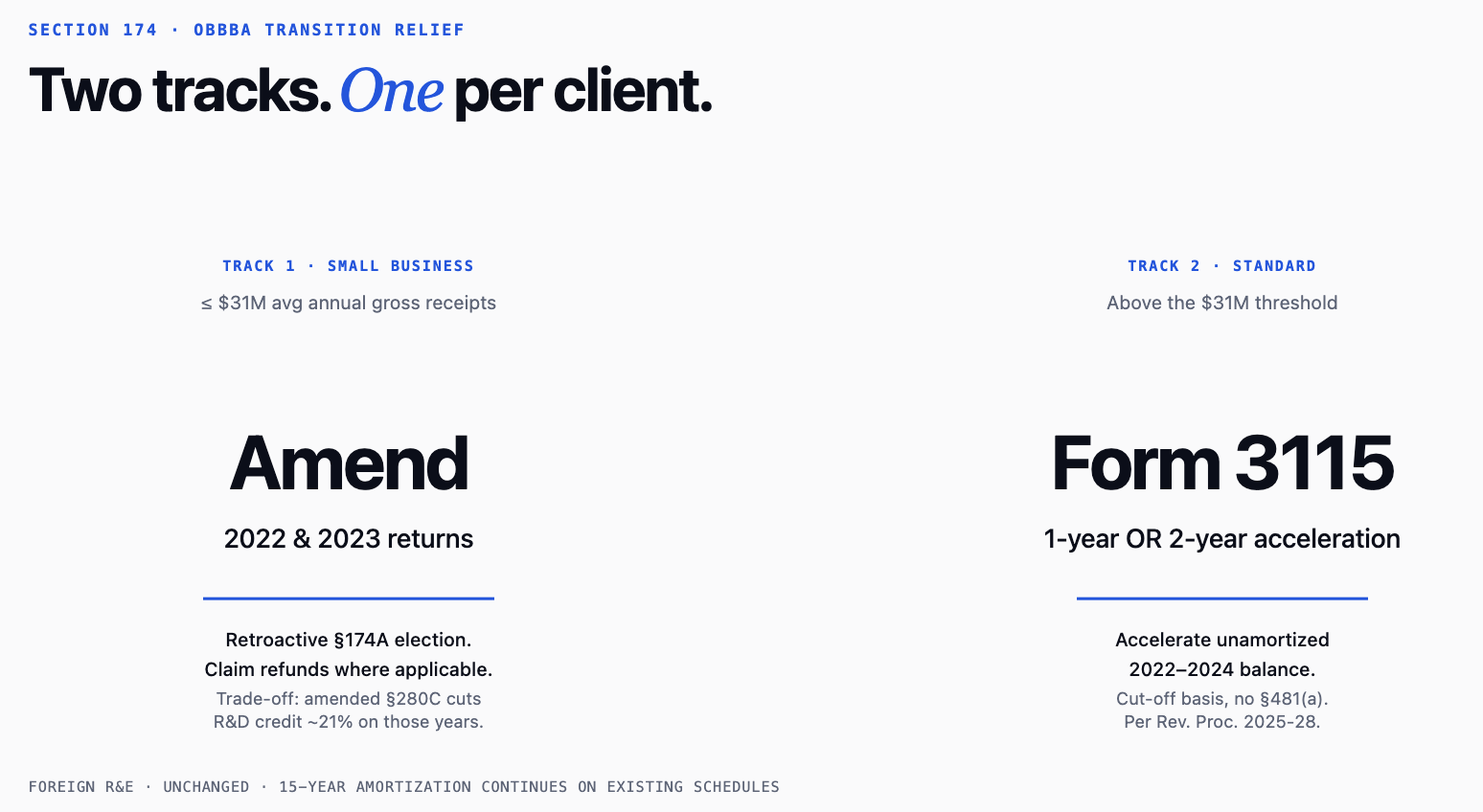
Figure 2. Small business retroactive amendment vs standard 1- or 2-year acceleration. The choice is per-taxpayer, not per-industry.
What CPA firms are actually filing on Form 3115 in 2026
For non-small-business taxpayers, practical filing sequence is:
- Compute unamortized 2022–2024 domestic §174 balance pull 5-year schedule for each of three years, tally remaining basis.
- Choose 1-year or 2-year acceleration model both, pick based on marginal-rate expectations and taxable-income smoothing needs.
- File Form 3115 (Application for Change in Accounting Method) cut-off basis, no §481(a) adjustment, referencing automatic consent procedure under Rev. Proc. 2025-28.
- Attach §174A election statement to 2025 (and if applicable 2026) return declaring change.
- Update §41 credit worksheet apply amended §280C reduction unless electing reduced credit.
- Reclassify going-forward 2025 and later domestic R&E as ordinary deductions no more capitalization schedule for domestic work.
- Continue foreign R&E amortization schedule unchanged 15-year straight-line, no OBBBA relief.
For small business taxpayers pursuing Track 1, workflow adds:
- Amended returns for 2022 and 2023 (and 2024 if not yet amended)
- Refund claims where amendments reduce prior tax
- §41 credit true-up on amended returns
Where §174 calculation goes wrong upstream
Every calculation above assumes underlying books distinguish R&E from non-R&E clearly. In practice, failure points are:
- Engineering payroll booked as a single line item cannot split domestic vs foreign without re-mapping timesheets or contractor invoices
- Contract research paid to a foreign development shop treated as "software subscription" misses §174 foreign amortization exposure entirely
- SaaS platform maintenance blended with new-feature development one is outside §174, other is inside; blending them overstates or understates R&E pool
- Stripe-processed vendor payments to research suppliers hitting ledger as net payouts (fees stripped out incorrectly) supplies and overhead line items get understated
- Depreciation on R&E-dedicated equipment not tagged to R&E workpaper
Finlens automates ledger cleanup: transaction categorization with per-client rules, Stripe payout decomposition, deferred revenue schedules, clean journal entries to QuickBooks Online. For SaaS clients where §174 is a material return item, that upstream cleanup is what makes workpaper defensible. Related: bookkeeping services fees in 2026 covers delivery-cost math for underlying work.
Conclusion
Pick one client with material 2022–2024 §174 amortization balances still on books bring three months of their QBO plus current §174 schedule and we'll walk domestic vs foreign split before Form 3115 draft.
Frequently asked questions
What is Section 174?
Section 174 of Internal Revenue Code governs tax treatment of research and experimental (R&E) expenditures. From 2022 through 2024, §174 required all R&E costs to be capitalized and amortized (5 years domestic, 15 years foreign). Under One Big Beautiful Bill Act (OBBBA) effective for tax years beginning after 12/31/2024, new §174A restores immediate deductibility for domestic R&E; foreign R&E must still be capitalized over 15 years.
Was Section 174 repealed in 2025?
Materially yes for domestic R&E. OBBBA (P.L. 119-21) enacted new IRC §174A that restores immediate expensing for domestic R&E for tax years beginning after December 31, 2024. Foreign R&E is not repealed and continues to require 15-year capitalization + amortization under §174.
What counts as an R&E expenditure under §174?
Costs of developing a new or improved product, process, or service where there was technological uncertainty at outset. Includes all software development, researcher wages (broader than §41's Box-1-only limit), contract research at 100% (vs §41's 65%), supplies, allocable overhead, and depreciation of R&E equipment.
Is software development a Section 174 expenditure?
Yes. Since TCJA, all software development costs are statutorily included as R&E under §174. This covers internal-use systems, customer-facing SaaS platforms, websites, mobile apps, and ERP development. Configuration of existing off-the-shelf software and SaaS maintenance/support are generally outside §174.
What is small business exception under OBBBA?
Taxpayers with average annual gross receipts of $31 million or less over 3-year lookback period (per §448(c)) may retroactively elect §174A expensing on amended 2022, 2023, and 2024 returns. Larger taxpayers cannot amend and must instead accelerate unamortized 2022–2024 costs in 1 or 2 years starting after 12/31/2024, via Form 3115.
How do I file Section 174A election?
Non-small-business taxpayers file Form 3115 (Application for Change in Accounting Method) on a cut-off basis with no §481(a) adjustment, referencing automatic consent procedure in Rev. Proc. 2025-28. Small businesses pursuing retroactive relief file amended returns for applicable years with a §174A election statement attached.
How does §174A interact with §41 R&D credit?
Amended §280C(c) requires that domestic R&E deduction be reduced by amount of §41 R&D credit claimed for same year or taxpayer may elect reduced-credit option under §280C(c)(2) and take approximately 79% of full credit at 21% corporate rate. On amended returns for 2022–2023, this typically costs ~21% of historical credit unless reduced-credit election was originally made.
Does OBBBA affect foreign R&E?
No. Foreign research expenditures continue to be capitalized and amortized over 15 years under §174 TCJA foreign-amortization rule is unchanged. Offshore engineering teams remain a §174 exposure for any US taxpayer.
What is Revenue Procedure 2025-28?
Rev. Proc. 2025-28 provides transition mechanics for §174A implementation automatic consent procedures for Form 3115 filings, deadlines for late-election relief, and specific rules for 1-year and 2-year acceleration options. Some deadlines under Rev. Proc. landed as early as September 15, 2025.
What happens to unamortized §174 costs from 2022–2024?
Non-small-business taxpayers accelerate unamortized domestic balance in one year (in first tax year beginning after 12/31/2024) or ratably over two years (2025 and 2026 for calendar-year filers). Small businesses may amend 2022 and 2023 returns to eliminate capitalization entirely and claim refunds. Foreign unamortized balances continue amortizing on their original 15-year schedules.
Section 174, §174A, OBBBA implementation, Rev. Proc. 2025-28, and Form 3115 mechanics are current as of 2026-07-29 based on P.L. 119-21 and Treasury guidance publicly available at that date. Effective dates, deadlines, and small-business threshold amounts change; verify current guidance at irs.gov before filing. Nothing in this article is legal or tax advice engage a licensed CPA, EA, or attorney for return preparation and §174 planning. Third-party trademarks referenced (QuickBooks®, Stripe®) belong to their respective owners.

