
Tax Resolution (2026): CPA Firm Process, Fees, and How Resolution Firms Actually Deliver


Key takeaways
- Tax resolution engagements move a client from tax distress → compliance → resolution → future prevention. The four phases (Investigation, Financial Modeling, Structuring, Mitigation) are standard across mature firms.
- CPAs, EAs, and tax attorneys all have unlimited IRS representation rights under Circular 230 CPA advantage is holistic financial view plus ethics rules that filter “tax relief mill” behavior.
- The RCP formula IRS uses to evaluate settlements: Realizable Value of Assets + Future Income. Every resolution path is priced against RCP.
- Fee shape for firm-owners in 2026: retainer $1,500–$3,500 (investigation), settlement flat fee $3,000–$7,000+, total engagement $5,000–$25,000+. Bill by phase, not by hour.
- The scale problem: back-year books usually have to be prepared before Phase 3 can start. That compliance cleanup can eat 60% of engagement calendar. Finlens is designed to compress that cleanup categorizes transactions, decomposes Stripe payouts, and writes clean entries to QuickBooks Online so firm gets to filing sooner.
Tax resolution paths comparison table (as of 2026-07-17)
Fee ranges compiled from 2026 firm-pricing surveys and vendor guides as of 2026-07-17. Actual fees vary by geography, complexity, and phase inclusion. Verify current IRS form numbers and requirements directly with IRS.
Related reading: First-time penalty abatement when it works and how to request it covers FTA workflow in depth.
Why CPA firms are structurally positioned to run tax resolution
Three federal facts shape practice, and firm-owners evaluating whether to add resolution as a service line should hold them clearly:
- Unlimited representation rights. Under IRS Circular 230, CPAs (like enrolled agents and attorneys) can represent taxpayers at any IRS office, at any administrative level audit, collection, Independent Office of Appeals without volume limits. Non-credentialed preparers cannot.
- Circular 230 ethics rules. CPAs cannot make unrealistic “pennies on dollar” settlement promises that “tax relief mill” telemarketers built reputation of. The rules filter marketing behavior and protect CPA-client relationship.
- Holistic financial view. Because a CPA firm already handles client’s bookkeeping, entity structure, and future tax planning, resolution engagement can be paired with prevention CNC monitoring, quarterly estimated tax planning, entity restructuring after OIC is accepted. That’s durable revenue.
The competitive positioning: EAs offer unlimited representation but not full-service financial view. Tax attorneys offer both plus attorney-client privilege but at 2–3× fee. CPA firms sit in middle full financial view, fair pricing, ethics-bounded representation. See enrolled agent vs CPA for how EA and CPA representation compare in resolution engagements.
Phase 1: Investigation and IRS transcript analysis
The engagement starts with a signed Form 2848 (Power of Attorney) and a full IRS transcript pull. Every mature firm does same four sub-steps:
- Execute Form 2848. Establishes formal representation, routes all IRS notices to CPA, and critically halts direct IRS collections contact with taxpayer. This alone reduces client anxiety before any negotiation has happened.
- Pull comprehensive transcripts via IRS e-Services and Centralized Authorization File (CAF):
- Account Transcript tracks assessments, payments, penalties, interest.
- Return Transcript shows exact line items from filed returns.
- Wage and Income Transcript third-party data: W-2s, 1099s, K-1s.
- Calculate Collection Statute Expiration Date (CSED). The IRS’s 10-year window to collect. Identify tolling events (bankruptcy filings, prior appeal requests) that pause clock. Sometimes correct advice is wait statute out rather than file a settlement that resets it.
- Check for Substitute for Return (SFR) assessments. If IRS filed on client’s behalf using worst-case brackets, an audit reconsideration to replace SFR with an accurate original return often drops base tax liability materially before any settlement conversation.
Firms typically bill this phase as a $1,500–$3,500 retainer with a fixed scope. Deliverable at end of Phase 1 is a written diagnostic memo liability by year, CSED map, SFR list, and preliminary path recommendation.
Phase 2: Financial modeling and Reasonable Collection Potential (RCP)
The IRS evaluates settlement offers against an internal formula. Firms match client’s finances against that exact formula:
RCP = Realizable Value of Assets + Future Income
- Realizable asset value quick-sale discount (typically 80% of FMV) on real estate, vehicles, and investments, minus senior encumbrances (mortgages, liens).
- Future income calculation subtract IRS National and Local Standards for housing, utilities, transport, and healthcare from gross monthly income; multiply residual by applicable evaluation period.
- Strategic discrepancy defense argue past IRS standard caps where actual living expenses are non-discretionary (out-of-pocket medical, essential business operating capital).
Where firms lose weeks: pulling client’s financial picture. If client’s bookkeeping is behind or messy, building an accurate 433-A / 433-B (OIC) statement takes days-to-weeks of prep work. See compliance-cleanup section below for how this bottleneck shows up in engagement economics.
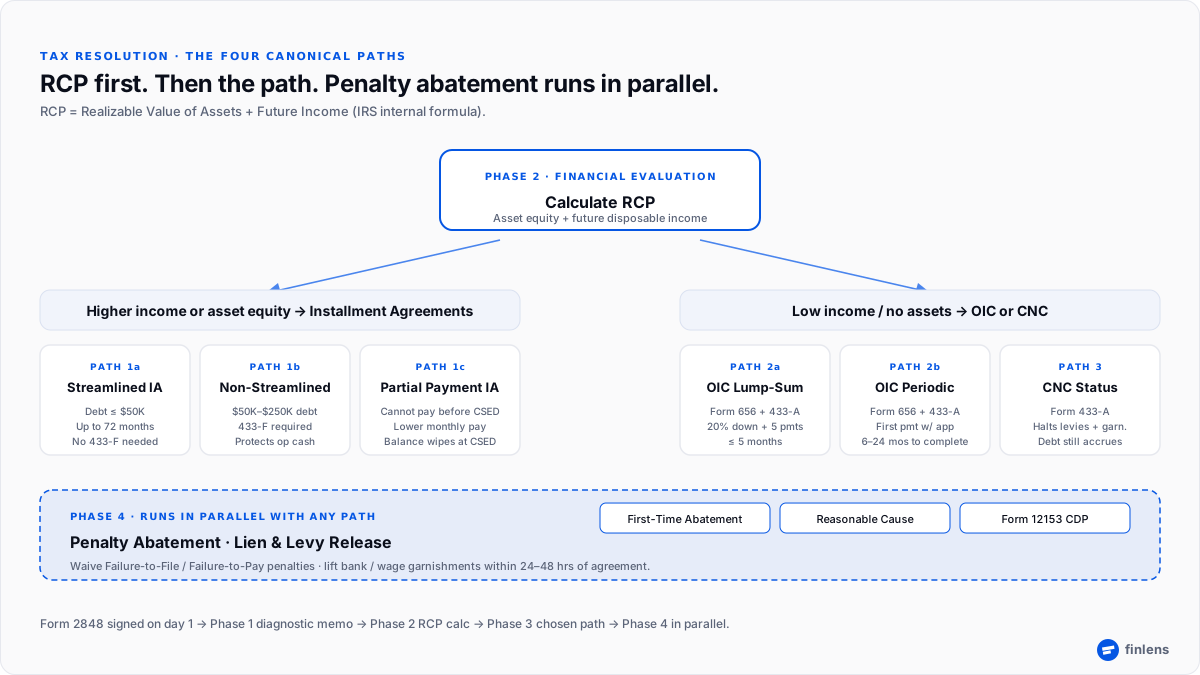
Figure 1. Four canonical resolution paths Installment Agreement, Offer in Compromise, Currently Not Collectible, Penalty Abatement each keyed to RCP and taxpayer profile.
Phase 3: Structuring resolution which path and why
The four canonical paths, keyed to RCP and taxpayer profile:
Installment Agreements
- Streamlined debt ≤ $50,000; up to 72 months; direct-debit avoids federal tax lien filing.
- Non-Streamlined debt $50,001–$250,000; requires Form 433-F disclosure; CPAs negotiate to protect essential business operating capital.
- Partial Payment Installment Agreement (PPIA) cannot pay full debt before CSED; lower monthly payment on disposable income; remaining balance wipes at CSED expiration.
Offer in Compromise
Two flavors, both filed on Form 656 + Form 433-A (OIC):
- Lump-Sum Cash Option 20% down with application; balance paid in ≤ 5 installments within 5 months of approval.
- Periodic Payment Option first installment with application; balance over 6–24 months while IRS evaluates.
Currently Not Collectible (CNC)
Secured via Form 433-A when gross monthly income is entirely consumed by IRS allowable living expenses. Halts levies, garnishments, and collection calls immediately. Not a debt forgiveness debt still accrues interest and can be reactivated if future income rises.
Penalty Abatement (see Phase 4 for detail)
Runs in parallel with any of above.
Phase 4: Penalty mitigation and lien/levy release
Runs concurrently with Phase 3 or as a standalone engagement:
- First-Time Penalty Abatement (FTA) administrative waiver for Failure to File or Failure to Pay; requires clean 3-year compliance history. Fast to file; often overlooked by DIY taxpayers.
- Reasonable Cause Abatement formal petition for penalty removal on documented hardship (disaster, serious illness or death of immediate family, reliance on erroneous IRS written advice).
- Release active levies and liens if a Final Notice of Intent to Levy has landed, file Form 12153 for a Collection Due Process (CDP) Hearing within strict 30-day window. Halts bank freezes and wage garnishments; coordinate with client’s payroll provider to lift employer garnishment orders within 24–48 hours.
Tax resolution engagement economics what CPA firms actually charge
Fee shape is remarkably consistent across mature 2026 firms:
- Phase 1 retainer $1,500–$3,500 flat. Covers transcript pull, CSED map, SFR check, diagnostic memo. Non-refundable.
- Compliance cleanup billed separately as tax preparation ($500–$3,000 per unfiled year). If back years are missing, this happens between Phase 1 and Phase 3. This is where engagement calendars stretch.
- Phase 3 settlement submission $3,000–$7,000+ flat. Covers compile, draft, and IRS defense of chosen resolution package.
- Penalty abatement (Phase 4) $500–$4,000 flat depending on FTA vs Reasonable Cause vs CDP.
Total engagement all-in:
- Simple IA on a compliant client: $5,000–$8,000
- OIC with 1–2 back years to file: $10,000–$18,000
- Payroll tax + trust-fund exposure with 3+ unfiled years and audit reconsideration: $25,000–$50,000+
The compliance cleanup slice is 30–60% of calendar time on most engagements and 20–40% of fee. Compressing it is single highest-ROI operational move a resolution practice can make.
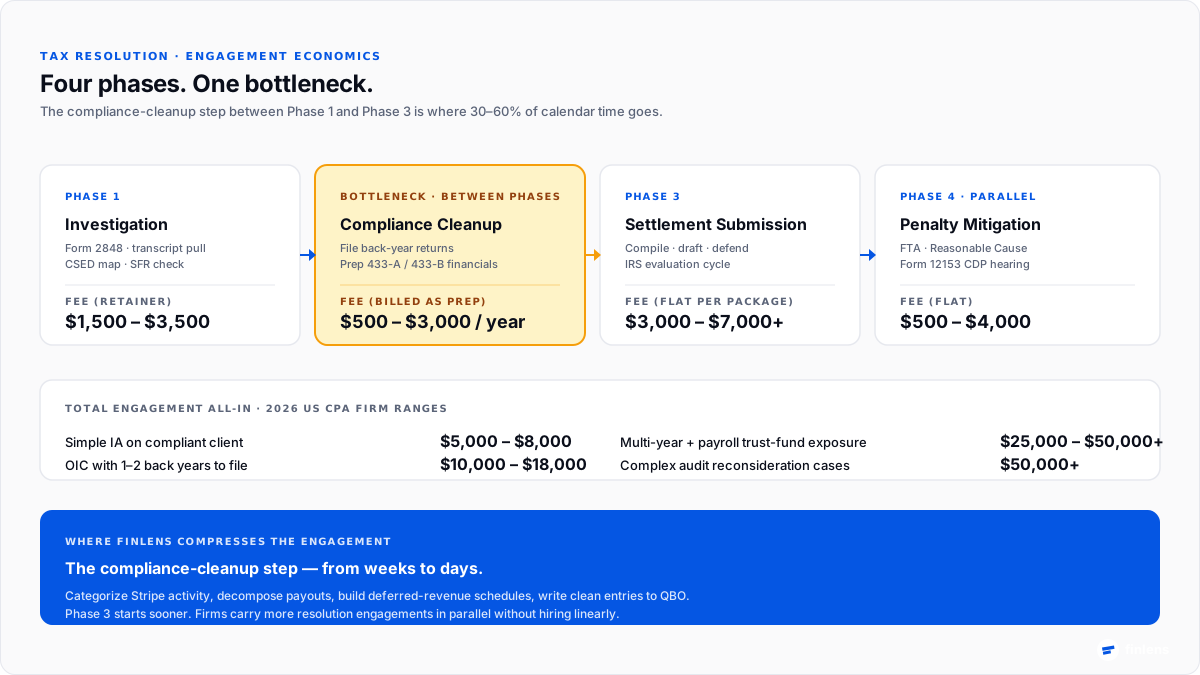
Figure 2. Phase-by-phase engagement math. The compliance-cleanup step between Phase 1 and Phase 3 is where most firms lose calendar time and where AI-native ledger tooling changes delivery cost.
Where resolution stack breaks and where Finlens fits
Mature resolution firms all run some combination of PitBullTax or Canopy Tax for transcript sync, IRS form pre-population, and OIC viability calculators, plus IRS e-Services for CAF pulls. These tools compress IRS-side work.
What they don’t touch: client-side compliance cleanup. Before an accurate 433-A can be built, client’s underlying books have to be current. On Stripe-heavy or subscription-heavy clients SaaS, e-commerce, restaurants bookkeeping cleanup is bottleneck, not IRS paperwork:
- Stripe payouts arrive as single deposits; individual charges, refunds, fees, and disputes have to be decomposed before P&L or 433-B is defensible.
- Deferred revenue schedules on subscription books have to be reconstructed before OIC financial statement holds.
- Per-client categorization decisions have to be made month-by-month for back-year returns.
This is where Finlens sits in resolution stack a ledger-layer tool that decomposes Stripe payouts, categorizes transactions with a human-in-the-loop review queue, builds deferred-revenue schedules, and writes clean entries directly to QuickBooks Online. On resolution engagements, that compresses compliance-cleanup calendar from weeks to days so Phase 3 can start sooner and firm can carry more resolution clients in parallel without hiring linearly.
Related: bookkeeping services fees in 2026 covers underlying delivery-cost math for compliance work.
The tax-resolution software stack CPA firms actually run
- PitBullTax or Canopy Tax transcript syncing, IRS form pre-population, OIC viability computation. The core resolution-specific tools.
- IRS e-Services + CAF real-time transcript pulls without calling Practitioner Priority Service.
- Practice management Karbon, Canopy, Financial Cents, Pixie for engagement workflow. See Karbon vs Jetpack Workflow and Pixie vs Karbon for PM tool comparison.
- Secure client portal SmartVault, TaxDome, Liscio for KBA-authenticated 8879 and secure exchange of Form 2848, 656, 433-A. See secure client portal for accountants.
- Ledger cleanup layer where Finlens sits. Not a resolution-specific tool; it’s upstream cleanup that makes Phase 2 and Phase 3 possible on messy books.
Who should add tax resolution as a firm service line
- Firms with existing bookkeeping clients running Stripe or subscription revenue you already know books; resolution is natural advisory upgrade when a client hits an IRS problem.
- Tax-heavy firms with audit representation experience resolution is an adjacent controversy skill; workflow overlap is high.
- Firms building a productized advisory tier resolution is one of highest-value single engagements you can sell; $10K–$25K per case is standard.
Where resolution doesn’t fit:
- Firms without a licensed CPA, EA, or attorney on staff. Unlimited representation rights are a credential requirement, not an aspirational one.
- Firms unwilling to model RCP formally. OIC filings without a defensible RCP get rejected and burn client’s trust.
- Firms unable to run compliance-cleanup step at speed. If cleanup drags 8 weeks per case, resolution never scales past a handful of engagements per year.
Frequently asked questions
What is tax resolution?
Tax resolution is practice of representing taxpayers before IRS or state tax authorities to fix existing tax problems unfiled returns, unpaid balances, active levies or garnishments, audit assessments, or trust-fund penalty exposure. It is different from tax preparation (future returns) and tax planning (future transactions) resolution deals with problems that already exist.
Can a CPA firm represent me in front of IRS?
Yes. CPAs (like enrolled agents and attorneys) have unlimited representation rights under IRS Circular 230, meaning they can represent taxpayers at any IRS office, at any administrative level, without volume or scope limits. Non-credentialed preparers cannot.
What is Form 2848?
IRS Form 2848 (Power of Attorney and Declaration of Representative) authorizes a CPA, EA, or attorney to speak, negotiate, and sign agreements with IRS on taxpayer’s behalf. It also routes all IRS notices to representative, which effectively halts direct IRS collections contact with taxpayer.
What is Reasonable Collection Potential (RCP)?
The IRS’s internal formula for evaluating settlement offers: Realizable Value of Assets + Future Income. Realizable value applies a quick-sale discount (typically 80% of FMV) minus encumbrances; future income subtracts IRS National and Local Standards from gross monthly income. Every resolution path is priced against RCP.
What is an Offer in Compromise (OIC)?
An OIC is a negotiated settlement where IRS accepts less than total tax liability. Two flavors: Lump-Sum Cash Option (20% down with application, remaining balance in 5 or fewer installments within 5 months of approval) and Periodic Payment Option (first installment with application, balance over 6–24 months while IRS evaluates). Filed on Form 656 + Form 433-A (OIC).
How much does a CPA firm charge for tax resolution?
Typical 2026 fee shape: $1,500–$3,500 retainer for Phase 1 investigation, $3,000–$7,000+ flat for Phase 3 settlement submission, plus compliance cleanup billed separately as tax preparation. Total engagement all-in: $5,000–$8,000 for a simple installment agreement, $10,000–$18,000 for an OIC with 1–2 back years to file, $25,000–$50,000+ for complex payroll-tax or multi-year cases.
What’s difference between tax resolution and tax controversy?
Tax resolution focuses on collection problems negotiating payment plans, offers in compromise, penalty abatement after a liability has been assessed. Tax controversy focuses on challenging tax authority’s position itself audits, appeals, Tax Court. The two overlap and mature firms handle both, but workflows and forms differ.
What is Collection Statute Expiration Date (CSED)?
The 10-year legal window during which IRS can collect an assessed tax debt. Certain events “toll” (pause) clock bankruptcy filings, prior appeal requests, pending OICs. If CSED is imminent, right advice may be to wait out statute rather than file a settlement that resets clock. CSED analysis is standard Phase 1 work.
How does a CPA firm scale a tax resolution practice?
The primary scale lever is compressing compliance-cleanup step. Most resolution engagements pause between Phase 1 and Phase 3 while back-year books get prepared that gap is 30–60% of engagement calendar and 20–40% of fee. Firms that shorten this step (through AI-native ledger tools) run more parallel engagements without hiring linearly.
Conclusion
Pick one active resolution engagement (or one client you know is heading into one) where back-year books are reason Phase 3 hasn’t started bring three months of that client’s QBO and we’ll show you categorization queue live before we say a word about resolution package.
Fee ranges and workflow descriptions in this article are compiled from 2026 firm-pricing surveys and CPA-firm workflow guides as of 2026-07-17. Actual fees vary by geography, complexity, and phase inclusion. IRS forms, thresholds, and procedures change frequently verify current IRS form numbers, thresholds, and requirements directly with IRS (irs.gov) before filing. Third-party trademarks (PitBullTax®, Canopy Tax®, QuickBooks®, Karbon®, TaxDome®, SmartVault®, Liscio®) belong to their respective owners; Finlens is not affiliated with or endorsed by any of them. Nothing in this article is legal or tax advice engage a licensed CPA, EA, or attorney for representation.

