
How Long to Keep Business Tax Records: IRS Rules and Practical Retention Guide


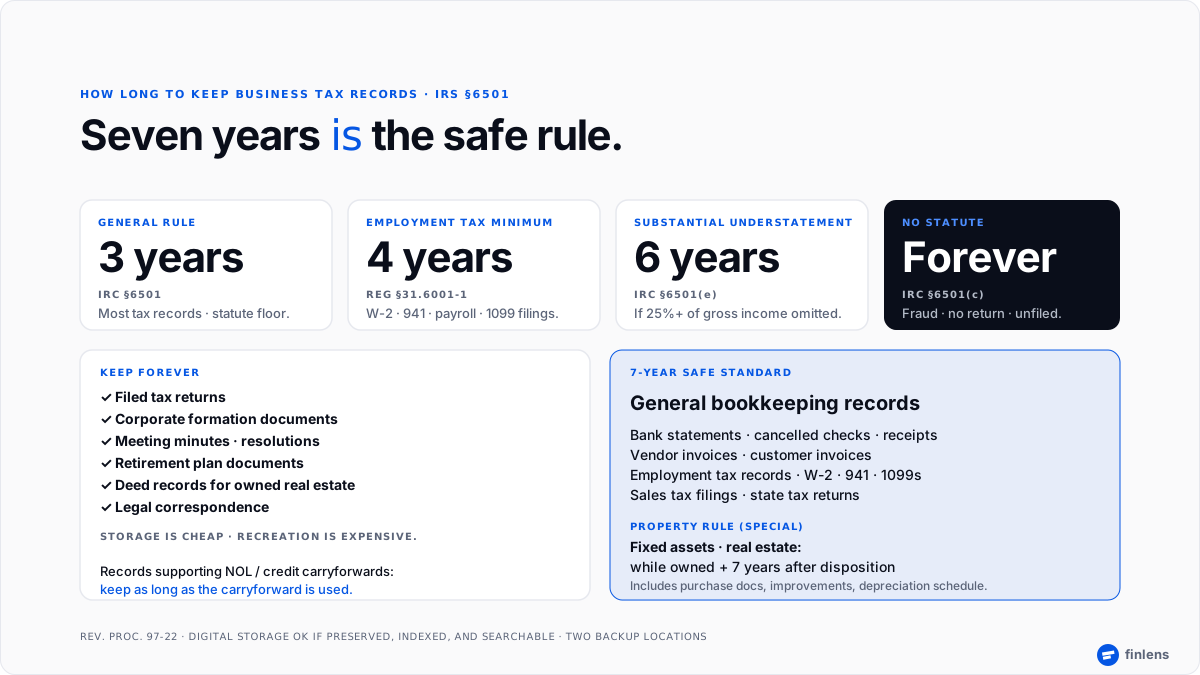
The IRS statute of limitations for auditing a tax return is generally 3 years from filing date, which sets floor for tax record retention. That extends to 6 years for substantial income understatement (25% or more of gross income) and indefinite for fraud or unfiled returns. On top of that, employment tax records have a 4-year minimum, property records must be kept while asset is owned plus at least 3 years after disposition, and some documents entity formation records, tax returns themselves are worth keeping permanently.
This guide covers IRS retention rules by document type, practical safe-retention schedule most CPAs recommend, and how to store records so they survive an audit request years later.
The IRS statute of limitations rules
IRC §6501 sets statutory limits on when IRS can assess additional tax. These limits determine how long you need to keep records that support each return.
3 years (general rule) for most returns, IRS has 3 years from return filing date to assess additional tax. Records supporting return should be kept at least this long.
6 years if you omitted more than 25% of gross income from a return, statute extends to 6 years. This applies to underreported income specifically not overstated deductions.
7 years if you claimed a loss from worthless securities or a bad debt deduction. This is a specific extension for those items.
Indefinite no statute of limitations applies if:
- No return was filed
- A fraudulent return was filed
- A willful attempt was made to evade tax
The IRS's own retention guidance is laid out in IRS Publication 583 (Starting a Business and Keeping Records) primary authoritative reference for business record-keeping under IRC §6001.
The safe default most CPAs recommend is 7 years for general business tax records. This covers 6-year substantial-understatement rule and adds a buffer. Some firms recommend 10 years for extra caution but 7 is practical minimum.
Retention schedule by document type
Employment tax records 4-year floor
Employment tax records have their own rule under IRS Regulation 31.6001-1. Keep employment tax records for at least 4 years after date tax becomes due or is paid, whichever is later.
This applies to:
- Amounts and dates of payroll payments
- Employee names, addresses, SSNs, and dates of employment
- Copies of Forms W-2 and W-3
- Copies of employee tax withholding certificates (Form W-4)
- Employer identification number filings
- Documentation of employment taxes withheld and deposited
- Employer's copy of Form 941, 940, W-3, and state equivalents
For businesses with any employees or contractors paid via 1099, 4-year employment tax retention is a floor 7-year default retention captures it easily.
Property records special rule
Fixed asset records have unique retention requirements because depreciation and gain/loss calculations depend on original cost basis. Keep property records while you own asset PLUS at least 3 years after disposition (sale, trade, abandonment).
Practical impact: buy a building in 2010, sell it in 2035, and you must keep original purchase records at least until 2038 (25 years total on that single set of documents).
Records to keep for property:
- Purchase invoice and closing documents
- Records of improvements (capitalized additions to basis)
- Depreciation schedule showing accumulated depreciation
- Sale documents and gain/loss calculation
- 1031 exchange documentation (like-kind exchanges) extends into replacement property's basis, so keep exchange docs for life of replacement property + 7 years
What "keep records" actually means
The IRS accepts digital copies for almost all business record types under Revenue Procedure 97-22 (still in force), provided digital storage system:
- Preserves record in a form that can be reproduced
- Includes indexing so specific records can be located
- Preserves both original document AND any changes
Practically:
- Scan paper receipts most receipt-capture apps (Expensify, Dext, QuickBooks receipt capture) qualify
- Store digital documents in native format save PDFs of invoices, statements, contracts
- Back up regularly cloud storage (Dropbox, Google Drive, Microsoft 365) plus local backup is standard
- Ensure searchability IRS can request specific documents; you need to produce them promptly
Paper records still qualify. But physical volume of 7 years of paper records is substantial for any active business most firms have moved to digital storage as primary method with paper only for documents that don't scan well (some legal originals).
For active bookkeeping and reconciliation workflows, receipt attachment at transaction level inside QuickBooks, Xero, or a similar system means retention happens automatically as part of monthly close.
Common retention mistakes
The mistakes we see most often when firms review a client's record-keeping:
1. Discarding tax returns after 3 years. Keep filed returns forever. They're anchor for basis calculations, audit defense, and history of positions taken.
2. Not keeping records to support carryforwards. NOLs, capital losses, credits carried forward records supporting original transaction need to be kept as long as carryforward is being used, even if that extends beyond general 3-year statute.
3. Purging employment records at 3 years. Employment tax records require 4-year retention. The 7-year default catches this, but firms that try to save storage by shortening general retention often forget employment exception.
4. Losing property basis records. Especially painful for real estate. Without original cost documentation, gain on sale defaults to full sale price (basis = $0), producing much higher taxable gain than actual.
5. Not documenting improvements. Capital improvements to real estate add to basis; receipts to prove them need to be kept for life of property + 3 years.
6. Digital records without backup. A single cloud service failure or account lockout can eliminate years of records. Two independent storage locations are minimum for digital-only businesses.
7. Discarding expense documentation too early. Deductions require supporting documentation. Purging receipts after 3 years exposes you to §6501(e) 6-year rule if audited.
Conclusion
Seven years is safe practical retention for general business tax records three years for general IRS rule, six for substantial understatement, and a buffer for edge cases. Employment records: four-year minimum but seven-year default covers it. Property records: while owned plus at least three years, but practically longer. Tax returns and corporate documents: forever.
FAQ
How many years of tax records should a business keep?
The IRS general rule is 3 years, extending to 6 years for substantial understatement and indefinitely for fraud or unfiled returns. The practical safe standard most CPAs recommend is 7 years for general business tax records.
How long to keep employment tax records?
Under IRS Reg 31.6001-1, at least 4 years after tax is due or paid, whichever is later. Most businesses keep employment records for 7 years as part of general retention.
How long to keep receipts for taxes?
At least 3 years, or 7 years for safe standard. Receipts supporting business expense deductions are first thing an IRS auditor asks for, so keeping them at transaction level in accounting system is more valuable than any general retention rule.
Can I keep digital records instead of paper?
Yes. Revenue Procedure 97-22 permits digital storage provided records are preserved, indexed, and searchable. Most modern accounting software's receipt-attachment feature meets these requirements.
How long to keep property records for real estate?
Keep original purchase documentation while you own property PLUS at least 3 years after sale. Practical rule: keep purchase documents, improvement receipts, and depreciation schedules for life of property + 7 years.
What happens if I get audited without records?
The IRS can disallow deductions and impose additional tax based on their reconstruction of your income. Rebuilding records after fact from bank statements, credit card records, and vendor invoices is possible but time-consuming and doesn't always succeed. Original documentation is materially better.
Do I need to keep records for NOL and credit carryforwards?
Yes. Records supporting original transaction that generated NOL or credit need to be kept as long as carryforward is used potentially decades. This is a common trap when businesses purge routinely at 7 years without considering carryforward positions.
What business records should I keep forever?
Filed tax returns, corporate formation documents, meeting minutes and resolutions, retirement plan documents, key contracts, deed records for real estate owned, and legal correspondence. Storage is cheap; recreation is expensive.

