
How to Write Off Business Expenses: A Practical Guide for Small Business Owners


Writing off a business expense means deducting it from your business's taxable income. Under Internal Revenue Code Section 162, an expense is deductible if it is both "ordinary" common and accepted in your trade and "necessary" helpful and appropriate to business. That is entire legal test, and it covers almost every real business expense you incur.
The practical work is knowing which specific categories IRS allows, how each is documented, what percentage is deductible, and where each shows up on tax return.
What "writing off" actually means
Three phrases get used interchangeably but mean different things:
- Tax deduction reduces taxable income. Every dollar deducted saves you tax at your marginal rate. A $1,000 deduction at a 24% marginal rate saves $240.
- Tax credit reduces tax dollar-for-dollar. A $1,000 credit saves $1,000. Much rarer than deductions.
- Write-off informal term usually meaning "deduction," but sometimes used to describe writing off a bad debt (uncollectible receivable) or an impaired asset (obsolete inventory).
When most business owners say "write it off," they mean take a deduction. The rest of this guide covers deductions specifically.
The IRS Section 162 test
Every business expense you deduct has to pass same two-part test in IRS Publication 535:
- Ordinary common and accepted in your trade or business
- Necessary helpful and appropriate for business
"Necessary" does not mean indispensable. A conference registration is necessary if it advances your business, even if you could theoretically run business without going.
Expenses that meet test are deductible in year paid (cash-basis) or incurred (accrual-basis). Expenses that create a long-term asset laptops, vehicles, buildings, equipment with useful lives over 1 year are generally capitalized rather than expensed.
Common categories of deductible business expenses
Almost every deductible expense falls into one of these categories. Track them by category in your bookkeeping that maps directly to tax return line items.
Advertising and marketing. Fully deductible. Includes website costs, ads, printed materials, sponsorships, and business branding. 100% deductible.
Bank and merchant processing fees. Fully deductible. Monthly bank fees, credit card processor fees (Stripe, Square, PayPal), wire fees, ACH fees. 100% deductible.
Business insurance. Fully deductible. General liability, professional liability, workers' comp, cyber, product liability. Health insurance for self-employed owners is separately deductible on personal return (not Schedule C).
Business meals. 50% deductible in most cases. 100% deductible for company events open to all employees (holiday parties) and for meals sold to customers. Entertainment is 0% deductible after TCJA.
Contract labor / independent contractors. Fully deductible. Amounts paid to freelancers, agencies, consultants. Requires 1099-NEC for any contractor paid $600 or more in a year.
Depreciation. Deduction for long-lived assets spread over their useful life. Section 179 and bonus depreciation allow first-year expensing of many items.
Employee benefits. Health insurance, retirement plan contributions, group life insurance, education assistance. Employer-side portion is deductible.
Home office (self-employed only). Deductible on Form 8829 if you use a portion of your home regularly and exclusively for business. Simplified method: $5/sq ft, up to 300 sq ft = $1,500 max.
Legal and professional fees. Fully deductible. Attorney fees for business matters, accountant fees (including tax prep for business return), consulting fees.
Office rent. Fully deductible. Includes coworking memberships.
Office supplies and small equipment. Fully deductible if under de minimis safe harbor ($2,500 per item invoice, or $5,000 with applicable financial statements). Larger items get capitalized and depreciated.
Software subscriptions. Fully deductible. Includes SaaS, project management tools, accounting software, communication tools.
Startup costs. Up to $5,000 deductible in year 1 (phases out if total startup costs exceed $50,000); remainder amortized over 15 years under Section 195.
Supplies used in operations. Fully deductible. Materials consumed in ordinary course.
Telephone and internet. Deductible for business use portion. Separate business lines are 100% deductible; shared home lines are prorated.
Travel. Fully deductible for business portion. Airfare, lodging, ground transportation, business meals during travel (50% rule applies).
Utilities. Fully deductible for business locations. Home-office utilities are prorated (part of Form 8829 calculation).
Vehicle expenses. Either standard mileage rate (see 2026 rates) or actual expenses. The choice in year 1 of ownership determines future flexibility.
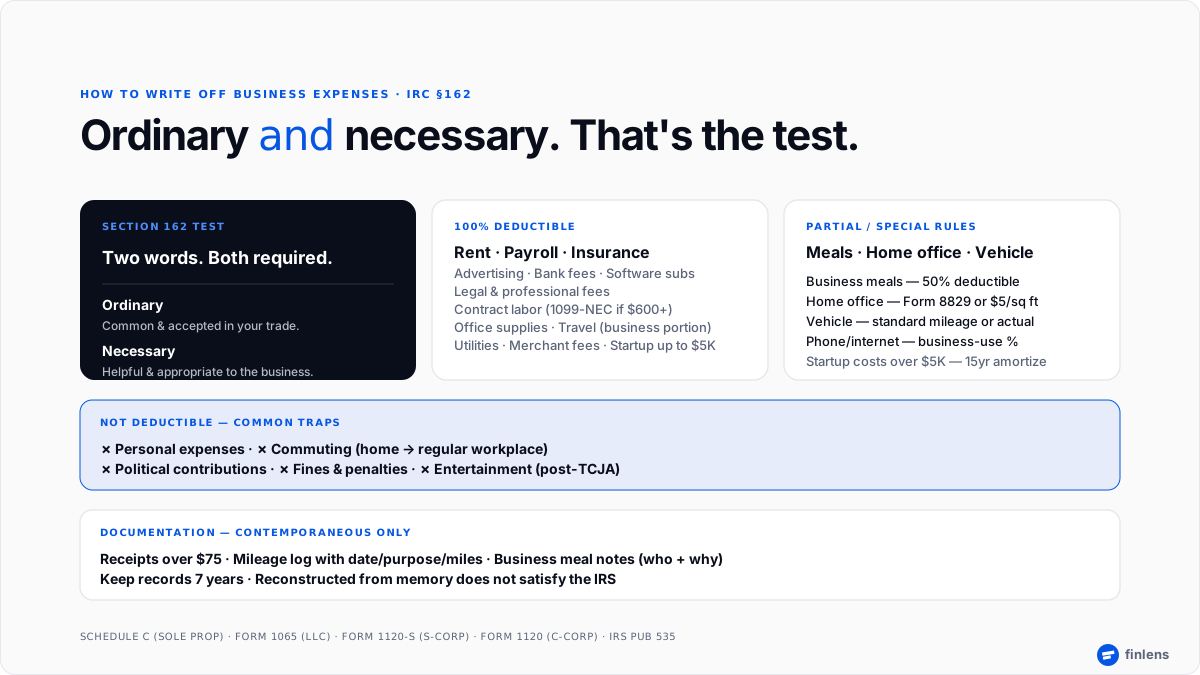
Documentation requirements
The IRS's audit standard for deductions is contemporaneous documentation. That means record was made at or near time of expense, not reconstructed later from memory or credit card statements.
What you need to keep, per deduction category:
- Receipts for any expense over $75 (IRS's small-expense threshold for most cases). Below $75, credit card statement usually suffices, but keeping receipt anyway is safer.
- Mileage log date, business purpose, starting/ending location, miles. Required contemporaneous, not reconstructed.
- Home office measurements, photos, description of exclusive use. Utilities and rent bills for year.
- Business meals receipt, plus business purpose and attendees (who and why). "Lunch with client X to discuss project Y" is sufficient documentation.
- Travel receipts for airfare, lodging, ground transport. Notes on business purpose per day of trip.
- 1099 contractor payments signed Form W-9 from contractor, 1099-NEC filed by January 31 following year.
- Depreciation invoice, in-service date, useful life, method chosen.
Retention: 7 years is safe rule for most business records. Employment tax records: 4 years minimum. Property records: while owned + 4 years after disposition. See our guide on how long to keep business tax records for full retention schedule.
What is NOT deductible
Common non-deductible expenses that trip up new business owners:
- Personal expenses never deductible even if paid from business account
- Commuting driving from home to your regular workplace is not deductible (see mileage rate guide for deductible-mile rules)
- Political contributions and lobbying non-deductible under IRC §162(e)
- Fines and penalties parking tickets, IRS penalties, regulatory fines all non-deductible
- Entertainment 0% deductible after TCJA (was 50% before 2018)
- Country club and gym memberships non-deductible even if used for business networking
- Life insurance premiums on owner/employees where business is beneficiary non-deductible
Where to record deductions by entity type
Which tax form and line depends on your business structure:
- Sole proprietor / single-member LLC (default) Schedule C, Form 1040
- Multi-member LLC (partnership) Form 1065, expenses flow through K-1
- S-corp Form 1120-S, expenses flow through K-1
- C-corp Form 1120, expenses reduce corporate taxable income
- Self-employed retirement plan contributions Adjustments to Income on Form 1040, not Schedule C
- Health insurance premiums (self-employed) Above-the-line deduction on Form 1040 Schedule 1
For most single-owner businesses, bookkeeping category maps directly to a Schedule C line. Getting categorization right during year rather than reconstructing at tax time saves hours of April cleanup and reduces audit risk.
Conclusion
Every deductible expense passes same test: ordinary and necessary for trade or business. Categorize consistently during year, keep documentation contemporaneous, and know four or five special rules (50% meals, home office simplified vs actual, mileage year-1 choice, startup cost phase-out) that trip up most first-time filers.
FAQ
Can I write off my car for business?
Yes, if you use it for business. Choose standard mileage rate (multiplier per mile) or actual expenses (business-use percentage of every actual cost). The year-1 choice affects your ability to switch later. Only business miles count commuting from home to a regular workplace is not deductible.
Can I write off my phone bill?
Yes, for business-use portion. A dedicated business line is 100% deductible. A shared personal/business phone is deductible for business percentage track approximate business use to justify deduction.
Can I write off business meals?
Generally 50% deductible. Meals must be with a business purpose (client, prospect, employee travel) and reasonable. 100% deductible for company events open to all employees and for meals sold to customers. Entertainment is 0% deductible.
How much of a home office can I deduct?
Under simplified method: $5/square foot, up to 300 sq ft = $1,500 maximum. Under regular method (Form 8829): actual home expenses × business-use percentage. Regular method usually produces a larger deduction if your home has meaningful utilities and mortgage interest.
Are startup costs deductible?
Yes, up to $5,000 in year 1 under IRC §195 (phased out if total startup costs exceed $50,000). Remainder amortized over 15 years. This includes market research, employee training before opening, professional fees for incorporation.
What business expenses can I NOT write off?
Personal expenses, commuting, political contributions, fines and penalties, entertainment (post-TCJA), country club dues, life insurance premiums where business is beneficiary. Also: expenses reimbursed by insurance (you got money back).
Do I need receipts for every expense?
For expenses over $75, keep receipt. Under $75, credit card statements and bank records usually suffice but keeping receipts anyway costs nothing and eliminates audit friction. Business meals, travel, and vehicle expenses always need documentation regardless of amount.
Where do I record business expenses on my tax return?
Sole proprietors and single-member LLCs: Schedule C. Partnerships and multi-member LLCs: Form 1065. S-corps: Form 1120-S. C-corps: Form 1120. Each form has specific line items that map to bookkeeping categories above.

