
Revenue vs Income: The Difference Every Small Business Owner Should Know


Revenue is top line of income statement total money business brings in from selling products or services before any expenses are subtracted. Income is bottom line what's left after every expense (cost of goods sold, operating expenses, interest, taxes) is deducted from revenue. In accounting, "income" almost always means net income, which is another name for net profit.
The two terms are commonly confused because "income" gets used loosely in everyday language to mean revenue ("annual household income"), but in accounting distinction is precise and it drives how financial statements are read.
The definitions
Revenue (also called sales, turnover, or top line): gross amount received or earned from selling products, services, or both. Revenue is recognized under GAAP when performance obligation is satisfied usually when product ships or service is delivered.
Income (in accounting, almost always means net income or net profit): revenue minus every expense. It's what actually accrues to owners of business after paying suppliers, employees, lenders, and government.
The most authoritative reference on each: Investopedia's Revenue definition and Investopedia's Net Income definition. Before these definitions make sense on an income statement, it helps to settle the bookkeeping question underneath them: whether revenue is a debit or a credit, and why it behaves the opposite way to an asset.
The income statement flow
The confusion between revenue and income disappears once you see them on actual income statement:
Revenue is first line. Net income is last. Every other line in between is an expense or an intermediate profit measure.
Why confusion exists
Everyday English uses "income" to mean money coming in your salary is your "income," a rental property produces "rental income," a business owner might talk about their "business income" and mean gross revenue. The IRS itself uses "gross income" on some forms to describe pre-deduction earnings.
But in accounting, "income" is a profit measure, not a revenue measure. When an accountant says "net income" or "operating income" or just "income," they mean profit revenue minus specific expenses.
The disambiguation:
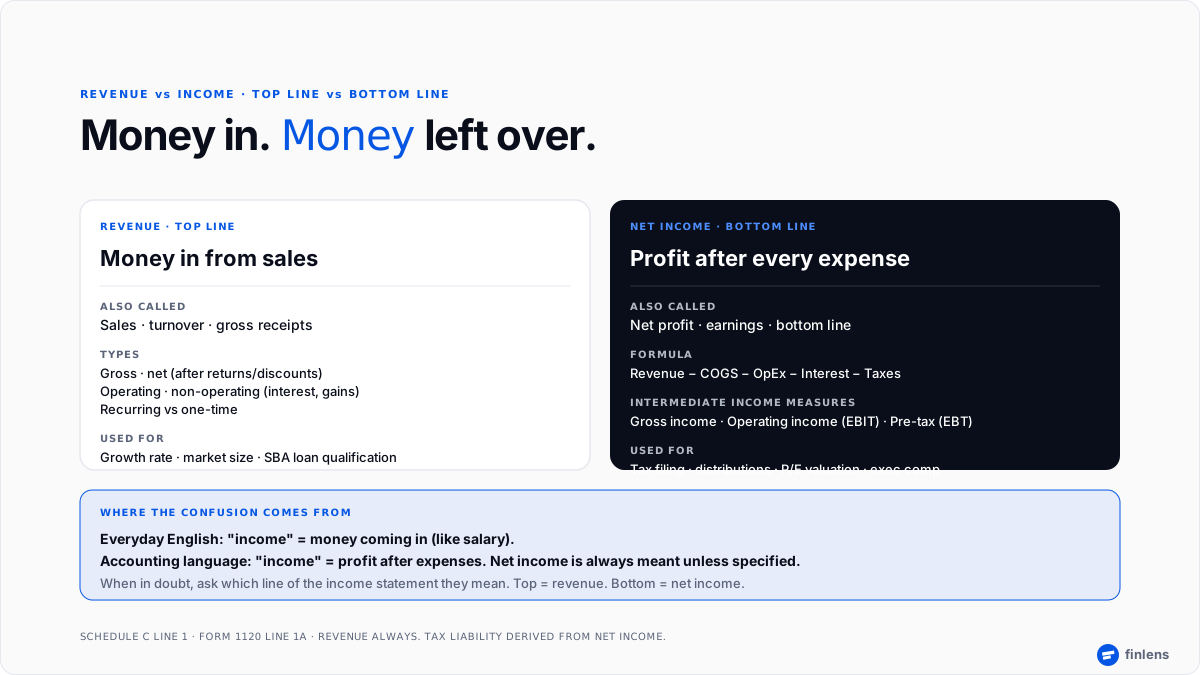
- Everyday "income" → money coming in → closer to accounting "revenue"
- Accounting "income" → profit after expenses → not same as revenue
Get this right and every finance conversation gets easier. Get it wrong and you'll confuse investors, lenders, and your own bookkeeper.
Types of revenue
Revenue can be broken down several ways depending on business:
- Gross revenue total revenue before any returns, allowances, or discounts
- Net revenue revenue after returns, allowances, and discounts
- Operating revenue revenue from primary business activity (product sales, service fees)
- Non-operating revenue revenue from secondary activities (interest income, gains on sale of assets, rent from unused space)
- Recurring revenue subscription or contract-based revenue that repeats
- One-time revenue non-recurring sales (project fees, one-off transactions)
Recurring vs one-time revenue matters enormously for business valuation. A business with $2M of recurring revenue is worth materially more than a business with $2M of one-time revenue at same margin.
Types of income
The income statement contains several intermediate "income" measures before arriving at net income. Each represents revenue minus a specific set of deductible business expenses:
- Gross income revenue minus cost of goods sold (same as gross profit)
- Operating income gross income minus operating expenses (also called EBIT Earnings Before Interest and Taxes)
- Pre-tax income operating income minus interest expense (also called EBT Earnings Before Taxes)
- Net income pre-tax income minus income taxes (bottom line, net profit)
- Taxable income a tax-specific number that reconciles net income to what IRS treats as taxable (see book-to-tax reconciliation for mechanics)
- Comprehensive income net income plus other comprehensive income items (unrealized gains/losses on certain investments)
When someone says "income" without qualifier, they usually mean net income. When someone says "operating income" or "gross income," they're pointing to a specific intermediate line.
Where each metric matters
Revenue is what you use for:
- Growth rate calculations (revenue growth year-over-year)
- Market size and market share analysis
- Sales performance measurement
- Bank loan qualification (annual revenue thresholds)
- SBA loan sizing
- Business valuation multiples (revenue multiple for early-stage companies)
Net income is what you use for:
- Tax return filing (business income tax on Schedule C, Form 1120, etc.)
- Dividend or distribution decisions (S-corp shareholder distributions, LLC member distributions)
- Executive compensation tied to profitability
- Earnings per share calculations
- Business valuation multiples (P/E ratio for mature businesses)
- Investor reporting and quarterly earnings
Gross income (revenue minus COGS) sits in between and is critical for pricing decisions, product-line analysis, and margin management.
Common mistakes conflating revenue and income
1. Reporting revenue as income to lenders or investors. A pitch deck that shows "$5M income" when it means $5M revenue misrepresents financial performance. Lenders read this as profitability; investors read this as bottom-line earnings.
2. Calculating owner distributions from revenue instead of net income. For pass-through entities (LLCs, S-corps, partnerships), distributions come from net income after expenses, not from gross revenue. Distributing revenue is distributing money that hasn't been earned yet after paying costs.
3. Comparing revenue-based valuation multiples to income-based ones. A 3× revenue multiple and a 3× earnings multiple mean completely different things. Confusing them produces valuation errors of 5–10× magnitude.
4. Using revenue as a proxy for cash flow. Revenue is booked when earned, not when collected. A business with $1M revenue and $600K in receivables has $400K in actual cash from revenue clean reconciliation between P&L and cash accounts is what surfaces distinction.
5. Assuming "gross income" means same on every form. IRS forms use "gross income" to include revenue minus some items but not others (COGS is subtracted for businesses, not for individuals). Reading tax-form instructions matters.
What accountants mean when they say "top line" and "bottom line"
Top line = revenue. When someone says "we're focused on top-line growth," they mean growing revenue, without necessarily improving profitability.
Bottom line = net income. When someone says "how does that affect bottom line," they mean net profit after every expense.
A business can have strong top-line growth (revenue up 40%) and a shrinking bottom line (net income down 20%) this happens when growth requires expensive investment in headcount, marketing, or infrastructure. This is exactly pattern most SaaS growth-stage companies show.
Conclusion
Revenue is top line. Income in accounting is bottom line. Everyday usage blurs distinction, but every financial statement, tax return, and investor conversation depends on getting it right. When you hear "income," think profit unless context specifically says otherwise.
FAQ
What is difference between revenue and income?
Revenue is top line of income statement total money from sales before expenses. Income (in accounting, usually meaning net income) is bottom line revenue minus every expense. Revenue is what comes in; income is what's left.
Is income same as profit?
In accounting, yes net income and net profit are same thing. Both refer to what's left after every expense (COGS, operating expenses, interest, taxes) is subtracted from revenue. Some publications use "net income" for after-tax and "net profit" more loosely, but they generally mean same measure.
What is gross income vs net income?
Gross income (or gross profit) is revenue minus cost of goods sold what's left after direct production costs. Net income is what's left after every other expense (operating expenses, interest, taxes). Gross income sits near top of income statement; net income is bottom line.
Which is bigger revenue or income?
Revenue is always bigger than net income for a profitable business, because expenses reduce revenue to arrive at net income. If a business's income is bigger than its revenue, either accounting is wrong or business had large non-operating gains (like a one-time asset sale).
Does revenue include tax?
Revenue is typically reported net of sales tax collected on behalf of state and local governments that sales tax is a liability owed to state, not business's revenue. Revenue is reported before income tax. Income tax is deducted from pre-tax income to arrive at net income.
Is revenue same as sales?
Yes, in most contexts. "Revenue," "sales," and "turnover" (in UK/international usage) all refer to top line of income statement amount earned from selling products or services. Some accountants distinguish "revenue" as broader term (including non-sales income like interest) and "sales" as subset from product/service transactions.
Where does revenue appear on tax return?
For sole proprietors and single-member LLCs: Schedule C, Line 1 (Gross receipts or sales). For C-corps: Form 1120, Line 1a (Gross receipts or sales). For S-corps: Form 1120-S, Line 1a. For partnerships/multi-member LLCs: Form 1065, Line 1a. See IRS Publication 334 for full small-business tax mechanics.
Can I have income without revenue?
Not in primary business sense. A business can have non-operating income (interest income, gains on asset sales) without operating revenue, but that's unusual. Businesses that generate cash from investments without operating revenue are usually investment vehicles rather than operating businesses.

