
What Is Deferred Revenue, Why It's a Liability


Key Takeaways
- Deferred revenue is cash received before a product or service is delivered. It is recognized as revenue only when the obligation is fulfilled.
- It is a liability, not an asset, because the business owes the customer a future delivery. Calling it "revenue" in the name is genuinely misleading.
- Deferred revenue can be current (earned within 12 months) or non-current (earned beyond 12 months). The classification affects balance sheet ratios.
- The journal entry on receipt debits cash and credits deferred revenue. As the obligation is fulfilled, deferred revenue is debited and revenue is credited.
- SaaS, subscription, and prepayment-heavy businesses carry the most deferred revenue and face the highest risk of recognition errors.
What Is Deferred Revenue?
Deferred revenue is a liability that represents cash collected from a customer for goods or services the business has not yet delivered. It is also called unearned revenue.
Under accrual accounting and GAAP, revenue is recognized when it is earned, not when cash is received. If a client receives $24,000 for a one-year software subscription in January, they have not earned that revenue yet. They have an obligation to deliver 12 months of service. The $24,000 sits as a liability until the service is delivered month by month.
According to Investopedia, deferred revenue is most common in subscription services, prepaid contracts, gift cards, retainers, and any business where payment comes in before delivery is complete.
Why Is Deferred Revenue a Liability?
This is the question every client asks when they see it on their balance sheet for the first time.
Deferred revenue is a liability because the business owes something to the customer. Cash was received, but the obligation has not been fulfilled. If the business fails to deliver, it owes the customer a refund. Until delivery is complete, that cash belongs to the customer in every practical sense.
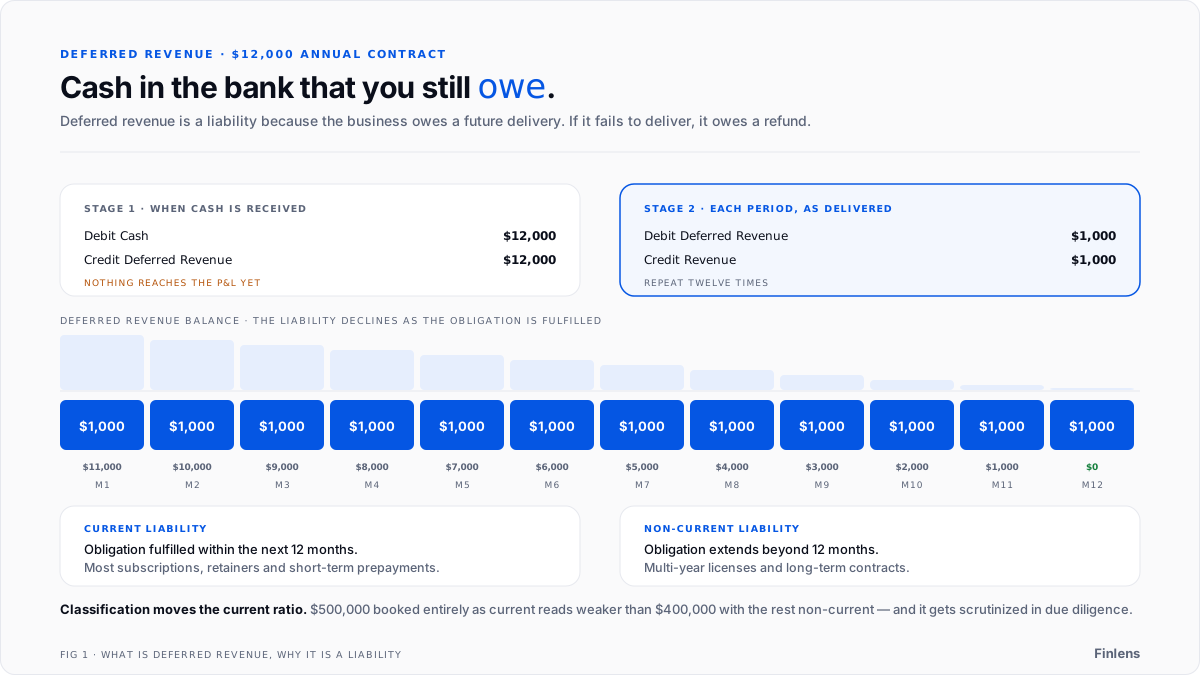
The liability decreases as the business fulfills its obligation. A client who receives $12,000 upfront for a year of monthly services recognizes $1,000 of that as revenue each month. After six months, $6,000 has moved from deferred revenue to earned revenue. The other $6,000 remains a liability.
This is fundamentally different from accrued revenue, which is earned but not yet billed. Deferred revenue is billed and collected but not yet earned. They sit on opposite sides of the ledger and get confused constantly. (Every junior accountant makes this mistake at least once, and it usually shows up at month-end when the numbers don't tie.)
Is Deferred Revenue a Current Liability?
It depends on when the obligation will be fulfilled.
Deferred revenue is a current liability when the business expects to deliver the goods or services within the next 12 months. Most subscription revenue, retainers, and short-term prepayments fall here.
Deferred revenue is a non-current liability when the obligation extends beyond 12 months. Long-term contracts, multi-year software licenses, and certain construction projects can create non-current deferred revenue balances.
The classification matters more than most clients realize. A business with $500,000 of deferred revenue classified entirely as current has a weaker current ratio than one with $400,000 classified as non-current. Misclassifying long-term deferred revenue as current overstates current liabilities and understates the true short-term financial position. When clients are seeking financing or preparing for due diligence, this distinction gets scrutinized.
Deferred revenue vs. accrued revenue
These two get confused constantly because they both involve timing gaps between cash and revenue. But they sit on opposite sides of the balance sheet.
The simplest test: did the customer pay you before you delivered? That's deferred revenue. Did you deliver before the customer paid? That's accrued revenue. For a full breakdown of how accrued revenue works on the balance sheet, see the accrued revenue guide.
Deferred Revenue Journal Entry
The deferred revenue journal entry has two stages.
Stage 1: When cash is received
- Debit: Cash
- Credit: Deferred Revenue (liability)
Stage 2: As the obligation is fulfilled (each period)
- Debit: Deferred Revenue
- Credit: Revenue
Example. Your client receives $12,000 in January for a 12-month service contract.
January (on receipt): Debit Cash $12,000 / Credit Deferred Revenue $12,000. Revenue is always a credit - for a refresher on why, see is revenue a debit or credit.
Each month (January through December): Debit Deferred Revenue $1,000 / Credit Revenue $1,000
By December, the full $12,000 has moved from the liability account to earned revenue. The deferred revenue balance is zero.
Here's the full 12-month recognition schedule for that $12,000 contract:
For how ASC 606 governs the timing of this recognition for SaaS contracts specifically, see the ASC 606 SaaS billing guide. If any month's entry is missed, the deferred revenue balance stays inflated and the income statement understates revenue for that period. By year end, the cumulative effect is a balance sheet that still shows a liability for services already delivered.
For partial deliveries, the same principle applies. If a client delivers 60% of a project milestone, 60% of the prepayment can be recognized. The remaining 40% stays in deferred revenue until the rest is delivered. Tracking that against actual delivery progress is where recognition errors creep in when it's being done manually across multiple contracts.
Common Scenarios Where Deferred Revenue Appears
Deferred revenue shows up most often in:
- SaaS and subscription businesses: Annual plans paid upfront, recognized monthly
- Retainer agreements: Law firms, consultants, and agencies who bill before work begins
- Gift cards: Recognized only when the card is redeemed
- Insurance premiums: Recognized over the coverage period
- Construction contracts: Recognized against project milestones
Any business model where customers pay before receiving the full value is a deferred revenue situation. SaaS and subscription clients tend to carry the largest and most complex deferred revenue balances, which is why automating deferred revenue recognition for SaaS is one of the highest-leverage things an accountant can do for those clients.
Managing Deferred Revenue Across Multiple Clients
If your managing deferred revenue manually for a book of clients with subscriptions, retainers, or prepayment models, the risk isn't just time. Its accuracy. Each client needs the right amount recognized in the right period every single month. Miss a recognition entry, and the income statement is understated. Recognize too early, and revenue is overstated. Either way, the financial statements misrepresent the business.
This is also one of those areas where errors compound quietly until someone asks why the balance sheet deferred revenue balance hasn't moved in three months.
Accountants who have built accrual automation into their month-end workflow catch recognition gaps before they become a close problem. And since deferred revenue directly affects how month-end close ties out, getting the recognition schedule right in real time is what keeps the close clean rather than requiring reconstruction.
Finlens runs on top of QuickBooks with no migration and automates the categorization and reconciliation work that accurate deferred revenue recognition depends on.
Before Finlens: Check each client's deferred revenue schedule manually, confirm deliveries against the recognition schedule, post the monthly entries, and hope nothing was missed.
After Finlens: Revenue recognition is tracked in real time. Monthly entries are consistent. The deferred revenue balance moves correctly every period without a manual reminder to make it happen.
What is deferred revenue at its core? It is a promise recorded as a number. Managing that promise correctly across every client, every month, is where the accounting work actually lives.
FAQ
What is deferred revenue in simple terms?
Deferred revenue is money a business has received but not yet earned. The cash is in the bank, but the product or service hasn't been delivered yet, so it cannot be recorded as revenue.
Is deferred revenue a liability?
Yes. Deferred revenue is a liability because the business owes the customer a future delivery. Until that obligation is fulfilled, the cash belongs to the customer in every practical sense.
Is deferred revenue a current liability?
It depends on timing. If the obligation will be fulfilled within 12 months, it is a current liability. If it extends beyond 12 months, it is a non-current liability. Many businesses split their deferred revenue balance between current and non-current depending on contract terms.
What is the deferred revenue journal entry?
On receipt: Debit Cash, Credit Deferred Revenue. Each period as the obligation is fulfilled: Debit Deferred Revenue, Credit Revenue. The entry repeats until the full balance is recognized.
What is the difference between deferred revenue and accrued revenue?
Deferred revenue is cash received before delivery. It is a liability. Accrued revenue is revenue earned but not yet billed. It is an asset. They are opposites and should never be confused on the balance sheet.
What types of businesses commonly have deferred revenue?
SaaS companies, subscription services, insurance providers, law firms on retainer, gift card issuers, and any business that collects payment before completing delivery.

