
When to Switch From Cash to Accrual Accounting: The Triggers and Mechanics


Most small businesses start on cash method record revenue when cash is received, record expenses when cash is paid. It's simple, aligns closely with bank activity, and works fine at low volumes. But at specific thresholds, switch to accrual accounting recording revenue when earned and expenses when incurred, regardless of cash timing either becomes mandatory or becomes strategically useful.
This guide covers exact triggers that force or motivate switch, and mechanics of actually changing methods with IRS.
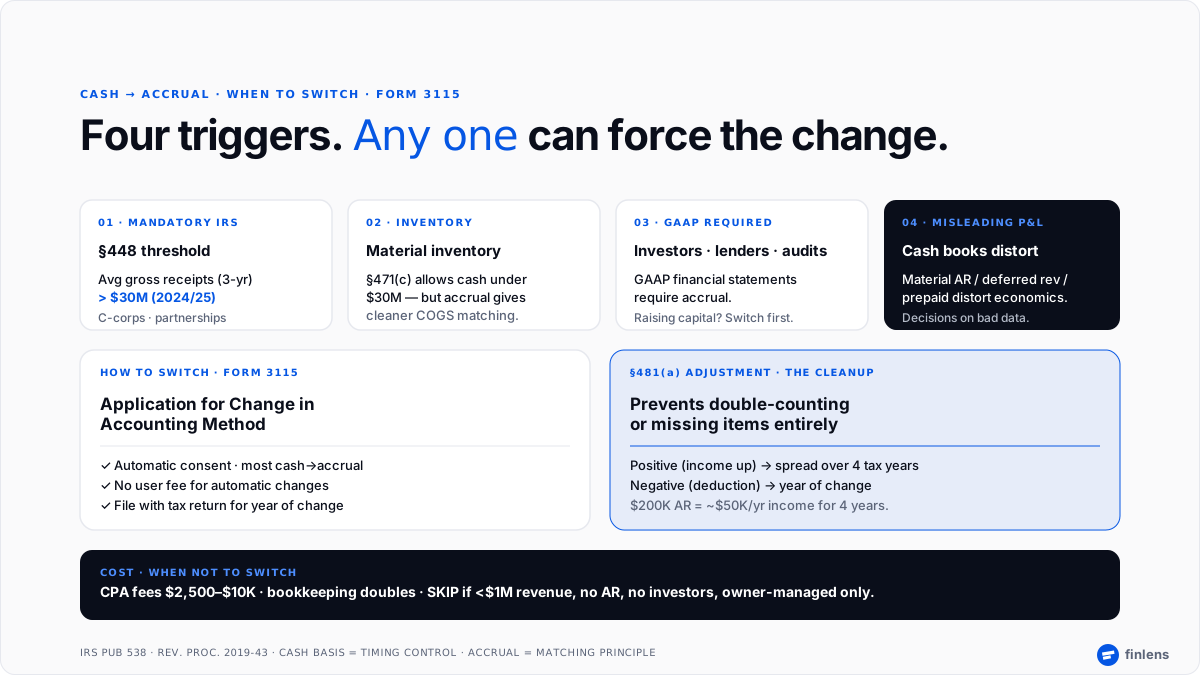
The four triggers that force or motivate switching
1. Mandatory IRS threshold average annual gross receipts over $30 million (2024/2025). Under IRC §448, C-corporations, partnerships with C-corp partners, and tax shelters must use accrual accounting if average annual gross receipts over prior three years exceed threshold. The 2024 threshold is $30 million; it adjusts annually for inflation.
For most small businesses well under this threshold, mandatory rule doesn't apply. But growing businesses should track it as they scale hitting threshold triggers a required method change.
2. Business has inventory as a material income-producing factor. Historically, any business with inventory was required to use accrual for that portion. The Tax Cuts and Jobs Act relaxed this under IRC §471(c), businesses with average gross receipts under §448 threshold can now use cash accounting even with inventory, either treating inventory as non-incidental supplies or following an applicable financial statement method.
Still, many inventory-heavy businesses find accrual more accurate operationally and switch voluntarily.
3. Investors, lenders, or auditors require GAAP-compliant statements. GAAP financial reporting requires accrual accounting. If your business is raising outside capital, taking on institutional debt, preparing for sale, or maintaining audited financial statements, accrual is effectively required.
4. Cash accounting starts producing misleading financial statements. A growing business with material receivables, deferred revenue, or prepaid expenses generates increasingly distorted P&Ls on cash accounting. Revenue collected doesn't match revenue earned; expenses paid don't match expenses incurred. Managers start making decisions on numbers that don't reflect economic reality.
For details on underlying methods, see IRS Publication 538 (Accounting Periods and Methods) authoritative reference on rules.
Cash vs. accrual quick refresher
Cash method:
- Revenue recognized when cash is received
- Expenses recognized when cash is paid
- Matches bank account movement closely
- Simpler bookkeeping
- Tax timing controllable by delaying receipts or accelerating payments
Accrual method:
- Revenue recognized when earned (product shipped, service delivered)
- Expenses recognized when incurred (bill received)
- Reflects economic activity, not cash timing
- Requires tracking AR, AP, prepaid expenses, accrued expenses, deferred revenue
- Required by GAAP
The difference between profit and cash flow is much wider under accrual because AR, AP, and other working-capital items sit on balance sheet rather than flowing through P&L in period they hit bank.
When accrual is actually better
Even below IRS threshold, accrual usually produces better information at these signposts:
Revenue exceeds $1M with material accounts receivable. If you have 30+ days of AR outstanding, cash accounting understates revenue in growing months and overstates it in collection months. Owners see a rollercoaster P&L that doesn't reflect operations.
Recurring subscription or retainer revenue. SaaS, agencies on retainer, and any subscription business benefits enormously from accrual + proper revenue recognition. Cash-basis SaaS looks profitable in months customers renew and loss-making in months they don't neither picture is real.
Meaningful inventory. Even with §471(c) allowing cash treatment, businesses with $500K+ in inventory get materially better information from accrual, especially for COGS matching.
Multi-entity operations. Consolidating multiple entities on cash accounting produces noise. Accrual makes intercompany transactions net cleanly.
Preparing for financing or sale. Any external financial statement user investors, lenders, buyers expects accrual. Sale discussions on cash statements typically get a haircut in valuation.
The mechanics Form 3115
Switching from cash to accrual requires filing Form 3115 (Application for Change in Accounting Method) with IRS. The instructions for Form 3115 walk through process.
There are two ways method change happens:
Automatic change procedure most method changes qualify for automatic consent. The taxpayer files Form 3115 with tax return for year of change and follows applicable Revenue Procedure (currently Rev. Proc. 2019-43 and its successors). No IRS user fee. No advance approval required. Filing is essentially notification.
Non-automatic change procedure for changes that don't qualify for automatic consent, taxpayer must file Form 3115 in advance and pay a user fee ($10,800 for most non-automatic changes). Requires IRS approval before implementing change.
Most cash-to-accrual switches for small businesses qualify for automatic consent.
The Section 481(a) adjustment
The most complex part of a method change is Section 481(a) adjustment accounting cleanup needed to prevent items from being either double-counted or missed entirely when method changes.
Example: A cash-basis business has $200,000 of AR (revenue earned but cash not yet collected) at time of switching to accrual. Under cash, that revenue would be recognized when cash arrives (post-switch). Under accrual, it would be recognized when earned (pre-switch). Without adjustment, revenue would either be double-counted (once under each method) or missed entirely (never recognized under either method).
The §481(a) adjustment forces recognition of pre-switch items in a specific way:
- Positive adjustments (income increases) are typically spread over 4 tax years
- Negative adjustments (deductions) are typically taken in year of change
The 4-year spread on positive adjustments smooths tax impact of switch. For a small business with $200K of AR converting to accrual, tax bill on that $200K spreads across 4 years rather than hitting all in year 1.
The accountant handling switch typically prepares a schedule showing:
- AR at date of change
- AP at date of change
- Prepaid expenses
- Accrued expenses
- Inventory adjustments (if applicable)
- Deferred revenue
These summed with proper signs produce §481(a) adjustment.
What switch costs
Professional fees. Expect $2,500–$10,000 for a CPA to prepare method change filing, calculate §481(a) adjustment, and manage tax impact. Complex cases (multi-entity, inventory-heavy) run higher.
Tax cost. The §481(a) adjustment usually creates a positive income adjustment spread over 4 years. For a business with growing AR, tax bill is real but manageable.
Bookkeeping cost. Ongoing bookkeeping under accrual is materially more work. Bank feeds don't capture whole picture bookkeeper has to track AR, AP, deferrals, accruals, and prepaid schedules. Monthly close time typically doubles when moving from cash to accrual with no system changes.
Modern reconciliation and automation tools help accrual automation on QuickBooks specifically handles AR/AP/deferral/prepaid mechanics that make accrual workflow harder to keep clean by hand.
When NOT to switch
Not every business benefits from switching. Reasons to stay on cash:
- Revenue is under $1M with no material AR
- No inventory
- No external financial statement users demanding GAAP
- Owner-managed with no board or investors
- Simplicity is a strategic advantage (single owner-operator, service business paid at completion)
If you're not required to switch by IRS §448 threshold and you don't have investors/lenders forcing GAAP, staying on cash saves time and money.
Conclusion
Switch when IRS makes you (§448 threshold), when investors or lenders require GAAP, or when cash accounting stops reflecting economic reality. Most businesses under $5M in revenue with limited AR should stay on cash. Most businesses over $10M or with material AR/inventory/deferred revenue benefit from switching regardless of whether it's mandatory.
FAQ
When am I required to switch from cash to accrual?
If your business is a C-corp, partnership with C-corp partners, or tax shelter AND average annual gross receipts over past three years exceeds §448 threshold ($30M for 2024). Growing businesses should also switch when investors, lenders, or auditors require GAAP-compliant financial statements.
Do businesses with inventory have to use accrual?
Not necessarily. Under IRC §471(c), businesses below §448 gross receipts threshold can use cash even with inventory. But many inventory-heavy businesses find accrual more accurate operationally and switch voluntarily.
How do I switch from cash to accrual?
File Form 3115 (Application for Change in Accounting Method) with IRS. Most cash-to-accrual switches qualify for automatic consent procedures. Include a §481(a) adjustment calculation showing pre-switch items (AR, AP, prepaids, accruals) that need cleanup to prevent double-counting.
What is Section 481(a) adjustment?
The accounting cleanup calculation when changing methods, ensuring items aren't double-counted or missed. Positive adjustments (income increases) are typically spread over 4 tax years. Negative adjustments (deductions) are taken in year of change.
How much does switching to accrual cost?
Professional fees to prepare method change filing typically run $2,500–$10,000 for straightforward cases; more for complex situations. Ongoing bookkeeping cost roughly doubles when moving from cash to accrual without automation.
Can I switch back to cash later?
Yes, but it requires another Form 3115 filing and another §481(a) adjustment. The IRS discourages frequent method changes expect scrutiny if you switch back and forth.
What are benefits of accrual over cash?
More accurate matching of revenue and expenses to period they belong to. Better financial statement quality for investors and lenders. Cleaner picture of business economics "profitable but out of cash" or "cash-rich but losing money" pattern shows up correctly.
What's biggest disadvantage of accrual?
Complexity. Bookkeeping requires tracking AR, AP, prepaid expenses, accrued expenses, and deferred revenue continuously. Monthly close is materially more work. And tax timing loses flexibility that cash provides (accelerating expenses / delaying receipts near year-end).

