
7 Best Zeni Alternatives For Startup Accounting: Outsource Or Automate? (2026)


Key takeaways
- Zeni is a managed accounting service for startups that handles books, taxes, and CFO work. It starts at $549/month and scales up fast.
- Not every startup needs a managed service. Some need software that automates work on top of what they already have.
- The best Zeni alternative depends on your stage, budget, and whether you want to hand off accounting or own it with better tooling.
- Finlens handles AI categorization, GAAP schedules, Stripe revenue recognition, and close automation natively inside QuickBooks. Free to start.
Why a managed accounting service might not be what you need
Zeni bundles bookkeeping, taxes, payroll, and fractional CFO into one package starting at $549/month. That works for a pre-Series A founder with zero accounting infrastructure. But the pricing scales to $2,000 to $5,000/month by Series B, and you lose daily visibility into your own numbers since the data lives in their system.
Y Combinator's advice to founders on financial awareness is direct: know your burn rate and runway at all times. Each is evaluated on what it does, who it's for, and what it costs.
How Zeni alternatives compare: feature matrix
7 best Zeni alternatives for startup accounting
1. Finlens
Migration Friction: Zero | Automation Depth: High | Pricing: Free to $49/mo
Best for: SaaS startups and CPA firms on QuickBooks that want AI automation without handing off control of their books to a managed service.
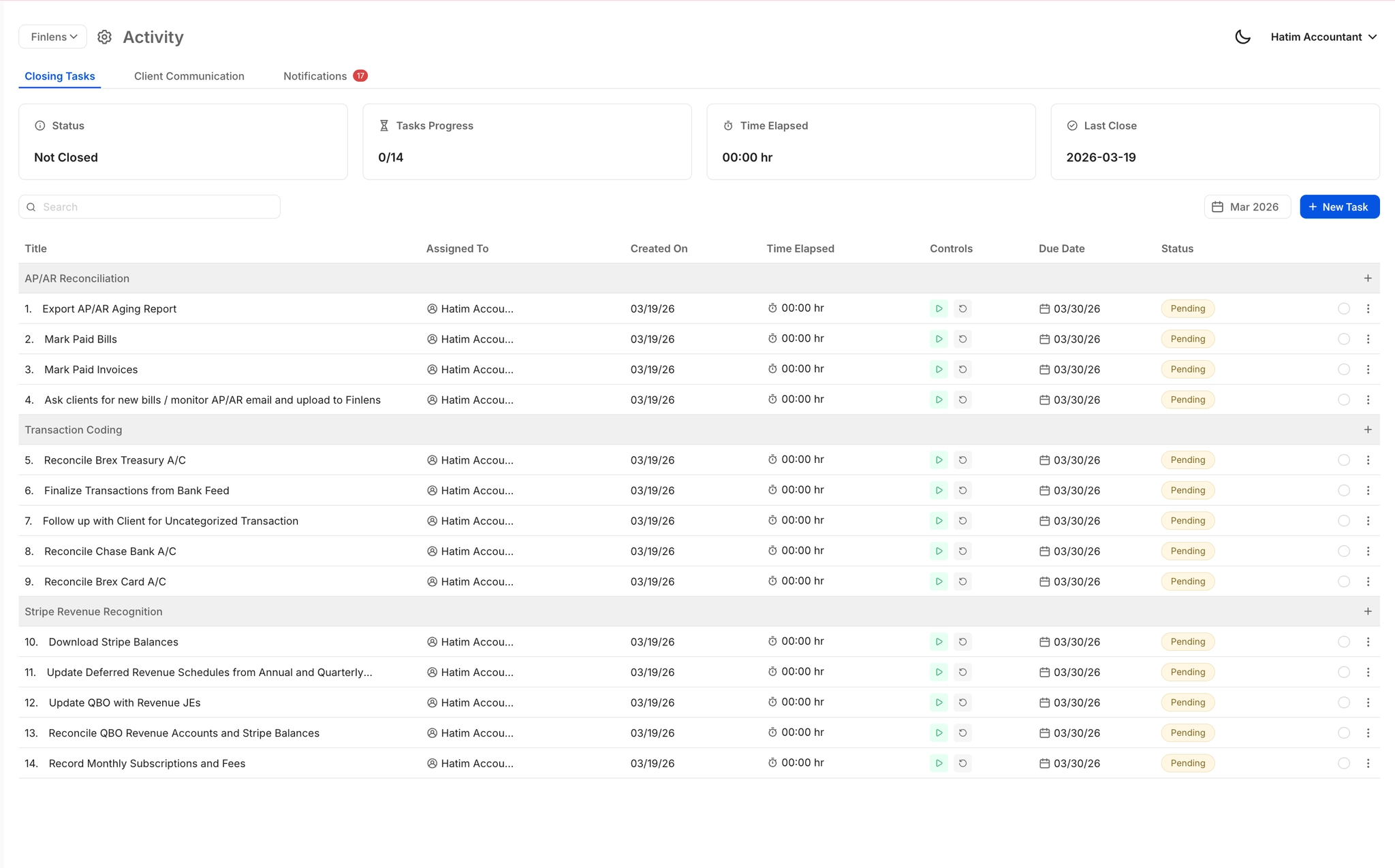
Finlens is only tool on this list that automates accounting work Zeni's team does manually, but inside your existing QuickBooks setup instead of a separate platform. It's not a managed service. It's software that makes your accountant (or you, if you're doing it yourself) fast enough that you don't need a service.
When transactions come in from your bank feed, Finlens reads vendor, amount, and how similar transactions have been coded before. It assigns a category. Your accountant (or you) sees a review queue of suggested entries, not a pile of uncategorized line items. Approve or adjust in one click. QBO updates in real time.
For SaaS companies on Stripe, Finlens auto-separates gross revenue from processing fees and refunds. Annual subscriptions get broken into monthly deferred revenue entries. The journal entries write directly to QBO. No spreadsheet or separate revenue tool.
GAAP schedules for accruals, prepaids, and amortization generate automatically based on your existing QBO entries. No rebuilding in Excel every month. Your accountant reviews output instead of building it from scratch.
For CPA firms managing multiple startup clients, Finlens shows all clients in one dashboard with close status, open items, and deadlines. Firms report 40 to 70% faster close times across their client book.
Capabilities:
- AI transaction categorization. Learns from your GL history. Firms report 80%+ reduction in bookkeeping time.
- Stripe revenue recognition. Auto-separates revenue, fees, and refunds. Annual subs split into monthly deferred entries.
- GAAP schedule automation. Accruals, prepaids, and amortization generated per client without spreadsheets.
- Real-time dashboard. Live burn rate, runway, MRR, ARR, cash flow.
- Month-end close automation. Task management, progress tracking, multi-client view.
For a detailed look at when automation makes sense versus outsourcing at each startup stage, this article on when to automate your startup's bookkeeping covers decision in depth.
QuickBooks support: QuickBooks Online, native two way real time sync.
Sync frequency: Real-time.
Pricing: Free Starter plan (up to $50k/month in expenses). AI Accounting at $49/month for founders. CPA firms at $30/client/month.

2. Pilot
Migration Friction: Low | Automation Depth: None (human service) | Pricing: $499/mo
Best for: VC-backed startups that want managed bookkeeping with human accountants and don't need real-time data visibility.
Pilot is closest direct alternative to Zeni in managed service category. You get a dedicated bookkeeping team that handles your monthly books, financial statements, and reporting. They also offer tax preparation and fractional CFO services as paid add-ons.
Pilot works on top of QuickBooks, which means your books stay in QBO. That's an advantage over Zeni if you ever need to switch providers, since data is in a system you own rather than service's proprietary platform.
The tradeoff is speed and visibility. Pilot delivers monthly financial statements, not real-time dashboards. If you need live burn rate or runway, you're waiting for monthly package or asking your bookkeeper. Pricing starts at $499/month for basic bookkeeping and scales to $599/month for Core plan. Tax and CFO services add significantly on top.
QuickBooks support: Works on top of QBO.
Pricing: Bookkeeping starts at $499/month. Tax starts at $2,450/year. CFO starts at $1,875/month. See Pilot pricing.
3. Kruze Consulting
Migration Friction: Low | Automation Depth: None (human service) | Pricing: ~$600/mo
Best for: Funded startups (Seed through Series C) that need full-service accounting, tax, R&D credits, and CFO advisory from a firm that specializes in venture-backed companies.
Kruze Consulting is a full-service accounting firm, not a software product. They have 150+ professionals including Big Four alumni and former startup CFOs. If your startup has raised venture funding and needs a firm that understands cap tables, 409A valuations, R&D tax credits, and investor reporting, Kruze is built for that.
The advantage over Zeni is depth of expertise. Kruze specializes exclusively in VC-backed startups. The disadvantage is cost: pricing starts around $600/month and scales based on complexity. Like Zeni, you're outsourcing function entirely, which means visibility tradeoff applies here too.
QuickBooks support: Works on QBO.
Pricing: Starts around $600/month. Custom pricing based on complexity. See Kruze pricing calculator.
4. Puzzle
Migration Friction: Medium (new GL) | Automation Depth: Partial | Pricing: Free
Best for: Early-stage startups that want accounting software designed specifically for startups, with a focus on automation and a clean interface.
Puzzle is gaining traction as a startup-first accounting platform. One founder on r/TheTechStack described it as "clearly built with startups in mind." Another on r/startups called it "hot one for startups right now" and said it's easier than QuickBooks.
Puzzle provides its own general ledger rather than sitting on top of QBO, which means it's a migration rather than an overlay. It connects to banks, Stripe, and payroll providers, and handles categorization with some automation. The interface is clean and startup focus is genuine.
The limitation is maturity. Puzzle is newer than established platforms, and teams with complex accounting needs (multi-entity, detailed GAAP schedules, enterprise revenue recognition) may find gaps. It also doesn't replace a human accountant for review and judgment. If you want software that adds intelligence to your existing QBO setup without migrating, Finlens is a closer fit. If you want to start fresh on a startup-native platform, Puzzle is worth evaluating.
QuickBooks support: Imports from QBO but uses its own GL.
Pricing: Free tier available. See Puzzle pricing.
5. Zoho Books
Migration Friction: High (separate platform) | Automation Depth: Low | Pricing: Free
Best for: Bootstrapped and early-stage startups that need solid accounting software at lowest possible cost.

Zoho Books is budget option on this list, and it's genuinely good at that tier. One founder on r/startups called it "fantastic" and noted free tier covers up to $50k in revenue.
It handles invoicing, expense tracking, bank feeds, and basic tax reporting. The interface is clean enough for a founder with no accounting background. If you're pre-revenue or very early and just need your books organized without paying anything, Zoho Books is a reasonable starting point.
The limitation is that it's a standalone platform. It doesn't integrate with QuickBooks, doesn't have AI categorization, doesn't generate GAAP schedules, and doesn't provide real-time SaaS metrics like burn rate or runway. You'll outgrow it as your accounting needs get more complex, but for first year or two it handles basics without costing anything.
QuickBooks support: No. Separate platform.
Pricing: Free for businesses under $50k in revenue. Paid plans start at $15/month. See Zoho Books pricing.
6. Xero
Migration Friction: High (replaces QBO) | Automation Depth: Low | Pricing: $29/mo
Best for: Startups that want a cloud accounting platform with strong integrations and prefer an alternative to QuickBooks.

Xero is a publicly traded company with close to 5 million small business customers. One user on r/QuickBooks called it "way better than QuickBooks Online." It's widely used in UK, Australia, and New Zealand, and has a growing US user base.
Xero handles invoicing, bank reconciliation, expense claims, and financial reporting. Its app marketplace has hundreds of integrations, and interface is generally considered cleaner than QBO's. For startups that haven't committed to QuickBooks yet, Xero is a legitimate alternative.
The limitation for this comparison: Xero replaces QuickBooks, it doesn't sit on top of it. If your accountant or CPA firm already works on QBO, switching to Xero is a migration. It also doesn't have AI categorization, GAAP schedule automation, or real-time SaaS dashboard that tools like Finlens provide. It's accounting software, not an automation layer.
QuickBooks support: No. Replaces QBO. Pricing: Starts at $29/month. See Xero pricing.
7. WaveApps
Migration Friction: High (separate platform) | Automation Depth: None | Pricing: Free
Best for: Pre-revenue and very early startups that need free accounting software with zero commitment.

WaveApps has been around for years and core pitch hasn't changed: it's free accounting software. Invoicing, expense tracking, bank connections, and basic reporting are included at no cost. One user on r/QuickBooks described it simply as "just accounting."
Another on r/smallbusiness recommended it for "startups that need barebones," though they noted free tier is getting more limited over time. Payroll and tax services are available as paid add-ons.
WaveApps is right choice when you're pre-revenue, your transaction count is low, and you genuinely cannot spend money on accounting tools. It doesn't have AI features, doesn't integrate with QBO, and doesn't scale well past earliest stage. But for first few months of a bootstrapped startup, it covers basics.
QuickBooks support: No. Separate platform. Pricing: Free for core accounting. Payroll and tax are paid add-ons. See WaveApps pricing.
Which Zeni alternative is right for you?
Startup on QBO that wants AI automation with live visibility and no outsourcing? Finlens.
VC-backed and want a human team handling everything on QBO? Pilot.
Funded startup needing full-service with tax, R&D credits, and CFO advisory? Kruze Consulting.
Early-stage wanting startup-native accounting software? Puzzle.
Bootstrapped and need free accounting that covers basics? Zoho Books or WaveApps.
Want a QBO alternative with a cleaner interface? Xero.
For a detailed breakdown of which financial metrics investors focus on at each stage, this guide on startup finance metrics investors actually care about is worth reading before your next raise.
For a broader view of close automation tools across different company types, this roundup of best tools to automate month-end close covers full category.
Keep your numbers in your hands, not someone else's
The choice between Zeni and its alternatives comes down to one question: do you want someone else to own your books, or do you want to own them with better tooling?
Managed services like Zeni, Pilot, and Kruze give you time back. They also put your daily financial data one step away from you at exactly moments you need it most: investor meetings, board updates, and mid-month decisions.
Finlens takes a different approach. It automates manual work your accountant does on QuickBooks: categorization, reconciliation, GAAP schedules, revenue recognition. Your accountant stays in control. Your dashboard shows live numbers. Your books stay in QBO where you own them.
It starts free, works on your existing setup, and doesn't require migration. If you want to see how automation works with your actual QBO data, book a walkthrough. It takes about 20 minutes.

FAQ
1. What is best Zeni alternative for startups on QuickBooks?
Finlens. It automates categorization, GAAP schedules, Stripe revenue recognition, and close management natively inside QBO. Free to start, with a live dashboard for burn, runway, MRR, and ARR.
2. Is Pilot cheaper than Zeni?
Roughly same. Pilot's bookkeeping starts at $499/month versus Zeni's $549/month. Both scale up with complexity. Tax and CFO services are additional at both.
3. Is there a free alternative to Zeni for startups?
Yes. Finlens is free up to $50k in monthly expenses and includes AI categorization and real-time dashboards. Zoho Books and WaveApps offer free core accounting without AI or QBO integration.
4. Should startups outsource accounting or automate it?
Depends on your stage. Pre-Series A with no accounting infrastructure, outsourcing to Pilot or Kruze makes sense. Series A and beyond with an existing accountant, automating with Finlens gives you speed and control at a fraction of cost.
5. Does Zeni work with QuickBooks?
Yes, but Zeni manages books in their own system. Your daily data lives with Zeni, not in QBO. Finlens and Pilot both work directly on QuickBooks, keeping your data in a system you own.

