
The employee vs contractor classification guide for QuickBooks payroll (2026)


This is a working reference for founders, controllers, and firm bookkeepers deciding whether a new hire is a W-2 employee or a 1099 independent contractor. Every test, penalty, and safe harbour is sourced to IRS documentation, state statute, or a real thread on the QuickBooks Community. Legal citations should be verified against current guidance for the specific state before any classification decision.
The problem this guide addresses
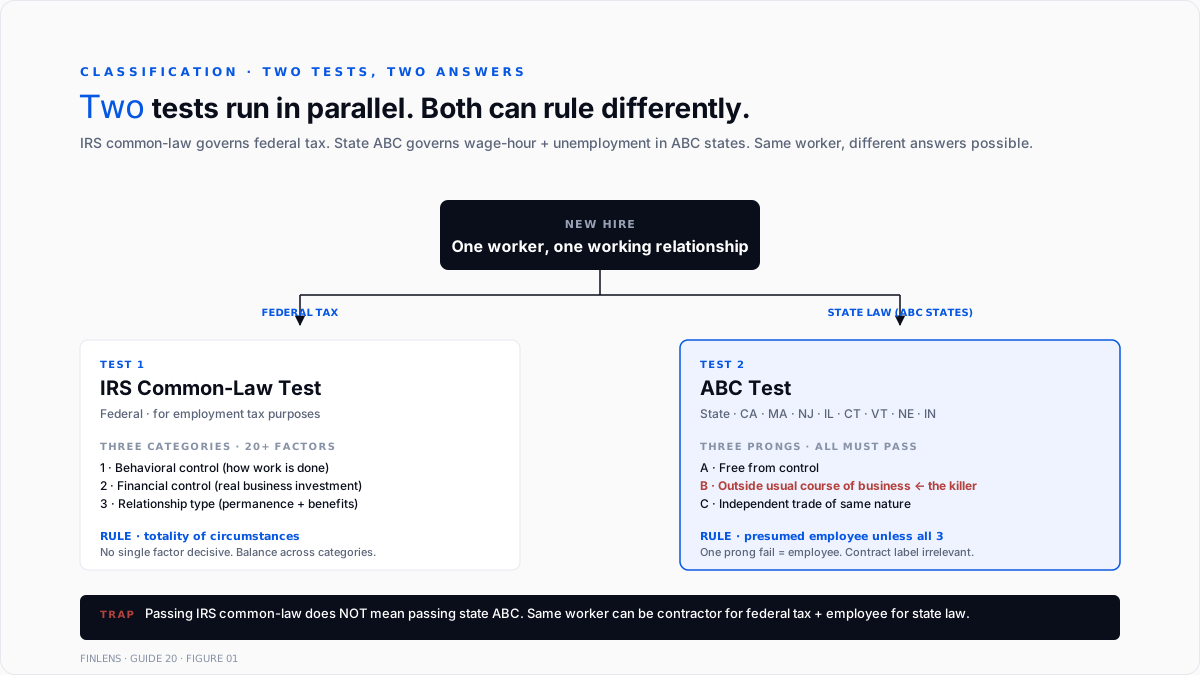
Two conflicting classification tests are the trap on every new hire in 2026.
The first is the IRS common-law test. Federal for tax purposes. Weighs 20+ factors across three categories (behavioral control, financial control, type of relationship) and considers the totality of the circumstances. No single factor is decisive. A worker can be a contractor for federal tax purposes if the majority of factors favor contractor status.
The second is the ABC test. State law for wage-hour and unemployment purposes in a growing number of states. Presumes employee status unless the hiring entity proves all three of: (A) worker is free from control, (B) work is outside the usual course of the hiring entity's business, and (C) the worker is customarily engaged in an independent trade of the same nature. Prong B is the killer - a marketing agency hiring a marketing contractor fails prong B automatically because marketing is the usual course of the agency's business.
Books can pass the IRS common-law test and fail the state ABC test on the same worker. Books can pass ABC in a non-ABC state and get reclassified in an ABC state. Misclassification exposure - back employment taxes, unemployment premiums, workers' comp, benefits back-paid, interest, civil penalties, and 100% Trust Fund Recovery Penalty against individuals personally - can exceed $50,000 to $75,000 per worker in willful cases per the BoomTax misclassification penalty reference.
The sections below cover the IRS common-law test in detail, the ABC test and which states use it, the DOL's separate FLSA test, the classification decision workflow, misclassification penalty exposure, Section 530 safe harbor, Form SS-8 IRS determinations, the Voluntary Classification Settlement Program (VCSP), and how QuickBooks Online Payroll versus Contractor Payments enforces the decision at the ledger.
The IRS common-law test
Applied for federal tax purposes. Determines whether the business owes employment taxes (income tax withholding, FICA, FUTA). The IRS behavioural control page is the canonical reference for one of the three test categories.
Category 1 - Behavioural control
Whether the business directs how the work is done.
Employee indicators:
- Instructions on when, where, and in what sequence to work
- Required tools or systems mandated by the business
- Mandated training in the business's specific methods
- Review of the worker's methods, not just results
Contractor indicators:
- Worker sets own schedule and location
- Worker supplies own tools
- No training required
- Business reviews results, not methods
Category 2 - Financial control
Whether the worker has a real business independent of the hiring entity.
Employee indicators:
- Reimbursed for business expenses
- No significant investment in own equipment
- Not available to work for other clients simultaneously
- Paid hourly or on a fixed salary
- No opportunity for profit or loss beyond the pay cheque
Contractor indicators:
- Significant unreimbursed investment (owns equipment, workspace, software)
- Bears own business expenses
- Actively markets services to other clients
- Paid by project or on a flat fee
- Real opportunity for profit or loss (project can go over budget, worker eats the loss)
Category 3 - Type of relationship
The context and permanence of the working arrangement.
Employee indicators:
- Written contract stating employee relationship
- Provides employee-type benefits (health insurance, paid time off, retirement)
- Expected permanent relationship (not project-based end date)
- Services are a key activity of the business
Contractor indicators:
- Written contract explicitly identifying independent contractor status
- No benefits provided
- Project-based end date or specific deliverable-defined engagement
- Services peripheral to the business's core operations
The totality-of-circumstances rule
No single factor is decisive. The IRS weighs the balance across all three categories. A worker with strong contractor evidence on financial control (owns own gear, works for many clients) but strong employee evidence on behavioural control (required daily standup, business-mandated methodology, review of process) is still likely a common-law employee.
For 2026, the IRS continues to apply this common-law test - the underlying test hasn't changed for decades. What changes annually is IRS enforcement priorities and audit focus areas.
The ABC test
Applied under state law in states that have adopted it. Governs wage-and-hour, unemployment, and (increasingly) workers' compensation classification. The Worksuite AB5 reference covers the California origin at Labor Code § 2775.
The three prongs
A worker is presumed an employee unless the hiring entity proves ALL THREE of:
Prong A - Free from control. The worker is free from the control and direction of the hiring entity in performing the work, both under the contract and in fact.
Prong B - Outside the usual course of business. The worker performs work that is outside the usual course of the hiring entity's business.
Prong C - Independent trade. The worker is customarily engaged in an independently established trade, occupation, or business of the same nature as the work performed.
Prong B is the killer. A marketing agency hiring a marketing contractor fails prong B - marketing is the agency's core business. A restaurant hiring a delivery driver fails prong B in states that have ruled delivery is part of the restaurant's usual course. A software company hiring a software developer fails prong B for the same reason.
The ABC test failure rate is much higher than the IRS common-law test failure rate. A worker who passes the IRS common-law test can still fail ABC by definition on prong B.
States that have adopted the ABC test (partial list as of 2026)
Per the Terms.law gig-worker classification FAQ and Omnivoo's 2026 AB5 compliance guide:
- Massachusetts - since 2004, first state to adopt broadly
- California - AB5 effective 2020, codified at Labor Code § 2775
- New Jersey - broader formal regulations effective October 1, 2026
- Illinois - for certain purposes
- Connecticut - for certain purposes
- Vermont - for certain purposes
- Nebraska - for certain purposes
- Indiana - ABC test for unemployment purposes only
Each state's scope differs. Some apply ABC to all state-level worker classification decisions; others apply only to specific statutes (unemployment, wage hour, or specific industries). Verify the current scope for the specific state at the state DOL page before making a classification decision.
Federal ABC test?
No federal ABC test exists as of 2026. The IRS uses the common-law test. The DOL uses a six-factor economic-reality test for FLSA (wage-and-hour) purposes, updated in 2024. State ABC tests operate independently of both.
The DOL economic-reality test (FLSA)
Distinct from both the IRS test and state ABC tests. Applied for FLSA (Fair Labour Standards Act) wage-and-hour purposes at the federal level. Six factors per the DOL's 2024 rule per the Xero employee-vs-contractor guide:
- Opportunity for profit or loss based on managerial skill
- Investments by the worker vs the employer
- Degree of permanence in the working relationship
- Nature and degree of control by the employer
- Extent work is integral to the employer's business
- Skill and initiative required to perform the work
The DOL test is used when the question is about the federal minimum wage or overtime - not employment tax. The same worker can be a contractor under the IRS common-law test (for tax purposes) and an employee under the DOL FLSA test (for wage-hour purposes).
The classification decision workflow
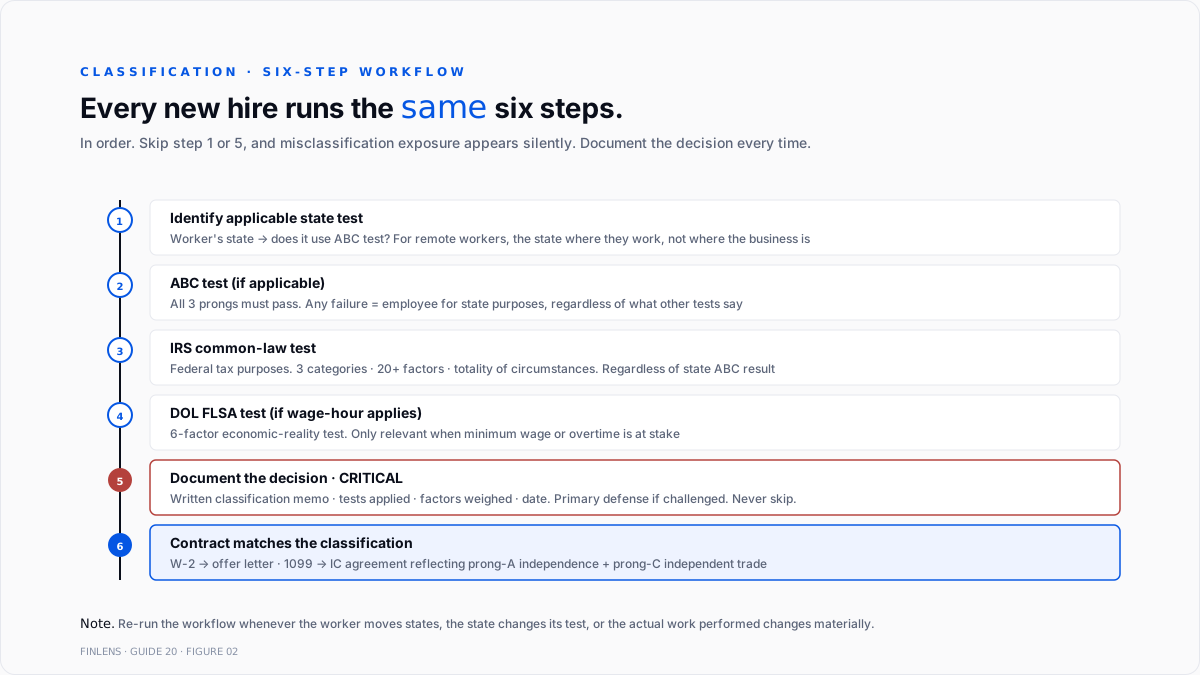
For every new hire, run through the tests in this order:
Step 1 - Applicable state test. Determine whether the state (or states, for remote workers) uses the ABC test for the purpose at hand (wage-hour, unemployment, workers' comp, all of the above).
Step 2 - ABC test (if applicable). If ABC applies, run through all three prongs. If any prong fails, the worker is an employee for state purposes regardless of what other tests say.
Step 3 - IRS common-law test. Regardless of the ABC test result, run through the IRS three-category test for federal tax purposes. Weigh the balance of factors across behavioural / financial / relationship.
Step 4 - DOL FLSA test. If minimum wage or overtime is at issue, run through the DOL six-factor economic-reality test.
Step 5 - Document the decision. Written classification memo per worker, citing the tests applied and the factors weighed. This document is the primary defence if the classification is later challenged.
Step 6 - Contract that matches the classification. For W-2 employees, an employment offer letter. For contractors, an independent contractor agreement that reflects prong-A independence (no control), prong-B non-integration (work outside the usual course), and prong-C independent trade indicators.
The written contract does not determine classification - the actual working relationship does. But an inconsistent contract (calling someone a contractor while treating them like an employee) is strong evidence of misclassification.
Misclassification penalty exposure
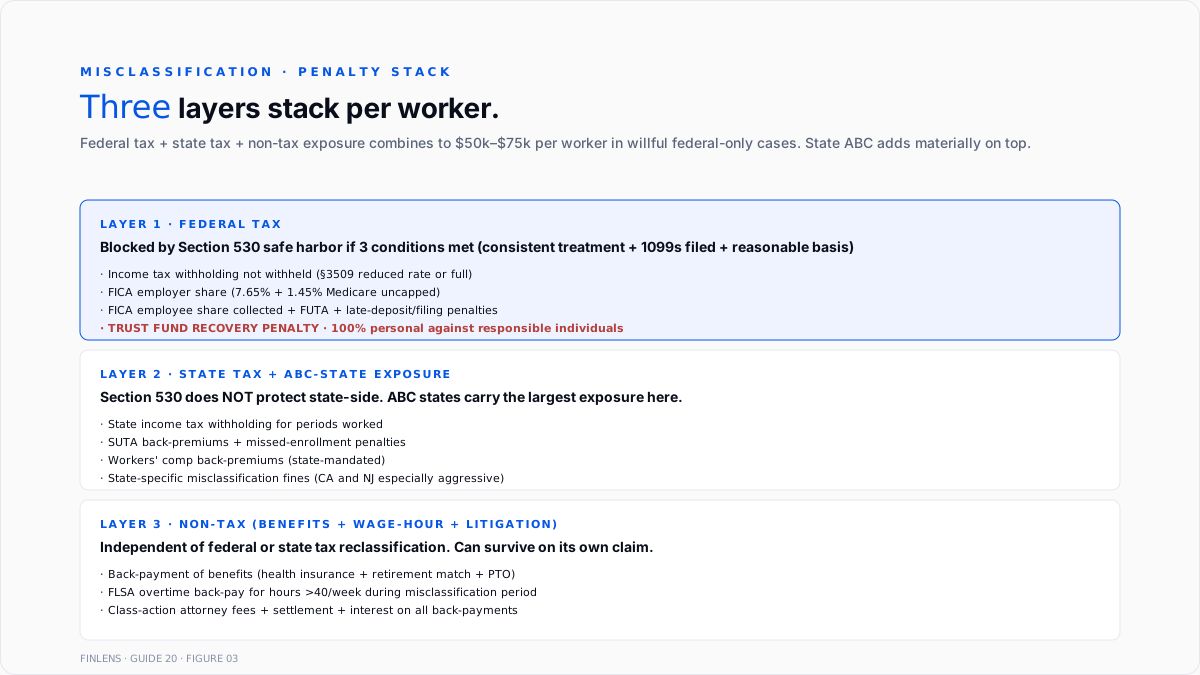
When a worker is reclassified from contractor to employee (by the IRS, a state agency, or a court), the business owes back-payments across multiple categories.
Federal tax layer
- Federal income tax withholding the employee owed but the business didn't withhold. Employer share via Section 3509 (reduced rate for good-faith cases) or full liability for willful cases.
- FICA employer share (7.65% up to the wage base + 1.45% Medicare uncapped)
- FICA employee share - nominally the employee's obligation but the business may end up paying if the employee-side withholding was never done
- FUTA (0.6% on the first $7,000 per employee)
- Interest on all of the above, compounding daily
- Failure-to-file penalties on the missed 941s and 940s
- Failure-to-deposit penalties on missed deposits (2%–15% tiers, covered in Guide 18 · Payroll taxes 941, 940)
- Trust Fund Recovery Penalty - 100% personally against responsible individuals
State tax layer
- State income tax withholding for the periods worked
- SUTA back-premiums - states typically charge back-premiums plus penalties for missed enrollment periods
- Workers' compensation back-premiums in states that mandate WC coverage
- State-specific misclassification penalties - California and New Jersey have specific statutes with fines per misclassified worker
Non-tax layer
- Back-payment of benefits the worker would have received as an employee (health insurance, retirement match, PTO)
- Overtime back-pay for hours worked over 40/week during the classification period
- Attorney fees in worker-filed class actions
- Interest on all back-payments
Total exposure per misclassified worker. Cited estimates in BoomTax and similar sources put the potential exposure at $50,000 to $75,000 per worker in wilful cases. Non-willful cases with the Section 530 safe harbour available can be materially lower.
Section 530 safe harbor
Federal protection under Section 530 of the Revenue Act of 1978. Blocks the IRS from reclassifying workers as employees for federal tax purposes if the business meets three conditions per Morris + D'Angelo's Section 530 reference:
The three conditions
1. Consistent treatment. The business consistently treated the worker (and workers in similar positions) as independent contractors for all periods at issue. Inconsistent treatment - treating one worker in the same role as an employee and another as a contractor - voids the safe harbour.
2. Filed all required 1099s. The business filed Form 1099-NEC (or 1099-MISC historically) timely for every reporting-threshold-exceeding contractor payment during the periods at issue. Missing 1099s void the safe harbour.
3. Reasonable basis. The business had a reasonable basis for the contractor classification. The four qualifying paths:
- Judicial precedent. Court cases or rulings support the classification for the specific type of worker.
- Past IRS audit. A prior IRS audit didn't reclassify the same workers.
- Longstanding industry practice. The industry customarily treats these workers as contractors.
- Other reasonable basis. Broad catch-all that courts construe generously - advice of counsel, published industry guidance, longstanding business custom.
What Section 530 does and doesn't protect
Protects: Federal employment tax liability (income tax withholding, FICA, FUTA, associated interest and penalties).
Does NOT protect: State employment tax liability, state unemployment premiums, workers' compensation, benefits back-payment, DOL FLSA overtime, class-action litigation, or state ABC test reclassification.
State ABC test rulings can hit the business even if Section 530 blocks the federal claim. This is why a worker can be a Section 530-protected contractor at the federal level and a state-law employee at the same time.
Form SS-8 - IRS determination
Either the worker or the business can file Form SS-8 asking the IRS for an official classification ruling. Common triggers:
- Worker files because they believe they're misclassified (typically after termination or a dispute about benefits)
- Business files proactively to get IRS blessing on a classification decision
The process:
- File Form SS-8 with the IRS
- The IRS solicits information from both parties
- IRS issues a binding determination – 6+ months typical
- If the determination reclassifies the worker as an employee, the business owes back employment taxes for the periods covered
- Section 530 safe harbour may still apply to limit federal-tax exposure
The worker-filed SS-8 is a common audit trigger - the IRS often expands the review beyond the worker who filed to look at similar workers in the same role.
VCSP – the proactive reclassification path
The Voluntary Classification Settlement Program (VCSP) lets businesses proactively reclassify workers with substantially reduced penalties. Per the Morris + D'Angelo VCSP reference:
- Pay 10% of one year's §3509-rate liability for the reclassified workers
- No penalties, no interest
- Prospective treatment - the reclassification applies going forward; prior periods are settled at the reduced rate
Not available if:
- The business is currently under IRS audit
- The IRS is contesting the classification of the same workers under another proceeding
- The business is under a Department of Labour investigation of the same workers
VCSP is the lowest-cost resolution path for a business that has determined it misclassified workers and wants to fix it before the IRS finds it.
The QuickBooks Online Payroll enforcement
QBO enforces the classification decision at the payroll-workflow level. W-2 employees run through QuickBooks Online Payroll. 1099 contractors run through the parallel Contractor Payments feature - the payroll tax write-up covers the tax-side context that determines which workflow applies.
The two workflows are physically separate:
- QBO Payroll. Payroll setup wizard, W-4 collection, tax withholding calculation, direct deposit, automatic 941/940 filing, W-2 issuance at year-end. Full workflow in the payroll setup guide (when live).
- Contractor Payments. Vendor setup with W-9, payment tracking with the "Track for 1099" flag, and 1099-NEC preparation at year-end. Full workflow in the accounts payable, vendor bills, and 1099 filing guide.
Running a contractor through QBO Payroll (which would produce a W-2 and withhold payroll taxes) is the misclassification failure mode covered in the payroll setup failure modes. Running a W-2 employee through Contractor Payments (which produces a 1099 and skips withholding) is the mirror-image misclassification. The QBO product separation reflects the underlying tax-code separation - one worker, one classification, one workflow.
The six recurring failure modes
1. Contract says contractor, working relationship is employment. The written contract carries less weight than actual working conditions. Fix: align the working relationship to the classification.
2. Passed IRS common-law but failed state ABC on prong B. Marketing agency's marketing contractor, software company's software contractor. Fix: reclassify in ABC states or restructure the work to fall outside the usual course.
3. Inconsistent treatment of similar workers. Two workers in the same role, one classified as employee and one as contractor - voids Section 530 safe harbor. Fix: classify all workers in the same role consistently.
4. Missing 1099-NEC filings. Voids Section 530 safe harbor. Fix: file 1099s timely for every reportable contractor payment. Details in the A/P and 1099 filing guide and the 1099-NEC filing deadline write-up.
5. Remote worker in a new state without checking that state's classification test. California AB5 or Massachusetts's ABC test applies to workers physically located in the state regardless of where the business is based. Fix: check each state's classification test before onboarding remote workers.
6. Owner or founder running themselves through Payroll on a pass-through entity. Not a classification issue per se, but the same setup mistake covered in Guide 15 · QBO Payroll setup - pass-through owners take Owner's Draw, not W-2 wages. S-corp owners take reasonable comp as W-2 plus distributions.
The Finlens approach
Finlens is an AI accounting platform for QBO firms and founder-led businesses. Classification decisions are legal decisions - Finlens doesn't make them. Where Finlens adds value at the workflow layer around the classification:
- W-2 vs 1099 audit. Every worker payment through the QBO GL was cross-checked against classification metadata. Workers who receive both Payroll and contractor payments (dual flow, a red flag) are flagged. Workers in the same role classified differently across the client base are flagged for review.
- 1099-NEC completeness check. Every contractor payment above the $2,000 federal threshold (or $600 for backup withholding cases, or state-specific thresholds) is tracked toward the year-end 1099 filing. Missing filings surface before the January 31 deadline.
- State-nexus classification alerts. For remote workers, Finlens flags when the worker's state has adopted the ABC test and the client's classification decision was based on the IRS common-law test only - a common gap in remote-first workforces.
The features that keep classification accurate at the workflow layer:
- Human-in-the-loop review on every classification-related adjustment before it posts
- Multi-client dashboard aggregates worker-classification status across every client on the firm's book.
- The audit log tracks every classification change, 1099 filing, and reclassification adjustment.
For a firm managing worker classification across multiple QBO clients, the firm platform automates the cross-client classification audit. For a controller running classification on a single company, the founder-facing product handles the same audit at company scale.
The verification checklist - before onboarding a worker
- Applicable state test identified (ABC vs common-law, or both).
- Test factors documented in writing per worker.
- Written contract matches the classification (offer letter for W-2, IC agreement for contractor).
- W-4 collected for W-2; W-9 collected for 1099.
- QBO workflow matched (Payroll for W-2, Contractor Payments for 1099).
- Consistent treatment across all workers in the same role.
- State-specific classification test verified for remote workers.
- 1099-NEC filing tracked for reporting-threshold contractors.
For an existing worker under review for reclassification:
- Section 530 safe harbor analysis: consistent treatment ✓, 1099s filed ✓, reasonable basis ✓
- VCSP eligibility check (not under audit, not under DOL investigation)
- State exposure separate from federal exposure (state-law claim survives Section 530 protection)
- Written classification memo updated to reflect current test application
For a firm managing classification decisions across multiple clients, the firm platform handles the cross-client audit workflow.
Conclusion
Two tests, two answers, two exposures. The IRS common-law test governs federal employment tax. The ABC state test governs state wage-hour and unemployment in ABC states. A worker can pass the IRS test and fail the state test on the same day. Section 530 protects the federal side; nothing protects the state side.
The failure mode isn't picking the wrong classification. It's picking a classification and never re-verifying when the worker moves states, the state changes its test, or the business changes what work the worker actually does. Classification is a decision that has to be re-run whenever any of those conditions shift. Firms and founders that treat it as a one-time decision on hire discover misclassification exposure years later, on audit. Ones that document the test applied at the time and re-run it on material changes stay in the safe harbour lane.
.png)
FAQ
The difference between an employee and an independent contractor?
An employee works under the direction and control of the business, receives payroll tax withholding, and is entitled to employment benefits and protections. An independent contractor operates as their own business, is paid gross without withholding, and receives Form 1099-NEC for tax reporting instead of a W-2. The classification is a matter of tax and labor law, not the label used in the contract.
Whether the ABC test overrides the IRS common-law test?
For state-law purposes in ABC states, the ABC test controls state-law issues (wage hour, unemployment, workers' comp). For federal tax purposes, the IRS common-law test still governs regardless of state law. A worker can be a state-law employee under ABC and a federal-tax contractor under common-law - or vice versa.
Whether an independent contractor agreement protects the business?
Partially. A well-drafted IC agreement is evidence of intent, but not decisive. Courts and agencies look at the actual working relationship. If the day-to-day work looks like employment (set schedule, employer-supplied tools, no other clients), the contract label doesn't save the classification.
How does Section 530 safe harbour work?
Federal-tax-only protection. Three conditions: consistent treatment as contractor, timely 1099 filings, reasonable basis for the classification. When all three are met, the IRS is barred from assessing federal employment tax for the period at issue. Does not protect against state-law reclassification.
Whether VCSP is available if the business is under IRS audit?
No. VCSP is proactive-only. Business must come forward before any IRS proceeding on the same workers begins. Under audit → VCSP unavailable → resolution via the audit process at higher cost.
Realistic misclassification exposure per worker?
Cited range: $50,000 to $75,000 per worker in wilful federal-only cases per third-party estimates. Non-wilful cases with Section 530 protection much lower. State-only exposure in ABC states (California, Massachusetts) adds significantly on top of federal. Class-action exposure on top of that. Every misclassification case is fact-specific – get counsel before quantifying exposure for a specific worker.

