
The QuickBooks guide to multi-entity accounting and inter-company transactions (2026)


This is a working reference for founders, controllers, and firm bookkeepers running two or more legal entities on QuickBooks Online. Every technique is sourced from Intuit's own documentation, the FASB standard, or a real thread on the QuickBooks Community. Numbers cited from user reports are flagged as anecdotal rather than benchmarks.
The problem this guide addresses
Two failure modes account for most misstated financials on multi-entity books running QBO.
The first is that QuickBooks Online has no native consolidation. One QBO subscription equals one company file. There is no consolidated P&L, no consolidated balance sheet, and no consolidated cash flow that spans two or more QBO entities inside the platform. Intuit's help article on consolidating a multi-entity chart of accounts applies to Intuit Enterprise Suite, a higher tier than QBO Advanced, and is not available on the standard QBO product line. Every consolidated view has to be assembled outside QBO, in Excel, in a spreadsheet sync tool, or in a dedicated consolidation platform.
The second is un-eliminated inter-company transactions. Under US GAAP (and FRS 102), inter-company balances and transactions must be eliminated on consolidation. A parent that sells a service to a subsidiary and books $100,000 of revenue while the subsidiary books $100,000 of expense produces $100,000 of overstated group revenue and $100,000 of overstated group expense if neither side is eliminated on the consolidated statements. The community thread on group accounting and consolidation documents this failure at scale.
The sections below cover the entity structure, when to use separate QBO files versus classes/locations within a single file, the Due To / Due From method for tracking inter-company transactions, the four inter-company transaction types and their elimination entries, the consolidation workflow, foreign-subsidiary treatment, and where QBO stops scaling.
The consolidation identity
Every consolidated statement resolves to a three-step equation:
Consolidated P&L = Σ (entity P&Ls) − Σ (inter-company revenue and expense) − Non-controlling interest
Consolidated Balance Sheet = Σ (entity balance sheets) − Σ (inter-company balances) ± Consolidation adjustments
Consolidated Cash Flow = Σ (entity cash flows) − Σ (inter-company cash movements)
A misstated consolidation resolves to one of five defects: an entity omitted from the aggregation, an inter-company transaction not identified, an inter-company transaction eliminated on one side only, a currency-translation entry missing on a foreign subsidiary, or a consolidation adjustment (fair value, goodwill, non-controlling interest) not booked.
Every fix reduces to identifying which of the five applies.
The entity architecture decision
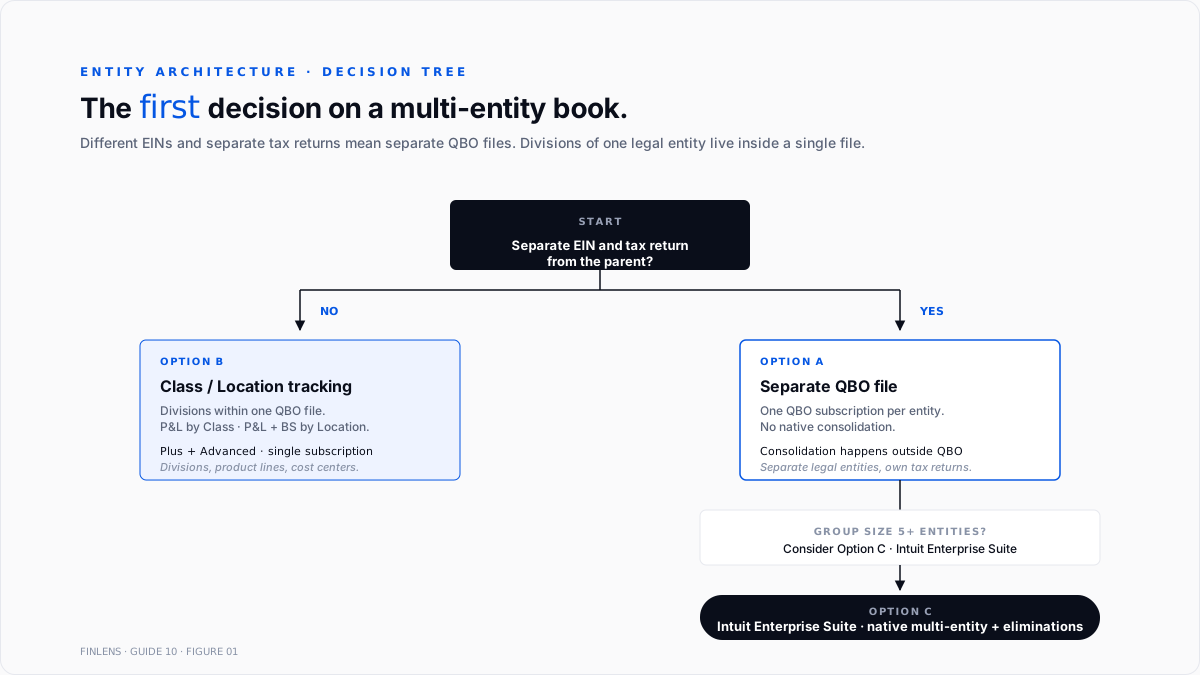
Before opening a second QBO file, the parent decides whether to model the additional entity as (a) a separate legal entity requiring its own QBO subscription and its own tax filing, or (b) a division of the parent tracked through QBO's Class or Location tracking within a single file.
Figure 1 (referenced above) traces the decision tree.
Option A: Separate QBO file (separate legal entity)
Use when the entity is legally separate: distinct EIN, distinct state of incorporation, distinct bank accounts, distinct payroll, distinct tax return.
- Pros. Legal separation. Clean audit trail. Independent user access.
- Cons. No native consolidation. Every consolidated view is external. Two subscriptions equals two monthly fees.
Option B: Class or Location tracking (division of a single entity)
Use when the "entity" is really a division, product line, cost centre, or geography of a single legal entity.
- Pros. Single QBO subscription. Native P&L by Class or by Location. Every transaction rolls up automatically. Available on QBO Plus and Advanced (Class + Location) or Essentials (Location only).
- Cons. Not appropriate for legally separate entities. No separate balance sheet by class (QBO reports only the P&L by class; location supports both P&L and balance sheet on Plus and Advanced).
The most common mistake: modelling two legal entities as classes within one QBO file to avoid the second subscription cost. This produces one tax return covering activity from two EINs, a filing defect that surfaces at audit or IRS notice.
Option C: Intuit Enterprise Suite (native multi-entity)
Intuit's higher-tier offering, Intuit Enterprise Suite, adds shared chart of accounts and native inter-company elimination workflows across entities. It's positioned above QBO Advanced and targets businesses with 5+ entities running QBO. Intuit's help article on multi-entity in Enterprise Suite covers the feature. Books already on QBO Advanced can migrate; the pricing shift is material and worth evaluating before switching.
The Due To / Due From account structure
For books running separate QBO files without Intuit Enterprise Suite, the Due To / Due From method is the standard bookkeeping technique for tracking inter-company balances.
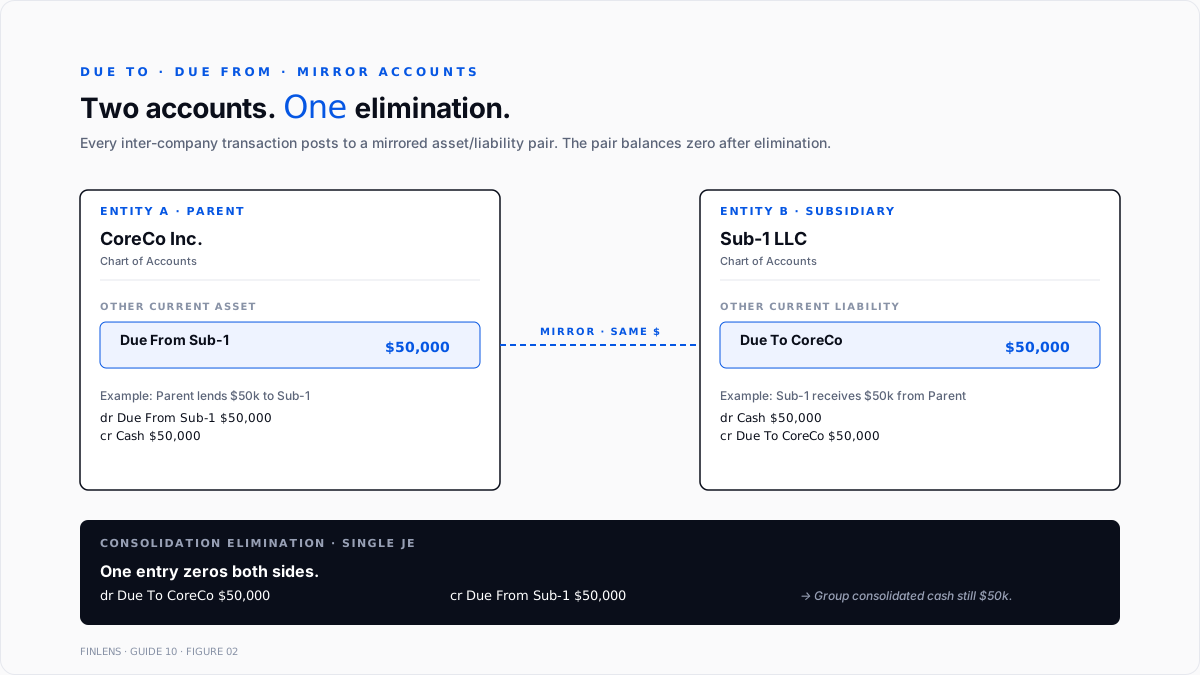
The setup:
- On Entity A's chart of accounts: create "Due From Entity B" as an Other Current Asset.
- On Entity B's chart of accounts: create "Due To Entity A" as an Other Current Liability.
Every inter-company transaction posts to one of these accounts on each entity, so at any point in time, Entity A's Due From Entity B balance should equal Entity B's Due To Entity A balance. When they don't agree, a transaction was posted on one side but not the other the reconciliation flag.
Naming discipline. Use the same account naming convention across every entity's chart. "Due From CoreCo" on the subsidiary, "Due To Sub-1" on the parent. Consistent names make consolidation search-and-replace trivial. The Method write-up on QuickBooks inter-company transactions covers the naming pattern.
Scaling. For books with 3+ entities, add sub-accounts: Due From Sub-1, Due From Sub-2, Due From Sub-3 on the parent. Each pair of entities has its own reconciling account balance.
Reconcile monthly. The Due To / Due From accounts should reconcile at each month-end before consolidation. A residual on either side indicates an in-transit transaction, a one-sided entry, or a wrong-entity posting.
The four inter-company transaction types
Every inter-company transaction falls into one of four patterns. Each has its own bookkeeping entry on each side, and each requires a specific elimination on consolidation.
1. Cash transfer
Parent lends $50,000 to Subsidiary.
- Parent: dr Due From Subsidiary $50,000, cr Cash $50,000.
- Subsidiary: dr Cash $50,000, cr Due To Parent $50,000.
Elimination on consolidation: dr Due To Parent $50,000, cr Due From Subsidiary $50,000. The inter-company receivable and payable disappear; consolidated cash stays at $50,000 (the same cash sits in the subsidiary's bank).
2. Service or expense allocation
Parent pays $10,000 in shared IT costs and allocates $6,000 to Subsidiary.
- Parent: on payment, dr IT Expense $10,000, cr Cash $10,000. On allocation, dr Due From Subsidiary $6,000, cr IT Expense $6,000. Parent's net IT expense is $4,000.
- Subsidiary: dr IT Expense $6,000, cr Due To Parent $6,000.
Elimination on consolidation: dr Due To Parent $6,000, cr Due From Subsidiary $6,000. Consolidated IT expense is $10,000 (correct the original external cost).
3. Inter-company sale (revenue on one side, cost on the other)
Parent bills Subsidiary $20,000 for a service delivered.
- Parent: dr Due From Subsidiary $20,000, cr Service Revenue $20,000.
- Subsidiary: dr Service Expense $20,000, cr Due To Parent $20,000.
Elimination on consolidation (two entries):
- dr Service Revenue $20,000, cr Service Expense $20,000. Removes the double-counted revenue and expense.
- dr Due To Parent $20,000, cr Due From Subsidiary $20,000. Removes the inter-company balance.
If the underlying service was resold externally by the subsidiary at $25,000, consolidated revenue equals $25,000 (external only), consolidated expense equals whatever was consumed externally, and the inter-company margin is eliminated.
4. Inter-company asset transfer
Parent transfers a $30,000 piece of equipment to Subsidiary at book value.
- Parent: Dr Due From Subsidiary $30,000, cr Equipment $30,000 (or through Accumulated Depreciation depending on age).
- Subsidiary: Dr Equipment $30,000, cr Due To Parent $30,000.
Elimination on consolidation: dr Due To Parent $30,000, cr Due From Subsidiary $30,000. Consolidated equipment stays at $30,000 (correct the asset moved sides but stayed inside the group).
Asset transfers at above or below book value create a gain or loss on the transferring entity's P&L that must also be eliminated on consolidation.
The consolidation workflow
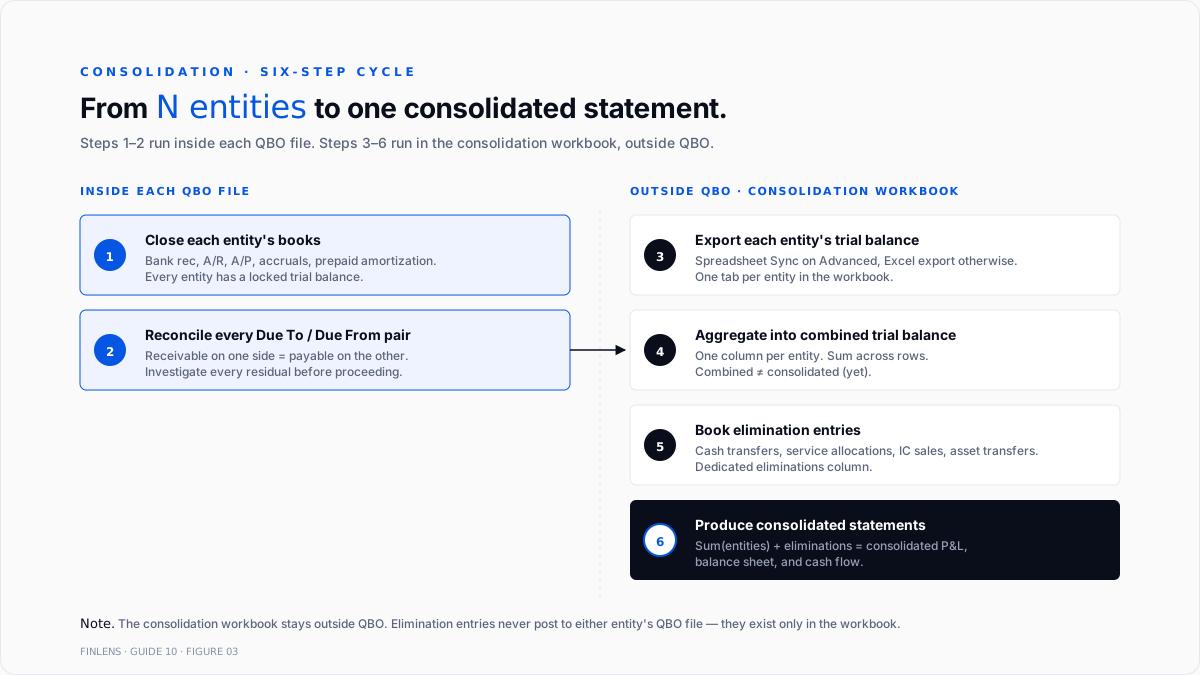
Every consolidated statement follows the same six-step cycle. Full close treatment for a single entity sits in the QuickBooks month-end and year-end close guide; consolidation adds four steps beyond that.
1. Close each entity's books. Every entity in the group runs its full month-end close (bank rec, A/R, A/P, prepaid amortization, accrual entries, revenue recognition). No entity begins consolidation until its own trial balance is locked.
2. Reconcile Due To / Due From across every pair. For every pair of entities in the group, the receivable on one side must equal the payable on the other. Investigate every residual. Book any correcting entries in the current period before proceeding.
3. Export the trial balance from every entity. QBO Advanced users can use Spreadsheet Sync (Settings → Spreadsheet Sync) to push each entity's data to Google Sheets or Excel. Books without Advanced export via the Trial Balance report → Export → Excel.
4. Aggregate into a consolidated trial balance. In the consolidation workbook, one column per entity, one row per account. Sum across entities to get a "combined" trial balance combined, not yet consolidated.
5. Book the elimination entries. For every inter-company balance and every inter-company transaction, apply the elimination entry per the four types above. The eliminations go in a dedicated column of the consolidation workbook, not in either entity's QBO file.
6. Produce the consolidated statements. Sum entities + eliminations = consolidated P&L, consolidated balance sheet, consolidated cash flow.
The consolidation workbook stays outside QBO. Each period, refresh the entity exports, refresh the eliminations, produce the statements. The LiveFlow write-up on consolidating multiple QBO entities covers the tooling landscape.
Foreign subsidiaries and currency translation
For groups with foreign subsidiaries, each subsidiary reports in its functional currency, and the parent translates on consolidation. Under FASB ASC 830 (Foreign Currency Matters), the translation method depends on whether the foreign subsidiary's functional currency is the local currency or the parent's currency.
Functional currency = local currency (typical for stand-alone foreign subsidiary). Translate income statement at the average rate for the period. Translate balance sheet at the period-end rate. The translation gain or loss lands in Accumulated Other Comprehensive Income (AOCI) on equity, not the P&L.
Functional currency = parent's currency (typical for a foreign branch of a US parent). Remeasure using the temporal method: monetary items at current rate, non-monetary items at historical rate. The remeasurement gain or loss lands in the P&L.
QBO's multi-currency feature handles individual transaction-level FX gains and losses on the source entity's books. It does not handle the entity-level translation for consolidation. The translation runs in the consolidation workbook, one FX rate per rate period per statement.
Common failure modes at multi-entity scale
Six failure modes recur on multi-entity QBO books.
Due To / Due From does not agree. The most common. One side posted the entry, the other didn't. Fix by identifying the missing side and booking it in the current period.
Same inter-company transaction posted twice on one side. Duplicate entry on one entity's books, single entry on the other. The Due To / Due From balances don't agree, and the transaction accumulates on the entity with the duplicate.
Inter-company invoice through the standard A/R workflow. When the parent bills the subsidiary through Create Invoice, the invoice hits A/R (not Due From). Same for the subsidiary's A/P. The transaction is real but the receivable and payable are in the wrong accounts, making consolidation elimination harder to identify.
Fix. Either use Due To / Due From consistently and avoid the customer-invoice workflow for inter-company transactions, or add a naming convention (Customer name = "IC-Subsidiary Name") so inter-company A/R is filter-able and reclassifiable at consolidation.
Eliminated on one side but not the other. A consolidation adjustment that debits Due To Parent but forgets to credit Due From Subsidiary leaves an out-of-balance consolidated balance sheet. Every elimination JE must balance itself and both sides of the inter-company pair.
Entity omitted from consolidation. New subsidiary added mid-year and forgotten in the consolidation workbook. Consolidated statements look right (they balance) but understate assets, liabilities, and activity.
Foreign subsidiary translated at the wrong rate. Balance sheet translated at the average rate instead of period-end, or income statement translated at period-end instead of average. Common cause of small consolidated variances that compound quarter-over-quarter.
Where in-QBO multi-entity workflow stops scaling
Three failure modes compound past 2–3 entities.
Manual consolidation workbook maintenance. For a group of 3 entities with 3 inter-company pairs, monthly consolidation is 4–8 hours of manual export, aggregation, elimination, and review. Add a fourth entity and the pair count rises to 6; add a fifth and the pair count rises to 10.
Version-control on the consolidation workbook. The workbook lives outside QBO and typically outside the primary accounting file share. Concurrent edits, stale exports, and copy-paste errors compound. Books that ran multi-entity consolidation in a shared Google Sheet for two years usually have at least one month where the "final" workbook and the workpapers disagree.
Foreign-currency translation. Once a foreign subsidiary joins the group, FX rate maintenance, translation adjustments, and CTA (cumulative translation adjustment) tracking require dedicated FX schedules outside QBO.
At that point, the fix is not more workbook discipline; it is a tooling shift, either to Intuit Enterprise Suite, a dedicated consolidation platform (LiveFlow, Fathom, XLReporting), or a mid-market GL (NetSuite, Sage Intacct, Rillet) that has native consolidation.
The Finlens approach
Finlens is an AI accounting platform for QBO firms and founder-led businesses. Multi-entity workflow is one feature in a 17-feature product.
For multi-entity specifically, Finlens does the following:
- Aggregates trial balances across every entity on the firm's book into one dashboard, so a firm managing 20 QBO clients or a business with 5 legal entities sees a consolidated view without exporting.
- Flags Due To / Due From reconciliation breaks the moment they occur, so the mismatch does not compound between period-ends.
- Auto-generates elimination entries for each of the four inter-company transaction types once the Due To / Due From pair is tagged, so the consolidation workbook rebuilds itself each period.
The features that keep multi-entity accurate rather than just automated are the ones surrounding the consolidation itself:
- Class and location tracking sync across QBO files, so a division within one entity and a separate entity roll up to the same consolidated segment.
- Human-in-the-loop review gates every elimination entry and every currency translation through a CPA before the consolidated statements lock.
- The audit log produces a tamper-evident record of every consolidation, every elimination, and every reclassification.
- Multi-currency translation applies the correct rate per FASB ASC 830 by rate period, with CTA tracked automatically.
The verification checklist
- Every entity's month-end close is locked before consolidation begins.
- Every Due To / Due From pair reconciles across the two entities.
- Every inter-company transaction is tagged, and its elimination entry is booked in the consolidation workbook.
- Consolidated P&L equals Σ(entity P&Ls) minus Σ(inter-company revenue and expense).
- Consolidated balance sheet equals Σ(entity balance sheets) minus Σ(intercompany balances) plus consolidation adjustments.
- Every foreign subsidiary is translated per ASC 830 with the correct rate per statement.
- CTA balance on equity reconciles to the sum of prior period translations plus current period adjustment.
- Consolidation workbook saved to the audit workpapers with entity exports attached.
For a firm managing multi-entity consolidation across QBO clients, the firm platform runs the workflow at scale. For a controller running a parent + subsidiaries group, the founder-facing product auto-generates elimination entries and translates foreign subsidiaries per ASC 830.
.png)
FAQ
When to use classes/locations vs a separate QBO file?
Classes and locations are appropriate for divisions or cost centres within a single legal entity – one EIN, one tax return, and one set of statutory financials. A separate QBO file is required when the additional entity has its own EIN and files its own tax return.
Does QBO Advanced support native consolidation?
No. QBO Advanced adds Spreadsheet Sync for exporting data to Google Sheets or Excel, but consolidation still runs outside the platform. Native multi-entity consolidation requires Intuit Enterprise Suite or a third-party tool.
The difference between Due To / Due From and standard A/R / A/P?
A/R and A/P are for external customers and vendors. Due To / Due From is a separate pair of internal accounts for inter-company transactions between entities in the same group. Keeping them separate makes consolidation eliminations trivial.
How to handle inter-company invoicing for tax purposes?
Even if inter-company transactions are eliminated on consolidation, they still exist for tax purposes. Each entity files its own tax return with its own revenue and expenses, including the inter-company portion. Consolidation is a group reporting concept, not a tax concept except for a US consolidated group filing Form 1120 consolidated.
Does QBO's multi-currency feature handle subsidiary translation?
Only at the transaction level (individual FX gains and losses on transactions denominated in a non-home currency). Entity-level translation for consolidation runs in the consolidation workbook per ASC 830, with the parent applying the correct rate per statement type.
Realistic multi-entity consolidation timing?
2–4 hours per month for a group of 2 entities with clean Due To / Due From reconciliation. 8–16 hours for a group of 5+ entities with foreign subsidiaries. Above ~8 entities, dedicated consolidation tooling is the pragmatic fix.

