
The QuickBooks payroll taxes guide: 941, 940, state withholding, and deposit schedules (2026)


This is a working reference for controllers, firm bookkeepers, and founders responsible for federal and state payroll tax deposits and filings on a QuickBooks Online Payroll book. Every deadline, deposit rule, and penalty tier is sourced to IRS documentation or a real thread on the QuickBooks Community. Rate changes cited from third-party payroll trackers are flagged as external estimates and shift each January.
The problem this guide addresses
Two failure modes account for most payroll-tax penalties on QBO Payroll books.
The first is wrong deposit frequency. The IRS assigns every employer a Monthly or Semi-weekly deposit schedule based on the prior 12-month lookback period - under $50,000 in reported payroll tax liability means Monthly, $50,000 or more means Semi-weekly. Books that keep depositing monthly after crossing the $50,000 threshold hit late-deposit penalties on every Semi-weekly cycle they miss. Books that switch to Semi-weekly before their liability warrants it deposit fine but overload the workflow.
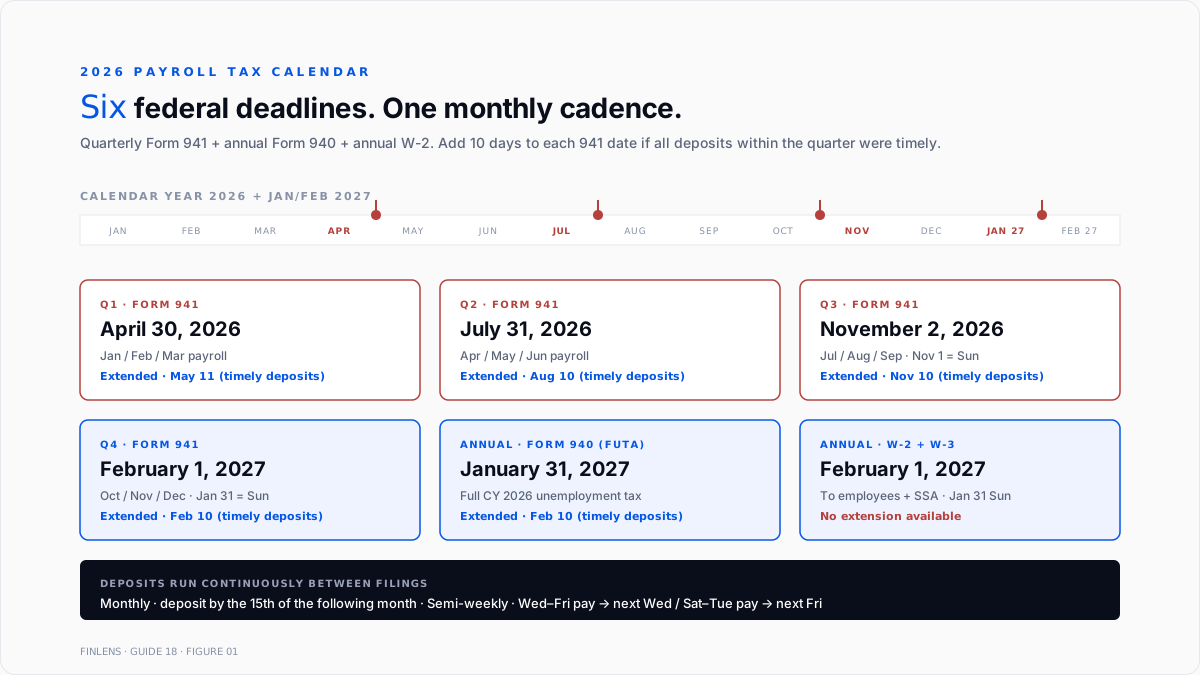
The second is missingmissed 941 filing deadlines. Form 941 is quarterly (April 30, July 31, November 2, February 1 for 2026, per TaxBandits' 2026 941 due-date reference). Missing a filing produces a 5% per-month penalty capped at 25%, on top of any failure-to-deposit penalties on the underlying taxes. Late filings compound faster than any other single payroll defect. QBO Payroll auto-files 941 when Automatic Tax Filings is enabled, but manual books and third-party payroll providers rely on the bookkeeper catching the deadline.
The sections below cover the federal deposit workflow (941 + 940 + FICA + FUTA), the monthly vs semi-weekly determination, the deposit due dates in each schedule, state withholding + SUTA, the penalty structure with tiers, corrections through Form 941-X, and how QBO Payroll automates the workflow versus what requires manual attention.
The federal payroll tax stack
Every W-2 payroll runs through the same three federal tax buckets:
Federal income tax withheld from employee. Every employee's W-4 election drives the withholding amount. Employer withholds and remits; the employee ultimately owes the tax through their annual 1040.
FICA - Social Security + Medicare. 15.3% total. Employee pays 7.65% via withholding (6.2% Social Security to the wage base of $176,100 for 2026 + 1.45% Medicare uncapped + 0.9% additional Medicare above $200,000). Employer matches the base 7.65%. Employer does not match the 0.9% additional Medicare.
FUTA - Federal Unemployment Tax. Employer-only. 6.0% on the first $7,000 of wages per employee, per year. Credit of 5.4% for states in good standing brings the effective rate down to 0.6% - meaning most employers pay $42 per employee per year in FUTA.
The three buckets file on two forms:
- Form 941 (quarterly). Reports federal income tax withheld + FICA (employee + employer shares) for the quarter.
- Form 940 (annual). Reports FUTA for the calendar year. Due January 31 of the following year.
Both forms plus deposits go through the Electronic Federal Tax Payment System (EFTPS) - paper filing is not permitted for federal payroll for most employers. The payroll tax write-up on our blog covers the same stack from a broader employer-fundamentals angle.
The Monthly vs Semi-weekly determination
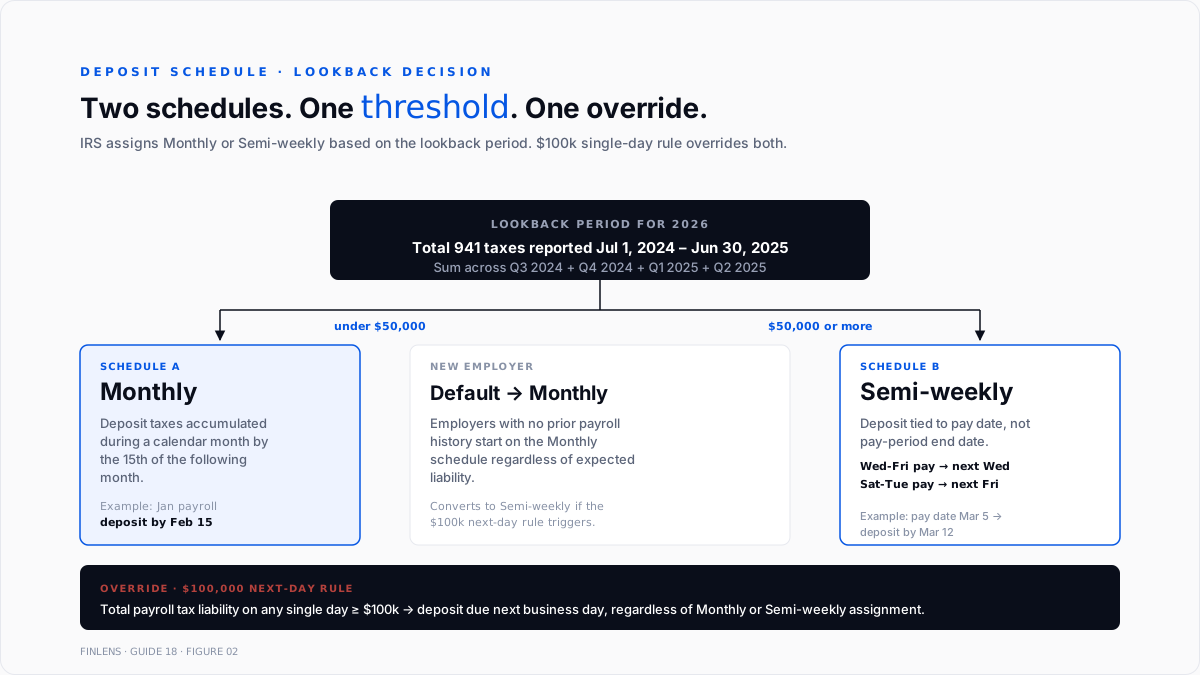
Every employer gets one of two deposit schedules, assigned per calendar year based on a lookback period:
The lookback period for 2026 = July 1, 2024 through June 30, 2025 (four quarters: Q3 2024, Q4 2024, Q1 2025, Q2 2025). Sum the total 941 taxes reported across those four quarters.
- Under $50,000 → Monthly depositor for 2026
- $50,000 or more → Semi-weekly depositor for 2026
The threshold applies annually. A book that reported $48,000 last lookback period is Monthly this year; if their 2026 payroll grows and next year's lookback shows $52,000, they switch to Semi-weekly in 2027.
New employer default. Any employer with no prior payroll history defaults to Monthly for the first year (or until the $100,000 next-day rule triggers, below).
Two special rules override the schedule:
- $100,000 next-day rule. If total payroll tax liability accumulated on any single day reaches $100,000, the deposit is due the next business day regardless of the assigned schedule. Common for large bonus payments or year-end true-ups.
- Once triggered, semi-weekly for the year. Any employer that hits the $100,000 rule during the year becomes a Semi-weekly depositor for the rest of the calendar year, plus the next full year.
Confirm the assigned schedule against IRS Publication 15 (Circular E) at the start of every calendar year. QBO Payroll reflects the schedule Intuit has on file, but the responsibility to verify sits with the employer.
Deposit due dates
Monthly depositors
Deposit taxes accumulated during a calendar month by the 15th of the following month. Late fees start the 16th.
Example: January payroll deposits due February 15. February payroll deposits due March 15.
If the 15th falls on a weekend or federal holiday, deposit is due the next business day.
Semi-weekly depositors
Deposit taxes based on the pay date:
- Wednesday, Thursday, or Friday pay date → deposit due by the following Wednesday
- Saturday, Sunday, Monday, or Tuesday pay date → deposit due by the following Friday
Example: pay date Wednesday March 5 → deposit due Wednesday March 12. Pay date Monday March 10 → deposit due Friday March 14.
Federal holidays extend the deposit window by one business day.
Semi-weekly deposits are always tied to the pay date, not the pay-period end date. A pay period ending February 28 but paid March 5 deposits on the March 5 schedule.
Form 941 filing deadlines (2026)
Quarterly filing. Due dates and extended dates per TaxBandits' 2026 reference:
The 10-day filing extension applies only if every deposit within the quarter was made on time. Any late deposit forfeits the extension - file by the standard due date to avoid a late-filing penalty on top of the late-deposit penalty.
Filing is separate from depositing. A book can be current on deposits but late on filing (and vice versa). Both are billed independently.
Form 940 filing deadline (annual)
Form 940 covers the full calendar year. Due January 31 of the following year (or February 10 if all FUTA deposits were made timely).
For calendar year 2026, Form 940 is due January 31, 2027 (extended to February 10, 2027, if timely).
FUTA deposit trigger. FUTA is deposited when the accumulated liability crosses $500 in a quarter. For most books, that means Q4 or January of the following year.
Credit reduction states. States that borrowed from the federal unemployment fund and haven't repaid have their 5.4% FUTA credit reduced. Per Experian's 2026 FUTA outlook, the credit reduction states expected for 2026 (filing in January 2027), includes:
- California - 0.9% credit reduction (three consecutive years)
- New York - 0.6% credit reduction (two years)
- US Virgin Islands - 3.0% credit reduction (special status)
Employers with wages in those states file Schedule A (Form 940) and pay the higher FUTA rate on those wages. QBO Payroll includes credit-reduction handling automatically for Payroll Elite subscribers; Core and Premium require manual Schedule A completion.
State withholding + SUTA
State payroll tax runs in parallel to federal. Every state with income tax requires separate:
- Employer registration with the state's Department of Revenue and Department of Labor
- State withholding tax deposits on a state-specific schedule
- State unemployment (SUTA) deposits on a state-specific rate
- Quarterly state filings (typically due 30 days after quarter-end)
- Annual state W-2 filing (aligns with federal January 31)
State schedules and rates vary widely. California has some of the strictest deposit rules (semi-weekly for many employers regardless of federal schedule); Texas and Florida have no state income tax (SUTA only). Contractor payments run through a parallel workflow - the 1099-NEC filing deadline write-up covers the 1099 side that runs alongside payroll.
The two most common state failure modes:
Wrong SUTA rate. The state assigns each employer an experience-based SUTA rate that changes annually. Missing the rate change notice means using the wrong rate for months. QBO Payroll pulls rate updates from most states automatically; some states require manual entry.
Multi-state employees. Remote workers add their state to the employer's registration list. Missing a state registration for a new remote hire triggers state notices 30–60 days later. Full workflow in the multi-state payroll guide (when published).
The penalty structure
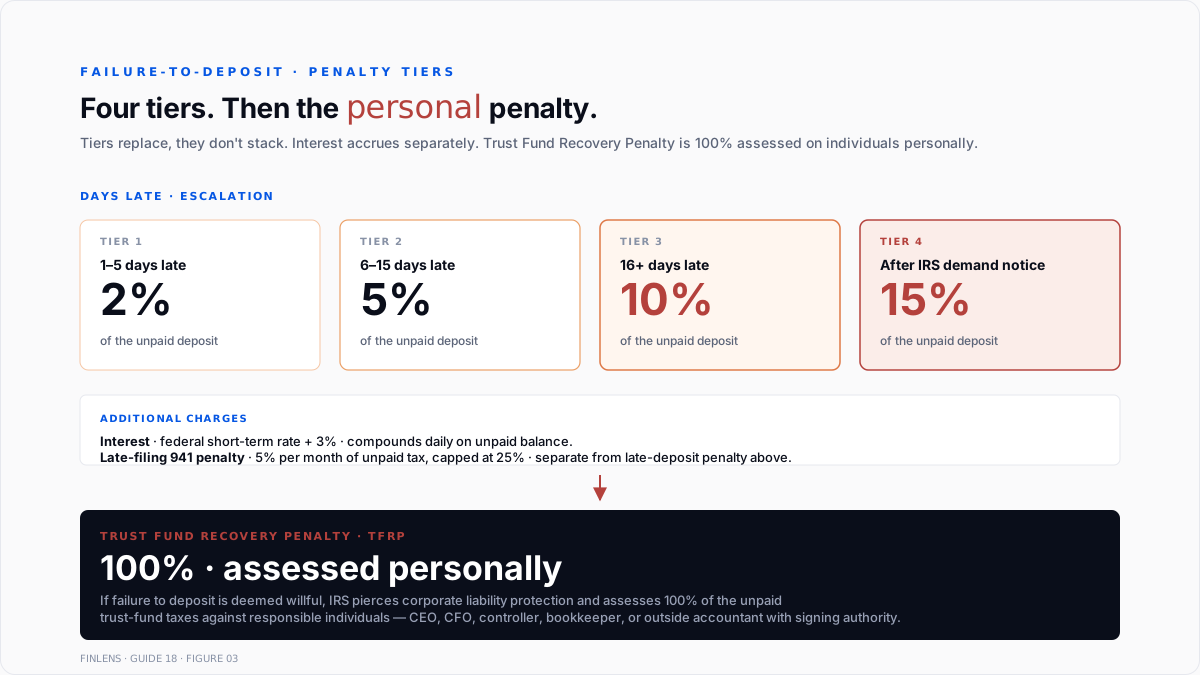
Per Wiggam Law's failure-to-deposit reference and Omni Tax Help's 2026 calculator, the IRS failure-to-deposit penalty escalates by days-late:
Tiers replace, they don't stack. A deposit that's 20 days late incurs 10%, not 2% + 5% + 10%.
Interest accrues separately. Interest on unpaid deposits compounds daily at the federal short-term rate + 3%, currently around 8% annualized (varies quarterly).
Trust Fund Recovery Penalty (TFRP). If the employer's failure to deposit is willful, the IRS can assess a 100% penalty against individuals responsible for payroll (CEO, CFO, controller, bookkeeper, or an outside accountant with signing authority). This penalty is personal - it pierces corporate liability protection.
Late-filing penalty (separate from late-deposit): 5% per month of the unpaid tax reported on Form 941, capped at 25%. Combined with late-deposit penalties, a book that misses both deadlines faces up to 40% in penalties on the same underlying tax.
Corrections through Form 941-X
Errors on a previously-filed 941 are corrected through Form 941-X (adjusted return). Common scenarios:
- Wrong wage or tax amount reported
- Missed employee added after filing
- Employer share of FICA miscalculated
- ERC or other credit claim from the pandemic era
941-X is filed independently for each quarter being corrected. There is no statute of limitations on underpayments (the IRS can assess them indefinitely). Refund claims have a statute of limitations - 3 years from the original 941 filing date or 2 years from the tax payment date, whichever is later.
QBO Payroll does not auto-generate 941-X. Corrections require manual filing directly with the IRS. Books using QBO Payroll Elite get Intuit-assisted 941-X preparation as part of the tax-penalty protection benefit.
The QBO Payroll automation split
What QBO Payroll handles automatically:
- Automatic tax calculations on every payroll run
- Automatic federal deposits via EFTPS integration (Core, Premium, Elite tiers)
- Automatic state deposits where the state supports Intuit's e-file integration
- Automatic 941 filing at the quarterly deadline (Core+)
- Automatic 940 filing at the annual deadline (Core+)
- Automatic W-2 filing + distribution at January 31 (Core+)
- Tax-penalty protection - Intuit covers penalties from their own tax calculation errors, up to $25,000 for Elite subscribers
What still requires manual attention:
- Deposit schedule confirmation at the start of every calendar year (verify against IRS Publication 15)
- State registration for new remote employees or new state hires
- SUTA rate updates for states that don't push updates to Intuit
- Credit reduction Schedule A for Core and Premium (Elite handles automatically)
- Form 941-X for any correction to a previously-filed 941
- Trust Fund Recovery Penalty exposure review on any late-deposit incident
The six recurring failure modes
1. Wrong deposit frequency assumption. Book stays on Monthly after crossing the $50,000 lookback threshold. Missed Semi-weekly deposits every pay cycle produce 2–10% penalties per cycle. Fix: verify frequency in QBO Payroll Settings → Tax Setup at the start of each calendar year.
2. State registration missing for remote hire. New employee in a new state, employer never registered. State deposit fails on first pay cycle. Non-filer notice arrives 30–60 days later. Fix: register with state DOR + DOL before the first pay cycle in that state.
3. Not enrolled in EFTPS. New employer defaults to paper coupon (Form 8109) - which the IRS discontinued. Enrollment in EFTPS takes 5–7 business days; without it, deposits can't be made. Fix: enroll at eftps.gov during payroll setup, not on the day of first deposit. If deposits have already lapsed, the IRS payment plan write-up covers the installment-agreement path.
4. Missed 941 deadline while current on deposits. Deposit-timely means no late-deposit penalty, but failing to file 941 by the standard deadline forfeits the 10-day extension AND triggers a late-filing penalty. Fix: file 941 on the standard due date if depositing manually.
5. Late FUTA deposit from mid-year threshold crossing. FUTA deposits trigger when quarterly liability crosses $500. A book that crossed $500 in Q2 but didn't deposit until year-end owes penalties on the missed Q2 deposit. Fix: monitor quarterly FUTA accumulation; deposit as each $500 threshold is reached.
6. SUTA rate not updated after state annual notice. State sends new SUTA rate notice each December/January. Failing to update in QBO Payroll means paying at the old rate - either overpaying (state credits back at year-end) or underpaying (state assesses shortfall). Fix: update Payroll Settings → State Tax Setup when the notice arrives.
The Finlens approach
Finlens is an AI accounting platform for QBO firms and founder-led businesses. Payroll tax filing is Intuit's product - QBO Payroll handles the automation. Where Finlens adds value at the GL and reconciliation layer:
- Payroll tax liability aging. Every Payroll Liabilities account (Federal Withholding, FICA, FUTA, State Withholding, SUTA) should clear to zero after each deposit. Finlens flags any account carrying a stale balance older than the deposit frequency - Monthly liabilities aging past 30 days, Semi-weekly aging past 7 days.
- Cross-client deposit-schedule tracker. For firm bookkeepers managing multiple QBO Payroll clients, Finlens aggregates the deposit-schedule assignment per client and flags books at risk of frequency transition based on trailing lookback totals.
- Deposit-vs-file reconciliation. Every 941 filing should reconcile to the sum of deposits made during the quarter. Finlens auto-reconciles the two before Intuit or the bookkeeper submits.
The features that keep payroll-tax accuracy at the GL layer:
- Human-in-the-loop review on every payroll-JE audit before it posts.
- Multi-client dashboard aggregates deposit status across every client on the firm's book.
- Audit log tracks every payroll-liability adjustment, correction, and reconciliation.
For a firm managing payroll-tax compliance across multiple QBO clients, the firm platform automates the cross-client deposit and reconciliation workflow. For a controller running payroll on a single book, the founder-facing product handles the same audit at company scale. Book a 20-minute walkthrough: cal.com/finlens/intro.
The verification checklist - per quarter and per year
Per quarter (Q1, Q2, Q3, Q4):
- 941 filed on or before the standard due date (or extended date if all deposits timely).
- Deposits reconcile to the 941 line-by-line.
- Every state 941-equivalent filing submitted on the state deadline.
- No Payroll Liability account carrying an unpaid balance older than the assigned deposit frequency.
Per calendar year (early January):
- IRS deposit-frequency assignment confirmed for the new year (monthly vs semi-weekly).
- SUTA rates updated for every state where employees work.
- FUTA credit-reduction states reviewed against the current-year list.
- EFTPS PIN confirmed active (PINs expire; check before the first deposit of the year).
- State registrations confirmed active for every state with an active employee.
- 940 filed on or before January 31 (or February 10 extended).
- W-2s filed with SSA and distributed to employees by January 31.
- Any 941-X corrections filed for prior-year issues before the statute of limitations expires.
For a firm managing payroll compliance across multiple QBO clients, the firm platform automates the deposit-vs-file reconciliation. For a founder running payroll on a single book, the founder-facing product handles the same reconciliation at company scale.
Conclusion
Payroll tax compliance is deadline-driven and penalty-heavy. Miss a deposit, pay 2–10%. Miss a filing, pay 5% per month up to 25%. Miss both, pay both. Miss enough that the IRS deems it wilful, and the CFO or bookkeeper pays 100% personally through the Trust Fund Recovery Penalty.
QBO Payroll's automatic filings and deposits reduce most of the risk when the setup is right. The residual risk sits in the manual gaps – deposit-frequency confirmation each January, state registration for new hires, SUTA rate updates, credit-reduction Schedule A for Core and Premium tiers, and 941-X corrections. Firms and controllers that build those gaps into a monthly and annual calendar keep clean books. Ones that rely on Intuit's automation to catch everything hit the manual gaps at penalty time.
.png)
FAQ
Whether QBO Payroll files 941 automatically?
Yes on Core, Premium, and Elite tiers when Automatic Tax Filings is enabled during setup. The employer-signed authorization (principal officer authorisation during setup) transfers filing authority to Intuit. Verify the toggle in Payroll Settings → Tax Setup.
The 2026 Form 941 deadlines?
April 30 (Q1), July 31 (Q2), November 2 (Q3, since Nov 1 is Sunday), February 1, 2027 (Q4, since Jan 31 is Sunday). Add 10 days to each if all deposits within the quarter were timely.
How to tell if the book is monthly or semi-weekly depositors?
Sum the total 941 taxes reported from July 1, 2024, through June 30, 2025 (the 2026 lookback). Under $50,000 = Monthly. $50,000+ = Semi-weekly. QBO Payroll shows the assigned schedule at Payroll Settings → Tax Setup.
What happens if a state SUTA rate notice arrives after the year starts?
Update the rate in QBO Payroll immediately. Prior payroll runs at the old rate are corrected on the next state quarterly filing - either credited back (if the new rate is lower) or paid as a shortfall (if higher). Do not attempt to manually restate the prior payrolls in QBO.
Whether Form 940 penalties work the same as 941?
Similar structure. FUTA deposits are less frequent (only when quarterly liability crosses $500, typically just Q4 for most books) and Form 940 filing is annual. Late-deposit and late-filing penalties follow the same tier structure as 941.
Realistic payroll-tax setup timeline?
30 minutes for federal tax setup (FEIN + EFTPS enrollment) if the FEIN exists and EFTPS enrolment is pre-started. 1–4 weeks for state setup - state registrations vary widely (Texas and Florida in hours, California and New York in 2–4 weeks). Setup should start 30+ days before the intended first pay date.

