
IRS Payment Plan: How to Set One Up, Cost, and What Actually Happens After You Apply


An IRS payment plan is an agreement to pay your federal tax balance over time instead of paying in full by original due date. The IRS offers two options: a short-term payment plan (up to 180 days, no setup fee) for balances under $100,000 combined tax/penalty/interest, and a long-term payment plan (also called an installment agreement, monthly payments for up to 72 months) with a setup fee for balances of $50,000 or less. You can apply online in most cases, and IRS is generally prohibited from levying your accounts once your request is pending.
This guide covers both plan types, eligibility thresholds, actual setup fees, how to apply online / by mail / by phone, and how to manage plan without defaulting.
The two IRS payment plan types
Per IRS Payment Plans page, you have two options if you can't pay in full:
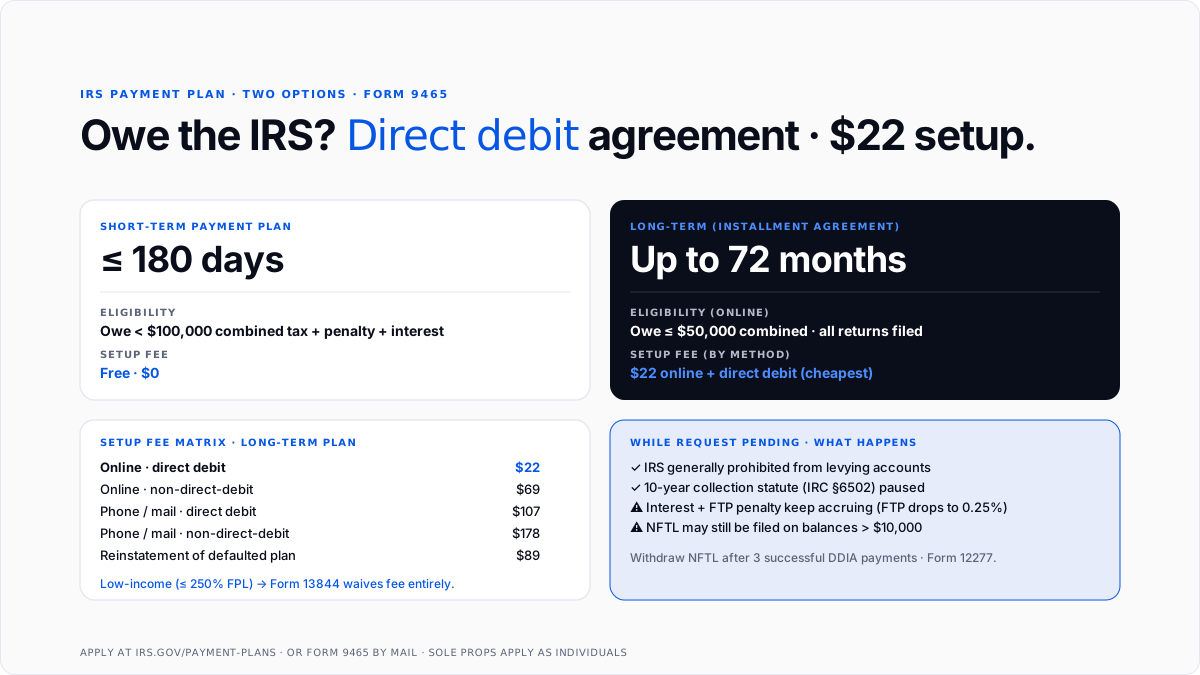
Short-term payment plan. Pay in full within 180 days. No setup fee. You're eligible if you owe less than $100,000 in combined tax, penalties, and interest. Interest and failure-to-pay penalty continue accruing on unpaid balance until you're paid off, but there's no separate fee to enter plan.
Long-term payment plan (installment agreement). Monthly payments for up to 72 months. Setup fees apply currently $22 for online applications with direct debit, ranging up to $225 for mail-in applications. You're eligible for online application if you owe $50,000 or less in combined tax, penalties, and interest and have filed all required returns.
Businesses can also enter payment plans but apply by calling 800-829-4933 rather than through individual online portal. Sole proprietors and independent contractors apply as individuals.
Setup fees what you actually pay
The setup fee for a long-term installment agreement depends on how you apply AND how you pay:
The lowest fee $22 is online application with a Direct Debit Installment Agreement (DDIA). Direct debit also protects you from most common plan-default triggers (missed manual payments), so it's recommended path unless you have a specific reason to avoid automatic debits.
Low-income taxpayer waiver. Individuals with adjusted gross income at or below 250% of federal poverty level can get setup fee waived entirely on a DDIA, or reimbursed at end of installment agreement if they cannot make direct debit work. Apply via Form 13844 (Application for Reduced User Fee for Installment Agreements) within 30 days of your acceptance letter.
How to apply
Four ways to apply, in order of speed and cost efficiency:
1. Online Payment Agreement (OPA) tool. Fastest and cheapest. Requires an IRS Online Account with identity verification. Available for individuals owing $50,000 or less (long-term) or $100,000 or less (short-term). Approvals are usually immediate.
2. Form 9465 Installment Agreement Request. File by mail if you owe more than $50,000, don't want to apply online, or need special payment terms. Attach Form 9465 to front of your tax return, or mail separately to IRS address listed in form instructions. Processing takes 30–60 days.
3. Phone. Call 800-829-1040 (individuals) or 800-829-4933 (businesses). Useful for larger balances or complex situations where you want to talk through plan structure.
4. In person. Local IRS Taxpayer Assistance Centers accept installment requests by appointment. Rarely necessary but occasionally fastest path for complex cases.
If you owe more than $50,000, you generally cannot use online application. You'll need to file Form 9465 with Form 433-F (Collection Information Statement) documenting your income, expenses, and assets so IRS can determine an appropriate monthly payment.
What happens after you apply
Once your request is pending, three important things happen:
The IRS is generally prohibited from levying your accounts. With certain exceptions, IRS cannot garnish wages, seize bank accounts, or take other enforcement action while your installment agreement request is under review.
The collection statute is suspended. The IRS's 10-year statute of limitations to collect (IRC §6502) is paused during review period. If you appeal a rejection, statute is also suspended during appeal.
A Notice of Federal Tax Lien may still be filed. For balances over $10,000, IRS may file a Notice of Federal Tax Lien (NFTL) even after you enter a payment plan. This is a public filing that attaches to your property and appears on your credit history. For balances under $50,000 on a Direct Debit Installment Agreement, you can request lien be withdrawn after 3 consecutive successful payments using Form 12277.
For businesses and higher-net-worth individuals, professional representation on installment negotiation matters see our IRS Power of Attorney guide for how Form 2848 authorizes a CPA or EA to negotiate on your behalf.
Interest and penalties keep accruing
The most common misunderstanding: entering a payment plan does NOT stop interest or failure-to-pay penalty. Both continue accruing on unpaid balance until plan is paid off.
Interest: Federal short-term rate + 3%, compounded daily. For 2026 this runs roughly 7–8% annualized.
Failure-to-pay penalty: 0.5% per month on unpaid balance. Reduced to 0.25% per month once you're on an approved installment agreement a real benefit of getting on plan versus staying in unpaid-balance status.
Failure-to-file penalty: 5% per month, capped at 25%. This is why filing return on time matters even if you can't pay FTF penalty is 10× FTP penalty.
Practical impact: on a $10,000 balance at year 1 of a 72-month installment agreement, you'd pay roughly $3,000–$4,000 in interest and penalties over life of plan, plus $22 setup fee. Not free but manageable compared to enforcement action.
Common plan-management mistakes
1. Missing a payment. One missed monthly payment triggers a default warning. Two missed payments typically terminates plan. Direct debit eliminates this risk almost entirely.
2. Filing late in a subsequent year. If you have an active installment agreement and file a subsequent-year return late or with a balance due, IRS treats it as a default of existing plan. File on time even if you can't pay in full.
3. Not adjusting withholding. If you owed taxes this year, you probably need to adjust your W-4 (employee) or quarterly estimated payments (self-employed) to avoid owing again next year which would default existing plan.
4. Ignoring low-income status. If your AGI is under 250% of federal poverty level and you didn't apply for fee waiver, you're leaving money on table. Form 13844 within 30 days of acceptance.
5. Trying to negotiate installment monthly amount when Offer in Compromise fits better. If you truly cannot pay full balance within collection statute, an Offer in Compromise (Form 656) may settle debt for less than owed. Payment plans are for people who CAN pay, just not immediately. See our tax resolution overview for how OIC differs from an installment agreement.
Alternative options if you don't qualify
If you can't get an installment agreement approved:
- Currently Not Collectible (CNC) status IRS pauses collection because you can't afford basic living expenses. Interest keeps accruing but no monthly payments. Requires Form 433-F documentation.
- Offer in Compromise Settle for less than owed. High documentation burden, low acceptance rate.
- Partial Payment Installment Agreement (PPIA) Monthly payments that don't fully pay off balance within collection statute. Effectively partial forgiveness at statute expiration.
- Bankruptcy Some tax debts are dischargeable in Chapter 7 or restructurable in Chapter 13. Consult a bankruptcy attorney; tax discharge rules are narrow.
For most balances under $50,000 with steady income, a Direct Debit Installment Agreement online is cheapest and fastest option.
Conclusion
The IRS payment plan is one of most-used taxpayer tools apply online with direct debit for cheapest setup ($22) and lowest default risk. Short-term for anything you can pay in 180 days. Long-term installment agreement for anything else up to $50,000 on online path or Form 9465 for larger balances. File future returns on time to avoid default.
FAQ
How much will IRS accept for a payment plan?
The IRS accepts any monthly payment that will pay off balance within 72 months (long-term) or 180 days (short-term). For balances over $50,000, they'll require Form 433-F documentation and set payment based on your income minus allowable living expenses.
What is minimum monthly payment for an IRS installment agreement?
For balances under $50,000, IRS accepts whatever monthly amount pays off debt within 72 months so total balance ÷ 72 is your floor. Above $50,000, payment is set through Form 433-F analysis of your income and allowable expenses.
What is setup fee for an IRS payment plan?
$22 for online + direct debit (cheapest), $69 for online + non-direct-debit, $107 for phone/mail + direct debit, $178 for phone/mail + non-direct-debit. $89 to reinstate a defaulted plan. Low-income taxpayers can waive fee entirely with Form 13844.
Will IRS approve my payment plan?
For individuals owing $50,000 or less with all required returns filed, online applications are usually approved immediately. Larger balances or complex situations go through Form 433-F financial analysis and take 30–60 days to review.
What are disadvantages of an IRS payment plan?
Interest and penalties continue accruing on unpaid balance. A Notice of Federal Tax Lien may still be filed for balances over $10,000. The 10-year collection statute is suspended during review. And you must file all future returns on time and pay in full to avoid default.
Can I have an IRS payment plan and get a tax refund?
The IRS applies future refunds to your unpaid tax balance meaning any refund you'd otherwise receive is offset against balance you owe. This continues until balance is paid off.
How long does an IRS payment plan take to set up?
Online applications with direct debit are approved immediately in most cases. Mail applications (Form 9465) take 30–60 days. Complex cases requiring Form 433-F analysis take longer.
Can I appeal a rejected payment plan?
Yes. Request a Collection Due Process (CDP) hearing within 30 days of rejection via Form 12153, or request an equivalent hearing after 30 days. The IRS Independent Office of Appeals reviews case with independent authority.

