
Client Accounting Services (CAS): The CPA Firm's Practice Building Playbook


Client Accounting Services is fastest-growing service line in accounting profession. Median CAS revenue per firm has grown at roughly 15–20% annually for five straight years strongest sustained growth rate of any segment in public accounting. And unlike compliance work, CAS is a recurring monthly engagement, not a seasonal deliverable.
Three terms circulate in market and firms use them inconsistently:
- Client Accounting Services (CAS) umbrella term. Ongoing outsourced accounting support: bookkeeping, payroll, financial reporting, month-end close, controller oversight.
- Client Accounting and Advisory Services (CAAS) CAS plus strategic advisory work: forecasting, business planning, financial modeling. Some firms use CAAS to signal advisory maturity.
- CAS 2.0 AICPA and CPA.com framing for firms that have moved beyond bookkeeping into full advisory. Emphasizes technology, standardized processes, and CFO-level outputs.
The AICPA Client Advisory Services practice area is authoritative resource on definitions, benchmarking, and profession-wide data.
For a CPA firm, label matters less than service-tier design. What matters is what client is paying for each month and what firm is delivering and whether margin at each tier justifies staff time.
The 3 tier CAS service model
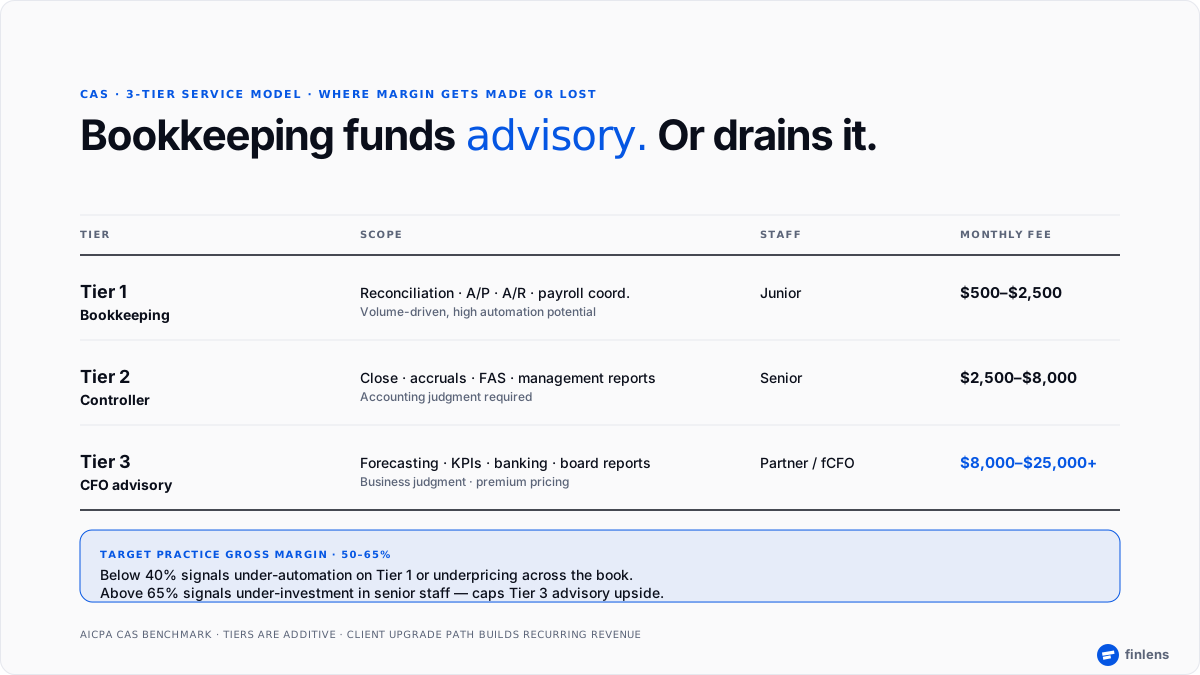
Every mature CAS practice organizes services into three tiers. The tiers are additive a client can start at bottom and expand upward, or engage at a higher tier from day one.
Tier 1 Bookkeeping and transaction management. Bank and credit card reconciliation, categorization, accounts payable and receivable, payroll processing coordination, sales tax filing prep. Delivered by junior staff. Volume-driven work. The tier where firms compete on price and where bookkeeping services fees discipline decides whether engagement is profitable.
Tier 2 Controller-level services. Monthly close, financial statement preparation, accrual and deferral entries, fixed asset schedule maintenance, balance sheet reconciliations, management reporting, budget-to-actual analysis. Delivered by senior staff or in-house controllers. Requires accounting judgment. This is where CAS starts producing management-grade output.
Tier 3 CFO advisory. Cash flow forecasting, three-statement modeling, KPI design, pricing analysis, banking relationships, board reporting, transaction advisory. Delivered by partners or dedicated fractional CFOs. Requires business judgment. This is tier that commands premium pricing and drives client retention.
Most firms launch with Tier 1 and 2 and add Tier 3 as senior capacity allows. The progression from bookkeeper to advisor is where CAS shifts from a service line into a practice.
Pricing models what actually works
Four pricing structures are defensible. Each fits a different client profile.
Hourly billing. Legacy model, still common in some regions. Predictable for firm's economics but produces client friction clients see a bill and question every entry. Reserve for irregular engagements. Not default for a CAS practice.
Fixed monthly retainer. One flat fee per month, scope defined in an engagement letter. Common range: $500–$2,500/mo for small clients (Tier 1 + light Tier 2), $2,500–$8,000/mo for mid-market clients (full Tier 2), $8,000–$25,000+/mo for CFO advisory clients (Tier 3). Most CAS practices settle here. Predictable revenue, clear scope.
Tiered packaging (bronze / silver / gold). Three or four pre-defined packages tied to service tiers above. Bronze = Tier 1. Silver = Tier 1 + 2. Gold = Tier 1 + 2 + 3. Standardizes conversations with prospects and gives clients a clear upgrade path. Often highest-margin structure at scale.
Value-based / % of revenue. Uncommon at CAS level but occasionally applied to CFO advisory engagements. Fee tied to client outcomes (funding secured, cost savings identified). Requires mature relationships and can create alignment issues if outcomes shift.
The pricing conversation depends on staff cost. A 10-hour/month engagement priced at $800 with $30/hr staff and $60/hr charge-out produces 63% gross margin. The same engagement priced at $500 does not cover senior review time and back-office general ledger reconciliation cost, and every additional client just multiplies loss.
The AICPA benchmark data
The AICPA CAS Benchmark Survey (published annually with CPA.com) is authoritative data source. Recent editions have shown:
- CAS practices growing revenue at 15–20% annual median rates.
- Top-quartile CAS practices producing net client fees per full-time employee substantially above firm-wide average.
- Advisory revenue (Tier 3) growing faster than bookkeeping (Tier 1) composition of a mature CAS practice shifts upward over time.
- Technology investment strongly correlated with practice profitability.
The takeaway for a firm building CAS: revenue growth is easy metric. Margin per FTE is metric that separates a growing service line from a growing loss.
The CAS tech stack
Every CAS engagement runs on a stack of software. The minimum viable stack for a modern practice:
- General ledger QuickBooks Online (60%+ of small-business market), Xero, or NetSuite (for mid-market clients). The choice depends on client complexity, not firm preference.
- Practice management Karbon, Canopy, Financial Cents, or Jetpack Workflow. Workflow, task assignment, client portal, deadline tracking.
- Payroll Gusto, ADP RUN, or QBO Payroll integrated with GL.
- Bill pay / AP Bill.com or Ramp for accounts payable automation.
- Expense management Ramp, Brex, or Divvy for corporate cards and receipt capture.
- Financial reporting Fathom, Reach Reporting, Jirav, or Spotlight for management reports that don't come out of QBO.
- Automation layer piece most firms underinvest in. See below.
The stack decision that most affects margin is last one. A firm can be on best practice-management tool available and still lose money if underlying bookkeeping automation never gets built.
The automation lever
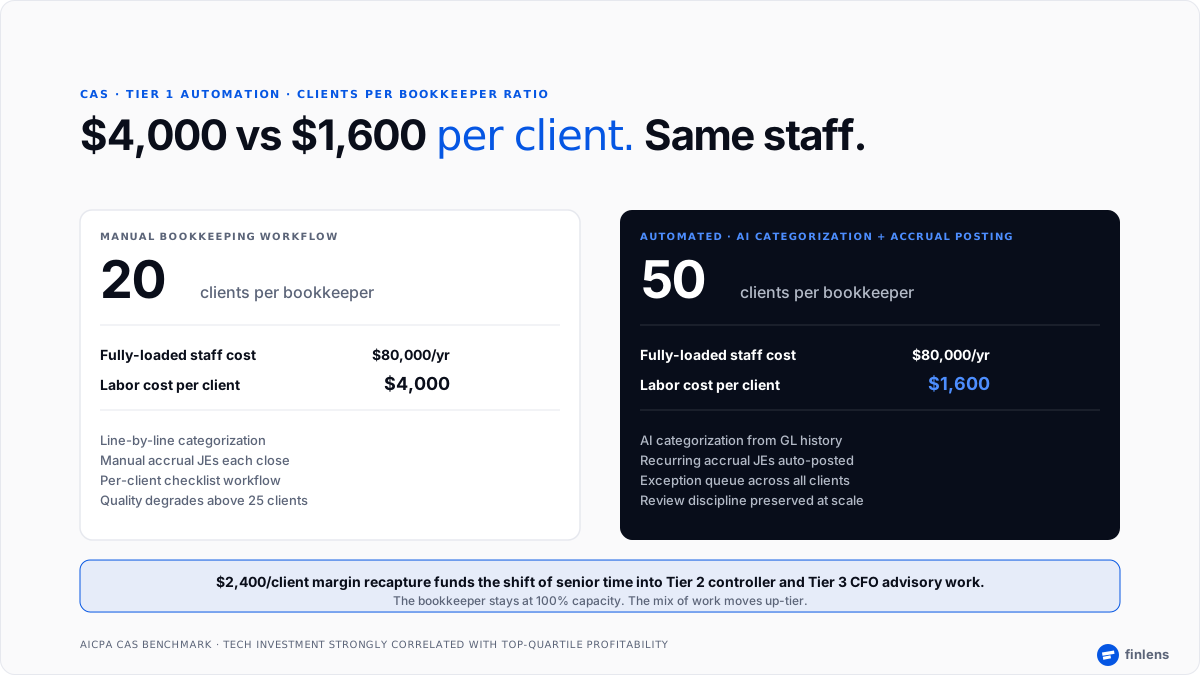
Tier 1 (bookkeeping) is where CAS margin gets made or lost. Bookkeeping is high-volume, low-differentiation work every additional client adds hours of transaction categorization, reconciliation, and journal entry posting. A firm that runs Tier 1 manually caps out at 15–25 clients per bookkeeper before quality degrades. A firm that automates ledger workflow can push that ratio to 50+ clients per bookkeeper while maintaining review discipline.
The economics matter. A firm at 20 clients per bookkeeper with $80K fully-loaded staff cost per bookkeeper spends $4K/year in labor cost per client on ledger. At 50 clients per bookkeeper same labor cost drops to $1,600/client a $2,400 margin recapture that flows to P&L or funds shift of that bookkeeper's hours into Tier 2 (controller) work.
The tools worth investing in:
- Transaction categorization automation using AI-powered accounting that learns from historical GL patterns.
- Accrual and schedule automation recurring monthly journal entries for deferred revenue, prepaid expenses, and depreciation posted without manual re-entry.
- Bank reconciliation automation that auto-matches deposits and payouts, flagging exceptions for review rather than requiring line-by-line human matching.
- Multi-client dashboards that surface exceptions across entire book of business at once, so a bookkeeper doesn't have to log into 30 separate client files to find two that need attention.
Client selection profile that actually works
Not every small business is a good CAS client. The profile that produces strongest engagement economics:
- Revenue $1M–$50M. Below $1M rarely justifies a controller-tier engagement. Above $50M usually needs an in-house controller.
- Recurring revenue business model SaaS, professional services, subscription. Predictable transaction volume makes automation ROI clearest.
- QBO or NetSuite already in use. Migrating GLs is expensive; firms that require it lose engagement on cost.
- Growth-stage client is scaling and doesn't have in-house finance capacity to keep up.
- Owner recognizes financial reporting as strategic, not just compliance.
The clients to avoid: pre-revenue startups burning cash on bookkeeping instead of product; sub-$500K clients who need Tier 1 only at prices below firm's cost; mature businesses with in-house controllers who don't want to be replaced.
How Finlens fits CAS practice
Finlens is ledger-automation layer that sits between GL (QuickBooks Online) and practice management tool. It's designed for CPA firms running CAS, not for end-client business owners.
- Automates transaction categorization across entire client book using GL-history learning, reducing per-client Tier 1 labor by 40–60%.
- Posts recurring monthly journal entries (accruals, deferrals, depreciation) to QBO from a single dashboard.
- Reconciles Stripe, Shopify, and multi-currency bank feeds to GL without manual matching for common cases.
- Surfaces exceptions across entire book every client's month-end status visible from one screen.
- Feeds clean data into practice-management tool's task workflow so bookkeepers work from an exception queue instead of a client-by-client checklist.
The design goal is same as AICPA CAS Benchmark's top-quartile firms: raise revenue per FTE without adding headcount, and shift senior time from Tier 1 review to Tier 3 advisory.
Conclusion
A CAS practice is only as profitable as automation behind Tier 1. Every dollar of margin firm captures on bookkeeping tier funds senior time that produces Tier 3 advisory and defines whether CAS line grows firm or drains it.
see how Finlens raises clients-per-bookkeeper ratios by automating transaction categorization, accrual entries, and multi-client exception review across entire book. Built for CPA firm scaling a CAS practice, not for end client.
Bring file for firm running 25 CAS clients with two bookkeepers on manual workflows, wondering why practice grew revenue 40% last year but grew margin by 8%. That's file this workflow is built for.
Frequently asked questions
What's difference between CAS and outsourced accounting?
Outsourced accounting is buyer-side term. CAS is seller-side term used by CPA firms describing same service. Some firms use CAAS (Client Accounting and Advisory Services) to emphasize advisory tier.
How much can a CPA firm charge for CAS?
Small clients typically pay $500–$2,500/mo for bookkeeping and light controller work. Mid-market clients pay $2,500–$8,000/mo for full controller-level services. CFO advisory adds $3,000–$15,000+/mo on top. Package pricing produces higher margin than hourly billing.
What's target CAS gross margin?
Well-run CAS practices target 50–65% gross margin at practice level. Below 40% signals underpricing or under-automation on Tier 1. Above 65% often signals limited investment in senior staff, which caps advisory upside.
How many clients per bookkeeper is realistic?
Manual workflow: 15–25 clients per bookkeeper. Automated workflow with an AI categorization layer and accrual automation: 40–60 clients per bookkeeper while maintaining review quality.
Do I need to build all three tiers to launch CAS?
No. Most firms launch with Tier 1 and 2, then add Tier 3 as senior capacity becomes available. Some firms outsource Tier 3 to a fractional CFO partner in early years.
How is CAS different from tax work?
Tax is compliance deliverable-based, seasonal, high concentration in Q1 and Q3. CAS is monthly-recurring, non-seasonal, and consultative. The economics of CAS resemble a SaaS business more than they resemble a tax practice.

