
Client Onboarding for Accounting Firms: A Step-by-Step System That Actually Sticks


Quick answer: Client onboarding for accounting firms is structured five-stage handoff from signed engagement letter to a fully operational client file in your system. Done right, it takes 10 to 14 business days, produces a clean opening balance, and prevents scope creep that kills firm margins. Done wrong, you spend next twelve months chasing receipts and explaining what you already covered on kickoff call.
If you have ever taken on a client in week one and found yourself still untangling their books in month three, problem is not client. It is system. This guide walks through exact onboarding workflow that gets new clients live on your stack inside two weeks, with every document request, email template, and stage checklist that production firms use.
Why client onboarding for accounting firms is different from SaaS onboarding
In SaaS, onboarding is about teaching a user to push right buttons. In an accounting firm, onboarding is moment you take legal and operational responsibility for someone else's financial records. The cost of a sloppy handoff is not a confused user. It is a 1099 filed against wrong EIN, a bank reconciliation that has not been touched since prior accountant left, or a deferred revenue schedule that nobody has ever built.
Three things make onboarding accounting clients structurally harder than other professional services:
- You inherit history. Most new clients arrive with a partial QuickBooks file, a shoebox of receipts, and a story about why last bookkeeper "did not work out." You are not starting from zero. You are auditing, then rebuilding.
- You need authorization to do real work. Pulling bank feeds, accessing prior tax returns, and posting journal entries all require formal access. None of it can be skipped without creating compliance risk for both sides.
- The work is recurring, not one-time. Bad onboarding compounds. A missing chart of accounts decision in week one becomes 12 months of miscategorized transactions. The cleanup at other end takes ten times longer than original setup.
The firms that scale past 50 clients do one thing differently: they run a repeatable client onboarding system instead of a custom dance for every engagement.
The 5 stage client onboarding system
Here is full client onboarding process template that production firms use. Every stage has a clear owner, a deliverable, and an exit criterion. If a stage does not finish cleanly, you do not advance. This is single biggest behavioral change that fixes broken onboarding.
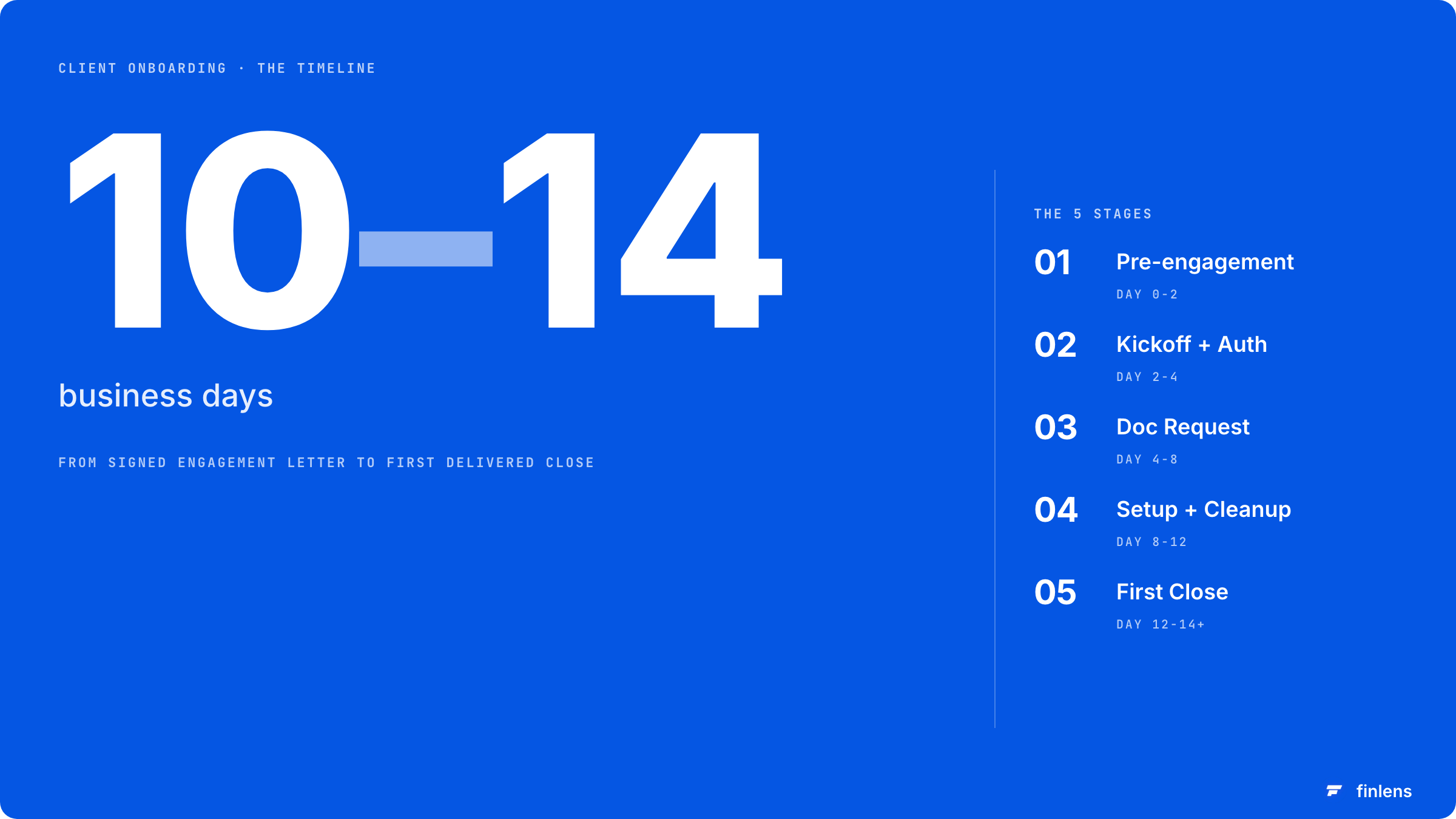
A clean onboarding flow runs in 10 to 14 business days. Anything longer signals either a complex book that needs a defined cleanup phase or a process failure that you should fix before taking on next client.
Stage 1: Pre engagement (Day 0–2)
This is part most firms rush. The cost of rushing it is everything that goes wrong in stages 2 through 5.
Three deliverables come out of this stage, and none of them are optional:
1. The engagement letter. Defines scope, deliverables, fees, and boundary between what you do and what they do. The AICPA publishes engagement letter standards that cover minimum required language. Do not skip scope-out clauses. If you do not write down what is excluded, you will end up doing it for free.
2. The new client questionnaire. Captures business structure, fiscal year, prior accountant, payroll provider, banking institutions, payment processors, and specific reason they are switching. The "why are you switching" answer tells you what to look for in cleanup. If prior bookkeeper "did not understand SaaS," there is a deferred revenue mess waiting for you.
3. The scoping notes. Internal document. Captures bookkeeper's read on complexity: number of transactions per month, number of bank accounts, payroll headcount, multi-entity yes or no, ASC 606 exposure, sales tax exposure by state. This is what determines actual hours engagement will eat versus what was sold.
Exit criterion: Signed engagement letter, returned questionnaire, internal scoping doc complete. Do not advance until all three exist.
Stage 2: Kickoff and authorization (Day 2–4)
Now you bring client onto your stack. This stage is mostly about access and expectations.
The kickoff call. Run a 45 minute structured agenda, not an open-ended chat. The agenda has four parts: (1) walk through engagement letter again so there is no ambiguity, (2) introduce team and who responds to what, (3) demonstrate client portal and where they upload documents, (4) lock recurring meeting cadence.
The authorizations. For tax clients, this means Form 8821 for information access or Form 2848 for power of attorney depending on scope. For bookkeeping, you need either QuickBooks Online Accountant invite as accountant (you stay on their books) or ownership transfer (they move to your firm subscription). The Intuit guide to inviting clients covers mechanics.
Most firm owners get this decision wrong by defaulting to one mode for every client. The right choice depends on who owns relationship long term:
Exit criterion: Authorizations signed, QBO access verified, banking integrations connected, client confirms portal login works.
Stage 3: Document request and intake (Day 4–8)
This is where most onboarding stalls. You send document request list. The client sends back 30% of it. You chase. They send another 20%. You chase again. Three weeks later you are still missing operating agreement.
The fix is to send full document request list once, with hard deadlines, and structure it so client can complete it in one sitting rather than 12 emails.
The document request list:
- Three most recent bank statements per account
- Three most recent credit card statements per account
- Most recent merchant processor reports (Stripe, Square, PayPal)
- Prior year tax return (federal + state)
- Most recent QBO file backup or trial balance
- Operating agreement or articles of incorporation
- Cap table (if equity-funded)
- Active loan agreements and amortization schedules
- Current employee and contractor roster (with start dates)
- W-9s on file for all 1099 vendors
- List of recurring monthly bills with amounts
- Login credentials for any subscription tools that touch books
The intake review. Once documents land, do a structured read against questionnaire. Flag every discrepancy. If questionnaire said "no multi-state sales tax exposure" and bank statements show a $40K invoice from a Texas customer, that is your first audit issue. Surface it before stage 4 starts.
Exit criterion: All documents received, intake review complete, list of open items shared with client.
Stage 4: Setup and cleanup (Day 8–12)
This is production stage. Bookkeeper or senior takes prior file, integrates bank feeds, finalizes chart of accounts, posts opening balances, and works through any prior-period mess.
Chart of accounts decision. Either you adopt client's existing COA, or you migrate to your firm's template. There is no third option. The decision should be made by senior reviewer in 15 minutes based on file complexity, not negotiated with client over three weeks.
Bank feed integration. Connect all bank accounts via Plaid or direct feeds. Plaid documentation covers consumer-permissioned flow. If prior bookkeeper used direct connections that broke, this is moment to fix them.
Opening balance posting. Pull trial balance from prior accountant or prior file. Reconcile against bank statements as of engagement start date. Post opening balance journal entry. This is single most error-prone moment in entire onboarding. A wrong opening balance pollutes every report you produce for next year.
Cleanup scope decision. If prior books are clean, skip this. If they are not, define cleanup scope explicitly: how far back, what work is included, what additional fee applies. The accounting cleanup process is its own engagement, not an extension of onboarding. Bill it separately.
This is also stage where your firm's tooling matters. If your team is opening 15 QBO tabs to manage active clients, onboarding work compounds every time you add one. A shared workspace that holds engagement scope, document checklist, integration status, and team assignments in one view turns setup stage from a coordination problem into a checklist. Finlens sits on top of QBO and gives accounting firms a multi-client dashboard plus AI categorization that learns from your GL logic, which means new clients reach a usable state without 10 to 15 hours of manual categorization setup that most firms eat as overhead.
Exit criterion: Chart of accounts locked, opening balance posted and reviewed, all integrations live, cleanup scope documented if applicable.
Stage 5: First close and 90-day audit (Day 12–14+)
The first month-end close is proof point. Everything you set up in stages 1 through 4 either works or it does not. Block calendar time for senior reviewer to walk through first close personally, not delegate it to new bookkeeper.
After first close ships, schedule a 90-day audit. This is unique step missing from every onboarding template you will read elsewhere. At day 90, sit down internally and answer four questions:
- Are we hitting close timeline we promised?
- Is client uploading documents on time, or are we chasing?
- Has scope crept beyond engagement letter?
- Is file still as clean as it was on day 14?
If any answer is no, you have a process problem that will compound. Fix it in month four, not month twelve.
A customer onboarding template you can copy
Here is email sequence that production firms use. Five emails, sent over first 14 days. Tone is direct and operational. No "we are so excited" filler.
Email 1 Day 0 (engagement signed): Welcome, confirm scope, link to questionnaire, propose three times for kickoff call. Sets cadence that you respond fast and expect them to do same.
Email 2 Day 2 (kickoff confirmed): Calendar invite for kickoff, link to document request list, agenda for call, link to client portal with login credentials. Tells them what to do before call.
Email 3 Day 4 (post-kickoff): Recap of call decisions, list of action items with deadlines, list of action items on your side with deadlines. This is most important email in sequence. It creates written record that scope was X, and Y is your responsibility.
Email 4 Day 8 (document follow up): Specific list of what is still outstanding. Not "please send rest of documents." Itemized: "We still need August bank statement for Chase 4523 and Form W-9 for vendor Acme Marketing." Vague follow-ups get ignored. Specific ones get answered.
Email 5 Day 14 (first close delivered): Delivers closed financials, walks through what changed from prior accountant, schedules recurring monthly review.
The bookkeeping client onboarding checklist (downloadable format)
For firms that want a single-page version, here is bookkeeping client onboarding checklist in its operational form:
- Engagement letter signed and filed
- New client questionnaire returned
- Internal scoping notes drafted
- Kickoff call scheduled and held
- QBO access verified (invite or transfer)
- Bank accounts connected and feeds tested
- Credit card accounts connected
- Payment processor reports pulled (Stripe, Square, PayPal)
- Payroll provider access verified
- Prior period trial balance received
- Document request list fully returned
- Chart of accounts decision made
- Opening balance journal entry posted
- Cleanup scope documented if applicable
- First month-end close delivered
- 90-day audit scheduled on calendar
Tax firms run a parallel version with Form 8821 or 2848 in place of QBO authorizations, and IRS Statement on Standards for Tax Services governing scope language.
The tax client onboarding checklist
For tax-only engagements, structure is same five stages but deliverables shift. Stage 2 authorization is Form 8821 (information) or Form 2848 (representation). Stage 3 document request swaps banking statements for prior-year returns, W-2s, 1099s, K-1s, and brokerage statements. Stage 4 setup is opening file in your tax software and reconciling carryforward items rather than posting opening balances in QBO. Stage 5 is actual return preparation rather than a close.
Common mistakes that wreck client onboarding best practices
Five mistakes account for most failed onboardings. None of them are technical:
1. No defined exit criteria. Stages bleed into each other. Setup starts before documents arrive. Cleanup starts before scope is agreed. Fix it by writing exit criterion at top of every stage and not advancing until it is met.
2. Verbal scope agreements. Anything not in engagement letter or post-kickoff email recap will become a free request inside three weeks. Document everything in writing same day.
3. Single point of failure on client side. If only founder can answer questions and founder is traveling, your timeline collapses. Confirm in kickoff call who else can authorize and respond.
4. Optimistic timeline promises. "We can have you live in a week" sounds great in sales call. It produces a permanently broken client relationship when week three rolls around and you are still chasing an operating agreement. Promise 14 business days and beat it.
5. No 90 day audit. Without structured 90-day review, scope creep and process failures accumulate silently. Half of "this client is a nightmare" complaints from senior staff at month nine trace back to an onboarding decision that nobody flagged at time.
Most of these are communication failures rather than process failures, which is why it pays to rehearse the scripts and scenarios that actually hold up with clients before the awkward conversation arrives.
How Finlens fits into client onboarding for accounting firms
Finlens is layer that holds onboarding flow together after stage 2. It sits on top of QuickBooks Online (no migration), connects to new client's bank feeds and Stripe in stage 4, and starts AI-categorizing transactions against your firm's GL logic from day one. For firms managing more than 30 clients, time saved on categorization piece alone covers the cost of tool. The shared workspace also means engagement scope, document checklist, and team assignments live in one view that whole firm can see.
The free plan covers up to $50k/month in client expenses. No credit card required to start.
Frequently asked questions
How long should client onboarding take for an accounting firm?
A clean onboarding runs 10 to 14 business days from signed engagement letter to first delivered close. If prior books require cleanup, that is a separate engagement with its own timeline (typically two to six weeks depending on mess).
What is a customer onboarding checklist for an accounting firm?
A structured list of every action that must happen between engagement signature and first delivered month-end close. Standard items include engagement letter, kickoff call, QBO access, bank integrations, document request, chart of accounts decision, opening balance posting, and first close delivery.
How do you onboard a new bookkeeping client without losing two weeks to email chasing?
Send full document request list once with a 5-day deadline rather than dripping requests as you think of them. Make every follow-up itemized rather than generic ("we still need August Chase statement" not "please send remaining documents"). Use a client portal with upload tracking so you can see who has uploaded what without asking.
What documents should I request from a new accounting client?
Three months of bank and credit card statements, prior year tax return, current QBO file or trial balance, operating agreement, payroll roster, W-9s on file for 1099 vendors, recurring bill list, and login credentials for subscription tools that touch books.
Should I invite a new QBO client as an accountant or transfer ownership to my firm?
Invite as accountant when client wants to retain their QBO subscription and you provide ongoing services. Transfer ownership when client wants you to fully manage file long-term and you are billing through a packaged fee that includes QBO. The choice should reflect long-term billing model, not be defaulted across every client.
What is a 90 day audit in client onboarding?
A structured internal review at day 90 of every new client engagement. Reviews close timeline adherence, document upload behavior, scope creep, and ongoing book quality. Catches process failures and scope problems before they compound across first year of engagement.
What software should accounting firms use to manage client onboarding?
A client portal for document collection (most QBO firms use a dedicated portal tool, not email), a practice management platform for workflow and task assignment, and an automation layer like Finlens for categorization and close work that starts in stage 4. The single biggest mistake is trying to run onboarding out of email and spreadsheets past 20 clients.
If your firm is still onboarding clients out of email threads and a shared Google Doc, you are not running an onboarding system. You are running a personal favor that scales linearly with your headcount. The five-stage workflow above replaces favor with a process. The 90-day audit replaces hope with a structured review. The shared workspace replaces 15-tab QBO juggling act with one view.
If you are evaluating tools, start with best accounting client portal software breakdown, then practice management platforms comparison. Both cover specific gaps in workflow above.
For firms past 30 clients, Finlens automates categorization and close work that compounds with every new client added. Free plan available.

