
Communication Skills for Accounting: Scripts and Scenarios That Actually Hold Up With Clients


A senior preparer at a 12-person firm hangs up the phone with a client who just yelled at her about a $4,200 tax bill. The client is convinced the firm "missed something" because the bill is higher than last year. The preparer spent 25 minutes trying to explain that the client's K-1 income jumped 40% and his withholding stayed flat. The client wouldn't hear it. She gets off the call shaking and sends a Slack message to the partner saying she doesn't want to handle this client anymore.
The technical work was right. The bill was correct. The preparer is competent. What broke was the communication. Specifically, nobody had ever given her a script for the "your bill is higher than you expected" conversation that 70% of preparers will have during any given tax season.
This post is the actual scripts and frameworks I've seen work for the conversations every accounting practitioner runs into and that nobody teaches in CPE.
Why "communication skills" training in our profession is mostly useless
The standard CPE on communication is generic. Active listening: mirror their words and summarize back. None of that survives contact with a client who's frustrated about money and convinced you made an error.
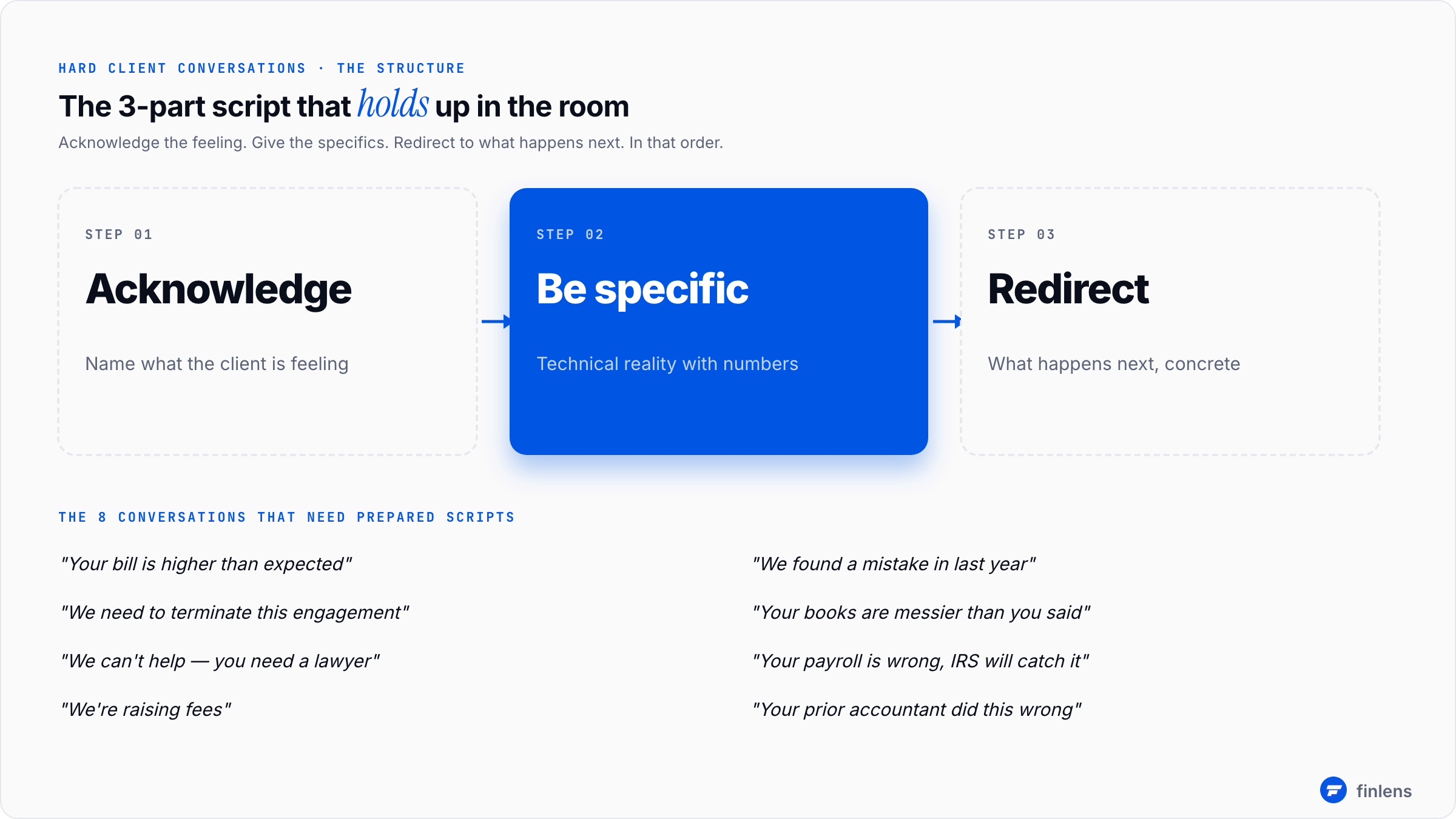
The specific accounting conversations that need specific scripts:
- The "your bill is higher than expected" call
- The "we found a mistake in last year's return" disclosure
- The "we need to terminate this engagement" exit
- The "your books are messier than you said" cleanup pricing conversation
- The "we can't help you with that, you need a lawyer" referral
- The "your payroll is wrong and the IRS will catch it" intervention
- The "we're raising fees by 15%" annual pricing conversation
- The "your prior accountant did this wrong" reframe
Each one has a structure that works and several that don't. The structure that works is consistent: name what the client is feeling, give them the technical reality without softening it too much, and end with what happens next.
The "your bill is higher than expected" conversation
This is the most common difficult conversation in tax practice. The script that works:
"I understand this isn't what you were hoping for. Let me walk you through why the number came out the way it did, and then we can talk about what to do for next year.
Your taxable income went up by [specific dollar amount or percentage] compared to last year. The main drivers were [specific items: the K-1 from your investment, the bonus, the capital gains, etc.]. Your withholding for the year was [specific dollar amount], but the tax owed on the higher income is [specific dollar amount]. The gap is [specific dollar amount].
This isn't a mistake on the return. The return is preparing exactly what's owed based on the income reported. The conversation we should have is whether to adjust your estimated payments or withholding for next year so this doesn't happen again."
The structure: acknowledge the feeling, give them the specifics, name explicitly that it's not an error, and redirect to what to do next.
What doesn't work: "Well, you made more money, so you owe more." Technically correct. Conversationally a disaster.
What also doesn't work: defending the firm. "Our preparation is accurate." The client isn't questioning your accuracy. They're processing a bigger-than-expected number.
The "we found a mistake in last year's return" disclosure
This is the conversation that scares preparers the most. The instinct is to soften it or delay it. Both make it worse.
The script that works:
"I need to tell you something that came up while we were preparing this year's return. We found an issue with last year's return that we need to address.
Specifically, [specific finding: the depreciation schedule was missing a vehicle; the K-1 we received was incorrect, and the corrected one came in afterwards, etc.]. The impact is [specific dollar amount of additional tax owed, or refund due].
We need to file an amended return. The cost to do that is [specific dollar amount, usually $400-$1,500 depending on complexity]. We're going to handle the IRS notification ourselves. Here's what happens next: [specific timeline]."
The structure: name the problem directly, quantify the impact, state what you're doing about it, give the cost.
What doesn't work: "We may have noticed something that could potentially require some adjustment." Soft language increases anxiety because the client knows you're hiding something.
What also doesn't work: "It's not really our fault because..." Even if the prior preparer made the error, taking responsibility for the current relationship signals professionalism. The blame-shifting signals the opposite.
The "we need to terminate this engagement" exit
The conversation firm owners avoid for months and then handle poorly when they finally have it.
The script that works:
"I want to be direct with you. Our firm isn't the right fit for what you need going forward, and I want to give you enough notice to transition smoothly.
The reason is [specific, honest reason: the scope of work has grown beyond what we're set up to handle; the working relationship has become difficult; the work has become unprofitable at our pricing; your needs have changed]. We've thought about this carefully, and we're sure about the decision.
Here's what we'll do to make the transition clean: we'll complete [specific work in flight], we'll prepare a [specific package of documents and information] for your next accountant, and we'll be available for transition questions for [specific period, usually 60-90 days]. We can recommend several firms that we think would be a better fit. Would you like those referrals?"
The structure: name the decision, give the reason, lay out the transition, offer help.
What doesn't work: "We're really busy right now and might not be able to take you on next year." The client knows that's not the real reason. The relationship ends badly because nobody addressed the actual situation.
What also doesn't work: dragging it out. Firms that hint about ending engagements without committing to it leave clients in limbo. Directness is kinder.
The cleanup pricing conversation
A new client's books are worse than they described in the initial scope conversation. You need to charge them more than the engagement letter said.
The script that works:
"I want to walk you through what we found when we got into your books and what it means for the work scope.
When we talked initially, we agreed to [specific scope and price]. As we got into the work, we found [specific findings: prior categorization needs significant rework, multiple months were never reconciled, vendor 1099s are missing for three years, etc.].
This is meaningful additional work beyond the initial scope. To get you to a clean starting point will require approximately [specific hours] of additional work. At our rate of [specific hourly rate or flat fee], that's [specific dollar amount].
Here are the options: we can do this cleanup work and bill separately for it, we can adjust your monthly fee to absorb the cleanup over a longer period, or we can adjust the scope to leave some of the historical mess in place and only clean up going forward. I'd recommend [your specific recommendation with reasoning]."
The structure: anchor to the original scope, name what's different, quantify, and offer options with a recommendation.
What doesn't work: just sending an invoice for more than the engagement letter without prior conversation. The trust damage is permanent.
What also doesn't work: absorbing the extra work without saying anything. The firm loses margin and sets a precedent that scope is negotiable.
The "we can't help you with that" referral
A client asks for help with something outside your scope or expertise. A tax practitioner gets asked about estate planning. The bookkeeper gets asked about audit defense. Either you refer or you damage the relationship by giving subpar advice.
The script that works:
"That's an important question, and I want to make sure you get good advice on it. Honestly, [specific topic] is outside what we do regularly enough to give you the best answer.
I'd recommend talking to [specific type of professional: estate planning attorney, tax controversy specialist, valuation expert]. I can introduce you to [specific name(s)] if you'd like.
Once they've given you their guidance, I'm happy to work with them on the accounting side or coordinate with them if there are tax implications."
The structure: validate the question, name the scope limit directly, refer to specific people, and offer to coordinate.
What doesn't work: trying to wing it. Giving rough advice on something outside your expertise creates liability for you and bad outcomes for the client.
What also doesn't work: "You should talk to a lawyer." Generic referrals don't help the client. Specific introductions do.

The "we're raising fees" conversation
The annual fee adjustment. The conversation most firms handle by sending an updated invoice with no explanation and hoping nobody notices.
The script that works
"I want to give you advance notice that we're adjusting our fees for next year. Your monthly fee will go from [current amount] to [new amount], starting [specific date].
The reason is [specific, honest reason: our costs have increased, the scope of work has grown, we've added capabilities like X that benefit you specifically]. We've kept your rate steady for [time period], and this adjustment brings it in line with our current pricing for similar engagements.
If this is a problem, I'd like to know now so we can talk about it. Otherwise, the change goes into effect [specific date]."
The structure: name the change, give the specific reason, invite pushback, set a deadline.
What doesn't work: hoping they don't notice. Some will. The ones who do feel disrespected and the ones who don't are the ones you'd most want to discuss it with.
What also doesn't work: over-justifying. A three-paragraph email explaining the cost pressures of running a firm sounds defensive. One clean sentence on reason is enough.
How to actually train these skills
Most firms try to train soft skills by talking about them at staff meetings. It doesn't stick.
What works better:
Recorded role-play. Pair junior staff with senior staff for 30-minute sessions where the senior plays the client and the junior runs the script. Record it. Watch it together. The discomfort of watching yourself communicate is where the learning happens.
Script libraries. Build your firm's specific scripts for the conversations above. Store them somewhere the team can find them. Update them as you learn what works.
Post-mortem on hard calls. When a difficult call happens, schedule a 15-minute debrief with the staff member. What did they say? What worked. What didn't? What would they say differently next time?
Senior staff sitting in. Have a senior staff member silently observe difficult calls (with the staff member's permission) and give specific feedback afterward. Generic feedback doesn't help. Specific feedback ("When the client said X, you got defensive; try this instead") does.
The client onboarding pillar covers some of the structured client conversations that happen early in engagements. Communication skills compound from those early conversations onward.
Frequently asked questions
Are these scripts memorize-and-deliver or guidelines?
Guidelines. Memorizing word-for-word makes you sound like a robot. The structure is the actionable part. Adapt the specific words to your voice.
What about written communication versus phone calls?
The same structures work for both. Written communication should be tighter and skip some of the relational framing. Phone communication needs the relational framing more because tone matters.
How do you handle clients who interrupt or won't let you complete the script?
Most clients who interrupt are processing emotion. They calm down once they feel heard.
Should junior staff handle difficult conversations or escalate to seniors?
Junior staff handle straightforward client conversations from day one. Difficult conversations (terminations, large fee increases, mistakes on prior returns) should generally be handled by seniors or partners. The line moves as staff grow.
What about clients in conflict with each other (divorced couples, business partners splitting)?
A different category of conversation that requires its own structure plus often a legal referral. The base skill is similar, but the stakes are higher and the documentation requirements are stricter.
How does Finlens fit?
Finlens doesn't help with communication skills directly. What it does help with is reducing the operational friction that creates difficult conversations in the first place. Automated categorization means fewer "we missed a transaction" disclosures. Faster month-end close means fewer "where are last month's books" calls. Better data means more confident "here's why your bill is what it is" conversations.
The scripts above are the ones I've seen work across dozens of firms. They're not universal. Adapt them to your voice. The discipline of preparing in advance for these specific conversations instead of winging them in the moment is the single biggest improvement most accounting practitioners can make to their client communication.
For the operational systems that surround client communication, see the client onboarding pillar and the engagement letters for the documents and processes that prevent some of these conversations from becoming difficult in the first place.

