
Form 1040-X: How to Amend Your Tax Return (Deadlines, E-File, Refund Tracking)


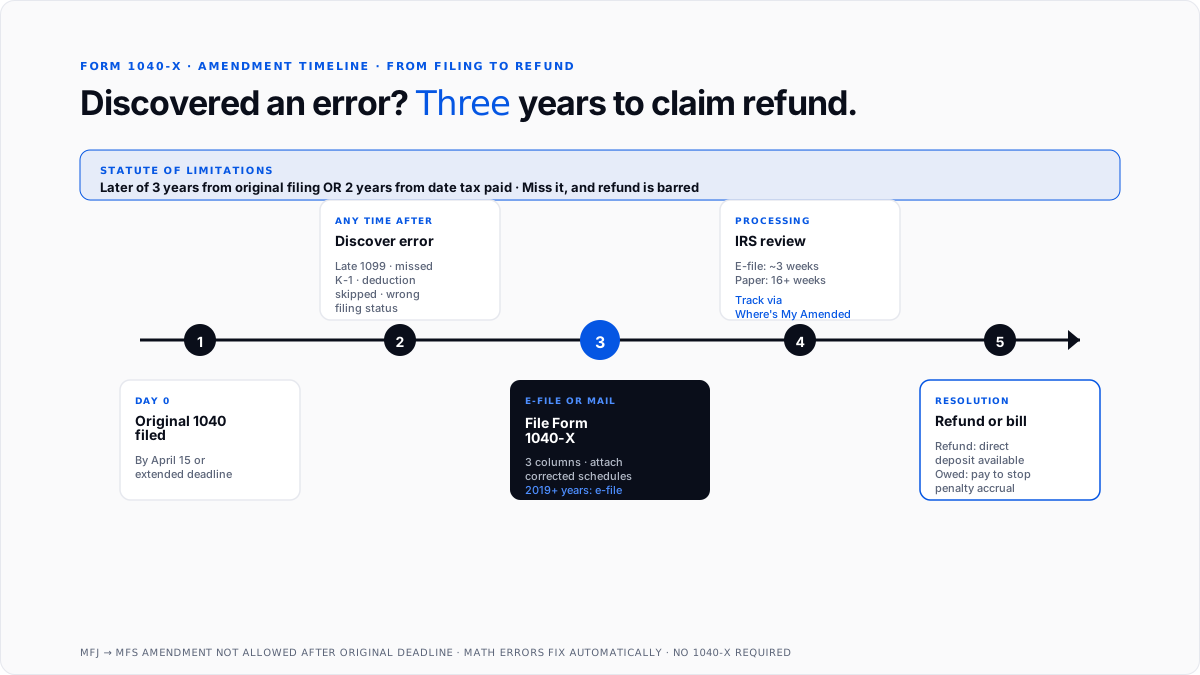
Form 1040-X is Amended US Individual Income Tax Return form you file when you need to correct an error on a previously filed Form 1040. Missed deduction? Forgot a W-2? Discovered a K-1 that arrived after you filed? Wrong filing status? Amend with a 1040-X. The IRS gives you three years from original filing date (or two years from when tax was paid, whichever is later) to submit changes and claim any refund.
This guide walks through when to amend, three-year statute of limitations, how to e-file 1040-X (available since 2020), what to include, how long processing takes, and how to track your amended refund via Where's My Amended Return.
What Form 1040-X does
Per IRS Form 1040-X page, Form 1040-X is used to correct any information on a previously filed Form 1040, 1040-SR, or 1040-NR. Common reasons to amend:
- Missed income a late 1099, missed W-2, or K-1 that arrived after filing
- Missed deduction or credit realized you qualified for something (e.g., Earned Income Credit, education credit, home office)
- Filing status change got married and want to change from Single to MFJ, or realized you qualify for Head of Household
- Wrong dependents added or removed a dependent
- Miscalculated tax math errors, wrong bracket applied, wrong withholding entered
- Wrong income allocation moved states mid-year and misallocated to state returns
Form 1040-X does NOT amend state returns each state has its own amended-return process. Amend federal first, then state.
The three-year statute of limitations
You have LATER of:
- 3 years from original filing date, OR
- 2 years from date you paid tax
...to file a 1040-X and claim a refund. After that, you can amend to REPORT change (still required for accuracy), but you cannot receive a refund of overpaid tax.
Example:
- Original 2021 return filed on April 15, 2022
- Refund claim deadline: April 15, 2025 (3 years from filing)
Extended returns: If you extended your filing deadline (Form 4868), 3-year clock starts on actual filing date (or October 15, whichever is earlier).
Balances owed: If you're amending to REPORT additional tax owed, you should file as soon as possible penalties and interest continue to accrue until you pay.
E-filing Form 1040-X (available for 2019+)
Since 2020, IRS accepts electronic Form 1040-X for tax years 2019 and later. E-filing:
- Processes in ~3 weeks vs. up to 16+ weeks for paper
- Requires original return to have been e-filed (paper-filed originals must amend by paper)
- Available through most tax software (TurboTax, H&R Block, Drake, Lacerte, ProConnect, TaxAct)
- Direct deposit available for refunds on e-filed 1040-X since 2023
Paper filing (required if):
- Original return was paper-filed
- Amending tax year 2018 or earlier
- Amending an amended return (you can amend a 1040-X, but by paper only)
- Certain state issues that require attached documentation
Mail paper 1040-X to IRS service center for your state. Include all corrected schedules and supporting documents.
Section-by-section: what Form 1040-X looks like
Form 1040-X has three columns and space for you to explain change:
Column A Original amount. What you originally reported on Form 1040. Get this from your originally filed return (not what you should have reported).
Column B Net change. The increase or decrease in each line as a result of amendment.
Column C Correct amount. What line SHOULD show after amendment. (Column A + Column B = Column C.)
Part III Explanation of Changes. Free-text field where you explain what changed and why. Be specific: "Missed 1099-NEC from XYZ Corp $8,500 added to Schedule C Line 1 gross receipts. Recalculated Line 31 net profit and Schedule SE. Additional tax owed: $1,320."
Attach corrected schedules. Any schedule that changed must be attached to 1040-X as a "corrected" version. If Schedule C changed, attach new Schedule C. If Schedule D changed, attach new Schedule D.
Payment or refund line. Line 22 refund; Line 20 amount you owe.
Processing timelines what to actually expect
E-filed 1040-X (2019+ returns):
- Acknowledgment: 1–3 days
- Processing: ~3 weeks
- Refund direct deposited (if applicable): 1–2 additional weeks
Paper 1040-X:
- Reaches IRS: 5–7 days mail
- Processing: 16+ weeks (currently 20+ weeks due to backlogs)
- Refund via paper check: 4–6 additional weeks
Complex amendments (K-1 changes, foreign income, prior-year credit adjustments) can extend processing to 6+ months.
Tracking via Where's My Amended Return
The IRS provides a specific tool for tracking 1040-X status: Where's My Amended Return.
What you need:
- Social Security Number
- Date of birth
- ZIP code
Status categories:
- Received. The IRS has your 1040-X in queue.
- Adjusted. The change has been processed and your account updated.
- Completed. Any refund has been issued or additional balance has been billed.
Data updates once per day, typically overnight. Availability starts about 3 weeks after e-filing or 3–4 weeks after mailing paper.
When you DON'T need to file 1040-X
Some errors get fixed automatically by IRS without you needing to amend:
Math errors: The IRS recalculates simple math errors and sends a CP notice showing correction. Just verify and, if agreed, no action needed.
Missing W-2 or 1099 that IRS already has: If IRS's data matches shows more income than you reported, you'll get a CP2000 notice. You can either agree (pay additional tax) or dispute no 1040-X required if you agree.
Missing forms attached to original return: If you forgot to attach a schedule but amounts are correctly reported on 1040, IRS may request missing form without requiring an amendment.
Simple withholding amount corrections: Sometimes IRS's W-2 records show different withholding than your return they'll adjust from their records and issue any additional refund.
For anything that changes your actual tax liability (income, deductions, credits, filing status), you must file 1040-X.
Amending to change filing status
Single → MFJ: Allowed if amendment is within 3-year window and you were legally married at year-end. Straightforward.
MFS → MFJ. Allowed within 3 years of LATER filing date of either spouse. Common for spouses who initially filed MFS to preserve refund allocation and then decide to combine.
MFJ → MFS:" NOT allowed after original filing deadline. Once you elect joint filing, you're locked in for that year (with narrow exceptions for injured spouse or innocent spouse relief).
Single → Head of Household: Allowed within 3 years if you meet HoH tests (unmarried, paid >50% of household costs, qualifying dependent).
Death of a spouse Qualifying Surviving Spouse status: Available for 2 years following year of death. Amend if you incorrectly filed Single instead.
Common 1040-X mistakes
Filing before original return is fully processed: The IRS system needs original in its records before it can process an amendment. If you e-filed original 3 days ago, wait 3+ weeks before amending.
Not attaching corrected schedule: A 1040-X changing Schedule C net profit must include revised Schedule C. Otherwise IRS can't verify Column B change.
Amending state without amending federal: Federal is master record. Amend federal first, then use federal 1040-X as evidence when amending your state return.
Filing multiple 1040-Xs for same year simultaneously: File one 1040-X covering all changes for a given year. Multiple pending amendments for same year confuse IRS system.
Forgetting explanation in Part III: IRS reviewers rely on Part III to understand change. A blank or generic ("Corrected error") explanation slows processing dramatically.
Missing statute of limitations: Amendments filed after 3 years can't claim a refund. Track your 3-year deadlines for open amendments especially if waiting for a resolution on an audit or CP notice.
Amending Form 941 with 1040-X: Wrong form. 1040-X amends individual income tax returns only. Employer payroll returns use Form 941-X. Business returns use Form 1120-X, 1120-S-X, or 1065-X.
Interest on refunds and owed balances
Refunds: The IRS pays interest on 1040-X refunds if refund is issued more than 45 days after you filed amendment. Current rate is ~8% APR.
Owed balances: Interest accrues from original due date of return, not from when you filed amendment. Late-payment penalty (0.5% per month) applies on top of interest if balance isn't paid promptly.
If your amendment reveals additional tax owed, pay balance with 1040-X (via check, Direct Pay, or EFTPS) to stop penalty clock.
Conclusion
Form 1040-X is safety net for every mistake on a prior tax return. Three-year window, e-file for 2019+ returns, and Where's My Amended Return for status tracking. The biggest risk isn't amendment itself it's discovering error too late and blowing statute.
Frequently asked questions
Can I amend a return I already amended?
Yes. File another 1040-X. Second amendments must be filed by paper e-file only supports first amendment per tax year.
How many years back can I amend?
3 years for refund claims. You can amend older returns to REPORT changes, but you can't receive refunds beyond 3-year window.
Does filing 1040-X restart audit clock?
No. The audit statute (also 3 years) runs from original filing date, not amendment date. However, amendments filed close to audit deadline may extend audit review if IRS is still examining.
What if my original refund was already paid?
The 1040-X reconciles against original refund. If amendment reduces your refund, you owe back excess. If it increases refund, you receive additional amount.
Can I use same tax software to amend?
Yes, most tax software supports 1040-X in same product. Software prepares Column A (original), you enter Column C (corrected), and it calculates Column B (change) automatically.
Do I need to send original 1040 with 1040-X?
No. The IRS has your original filing. Only send 1040-X + corrected schedules + supporting documents.
Can I amend to claim a credit I missed?
Yes. Missed QBI deduction, Earned Income Credit, education credit, Retirement Savings Contributions Credit all can be added via 1040-X within 3-year window.
What about state income tax on amended return?
Amend your state return separately using state's amended-return form (varies by state). Some states have a 4-year statute of limitations, longer than federal.

