
Form 941: Employer's Quarterly Federal Tax Return (Filing Guide + Deadlines)


Form 941 is Employer's Quarterly Federal Tax Return form every US business with employees files four times a year to report federal income tax withheld from paychecks, plus both halves of Social Security and Medicare tax. Once you've run a single payroll, you're on Form 941 schedule. Missing a due date triggers Failure-to-File and Failure-to-Deposit penalties within days.
This guide covers what Form 941 reports, quarterly deadlines, deposit schedule that determines whether you need Schedule B, corrections via Form 941-X, and situations where you file something else (Form 943, 944, or Schedule H) instead.
What Form 941 reports
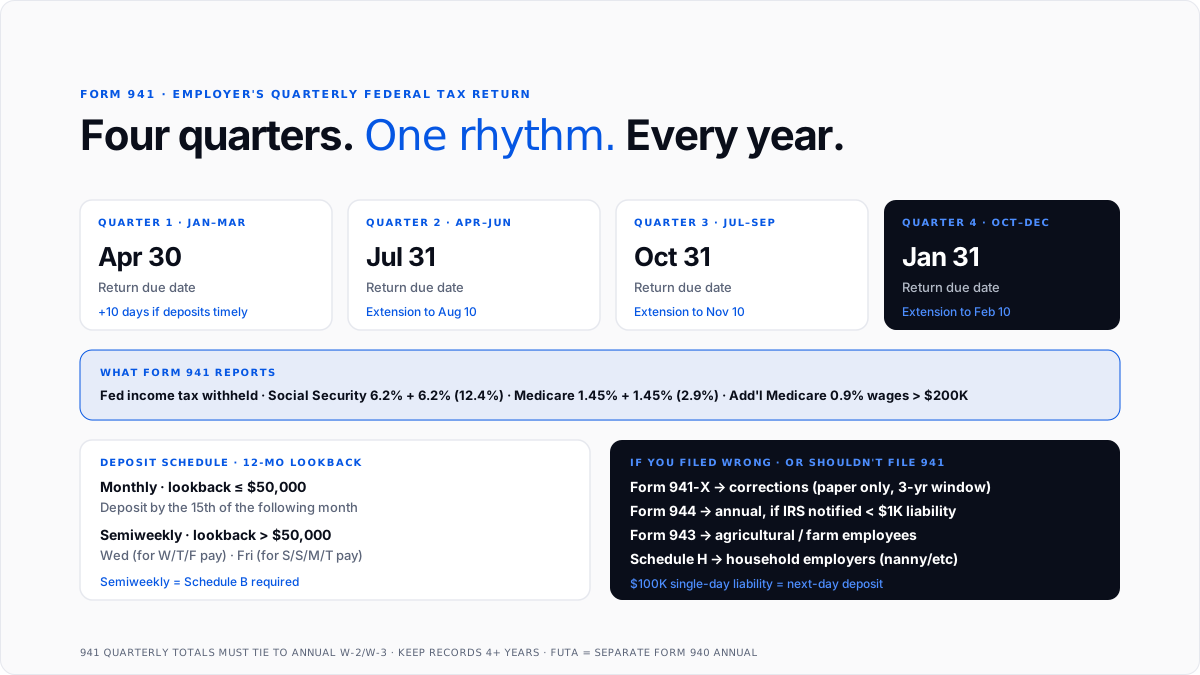
Per IRS Form 941 official page, every quarter you file Form 941, you're reporting three separate categories of federal payroll tax:
1. Federal income tax withheld from employee wages. This is what you subtracted from paychecks based on each employee's Form W-4 elections.
2. Social Security tax (both halves). 6.2% withheld from employee + 6.2% employer match = 12.4% total, up to annual Social Security wage base ($168,600 for 2024; $176,100 for 2025).
3. Medicare tax (both halves). 1.45% withheld from employee + 1.45% employer match = 2.9% total, with no wage cap. Plus Additional Medicare Tax of 0.9% withheld from wages above $200,000 for a single employee (employee-only; there's no employer match on additional 0.9%).
The form reconciles what you owed for quarter against what you already deposited. If deposits fell short, you pay difference with return. If you over-deposited, you can apply credit to next quarter or request a refund.
Quarterly due dates
Form 941 is filed four times a year. Per IRS Form 941 Instructions, due dates are:
The 10-day rule. If you made all required deposits on time and in full for quarter, you get an extra 10 days to file return. So a business that fully deposited Q1 taxes on schedule has until May 10 (instead of April 30) to submit Form 941 for Q1. This is a filing extension only deposits themselves must still hit their own semiweekly or monthly schedule.
Weekend / holiday rule. If a due date falls on a Saturday, Sunday, or federal holiday, return is due next business day.
Monthly vs. semiweekly depositors who needs Schedule B
Your deposit frequency is set by your total tax liability during a 12-month "lookback period" (July 1 through June 30 of prior year). Two schedules exist:
- Monthly depositor. Lookback period liability ≤ $50,000. Deposit by 15th of following month.
- Semiweekly depositor. Lookback period liability > $50,000. Deposits due on Wednesday (for paychecks issued Wed/Thu/Fri) or Friday (for paychecks issued Sat/Sun/Mon/Tue).
Semiweekly depositors must file Schedule B (Form 941) day-by-day breakdown of tax liability across quarter, not just monthly total. The IRS uses Schedule B to check that each deposit hit within its assigned window.
One-day override: if you ever accumulate $100,000 or more in tax liability on any single day, you're required to deposit by next business day AND become a semiweekly depositor for remainder of calendar year and all of next year. This most commonly trips up small employers who paid a large year-end bonus.
When you file something else
Not every employer files Form 941. Depending on workforce, you may file one of these instead:
Form 944 annual, not quarterly: The IRS notifies you if your total annual employment tax liability is $1,000 or less. Form 944 is filed once, in January, covering whole prior year. Don't switch to Form 944 without written IRS notification filing wrong return generates a mismatch that requires manual correction.
Form 943 agricultural employers: Farm workers are reported on Form 943, not Form 941. Non-farm employees of same business still go on Form 941; you'd file both.
Schedule H (Form 1040) household employers: Nannies, housekeepers, and other household employees are reported once a year on Schedule H, filed with your personal return.
Seasonal employer election: If you don't pay wages every quarter (summer camp, seasonal retail), check line 18 on Form 941 to indicate you're seasonal you can then skip filing quarters with zero wages. Without election, IRS expects a return every quarter and will send delinquency notices for gaps.
Line-by-line: what Form 941 actually looks like
Form 941 has five parts, but numbers-heavy work is concentrated in Part 1:
Part 1 Answer these questions for this quarter:
- Line 1: Number of employees who received wages this quarter
- Line 2: Total wages, tips, other compensation
- Line 3: Federal income tax withheld
- Line 5a: Taxable Social Security wages × 12.4%
- Line 5b: Taxable Social Security tips × 12.4%
- Line 5c: Taxable Medicare wages × 2.9%
- Line 5d: Wages subject to Additional Medicare (>$200K) × 0.9%
- Line 6: Total taxes before adjustments
- Lines 7–9: Adjustments (fractions of cents, sick pay, tips/group life)
- Line 10: Total taxes after adjustments
- Line 11: Nonrefundable credits (research, small employer health)
- Line 12: Total taxes after credits this is what you owe for quarter
- Line 13: Total deposits made this quarter
- Line 14: Balance due (or Line 15: Overpayment)
Part 2 Deposit schedule and tax liability by month (or refers to Schedule B for semiweekly).
Parts 3–5 Business closure/final return questions, third-party designee, signature.
Form 941-X: correcting a filed 941
If you find an error after filing missed wages, wrong withholding total, an employee misclassified you don't amend Form 941. You file Form 941-X (Adjusted Employer's Quarterly Federal Tax Return or Claim for Refund), a separate form used to correct any previously filed Form 941.
Key rules:
- Statute of limitations. File 941-X within 3 years of original 941 filing date, or 2 years from when you paid tax whichever is later.
- Underreported vs. overreported. Different sections of 941-X depending on whether you owe more or want a refund. Overreported errors can either be adjusted on a future 941 or claimed as a refund.
- Cannot be e-filed. Form 941-X is paper-only. Mail to IRS service center for your state.
- One 941-X per quarter. If you're correcting Q1 2025 and Q3 2025, file two separate Forms 941-X.
The most common Form 941 mistakes
Mismatched Form 941 and W-2 totals. The sum of Social Security wages, Medicare wages, and federal withholding across your four quarterly 941s must match annual W-2/W-3 you file in January. When they don't, IRS sends a CP notice asking for a reconciliation. See our guide on difference between W-2 and 1099 for how these forms interact.
Not depositing on time. Deposits are a separate obligation from filing. FTD (Failure-to-Deposit) penalties start at 2% (1–5 days late), scale to 5% (6–15 days), 10% (16+ days), and 15% (after IRS notice).
Missing 940 as well. Form 941 is federal income + SS + Medicare. Form 940 is separate annual return for FUTA (federal unemployment tax). They're two different filings covering two different tax obligations most employers file both.
Reporting owner draws as wages. If you're a sole proprietor or single-member LLC, your own draws are not wages and don't go on Form 941 they flow through your personal return. S-corp owner-employees are different: reasonable compensation must be run through payroll and reported on Form 941.
Forgetting Schedule B when you become a semiweekly depositor. The switch is automatic when your lookback crosses $50K IRS won't send a warning, and filing without Schedule B triggers a rejection.
When you're deep in payroll administration
Once you're running payroll, Form 941 is recurring anchor filing every quarter plus deposits every month or semiweekly, plus year-end W-2s, plus Form 940 for FUTA. Most small businesses either outsource this to a payroll service or run it through payroll management software that files 941 electronically.
For self-employed owners without W-2 employees, you're on estimated tax payments track instead quarterly personal payments, not Form 941.
Conclusion
Form 941 is quarterly rhythm of employer payroll tax. Miss a deposit and FTD penalties start counting in days; miss a filing and FTF penalty adds 5% per month. The tax itself is straightforward schedule is what catches employers.
Frequently asked questions
Do I have to file Form 941 if I had no employees this quarter?
Yes, unless you've made seasonal employer election (line 18) or have officially closed business by checking Part 3 Line 17 on a prior return. Filing a "zero return" is required to keep account open and avoid delinquency notices.
What if I miss a Form 941 due date?
The Failure-to-File penalty is 5% of unpaid tax per month (up to 25%), stacked with FTD penalties. File as soon as possible even a late 941 with payment stops 5%-per-month clock immediately.
Can I e-file Form 941?
Yes. Most payroll software submits 941 electronically. Direct e-file via IRS MeF is also available, though most small businesses use a paid preparer or payroll platform rather than filing directly.
Where do I mail Form 941 if I paper file?
The mailing address depends on your state and whether you're enclosing a payment. The IRS Form 941 Instructions list all six regional service centers.
Is Form 941 same as Form 940?
No. Form 941 is quarterly, reports fed income + SS + Medicare. Form 940 is annual, reports FUTA (federal unemployment tax) only. Different tax, different frequency, different form.
How long should I keep Form 941 records?
The IRS requires at least 4 years after return is filed or tax is paid, whichever is later. Best practice is 7 years to cover any state or audit lookback windows.
Does S-corp owner compensation go on Form 941?
Yes. S-corp shareholder-employees must take "reasonable compensation" as W-2 wages, which flows through Form 941 like any other employee's wages. Only K-1 profit distribution stays off payroll.
What's penalty for not filing Schedule B when required?
The IRS may reject return or reclassify your deposit schedule, which typically results in FTD penalties on deposits that didn't hit right window. If you're semiweekly, always file Schedule B.

