
Payroll Services Pricing: Compare Costs and Plans


Payroll is one of two most common service-line expansions for a CPA firm other is fractional CFO or advisory. Every existing client with employees is a payroll prospect, and every firm eventually decides whether payroll is a pass-through service (client uses Gusto, ADP, or QBO Payroll, firm reconciles) or a billable service line (firm runs payroll and prices it as a monthly recurring engagement).
What market charges 2026 benchmarks
Two separate price benchmarks matter: what payroll providers charge (firm's cost side) and what CPA firms charge their clients (firm's revenue side).
Payroll provider vendor pricing (firm cost):
- Square Payroll $35/mo base + $6 per employee per month (PEPM). Contractor-only: $6 PEPM, no base.
- Gusto $40/mo base + $6 PEPM (Simple); $80/mo + $12 PEPM (Plus).
- QuickBooks Payroll $50–$130/mo base + $6–$11 PEPM depending on tier.
- ADP RUN quote-based, typically $50–$150/mo base + $4–$12 PEPM for SMB.
- Paychex Flex quote-based, typically $60–$200/mo base + $4–$15 PEPM.
- Rippling / Justworks / Deel PEO or advanced HRIS, $8–$30 PEPM (broader scope than payroll only).
Small-business "all-in" payroll cost (CPA firm client-side benchmarks):
- Forbes (Oct 2025): $4–$22 PEPM on top of a base fee.
- Paychex (Feb 2025): $30–$100 per person per month for full outsourced payroll.
- HireLevel (Mar 2025): $125–$450/mo total for firms with 25–200 employees.
- Patriot Software survey: 42% of small businesses pay $101–$500/mo total; 22% pay $51–$100/mo.
The CPA-firm-billed price sits above raw vendor cost. The delta is firm's margin on reconciliation, tax filing management, garnishments, year-end forms, and client communication work.
The four pricing models
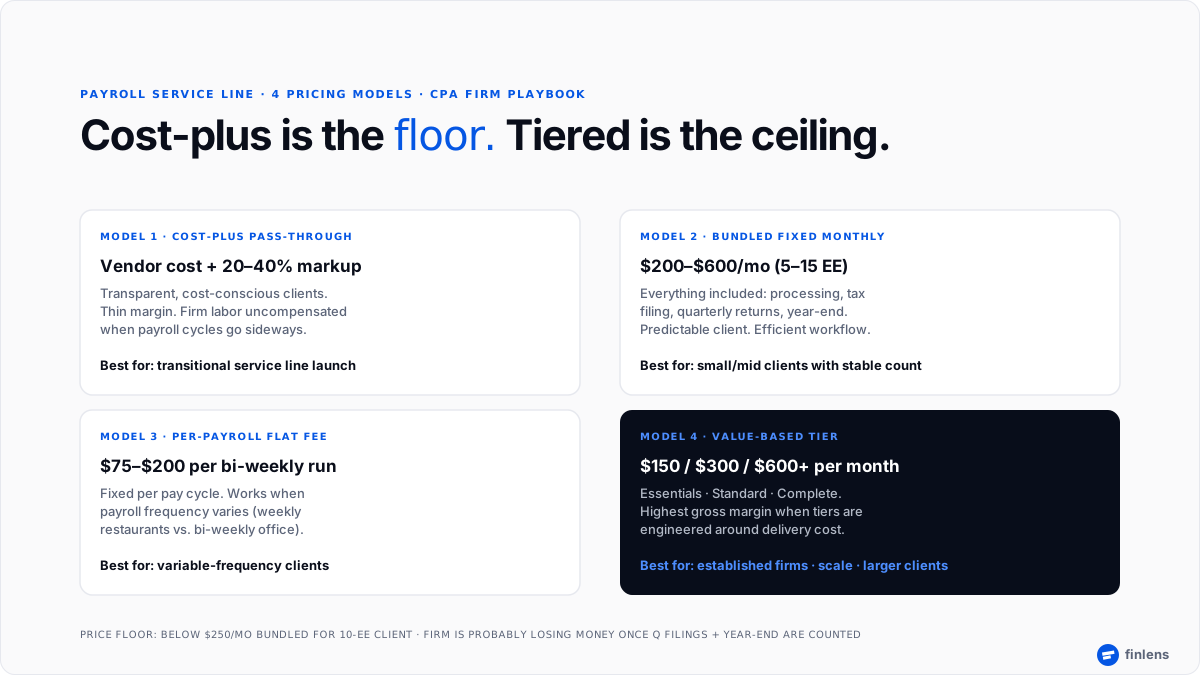
Model 1: Cost-plus (pass-through markup). Client pays vendor cost plus a fixed markup (typically 20–40%). Simple, transparent, and works for cost-conscious clients. Downside: margin is thin, and firm's time is not directly compensated when a payroll cycle goes sideways
Model 2: Bundled fixed monthly. One flat monthly fee covers vendor cost + processing + tax filing + quarterly returns + year-end. Common range: $200–$600/mo for a 5–15 employee client, $600–$1,500/mo for a 15–50 employee client. Best when client wants predictability and firm has efficient internal workflows.
Model 3: Per-payroll flat fee. A fixed fee per payroll run often $75–$200 per bi-weekly run for small clients. Works when payroll frequency varies (weekly restaurants vs. bi-weekly office clients). Downside: incentivizes fewer payroll runs, which is not always what client should do.
Model 4: Value-based tier. A tiered menu "Essentials" (payroll + basic tax filing), "Standard" (adds garnishments, multi-state, W-2/1099), "Complete" (adds HR support, benefits administration, workers comp reporting). Common range: $150 / $300 / $600+ per month. Highest gross margin when tiers are engineered around firm's actual delivery cost.
Most established CPA firms end up on Model 4 for larger clients and Model 2 for smaller ones. Cost-plus is transitional model when a firm first launches service line.
The 12 add-ons that price separately
Every payroll engagement should have a base scope and a clear list of add-ons priced à la carte. The 12 most common:
- Multi-state payroll additional state registration and filing per state, typically $50–$200 per state per month.
- Multiple pay frequencies running weekly for hourly staff and semi-monthly for salaried adds ~$50/mo.
- Garnishment processing $25–$50 per active garnishment per month.
- Child support and levy administration flat fee per order, ~$50–$100 setup, $10–$25/mo ongoing.
- 401(k) and benefits deduction sync $25–$75/mo depending on provider integration.
- Workers compensation "pay-as-you-go" $10–$50/mo integration fee.
- Time and attendance integration $25–$100/mo depending on system.
- W-2 / 1099 year-end forms either bundled or $5–$10 per form.
- Quarterly Form 941 filing often bundled; standalone $50–$150 per quarter.
- State unemployment (SUI) rate management $25–$75 per year per state to update.
- New hire reporting usually bundled; $10–$25 per new hire if standalone.
- Owner / S-corp reasonable compensation reviews $150–$400 per year per shareholder.
The default is to bundle 1–3 add-ons into base and price everything else separately. Firms that bundle everything into a single fee tend to underprice multi-state and garnishment work, which are two lines that consume most staff time.
The break-even math
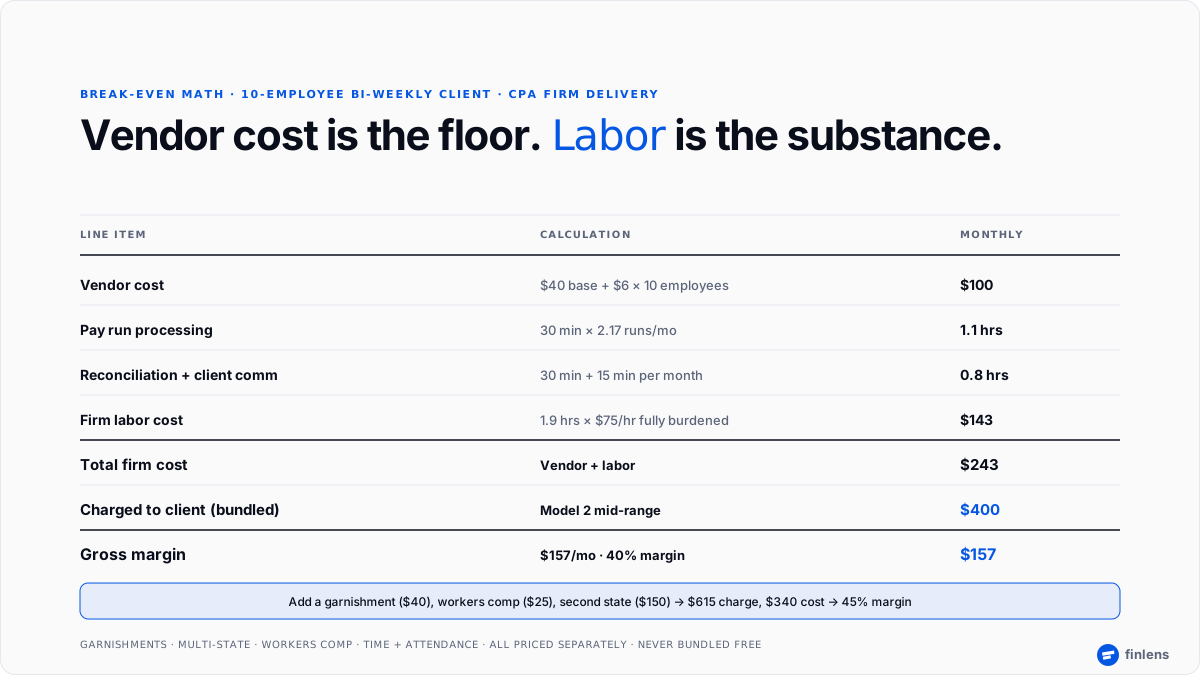
A CPA firm's break-even on payroll depends on hourly delivery cost, not on vendor invoice. Rough model for a 10-employee client on bi-weekly payroll:
- Vendor cost: $40 base + $6 × 10 = $100/mo
- Firm labor: ~30 minutes per pay run × 2.17 runs/mo = 1.1 hours + 30 min/mo reconciliation + 15 min/mo client communication = ~1.9 hours/mo
- At $75/hr fully burdened labor: $143/mo internal cost
- Total firm cost: ~$243/mo
- Charge $400/mo bundled: $157/mo margin, ~40% gross margin
Add a garnishment ($40/mo), workers comp integration ($25), and multi-state ($150 for a second state) and price is $615 against maybe $340 of cost 45% gross margin.
Below $250/mo bundled for a 10-employee client, firm is probably losing money on engagement once quarterly filings and year-end work are counted. That is price floor to guard.
What clients actually pay attention to
The features that drive client stickiness and therefore pricing power a CPA firm has are not raw price per employee:
- Direct deposit reliability a missed direct deposit is a client-losing event.
- Tax filing accuracy a mis-filed 941 or state withholding causes penalty letters that firm has to fix.
- W-2 and 1099 turnaround Jan 31 deadline pressure; firms that miss lose entire relationship.
- Portal usability for employees pay stub and W-2 access without support tickets.
- Owner reasonable compensation guidance a value-add most S-corp owners want but few firms deliver.
Every one of these has a price. A CPA firm's payroll service line should be priced on reliability and integration promise, not on vendor markup alone.
In-house delivery vs. white-label referral
Every CPA firm eventually decides whether to run payroll in-house on firm's Gusto or QBO account, or to refer clients to a payroll partner and take a referral fee.
In-house delivery. Firm holds vendor relationship, owns client communication, and controls workflow. Higher margin per client (40–50% gross) but requires trained staff and workflow discipline. Break-even is typically 15–25 payroll clients.
White-label referral. Firm refers clients to Gusto Pro, ADP Accountant Program, or a specialty partner. Firm collects a referral fee ($50–$200 per client per year) but doesn't do work. Zero delivery risk, minimal margin. Best for firms with fewer than 10 payroll-eligible clients or firms that don't want service line to grow into a business.
Hybrid. Firm runs payroll for anchor clients (10+ employees, multi-state) and refers small single-owner engagements. Most established firms end up here.
The pricing conversation is different in each model. In-house firms price against their own delivery cost. Referral firms price against vendor's list price (usually adding zero markup, taking only referral).
How Finlens fits payroll workflow
Payroll delivery involves payroll vendor + general ledger + tax authorities. Finlens is ledger layer between them.
- Payroll journal entry automation. Gusto, QBO Payroll, Rippling, and ADP export payroll data. Finlens posts gross wages, employer taxes, employee withholdings, benefits deductions, and 401(k) contributions to QBO as separate journal entries every pay period.
- Tax liability reconciliation. Employer payroll taxes (Social Security, Medicare, FUTA, SUTA) accrue to correct liability accounts and clear when payments are made.
- Multi-state accrual. State withholding and SUI accruals are split by state for multi-state clients so return prep and quarterly filings are straightforward.
- Owner reasonable compensation flag. S-corp shareholder wages are tagged in ledger with an annual review flag at year-end.
- Payroll-to-P&L reconciliation. Wages by department, by class, or by job flow from payroll journal to P&L, so firm can produce a labor cost report by dimension without a separate spreadsheet.
Finlens does not process payroll Gusto, ADP, and QBO Payroll continue to run vendor side. Finlens is ledger reconciliation layer that keeps payroll clean once it lands in QBO.
Conclusion
Payroll pricing is a delivery-cost question, not a vendor-invoice question. The vendor invoice is floor; firm's labor is substance. Under $250/mo bundled for a 10-employee client is almost always a loss.
see how Finlens posts Gusto, QBO Payroll, or Rippling payroll journal to QBO cleanly every pay period, splits multi-state accruals, and produces labor cost reporting firm needs to price its next client.
Bring file for client whose payroll journal hits QBO as one lump gross wages entry, whose multi-state withholdings sit in one account, and whose S-corp reasonable compensation review last happened three years ago. That's file this workflow is built for.
Frequently asked questions
How should a CPA firm price a new payroll client?
Start with a bundled fixed monthly quote based on employee count and payroll frequency. Reference market benchmark ($250–$500/mo for a 10-employee bi-weekly client is defensible). Adjust up for multi-state, garnishments, workers comp integration, or benefits admin.
Should payroll be a loss leader for firm?
No. A payroll service line that runs at negative margin pulls practice's attention away from higher-margin advisory work and consumes staff time. Every payroll engagement should carry at least 30% gross margin at steady state.
What's break-even employee count to run payroll in-house?
Typically 15–25 clients across firm's book. Below that, fixed overhead (compliance updates, software subscriptions, training) is not covered. Above that, marginal cost per client drops and service line becomes profitable.
When does a client outgrow a CPA firm's payroll service?
Usually at 50+ employees with multi-state operations or when a full HR function is needed. At that point, a PEO or a dedicated HRIS (Rippling, Justworks) is usually right referral.
What add-ons are most often underpriced?
Multi-state payroll, garnishments, and workers comp pay-as-you-go integration. These consume staff time and require specialty knowledge. Every firm should price them separately.
How much do CPA firms typically make per payroll client?
For a well-run practice, $150–$400/mo in gross margin per client, depending on complexity. A firm with 30 payroll clients averaging $250/mo margin is running a $90K/yr service line.
The authoritative compliance reference for withholding, deposit, and reporting rules that drive delivery cost is IRS Publication 15 Employer's Tax Guide. For broader service-line pricing framework same firm should apply to bookkeeping engagements, see Finlens guide to bookkeeping services fees.

