
Form W-4: How to Fill Out Employee's Withholding Certificate (2026 Guide)


Form W-4 is Employee's Withholding Certificate document you give your employer so they know how much federal income tax to withhold from each paycheck. The IRS redesigned Form W-4 in 2020 to eliminate old "allowances" system and align withholding to actual dollar amounts based on filing status, dependents, other income, and deductions. If you filled out a W-4 before 2020, format looks completely different now.
This guide walks through Form W-4 line by line, when to submit a new one, and how to handle most common situations that trip people up multiple jobs, working spouse, side income, and dependents.
What Form W-4 is used for
Employers use information on your Form W-4 to calculate federal income tax withholding on each paycheck. The withheld amount is credited toward your annual tax liability you either owe more, get a refund, or come out flat at tax filing based on how accurate withholding was.
Key facts:
- Required for every new hire before their first paycheck (per IRS Form W-4 official page)
- Not sent to IRS employer keeps it on file and uses it for payroll calculation
- Can be updated any time your personal or financial situation changes (marriage, new baby, second job, spouse starts working, home purchase, etc.)
- Only covers federal withholding state withholding uses a separate state W-4 equivalent
If you don't submit a W-4, employer withholds at highest rate (single with zero dependents, no adjustments) which usually over-withholds.
The five sections of Form W-4
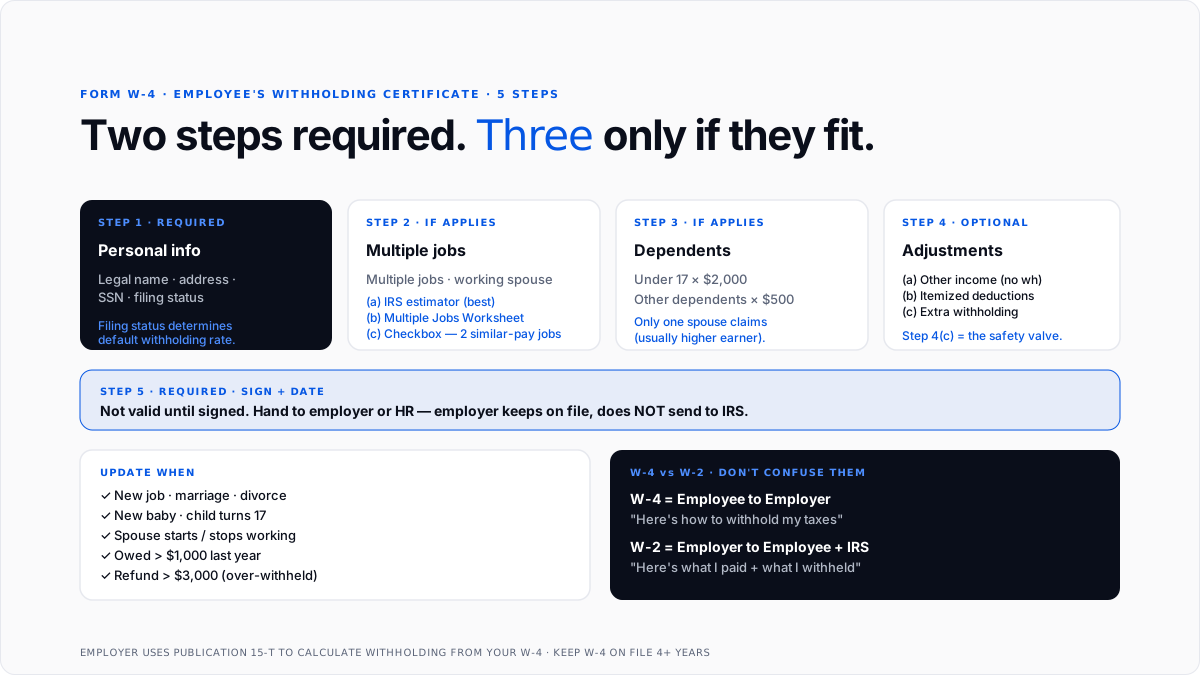
The current W-4 has five numbered steps. Only Steps 1 and 5 are mandatory for everyone. Steps 2, 3, and 4 apply only if they fit your situation.
Step 1 Personal information
Enter your legal name, address, Social Security Number, and filing status. Filing status options:
- Single or Married filing separately
- Married filing jointly (or Qualifying surviving spouse)
- Head of household
If both spouses work, one of you may need to select Step 2(c) or one of other Step 2 options see below.
Step 2 Multiple jobs or working spouse
Fill out only if you hold more than one job at a time, OR your spouse works and you file jointly. The IRS provides three options here:
- Option (a): Use IRS Tax Withholding Estimator most accurate for complex situations
- Option (b): Complete Multiple Jobs Worksheet on page 3 of Form W-4 more accurate than (c)
- Option (c): Check box in Step 2(c) if there are exactly two jobs (yours + spouse's) with similar pay simplest but least precise
Under-withholding on second job is #1 cause of taxpayers owing at year-end. If you and your spouse both work, one of you needs to indicate multiple-jobs status somewhere in Step 2.
Step 3 Claim dependents
Fill out if you're eligible to claim Child Tax Credit or Credit for Other Dependents:
- Multiply number of qualifying children under 17 by $2,000
- Multiply number of other dependents by $500
- Add and enter total on line 3
Higher-income taxpayers should verify eligibility Child Tax Credit phases out above $400,000 (married filing jointly) or $200,000 (all others). If you'd get phased out, don't claim on W-4.
Step 4 Other adjustments (optional)
Three optional lines:
- 4(a) Other income (not from jobs): Interest, dividends, rental income, retirement income where no tax is withheld
- 4(b) Deductions: If you'll itemize above standard deduction, use Deductions Worksheet
- 4(c) Extra withholding: Additional dollar amount per pay period safety-valve for anyone who's under-withheld in past
Step 4(c) is where most tax pros direct clients who've owed at year-end. Adding $50–$200 per pay period covers shortfall going forward.
Step 5 Sign and date
Not valid until signed. Sign, date, hand to your employer or HR.
Common W-4 mistakes
1. Not updating after major life changes: Marriage, divorce, new baby, home purchase, second job all change your withholding math. The default W-4 from onboarding is rarely correct 3–5 years later.
2. Both spouses filing jointly claim dependents: If both spouses file W-4s with dependents claimed in Step 3, total withholding is understated. Only one spouse should claim dependents on W-4 (usually higher earner).
3. Ignoring Step 2 when both spouses work: This is biggest source of surprise tax bills. If you're married filing jointly with both earning, you MUST handle Step 2 somehow.
4. Not accounting for side income: If you have significant 1099 income, retirement distributions, investment income, or rental income, that money isn't being withheld on. Use Step 4(a) to have your employer withhold extra to cover it or make quarterly estimated tax payments directly.
5. Setting Step 4(c) to a huge amount to "get a big refund.": Over-withholding is a zero-interest loan to IRS. If you're consistently getting refunds over $2,000, adjust downward.
When to submit a new W-4
Update anytime, but always after:
- Starting a new job
- Marriage or divorce
- Birth or adoption of a child
- Child turning 17 (loses Child Tax Credit eligibility)
- Spouse starts or stops working
- Buying a home (potential itemization change)
- Starting a side business or 1099 income
- Owing more than $1,000 at last year's filing (or getting a refund over $3,000)
Employers must process a new W-4 within first payroll period ending 30 days after receipt.
W-4 vs. W-2 different documents, different purposes
W-4 (this guide): what you fill out for your employer to tell them how much to withhold. Filled out by employee.
W-2 (Wage and Tax Statement): what your employer sends you at year-end summarizing wages paid and taxes withheld. Filled out by employer.
Both are federal forms tied to employment income. W-4 is input (withholding instruction). W-2 is output (year-end summary).
For employers what you do with W-4
Employers keep W-4 on file (do NOT send to IRS) and use it to compute withholding. Practical mechanics:
- Verify form is signed and dated
- Enter W-4 data into your payroll software
- Apply withholding calculation from IRS Publication 15-T
- Retain form for at least 4 years (per IRS record retention rules)
- If IRS sends a "lock-in letter" specifying a required withholding for a particular employee, follow that instead of employee's W-4
For business owners running payroll manually, this is one of reasons most SMBs use payroll software (Gusto, QuickBooks Payroll, ADP) rather than calculating withholding manually software applies W-4 + Publication 15-T calculation automatically.
Conclusion
Form W-4 is deceptively simple most people only need Steps 1 and 5. The complications come with multiple jobs, working spouses, and side income, where Steps 2 and 4 matter. Update anytime your situation changes, and if you owed tax last year, adjust Step 4(c) upward to prevent same surprise this year.
FAQ
What is a W-4 form used for?
Form W-4 tells your employer how much federal income tax to withhold from each paycheck. You submit it to your employer (not IRS) when you're hired and whenever your tax situation changes.
How do I fill out a W-4 correctly?
Complete Step 1 (personal info + filing status) and Step 5 (sign). Fill out Step 2 if you have multiple jobs or a working spouse. Complete Step 3 if you'll claim dependents. Use Step 4 for other income, itemized deductions, or extra withholding. Skip steps that don't apply.
Is Form W-4 mandatory?
Yes new hires must complete one before their first paycheck. If you don't submit one, your employer withholds at highest rate (single, no adjustments). Existing employees don't need to submit a new one every year unless their situation changed.
What should I put on my W-4 for withholding?
If your situation is simple (one job, filing status matches reality, no dependents), complete Steps 1 and 5 only default withholding for that filing status is usually accurate. If you owed at last year's filing, use Step 4(c) to withhold extra to cover shortfall going forward.
What is difference between W-4 and W-2?
W-4 is completed by employee at start of employment to tell employer how much to withhold. W-2 is completed by employer at year-end to report actual wages and taxes withheld to both employee and IRS.
Do I need to file a new W-4 every year?
Not required, but recommended when your situation changes. The IRS suggests reviewing your W-4 at start of each year, but you're only obligated to submit a new one when major changes occur (marriage, dependents, second job, etc.).
How does W-4 affect my paycheck?
More Step 3 dependents claimed = less withholding = larger paycheck (but potentially owed at year-end). More Step 4(c) extra withholding = more withholding = smaller paycheck (but potentially larger refund). Under-withholding produces a tax bill; over-withholding produces a refund.
What if I claim exempt on my W-4?
Only claim exempt if you had NO federal tax liability last year AND expect NONE this year. Write "Exempt" between Steps 4(c) and 5, then sign. Exempt status must be renewed each year by February 15. Misclaiming as exempt when you owe tax results in penalties.

