
IRS Offer in Compromise: When It Works, How to Apply (Form 656 + 433-A)


An Offer in Compromise (OIC) is an IRS program that lets qualifying taxpayers settle their federal tax debt for less than full amount owed. It's not "pennies on dollar" pitched in late-night ads IRS accepts fewer than half of OICs it receives each year, and settlement amount is calculated by a strict formula based on your assets and future income. But for right situation, an OIC can eliminate tens of thousands of dollars in tax debt.
This guide covers who qualifies, three legal bases for an OIC, how IRS calculates your minimum offer amount (Reasonable Collection Potential), required forms (656 + 433-A/B), payment options, and what happens when your offer is accepted or rejected.
What an Offer in Compromise is
Per IRS Offer in Compromise page, an OIC lets you settle your tax debt for less than full amount you owe when you cannot pay full liability or paying would create a financial hardship. It's one of several IRS collection alternatives, alongside:
- Full payment
- Short-term or long-term payment plan (installment agreement)
- Currently Not Collectible status (temporary halt of collection)
- Bankruptcy discharge (for tax debt that meets specific criteria)
The IRS approves an OIC when offer represents "most we can expect to collect within a reasonable period of time" a calculation called Reasonable Collection Potential (RCP).
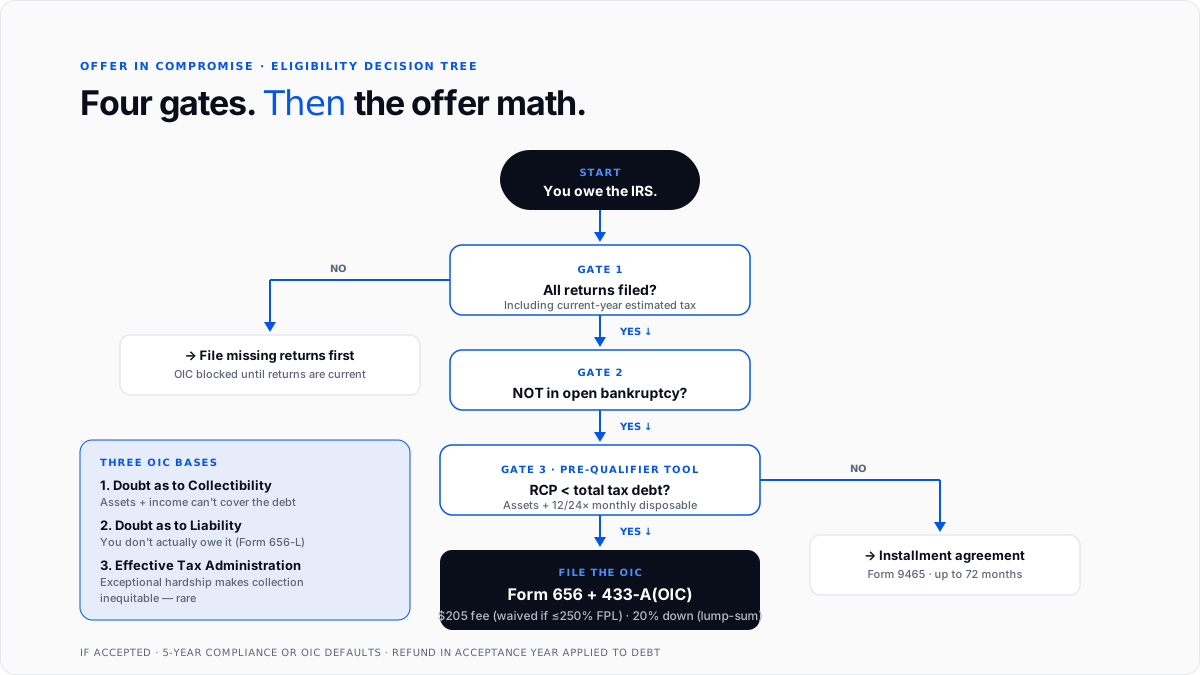
The three OIC bases
Every OIC application must be based on one of three legal grounds:
1. Doubt as to Collectibility. The most common OIC. Used when your assets and income can't cover tax debt within 10-year collection statute (IRC §6502). This is "I can't pay it all" argument, backed by financial disclosure.
2. Doubt as to Liability. Used when there's genuine doubt about whether you actually owe tax. Requires evidence you're not arguing you can't pay; you're arguing you don't owe it. Form 656-L is used instead of Form 656 for this basis.
3. Effective Tax Administration (ETA). Rare. Used when collecting full debt would be inequitable due to exceptional circumstances (severe illness, elderly on fixed income), even though you technically CAN pay. Requires documentation of hardship.
Most OICs are Doubt as to Collectibility that's what this guide focuses on.
Eligibility requirements
Before IRS will even consider your OIC:
- All required tax returns must be filed. Missing returns from any year block your OIC. File everything (even zero returns) before applying.
- All required estimated payments must be current. Self-employed filers must be caught up on current-year quarterly estimated tax. See our quarterly estimated tax guide for schedule.
- You cannot be in an open bankruptcy proceeding. Bankruptcy provides different remedies; OIC is not available while a bankruptcy is active.
- Employers must have made all required deposits for current and prior two quarters. Business OIC applicants must be current on payroll tax deposits.
- You must have received a bill for at least one tax debt. OIC is only available for assessed liability, not projected tax.
Fail any of these threshold requirements and IRS will reject OIC without evaluating merits.
The application forms
Form 656 Offer in Compromise. The core application. Contains offer amount, payment option, offer basis, tax periods, and signatures.
Form 433-A(OIC) Collection Information Statement for Individuals. Financial disclosure covering:
- Personal info + dependents
- Employment (or self-employment) income
- Bank accounts and investments
- Real estate and vehicles
- Household expenses (compared to IRS national/local standards)
- Assets in retirement accounts
- Life insurance cash values
Form 433-B(OIC) Collection Information Statement for Businesses. For business OIC applicants (sole prop with EIN, partnership, corporation).
Form 656-B Booklet with all forms. Downloadable from IRS.gov. Includes worksheets to calculate your offer amount.
The $205 application fee (and waiver)
Every OIC requires a $205 application fee submitted with Form 656. Two exceptions:
- Low-income waiver. If your household income is at or below 250% of federal poverty level, you qualify for low-income certification (Form 656, Section 1). The $205 fee is waived, and so is required initial payment.
- Doubt as to Liability OICs. No application fee required.
The $205 is non-refundable regardless of whether OIC is accepted. If rejected, it's applied to your tax debt.
Initial payment 20% or first monthly installment
In addition to $205 fee, you must submit an initial payment with OIC:
Lump-sum cash offer:
- Pay 20% of total offer amount with application
- If accepted, pay remaining 80% within 5 or fewer payments after acceptance
- Example: $30,000 offer → $6,000 initial payment + $24,000 in up to 5 payments after acceptance
Periodic payment offer:
- Pay first monthly installment with application
- Continue making monthly payments while IRS reviews (typically 6–12 months)
- If accepted, complete monthly payments through offer term (up to 24 months)
- If rejected, payments are non-refundable and applied to tax debt
Low-income certified applicants are exempt from initial payment requirement.
Reasonable Collection Potential (RCP) how IRS calculates minimum offer
The IRS calculates your Reasonable Collection Potential as minimum acceptable offer. RCP has two components:
1. Net Realizable Equity in assets.
For each asset (bank accounts, real estate, vehicles, retirement accounts, life insurance), IRS takes:
- Quick Sale Value (typically 80% of fair market value)
- Minus liens/loans against asset
- Equals Net Realizable Equity
2. Future Monthly Disposable Income × Multiplier.
- Monthly gross income minus allowable expenses (based on IRS national/local standards for food, transportation, housing, healthcare)
- Multiplied by 12 (lump-sum offer) or 24 (periodic offer)
RCP = Net Realizable Equity + Future Income Multiplier
Your OIC must be at least equal to RCP for IRS to consider acceptance.
Example:
- Total tax debt: $85,000
- Assets: House equity $15,000 + retirement $20,000 → Net Realizable = $28,000 (80% quick sale)
- Monthly disposable income: $400 × 24 months = $9,600
- RCP = $28,000 + $9,600 = $37,600 minimum lump-sum offer
An offer of $37,600 could resolve $85,000 in debt (46% haircut) if all other criteria are met.
The IRS pre-qualifier tool
Before applying, IRS provides an Offer in Compromise Pre-Qualifier Tool at irs.gov/oic that lets you input your financial situation and get an estimated minimum offer. This is a critical step a $205 non-refundable fee on an unfeasible offer is wasted money.
If pre-qualifier says "you do not qualify," typically your assets and income can pay debt in full over collection statute. In those cases, an installment agreement is right path.
What happens while OIC is under review
Levies suspended: The IRS generally cannot levy your bank accounts or wages while your OIC is under review, per IRC §6331(k). Existing wage garnishments continue but no new levies.
Collection statute paused: The 10-year collection statute (IRC §6502) is tolled during OIC review, adding review time to your remaining collection window.
Interest and penalties continue: Unpaid balances continue to accrue interest and Failure-to-Pay penalty during review.
Federal Tax Liens: The IRS may file a Notice of Federal Tax Lien (NFTL) during OIC review to protect its interest, particularly for balances over $10,000. See our IRS payment plan guide for how NFTLs interact with collection alternatives.
Automatic acceptance timeline: If IRS doesn't decide within 24 months of receiving your OIC, it's automatically accepted per IRC §7122(f). This deadline rarely matters in practice most OICs are resolved in 6–12 months.
When OIC is accepted
Five-year compliance requirement. You must file all required tax returns and pay all taxes on time for 5 years following acceptance (or through offer payment period, whichever is longer). Fail this compliance and OIC defaults compromised debt (plus penalties and interest) is reinstated.
Refund offset in year of acceptance. Any federal tax refund from year OIC is accepted is applied to compromised debt as part of offer amount, not returned to you.
Federal Tax Lien withdrawal. After OIC is fully paid, you can request lien withdrawal (Form 12277). Successful DDIA payment history can also support withdrawal.
Public record. OIC acceptances are public records available for inspection at IRS regional offices. High-profile OICs occasionally get media attention.
When OIC is rejected appeal options
If IRS rejects your OIC:
File a Collection Due Process (CDP) appeal within 30 days this preserves your right to Tax Court review.
Or file a Collection Appeal Request (CAR) using Form 9423 faster but doesn't preserve Tax Court rights.
Or submit a new OIC you can reapply immediately if your financial situation changed or if you can address specific reason for rejection.
Or accept alternative rejection letter typically includes an "acceptable alternative" (usually an installment agreement) that resolves debt without full-pay.
Common OIC mistakes
Applying while returns are unfiled: The #1 rejection reason. File everything first.
Understating assets or income: The IRS cross-references your 433-A(OIC) against bank records, real estate records, credit reports, and prior returns. Discovered omissions trigger rejection AND potential fraud referral.
Ignoring low-income waiver: Filers at ≤250% of federal poverty level often pay $205 fee unnecessarily. Check waiver box.
Filing a Doubt as to Collectibility OIC when you can actually pay: If your RCP exceeds tax debt, you don't qualify for OIC on this basis. Installment plan is correct route.
Failing 5-year compliance requirement: OIC acceptances that default during compliance period reinstate full compromised debt. Getting through five years of clean filing/payment is critical.
Attempting an OIC without professional help on a large debt: For debts under $10K, DIY is often fine. For debts over $50K, an Enrolled Agent or tax attorney is usually worth fee they know how local IRS office evaluates specific asset categories.
Conclusion
An Offer in Compromise is a legitimate IRS program that can settle large tax debts for less than face value but only for taxpayers whose assets and income genuinely can't cover debt within 10-year collection statute. The pre-qualifier tool tells you upfront whether you're a viable candidate.
Frequently asked questions
How long does OIC review take?
Typically 6–12 months. Complex cases can extend to 24 months, at which point automatic acceptance kicks in.
Can I settle state tax debt with an OIC?
Only federal tax debt. State tax debts have separate state-level programs (some states have similar OIC programs, others do not).
What's OIC acceptance rate?
Historically 30–40% of submitted OICs are accepted. The rate is higher when applicants use pre-qualifier tool and submit realistic offers.
Can I include penalty and interest in OIC amount?
Yes. The OIC settles entire tax debt including tax, penalty, and interest as of acceptance date. Interest continues to accrue during review.
Does an OIC affect my credit?
The OIC itself doesn't hit your credit report. But if IRS filed a Notice of Federal Tax Lien before your OIC, that lien is on public record and can affect credit. NFTL withdrawal after acceptance can restore credit.
Can I keep my home if I file an OIC?
Yes OIC doesn't require selling assets. The IRS calculates equity in your assets to determine your minimum offer, but you don't have to actually liquidate them. Financing offer via a home equity loan or 401(k) loan is common.
Can I file an OIC while on an installment plan?
Yes. The OIC supersedes installment plan during OIC review, installment payments are typically paused. If OIC rejected, installment plan resumes.
Should I use a tax relief company?
Generally no. The IRS-approved OIC process is documented at IRS.gov. Legitimate representation is available from CPAs, EAs, and tax attorneys these professionals are licensed and have direct IRS access. "Tax relief" TV advertisers often charge 5–10x fee of a licensed practitioner for same paperwork.

