
P&L Management: What It Actually Means and the Three Levers That Move Your Margin


Key Takeaways
- P&L management means making active decisions to improve profitability, not just reviewing the statement after the close.
- Gross margin is the most important and most under-managed line on the P&L. Revenue growth hides gross margin problems until it stops.
- The three levers that move P&L performance are pricing realization, cost of goods sold efficiency, and operating expense discipline.
- Monthly P&L reviews are too infrequent for active management. By the time a margin problem shows up in a monthly report, it has been compounding for four to six weeks.
- For founders on QuickBooks Online, P&L accuracy depends entirely on how clean and current the underlying transaction categorization is.
What Is P&L Management?
P&L management is the active practice of monitoring revenue, costs, and margins across the profit and loss statement and using that information to make operating decisions that improve profitability over time.
A profit and loss statement, also called an income statement, shows revenue at the top, subtracts the cost of goods sold to produce gross profit, then subtracts operating expenses to arrive at operating income, and finally accounts for taxes and interest to show net income at the bottom.
According to Investopedia, the profit and loss statement is one of the three core financial statements and the primary document used to assess a company's revenue generation and expense management over a specific period.
P&L management means treating each line of that statement as a decision variable, not just a reported outcome.
The P&L Structure: What Each Line Is Actually Telling You
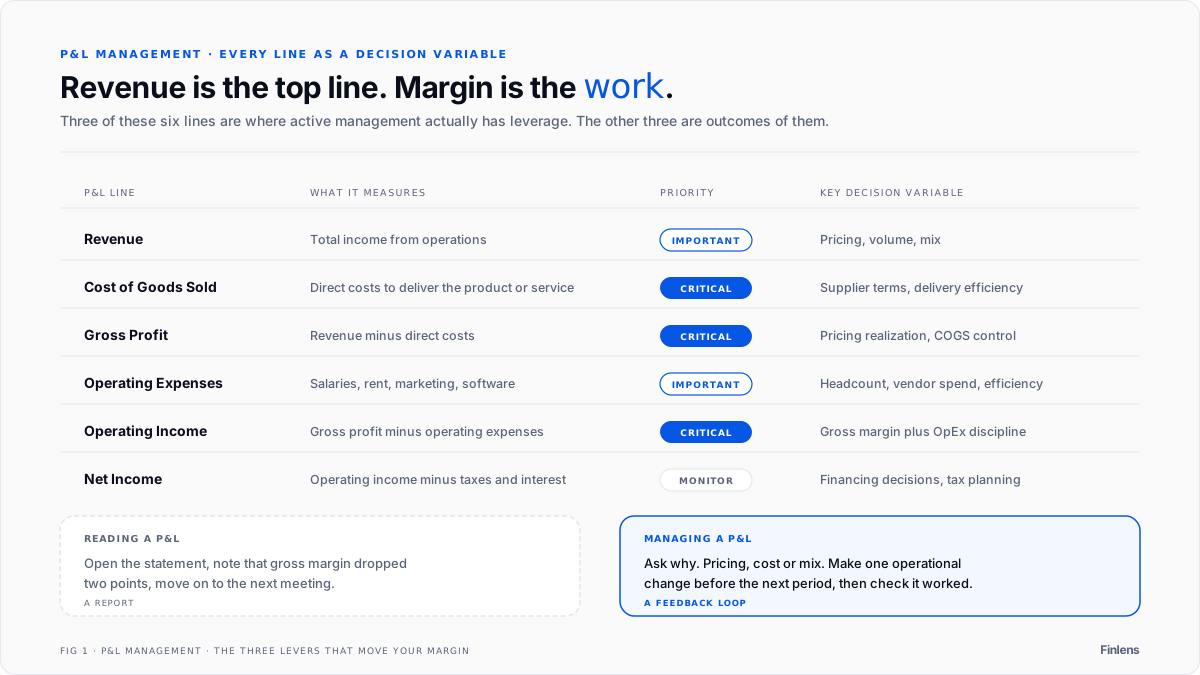
The table shows where active P&L management has the most leverage. Revenue is important but it is the top line. Gross profit and operating income are where the real management work happens. For how the income statement relates to the balance sheet and why both need to tie, see income statement vs balance sheet.
P&L Management vs Reading a P&L
This is the distinction most founders miss, and its the one that separates businesses that stay profitable from those that keep wondering why margin never improves despite growing revenue.
Reading a P&L means opening the income statement, scanning the numbers, noting that gross margin dropped two points, and moving on to the next meeting.
Managing a P&L means asking why gross margin dropped two points, identifying whether it was a pricing issue, a cost issue, or a mix shift, and making a specific operational change before the next period. Then checking whether that change worked.
The action is the difference. A P&L reviewed but not acted on is just a report. P&L management requires a feedback loop between the numbers and the decisions. For how P&L ownership translates into day-to-day accountability, see the P&L responsibility guide.
Most founders treat their P&L like a scoreboard. They watch the score but they don't change the play. Managing the P&L means adjusting the play while the game is still being played.
The Three P&L Levers That Actually Move Margin
Most P&L improvement conversations focus on cutting costs. That is one lever. It is not the only one and frequently not the right one.
Lever 1: Pricing realization
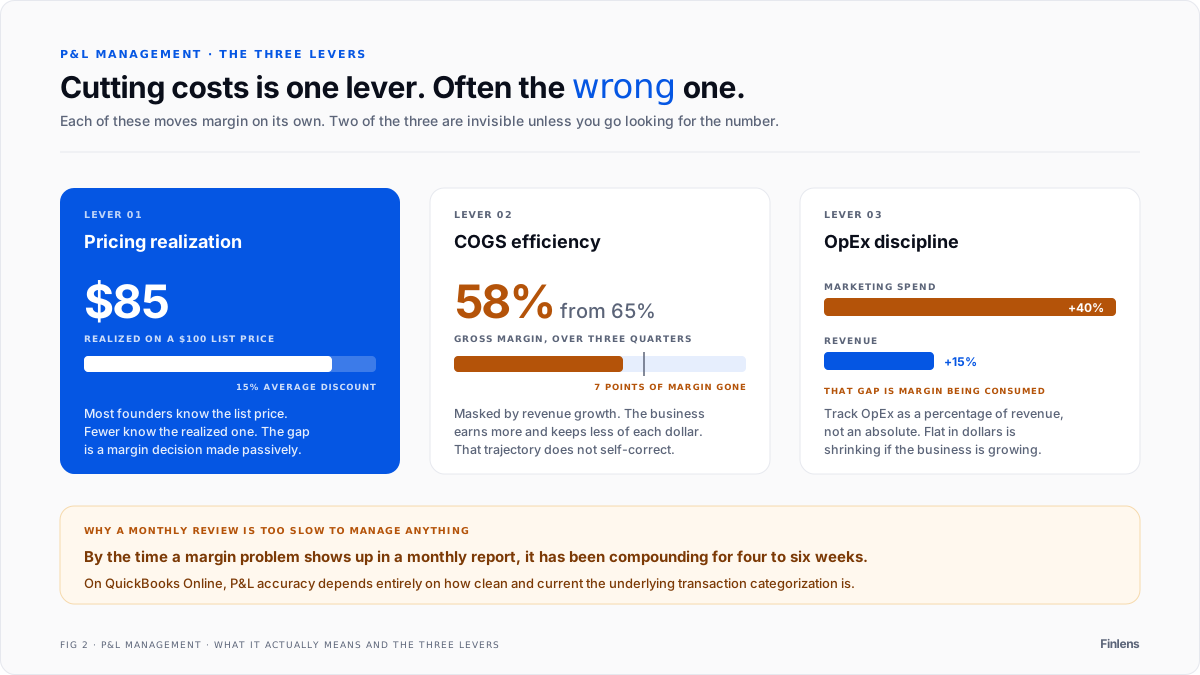
Pricing realization is the difference between your listed price and the price you actually collect after discounts, refunds, and adjustments. A business with a $100 product and a 15% average discount rate has an $85 realized price. Managing the P&L means knowing that number and making a deliberate decision about whether 15% discounting is generating enough volume to justify the margin it costs.
Most founders know their list price. Fewer know their realized price. The gap between the two is a margin decision that is being made passively rather than actively.
Lever 2: Cost of goods sold efficiency
Gross margin is the most critical line on any P&L. For a services business, cost of goods sold is primarily labor: the cost of delivering the service. For a product business, it's materials, manufacturing, and fulfillment. Either way, gross margin percentage tells you how much of each revenue dollar the business keeps before paying for anything else.
A gross margin that drifts from 65% to 58% over three quarters is a serious problem that often gets masked by revenue growth. The business is earning more and keeping a smaller percentage of each dollar. That trajectory does not self-correct.
Lever 3: Operating expense discipline
Operating expenses are not just a cost to minimize. They are investments in growth, and the P&L management question is whether they are generating proportionate return. Marketing spend that grows 40% while revenue grows 15% is an operating expense that needs a decision, not just a budget approval.
The businesses that manage OpEx well track it as a percentage of revenue, not just an absolute number. An expense that looks flat in dollars is actually shrinking relative to the business if revenue is growing. An expense that grows faster than revenue is consuming margin that was supposed to drop to the bottom line.
Monthly P&L review checklist
Run this every month after close. Each item takes less than five minutes if the books are current.
- Compare revenue to prior month and same month last year. Flag any variance over 10%. If revenue is hitting target but profit isn't, a budget variance report helps isolate where the gap is.
- Calculate gross margin percentage. Compare to trailing three-month average. A drop of two or more points needs investigation before the next review.
- Check COGS line by line. Identify any single cost that grew faster than revenue this period.
- Review operating expenses as a percentage of revenue. Total OpEx rising as a percentage while revenue is flat means margins are compressing.
- Look at net income trend over the last three months. A declining trend with stable revenue points to cost creep.
- Reconcile the P&L revenue line against the balance sheet. Revenue on the income statement should tie to the change in retained earnings plus distributions. If it doesn't, a categorization or timing error is hiding somewhere.
- Identify one action item. Every P&L review should produce at least one specific decision - adjust pricing, renegotiate a vendor contract, cut an underperforming channel, reallocate budget. A review with no action is just reading.
The Data Problem: Why Most P&L Management Arrives Too Late
Here is the structural problem with monthly P&L management: by the time the close is complete and the P&L is available, the data is four to six weeks old. A gross margin problem that started in the first week of the month does not show up in a report until the third week of the following month. By then it has been running for six to seven weeks with no intervention.
Founders who manage their P&L on monthly close cycles are always looking backward at a problem that is already past its cheapest fix point.
The alternative is current data. For founders on QuickBooks Online, P&L accuracy depends entirely on how clean and current the underlying transaction categorization is. Transactions that are miscategorized, delayed, or sitting in a clearing account do not show up correctly in the P&L until someone cleans them up. A P&L built on messy books is not a management tool. It is a best guess.
Founders who have connected their QuickBooks Online bookkeeping automation have categorization happening in real time rather than once a month after the fact. And since P&L accuracy is only as good as the close it comes from, automating the month-end close is what makes a current P&L possible rather than a monthly reconstruction.
For founders also running revenue through Stripe, keeping the revenue line clean and current requires connecting QuickBooks Online and Stripe so revenue categorization happens automatically rather than being manually reconciled at period end.
Finlens runs on top of QuickBooks Online with no migration and automates the categorization and reconciliation that makes real-time P&L visibility possible.
Before Finlens: Close happens in week three of the following month. The P&L review happens in week four. Decisions about a margin problem that started six weeks ago happen now. The fix takes another month to show results.
After Finlens: Categorization is automated. The P&L reflects current performance. A gross margin shift shows up the week it happens, not the month after next.
P&L management is not a finance department function. It is a founder discipline. The businesses that do it well are not the ones with the best financial models. They are the ones with the most current data and the habit of acting on it.
.png)
FAQ
What is P&L management?
P&L management is the ongoing process of monitoring your profit and loss statement and making active operating decisions to improve profitability. It is distinct from simply reviewing a P&L report because it requires a feedback loop between the numbers and the decisions.
What does P&L stand for?
P&L stands for profit and loss. The P&L statement is also called the income statement and shows revenue, costs, and profit over a specific time period.
What are the most important lines on a P&L?
Gross profit and operating income are the most critical lines for active management. Revenue is important but it is a lagging indicator. Gross margin percentage tells you the quality of revenue, and operating income tells you whether the business is generating sustainable profit.
How often should founders review the P&L?
At minimum monthly, but active P&L management requires more frequent access to current data. Monthly reviews on a 30-day close cycle mean decisions are always based on six-week-old information. Real-time categorization and weekly P&L visibility is the standard for businesses managing margin proactively.
What is the difference between gross margin and net margin?
Gross margin is revenue minus the direct cost of delivering the product or service, expressed as a percentage of revenue. Net margin is revenue minus all costs including operating expenses, interest, and taxes. Gross margin shows the efficiency of the core business model. Net margin shows overall profitability after all costs.
What causes gross margin to decline?
Pricing discounts, rising input costs, a mix shift toward lower-margin products or services, or deteriorating delivery efficiency. Gross margin decline is often masked by revenue growth until revenue growth slows, at which point the underlying margin problem becomes visible.

