
Real Estate Professional Status (REPS): The CPA's Practitioner Guide to IRC §469(c)(7)


Real estate professional status is one of most audited elections on Form 1040 because payoff is enormous and substantiation bar is unforgiving. Qualifying under IRC §469(c)(7) flips rental activity from passive to nonpassive, releases suspended passive activity losses (PALs) against ordinary income, exempts rental income from 3.8% net investment income tax (NIIT), and can open door to QBI deduction. It also draws Tax Court scrutiny more consistently than almost any other individual position and post-Inflation Reduction Act, IRS examination coverage of claim has climbed materially.
The three-tier test structure
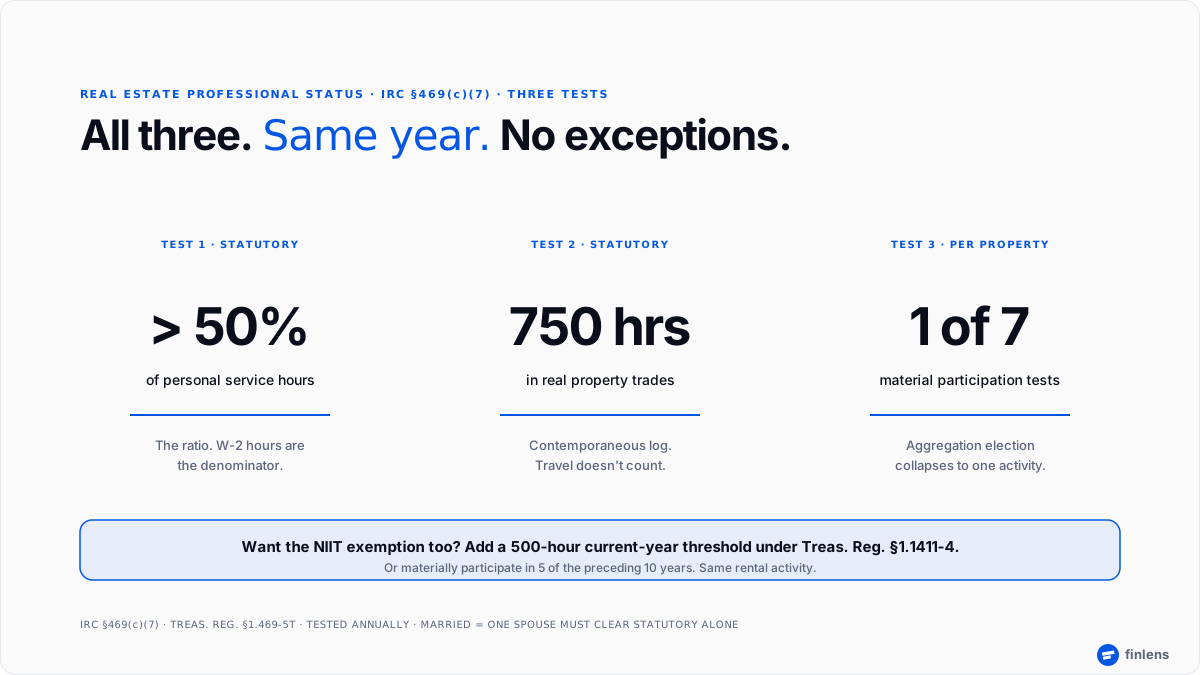
REPS is not one test it's three, and all three must be met in same tax year.
Tier 1 Statutory participation tests (§469(c)(7)(B)). Both must be satisfied:
- More than 50% of personal services taxpayer performs during year are in real property trades or businesses in which taxpayer materially participates ("50% test").
- More than 750 hours of services during year are performed in those real property trades or businesses ("750-hour test").
Tier 2 Material participation (Treas. Reg. §1.469-5T). Once taxpayer clears statutory hurdle, each rental activity must independently pass one of seven material participation tests unless taxpayer files a §1.469-9(g) aggregation election.
Tier 3 NIIT safe harbor (Treas. Reg. §1.1411-4). To keep rental income out of NIIT base, taxpayer must also participate more than 500 hours in current year, or in five of preceding ten years.
Miss any tier and return either loses PAL deduction (Tier 1), loses passive-to-nonpassive conversion for a specific property (Tier 2), or picks up NIIT (Tier 3). All three failure modes have been sustained by Tax Court within last four years.
What counts as a "real property trade or business"
IRC §469(c)(7)(C) lists eleven categories: real property development, redevelopment, construction, reconstruction, acquisition, conversion, rental, operation, management, leasing, or brokerage. This is broader than most investors realize but narrower than most claim
The categories that draw most exam attention:
- Brokerage counts (real estate brokers qualify) but per Chief Counsel Advice 201504010, mortgage brokers do not, because trade involves financial instruments, not real property.
- "Investing in" real estate does not count. The Tax Court has repeatedly held that mere ownership and financing decisions are not a real property trade or business.
- Property management counts when taxpayer performs day-to-day operations; it does not count when taxpayer supervises outside managers who perform substantially all of operational work.
The other rule that trips high-earner clients: for an employee's hours to count toward 750-hour test, taxpayer must own more than 5% of employer. A W-2 property manager without equity gets zero hours. This is primary reason nearly every W-2 earner who claims REPS without a spouse involvement fails on audit.
The 750-hour test in practice
The 750-hour test is where most claims fail not because taxpayer didn't work, but because wrong activities were logged.
Activities that count when performed by an owner directly involved in operations:
- Advertising vacancies, screening tenants, executing leases
- Rent collection and delinquency follow-up
- Hands-on maintenance and repairs
- Property inspections
- Legal, tax, and insurance administration for property
- Direct supervision of contractors and vendors on active projects
Activities that do not count:
- Travel to and from a rental is a commute, not participation (multiple Tax Court cases).
- Studying for a real estate license or exam is investor education.
- Reviewing prospective acquisitions is investor activity, not operational participation.
- On-call time without a specific service being performed.
- Research into markets or comparable properties for personal investment decisions.
- Bookkeeping and financial statement review performed as an investor, not as an operator.
For married couples, one spouse must independently clear 750-hour and 50% tests. Spousal hours are combined only for material participation test, not statutory tests. This is exact provision that eliminates most "my spouse handles our rentals" claims where both spouses hold W-2 jobs.
The seven material participation tests
Once statutory hurdles are cleared, each rental activity must pass one of these (Treas. Reg. §1.469-5T):
- More than 500 hours in activity during year.
- Substantially all of participation in activity by anyone (including non-owners and employees).
- More than 100 hours in activity, and no other individual participated more.
- Significant participation activity (SPA) with aggregate SPA time exceeding 500 hours.
- Materially participated in activity in any five of preceding ten years.
- Personal service activity materially participated for any three preceding years (not applicable to most rentals).
- Facts and circumstances regular, continuous, and substantial participation.
Test 1 (500 hours) is practitioner's default anchor for a single-property REPS claim. Test 3 is useful when property is small and no property manager is involved. Test 7 is weakest and rarely survives Tax Court on its own do not rely on it.
The §1.469-9(g) aggregation election
For clients with multiple rental properties, satisfying material participation test on each property separately is often impossible. Treas. Reg. §1.469-9(g) permits an election to treat all rental real estate interests as a single activity. Once elected, only aggregate hours must clear material participation threshold.
Mechanics that matter:
- The election is made by attaching a written statement to a timely-filed original return declaring that taxpayer is a qualifying real estate professional and electing to treat all interests in rental real estate as a single activity under §1.469-9(g).
- The election is binding for all subsequent years and can only be revoked with consent of Commissioner (or upon a material change in facts).
- The election covers only rental real estate it does not aggregate rentals with non-rental real property businesses.
- Rev. Proc. 2011-34 provides §9100 relief for a late aggregation election if taxpayer can establish reasonable cause and non-prejudice to government interests. The relief is fact-intensive but has been granted in numerous PLRs.
Without a valid aggregation election, a taxpayer with six rentals must clear a material participation test on each of six separately. Practically, this is only feasible under Test 2 (substantially all participation) or if taxpayer employs no property management. Most six-property portfolios fail without election.
The documentation standard Tax Court now enforces
Contemporaneous hours logs are not statutorily required Treas. Reg. §1.469-5T(f)(4) allows extent of participation to be "established by any reasonable means" but recent case law has made practical standard nearly ironclad.
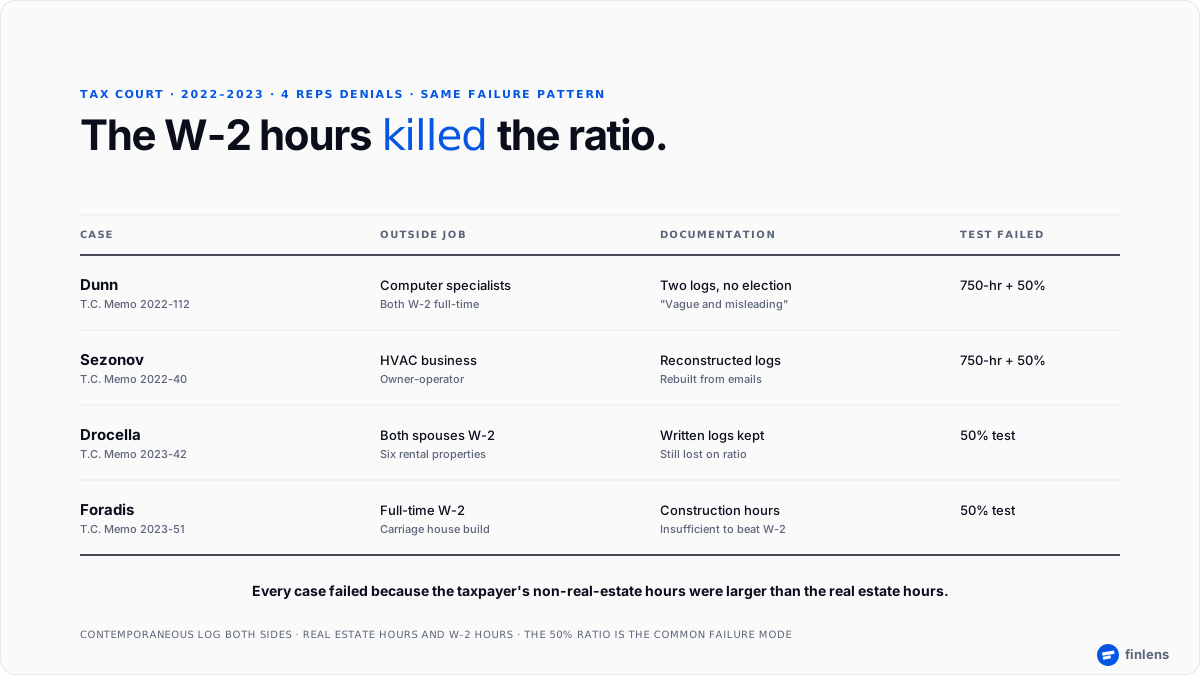
Four cases every practitioner should have in workpaper file:
- Dunn v. Commissioner (T.C. Memo 2022-112). Two computer specialists with rental properties and a real estate LLC. Kept two logs but no aggregation election. Court found logs "vague and misleading" on both time and task attribution. Failed 750-hour and 50% tests. Losses disallowed.
- Sezonov v. Commissioner (T.C. Memo 2022-40). HVAC business owners with rentals. Non-contemporaneous logs reconstructed from rental agreements and emails. Court held logs were unclear on time and on which spouse performed which task. Failed on both statutory tests.
- Drocella v. Commissioner (T.C. Memo 2023-42). Married couple with six rentals, both full-time employees elsewhere. Maintained written logs. Court found couple could not prove more than 50% of total personal service time was on real estate outside employment consumed too many hours.
- Foradis v. Commissioner (T.C. Memo 2023-51). Full-time W-2 employee spent substantial time on carriage house construction. Court disallowed REPS: hours claimed did not establish that real estate exceeded outside employment.
The pattern across all four: taxpayer's non-real-estate hours were what killed claim. The 50% test is a ratio, and W-2 hours are denominator. A CPA workpaper that ignores W-2 side of equation is incomplete.
Zaid Hakkak (T.C. Memo 2020-46) additionally warned that "ballpark guesstimates" and post-event reconstructions do not satisfy reasonable-means standard. The safe practitioner posture: log must exist during year, not be assembled following March.
The three tax benefits, mechanically
When all three tiers are met, return picks up three distinct benefits:
1. Passive activity loss release. Losses from rental real estate become nonpassive and offset ordinary income (wages, business income, portfolio) without $25,000 active participation cap and without phase-out at $100,000–$150,000 AGI. Suspended PALs from prior years also become deductible in year of qualification against nonpassive income sourced from same activity.
2. NIIT exemption. Rental income is normally investment income subject to 3.8% NIIT. Once taxpayer qualifies as a REP and activity clears §1.1411-4 safe harbor (500 hours in current year, or in five of ten prior years), rental income is derived in ordinary course of a trade or business and is excluded from NIIT.
3. QBI deduction eligibility. If rental activity rises to a §162 trade or business often case when REPS is met net rental income may qualify for 20% §199A deduction. Rev. Proc. 2019-38 provides a rental real estate safe harbor with a 250-hour threshold, but safe harbor is not exclusive path.
The short term rental alternative
STRs with average stays of seven days or less are trade or business activities under Treas. Reg. §1.469-1T(e)(3)(ii), not rental activities. The taxpayer needs only material participation on STR not 750-hour or 50% statutory tests. This path is often better answer for a W-2 earner who cannot clear REPS ratio.
The CPA workpaper package
For any client claiming REPS, return file should contain:
- An hours log with date, property or activity, task performed, and hours. Weekly at minimum, daily preferred. Contemporaneous, not reconstructed.
- A companion log of non-real-estate personal services hours W-2 duties, other business hours, professional services. This is what establishes 50% ratio.
- The §1.469-9(g) aggregation election statement attached to return in first year of election, or a note confirming it was made in a prior year.
- Property-by-property material participation determination or aggregation reference.
- Real property trade or business classification for each activity, tied to §469(c)(7)(C) categories.
- NIIT safe harbor documentation hours in current year, or a five-of-ten history if relying on prior-year track record.
- Copies of leases, service contracts, and vendor invoices supporting operational nature of taxpayer's activity.
- Prior-year suspended PAL schedule with release calculation for qualifying year.
Missing item 2 (W-2 side of equation) is single most common reason a REPS claim survives return preparation but fails on audit.
How Finlens builds REPS workpaper from QBO
Finlens keeps general ledger for client's rental entity or Schedule E activity reconciled month-by-month, so operational side of REPS claim is defensible before it hits return preparer's desk.
Where Finlens fits in eight-item workpaper package above:
- Item 5 (real property trade or business classification). Finlens tags every QBO transaction by property and by §469(c)(7)(C) category development, rental, operation, brokerage so each dollar of expense is anchored to a statutory category.
- Item 7 (leases, service contracts, vendor invoices). Finlens attaches source documents to underlying QBO transactions and produces a vendor-level audit trail keyed to each property.
- Item 8 (suspended PAL release). Finlens carries prior-year PAL schedule at property level, so when client crosses REPS threshold, release calculation is already reconciled.
- Multi-entity portfolios. Finlens consolidates rental LLCs and DREs into a single view for aggregation-election clients, so "single activity" treatment ties to a single reconciled ledger rather than five spreadsheets.
Finlens does not track hours hours log is client's responsibility (or a purpose-built app like REPSLog). Finlens makes sure ledger, schedule of losses, and property-by-property categorization behind REPS claim are ready when return preparer opens file.
Conclusion
REPS is a documentation game, not a knowledge game. Every client asking about strategy has already read three tax blogs; practitioner's value is producing an audit-defensible workpaper that survives a Tax Court judge reading it four years from now
see how Finlens ties QBO transactions to §469(c)(7)(C) categories, carries property-level PAL schedule, and prepares ledger side of workpaper before hours log ever arrives.
Bring file that failed on audit last year one where taxpayer had six rentals, no aggregation election, and a reconstructed hours log. That's file this system is built for.
Frequently asked questions
Does my spouse count?
For 50% and 750-hour tests, no those are individual tests. Only one spouse's own personal service time counts. For material participation test on each property, yes both spouses' hours combine.
What if I only have one rental?
No aggregation election needed. You still need to clear 750-hour and 50% tests personally, and pass one of seven material participation tests on that single property (typically Test 1 at 500 hours, or Test 3 at 100 hours if no one else works more).
Is aggregation election required for REPS?
No, but for taxpayers with multiple rentals, satisfying material participation property-by-property is usually impossible. Most multi-property REPS claims depend on election.
The authoritative source for passive activity rules and material participation tests is IRS Publication 925 every practitioner file for a REPS client should reference current-year edition. For cost-segregation side of REPS strategy, see Finlens guide to cost segregation for real estate.

