
Schedule C (Form 1040): Reporting Business Income as a Sole Proprietor


Schedule C is tax form sole proprietors and single-member LLCs use to report business income and expenses on their personal tax return (Form 1040). If you earned money as a freelancer, gig worker, consultant, or unincorporated small-business owner, this is schedule that converts your gross receipts into taxable net profit number that flows to Line 3 of Schedule 1 (added to your other income) and to Schedule SE (where self-employment tax is calculated).
This guide covers what Schedule C is, who files it, five parts of form, deduction categories that matter most, and how Schedule C interacts with Schedule SE, Schedule E, and Form 1099.
What Schedule C is
Per IRS Schedule C page, you file Schedule C to report income or loss from a business you operated or a profession you practiced as a sole proprietor. An activity qualifies as a business if:
- Primary purpose is income or profit not a hobby
- You're involved with continuity and regularity not a one-off transaction
The IRS uses those two tests to distinguish a business (Schedule C) from a hobby (line 8 "Other income" on Schedule 1, no expense deductions). Getting this wrong is expensive hobbies can't deduct any losses, while businesses can.
Schedule C-EZ, simplified version, was discontinued after tax year 2018. Everyone now files full Schedule C regardless of business size.
Who files Schedule C
You file Schedule C if you're:
- A sole proprietor (unincorporated, unregistered business)
- A single-member LLC that didn't elect S-corp or C-corp taxation (disregarded entity by default)
- A statutory employee reported on a W-2 with Box 13 checked
- A gig worker on platforms like DoorDash, Uber, Upwork, Etsy, or any 1099 income
- A freelancer or independent contractor with 1099-NEC income
- Anyone with a side hustle profitable enough to trigger $400 self-employment tax threshold
You don't file Schedule C if you're:
- A partnership or multi-member LLC you file Form 1065, and profit flows to partners via Schedule K-1
- An S-corp you file Form 1120-S, take reasonable compensation via W-2, and profit flows via K-1
- A C-corp you file Form 1120 as a separate taxpayer
- A landlord with rental real estate that goes on Schedule E, not C
- An investor capital gains and dividends go on Schedule D and Form 1040 directly
If you have multiple sole-prop businesses, you file a separate Schedule C for each one no combining allowed.
Part-by-part: five parts of Schedule C
Schedule C is two pages, organized into five parts.
Part I Income
- Line 1: Gross receipts or sales total revenue before any deductions
- Line 2: Returns and allowances
- Line 4: Cost of goods sold (from Part III, if you sell physical products)
- Line 6: Other income (interest earned, tax credits, prior deductions recovered)
- Line 7: Gross income top-line number before operating expenses
Part II Expenses (26 deduction categories on lines 8–27):
Lines 8–27 are operating deductions. The lines are pre-labeled you can't invent new categories at top level. Common lines:
- Line 8: Advertising
- Line 9: Car and truck expenses (standard mileage or actual)
- Line 10: Commissions and fees
- Line 11: Contract labor (payments to 1099 contractors anyone you sent a W-9 to)
- Line 13: Depreciation and Section 179
- Line 15: Insurance (other than health)
- Line 16a/b: Interest (mortgage or other)
- Line 17: Legal and professional services
- Line 18: Office expense
- Line 20a/b: Rent (vehicles/equipment or business property)
- Line 21: Repairs and maintenance
- Line 22: Supplies
- Line 23: Taxes and licenses
- Line 24a/b: Travel and meals (meals 50% deductible only)
- Line 25: Utilities
- Line 26: Wages
- Line 27: Other expenses (Part V detail)
Part III Cost of goods sold. Only if you sell physical products. Beginning inventory + purchases + labor + materials − ending inventory = COGS, which flows to Line 4.
Part IV Information on your vehicle. Only if you claimed car/truck expenses on Line 9. Requires date placed in service, business/commuting/other miles, and evidence that you have written records.
Part V Other expenses. The itemized detail for Line 27. Any deduction that doesn't fit one of pre-labeled Part II categories gets described and totaled here.
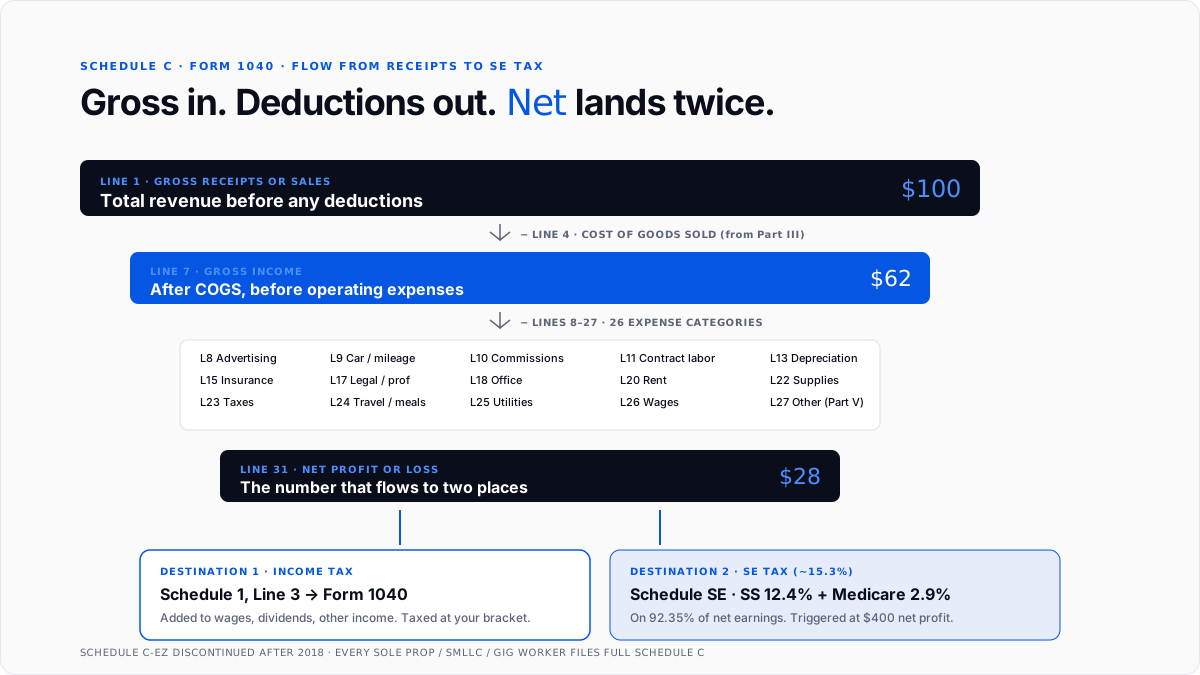
Net profit or loss and where it flows
Line 31 is punchline: net profit or loss. That number flows to two places:
1. Schedule 1, Line 3 → your Form 1040 taxable income: Net profit gets added to your wages, dividends, and other income. Net loss (up to certain limits) reduces your other income.
2. Schedule SE: The self-employment tax calculation. If net profit is $400 or more, you owe:
- 12.4% Social Security on 92.35% of net earnings (up to SS wage base $168,600 for 2024, $176,100 for 2025)
- 2.9% Medicare on all net earnings
- Additional 0.9% Medicare on net earnings above $200K single / $250K MFJ
Roughly, self-employment tax is ~15.3% of net Schedule C profit on top of income tax. The QBI deduction can then reduce federal income tax (not SE tax) by up to 20% of qualified business income.
Common Schedule C deductions people miss
Home office (Form 8829): If you use a portion of your home regularly and exclusively for business, you can deduct a proportional share of rent/mortgage interest, utilities, insurance, and depreciation. The simplified method is $5/sq ft up to 300 sq ft ($1,500 max), no depreciation. The regular method has higher potential deduction but requires tracking actual home expenses.
Retirement plan contributions: SEP-IRA, Solo 401(k), and SIMPLE IRA contributions for owner go on Schedule 1, not Schedule C (they're above-the-line, not business deductions). But contributions for employees DO go on Schedule C Line 19.
Health insurance premiums: Self-employed health insurance goes on Schedule 1 Line 17, not Schedule C. Limited to net profit shown on Schedule C if you had a loss, you can't take this deduction.
Startup costs: Up to $5,000 deducted in year one; rest amortized over 15 years. Goes on Line 27 (Other expenses).
Section 179 vs. bonus depreciation: Instead of depreciating equipment over years, Section 179 lets you deduct full cost in year placed in service (up to $1.16M for 2024). Bonus depreciation is separate 60% for 2024, phasing down. Both go on Line 13. See our guide on how to write off business expenses for timing decisions.
Schedule C vs. Schedule E vs. Schedule K-1
These three schedules all report business-adjacent income, but they aren't interchangeable:
- Schedule C active business as a sole prop / SMLLC. Subject to SE tax.
- Schedule E rental real estate, royalties, and pass-through K-1 income. Generally NOT subject to SE tax (rental income is passive).
- Schedule K-1 your share of partnership, S-corp, or trust income. K-1 income is reported on Schedule E (Part II).
If you run an Airbnb where you provide "substantial services" like daily cleaning and meals, it may actually be Schedule C business income (subject to SE tax), not passive Schedule E rental income. The rules are fact-specific 1099-K reporting guide covers where platform income lands.
Common Schedule C mistakes
Deducting personal expenses: Home internet, personal cell phone, personal car use, meals with your spouse these are audit red flags. If you can't show it's ordinary and necessary for business, it doesn't belong on Schedule C.
Not reconciling to 1099s received: The IRS receives every 1099-NEC and 1099-K issued in your name. Your Schedule C gross receipts (Line 1) must equal or exceed total 1099s IRS has on file. Underreport and you'll get a CP2000 notice.
Filing without an EIN when you have employees or a Solo 401(k): If you have any employees, or you have a Solo 401(k), or your LLC is multi-member, you need an EIN. Sole proprietors without employees can use their SSN, but an EIN is cleaner and free.
Missing quarterly estimated tax payments: Schedule C income doesn't have withholding. If you'll owe $1,000+ at year-end, you must make quarterly estimated payments (April 15, June 15, September 15, January 15) or face an underpayment penalty. See our quarterly estimated tax deadlines guide for schedule.
Combining multiple businesses on one Schedule C: Each distinct trade or business needs its own Schedule C running a design agency and a coffee shop under same sole prop doesn't combine into one form.
Treating a hobby as a business to deduct losses: The IRS presumes you're a business if you show a profit in 3 out of 5 consecutive years. Persistent losses on Schedule C without evidence of profit motive get reclassified as hobby.
Conclusion
Schedule C is tax home for every sole prop, single-member LLC, and gig worker. The form is straightforward discipline is in tracking receipts, categorizing expenses correctly across 26 lines, and reconciling to 1099s IRS already has on file.
Frequently asked questions
Do I file a Schedule C if my business had zero income?
Only if you had expenses or want to establish business for future carryover. Otherwise, no.
Can a married couple file one Schedule C for a jointly-owned business?
Only via a Qualified Joint Venture election, which splits Schedule C into two one for each spouse. Without election, joint business is technically a partnership and needs Form 1065.
Do I need receipts for every Schedule C deduction?
For deductions over $75, yes. For meals and entertainment, always. For cash payments to contractors, always plus a 1099-NEC if $600+.
What if my Schedule C shows a loss?
The loss reduces other income on Form 1040. Excess business losses beyond $305,000 (single, 2024) or $610,000 (MFJ) are capped and carried forward per excess business loss rules.
Does an LLC file Schedule C?
Only single-member LLCs that didn't elect S-corp or C-corp taxation. The LLC as a legal entity is transparent to IRS by default; owner reports on Schedule C.
Schedule C or Schedule SE which comes first?
Schedule C first (calculates net profit). Then Schedule SE uses net profit from Schedule C Line 31 to compute SE tax.
Can I use standard mileage rate and actual car expenses in same year?
No. Pick one method in year one. If you start with actual expenses, you can never switch to standard mileage for that vehicle. If you start with standard mileage, you can switch to actual in a later year.
Do gig workers file Schedule C?
Yes. Any 1099-NEC or 1099-K income from platforms (rideshare, delivery, marketplace) is sole-prop business income reported on Schedule C.

