
Standard Deduction: 2024 & 2025 Amounts by Filing Status (Plus Who Should Itemize Instead)


The standard deduction is a flat dollar amount that reduces your taxable income before federal income tax is calculated. It's simpler alternative to itemizing deductions on Schedule A no receipts, no worksheets, just check your filing status against IRS table and subtract. Since Tax Cuts and Jobs Act nearly doubled standard deduction in 2018, roughly 90% of filers now take it instead of itemizing.
This guide covers 2024 and 2025 amounts by filing status, additional amount for age 65+ and blind filers, dependent limit, and break-even math for when itemizing beats standard deduction.
What standard deduction is
Per IRS Tax Topic 551, standard deduction reduces income on which you're taxed. Everyone with US taxable income can claim either:
- The standard deduction (a flat amount based on your filing status), OR
- Itemized deductions on Schedule A (specific expenses like mortgage interest, state and local taxes, charitable contributions, medical expenses above 7.5% of AGI)
You choose whichever is larger each year you can switch between years, but not within a single return.
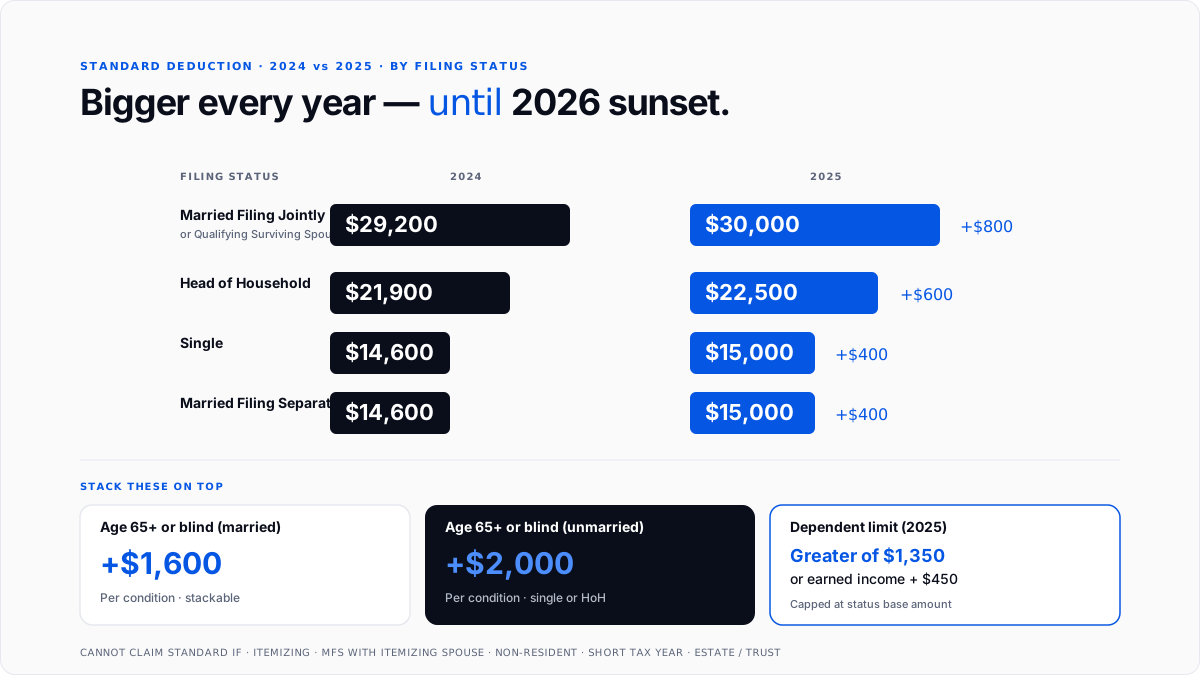
2024 standard deduction by filing status
For tax year 2024 (returns filed in 2025):
2025 standard deduction by filing status
For tax year 2025 (returns filed in 2026):
The IRS adjusts standard deduction annually for inflation using chained CPI. The 2018 TCJA amounts are scheduled to sunset after 2025 unless Congress extends them if they revert, pre-TCJA amounts (~half of current levels, adjusted for inflation) come back in 2026.
Additional standard deduction for age 65+ or blind
Filers who are age 65+ or blind (or both) at end of tax year get an extra amount added to their basic standard deduction.
2025 additional amounts:
- $1,600 per condition if you're married (whether MFJ, MFS, or Qualifying Surviving Spouse)
- $2,000 per condition if you're Single or Head of Household
You can stack: a 65+ blind married filer gets +$3,200; a 65+ blind single filer gets +$4,000.
Example MFJ, both spouses over 65: $30,000 (2025 base) + $1,600 (spouse 1 age 65+) + $1,600 (spouse 2 age 65+) = $33,200
Example Single, 65+ and blind: $15,000 (2025 base) + $2,000 (age 65+) + $2,000 (blind) = $19,000
Standard deduction if you're claimed as a dependent
If someone else claims you as a dependent on their return, your standard deduction is limited. For 2025, it's greater of:
- $1,350, OR
- Your earned income + $450 (but not more than regular standard deduction for your filing status)
Example college student earning $8,000 from a summer job, claimed by parents: $8,000 + $450 = $8,450 (greater than $1,350, less than $15,000 single cap) → $8,450 standard deduction
Example high school student earning $500 mowing lawns, claimed by parents: $500 + $450 = $950, less than $1,350 minimum → $1,350 standard deduction
When you CANNOT take standard deduction
Per IRS, you're NOT eligible for standard deduction if:
- You're itemizing on Schedule A (obvious pick one)
- You're MFS and your spouse itemizes both spouses must use same method
- You're a nonresident or dual-status alien (limited exceptions for treaties)
- Your tax year is less than 12 months because of a change in your annual accounting period
- You're filing as an estate, trust, partnership, or common trust fund those file separate business returns and have different deduction rules
Standard deduction vs. itemizing how to decide
The math is simple: whichever gives you larger deduction wins.
Common itemized deductions on Schedule A:
- Mortgage interest on up to $750,000 of qualified home debt (post-TCJA cap)
- State and local taxes (SALT) capped at $10,000 (single or married) per TCJA
- Charitable contributions cash gifts up to 60% of AGI; property gifts subject to lower limits
- Medical expenses portion exceeding 7.5% of AGI
Rough break-even math (2025):
- Single filer itemizing beats standard if your itemized deductions exceed $15,000
- MFJ filer itemizing beats standard if your itemized deductions exceed $30,000
For most non-homeowners without large charitable giving, standard deduction wins by a wide margin. Homeowners in high-tax states (NY, NJ, CA, CT) with a mortgage often clear itemizing threshold once you stack mortgage interest + capped SALT + some charitable contributions.
Above-the-line deductions still apply either way
A common misconception is that taking standard deduction disqualifies you from other deductions. Not true. Adjustments to income (Schedule 1, Part II) are available regardless of standard vs. itemized:
- Educator expenses ($300 cap, 2024)
- HSA contributions
- Self-employed retirement plan contributions (SEP-IRA, Solo 401(k), SIMPLE IRA)
- Self-employed health insurance
- Student loan interest ($2,500 cap, phase-out applies)
- Half of self-employment tax (see self-employment tax guide)
- IRA deductions (subject to phase-outs see Traditional IRA vs Roth IRA)
These reduce your AGI before standard deduction is applied. So a self-employed filer taking standard deduction can still deduct SEP-IRA contributions, half of SE tax, and self-employed health insurance premiums all above line.
Standard deduction and QBI
The Qualified Business Income (QBI) deduction up to 20% of qualified business income is technically a "below-the-line" deduction but is claimed separately from Schedule A. This means you can take BOTH standard deduction AND QBI deduction. See our QBI deduction guide for how it interacts with sole prop and pass-through income.
Common standard deduction mistakes
Married filers not knowing MFS rules. If you file MFS and your spouse itemizes, you MUST itemize too even if your itemized deductions are zero. The $14,600 (2024) MFS standard deduction is only available if other spouse also takes standard deduction.
Not stacking age/blind additions. A 65+ blind married filer often forgets +$3,200 add-on and just claims base $30,000. Update age/blind boxes on Form 1040 Line 39.
Dependents claiming full standard deduction. A college student with $10,000 W-2 income who fills out their return as "single" and claims full $15,000 but their parents also claim them as a dependent is filing incorrectly. The dependent limit ($10,450 in this case) applies.
Homeowners assuming they must itemize. Post-TCJA, many homeowners have mortgages small enough (or SALT caps that bite hard enough) that their itemized total falls below standard deduction. Check both every year don't assume.
Charitable contributions "wasted" under standard deduction. Between 2020–2021 there was a $300/$600 above-the-line charitable deduction for standard-deduction filers. That's expired. Currently, non-itemizers get no federal deduction for cash charity some filers use donor-advised funds or bunching strategies to itemize every other year.
Conclusion
For ~90% of filers, standard deduction is right move no receipts to track, no schedule to attach, and it's usually larger than what itemizing would produce. The main exceptions are high-mortgage homeowners in high-tax states and filers with large charitable giving.
Frequently asked questions
Should married couples always file jointly for standard deduction?
Usually yes MFJ gives you full $30,000 (2025). MFS gives $15,000 each, technically same, but MFS locks you out of several credits and deductions and often costs more overall. Run both scenarios if uncertain.
Can I claim standard deduction if I take home office deduction?
Home office (Form 8829) is a Schedule C business deduction, not a Schedule A itemized deduction. So yes, self-employed filers routinely take Schedule C business deductions (including home office) AND standard deduction. See our Schedule C guide.
Does standard deduction reduce self-employment tax?
No. SE tax is calculated on Schedule C net profit, before standard deduction is applied. The standard deduction only reduces federal income tax.
When does standard deduction change during year?
The IRS publishes next year's amounts in November of current year, in a revenue procedure (Rev. Proc.). 2025 amounts were announced in October 2024; 2026 amounts will be announced in October 2025.
Do I need to attach any form to claim standard deduction?
No. You just enter amount on Form 1040 Line 12. No supporting schedule or documentation is required. This is one reason ~90% of filers take it.
What happens if my itemized deductions equal standard deduction exactly?
You'd choose standard deduction same tax outcome, less paperwork. The IRS is fine with either.
Can I switch from standard to itemized in a future year?
Yes. You choose fresh each tax year. If you bought a house in 2025 that puts you over itemizing threshold, you take itemized for 2025 even if you took standard deduction every prior year.
Does standard deduction apply for state income tax?
Depends on your state. Most states have their own standard deduction that mirrors filing status but at different amounts. A few states (California, Massachusetts, others) require you to itemize on state if you itemize on federal.

