
Traditional IRA vs Roth IRA: How to Choose (Contribution Limits, Tax Treatment, and Withdrawal Rules)


A Traditional IRA is funded with pre-tax dollars you get a tax deduction in year you contribute, and pay income tax on withdrawals in retirement. A Roth IRA is funded with post-tax dollars no upfront deduction, but qualified withdrawals in retirement are entirely tax-free (both contributions AND growth). The right choice hinges on one question: do you expect your tax rate to be higher today or higher in retirement?
This guide covers current contribution limits, income phase-outs, key differences, withdrawal rules, and a practical decision framework for choosing between them.
The core difference in one line
- Traditional IRA: tax break now, pay later
- Roth IRA: pay now, no tax later
Everything else contribution limits, deduction phase-outs, required minimum distributions, early-withdrawal rules flows from that tax-timing distinction.
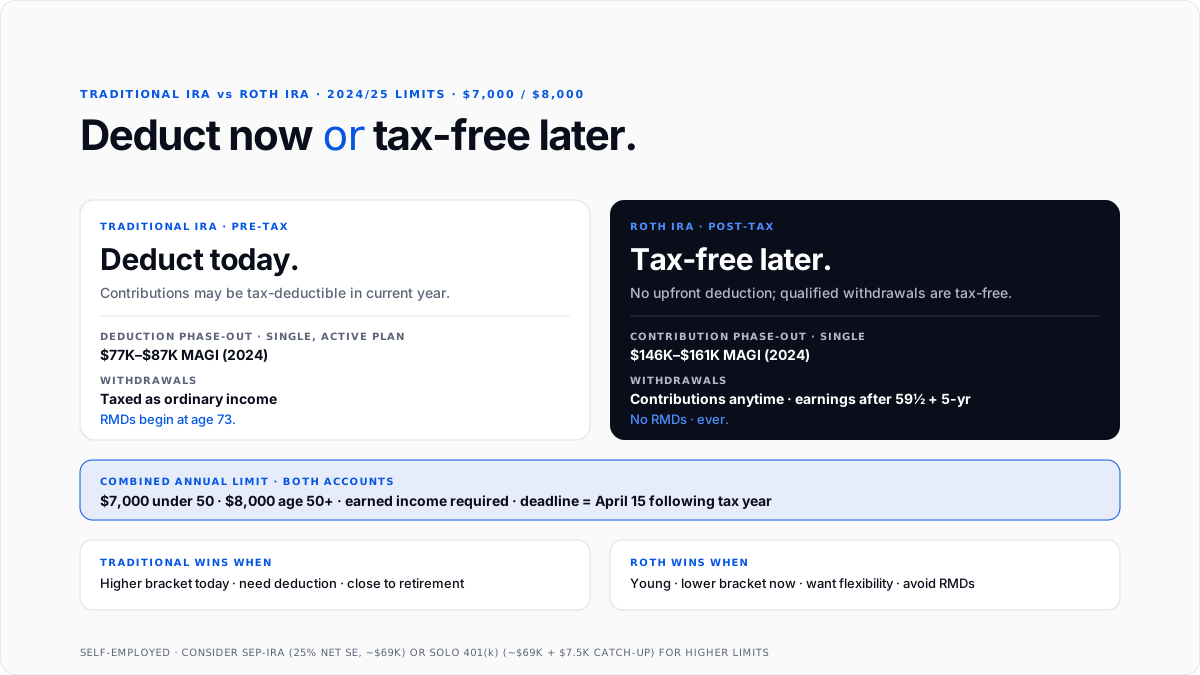
Per IRS Traditional and Roth IRAs page, both account types share same $7,000 combined contribution limit ($8,000 if age 50+) for 2024, but deductibility, income limits, and tax mechanics differ substantially.
2024 / 2025 contribution limits
Both account types share a combined annual limit you can split between two, but total contributions can't exceed cap:
You can contribute up until tax-filing deadline (April 15 following tax year) for prior tax year. Contributions must come from earned income you cannot contribute more than you earn in wages or self-employment income for year.
Traditional IRA deep-dive
Tax treatment:
- Contributions may be tax-deductible in year contributed (subject to income phase-outs see below)
- Investment growth is tax-deferred
- Withdrawals in retirement are taxed as ordinary income
Deduction phase-out (if you or your spouse have a workplace retirement plan):
For 2024, if you're covered by a workplace plan (401(k), 403(b), etc.):
If neither spouse has a workplace plan, deduction is unlimited by income.
Required Minimum Distributions (RMDs):
- Must begin by April 1 of year after you turn 73 (SECURE 2.0 raised age from 72)
- Required every year thereafter, based on IRS Uniform Lifetime Table
- Missing an RMD triggers a 25% excise tax on missed amount (reduced to 10% if corrected timely)
Early withdrawal: Withdrawing before age 59½ triggers a 10% penalty on top of income tax, with narrow exceptions (first home up to $10,000, higher education, medical expenses over 7.5% of AGI, disability, substantially equal periodic payments).
Roth IRA deep-dive
Tax treatment:
- No deduction for contributions
- Growth is tax-free
- Qualified withdrawals in retirement (contributions + earnings) are tax-free
Qualified withdrawal requires:
- Account has been open at least 5 years (5-year rule)
- AND one of: age 59½+, first home purchase ($10K lifetime cap), disability, or death
Income phase-out (contribution eligibility, NOT deductibility Roth has no deduction):
For 2024:
Above phase-out ceilings, direct Roth contributions are not allowed. The "Backdoor Roth" contribute to a nondeductible Traditional IRA, then convert to Roth is workaround for high earners. See IRS Roth IRAs page for authoritative guidance on conversions.
No required minimum distributions (RMDs). This is a major Roth advantage you can leave money invested for your entire lifetime, growing tax-free.
Early withdrawal: Contributions (not earnings) can be withdrawn any time, penalty-free. Earnings withdrawn before age 59½ or before 5-year rule triggers 10% penalty + income tax, with same exceptions as Traditional.
Side-by-side comparison
When Traditional IRA wins
- Your current tax bracket is HIGHER than what you expect in retirement upfront deduction is worth more than future tax-free growth
- You need current-year deduction to reduce taxable income (bringing yourself into a lower bracket or below AGI-triggered phaseouts elsewhere)
- You're close to retirement less time for tax-free growth to compound in a Roth
- You expect substantial income drop in retirement
- You don't qualify for direct Roth contributions AND don't want to deal with backdoor Roth conversions
When Roth IRA wins
- Your current tax bracket is LOWER than what you expect in retirement pay now at a lower rate
- You're young decades of tax-free compounding is worth more than upfront deduction
- You want flexibility Roth contributions can be withdrawn anytime penalty-free
- You want to avoid RMDs Roth is only IRA type with no RMD requirement
- You expect estate planning benefit Roth inherited by heirs continues tax-free (subject to 10-year distribution rule for non-spouse beneficiaries under SECURE Act)
- You're eligible under income limits (or willing to backdoor-Roth)
The self-employed and small business owner case
For self-employed filers and small business owners, IRAs are one part of a larger retirement plan menu:
- Traditional / Roth IRA: Any earned income, $7K/$8K limits foundation for most owners
- SEP-IRA: Higher limits (up to 25% of net SE earnings, cap ~$69K in 2024), employer-only
- Solo 401(k): Highest limits (employee + employer combined ~$69K, or $76,500 with catch-up), Roth option
- SIMPLE IRA: Lower limits ($16K for 2024, $19,500 with catch-up), simpler admin
For self-employed quarterly estimated tax planning, Traditional IRA / SEP-IRA contributions can reduce current-year tax owed factor this into Q4 planning. See our guide on how to write off business expenses for how retirement contributions flow through tax return, and QBI deduction guide for how pre-tax retirement contributions interact with 20% pass-through deduction.
Common decision-framework mistakes
1. Assuming lower tax bracket in retirement. Many retirees end up in same or higher bracket, especially if they have significant taxable investment income, Social Security, RMDs from other accounts, and (post-TCJA) rate expirations after 2025.
2. Doing all Traditional or all Roth. Diversifying between two ("tax diversification") gives you flexibility in retirement to draw from whichever account has better tax treatment in each year.
3. Missing backdoor Roth if over income limit. High earners often skip Roth entirely, missing backdoor conversion path.
4. Not contributing enough to get Traditional IRA deduction. The deduction has value leaving contributions in a taxable brokerage account instead of a Traditional IRA gives up deferral.
5. Withdrawing Roth earnings early. Contributions come out tax-free anytime, but earnings withdrawn before 59½ or before 5-year rule triggers full penalty and tax.
Conclusion
If your current tax rate is higher than what you expect in retirement, Traditional wins. If it's lower, Roth wins. If you're not sure, diversify. Contribute what you can each year up to $7,000 ($8,000 age 50+), split between two if choice isn't clear-cut, and consider backdoor Roth if you're above income limits.
FAQ
Who should not use a Roth IRA?
Someone very close to retirement who expects to be in a much lower tax bracket than currently, or someone whose current tax bracket is materially higher than any plausible retirement rate. Also: anyone above income phase-out ceiling who won't do a backdoor Roth.
What happens if I put $2,000 in a Roth IRA?
Nothing that's a valid contribution as long as your income is under phase-out threshold and you have at least $2,000 of earned income. Below $7,000 annual limit, you can contribute any amount.
Can I contribute to both a Traditional and Roth IRA?
Yes, but combined total can't exceed $7,000 ($8,000 age 50+) for 2024/25. You could split $4,000 to Traditional and $3,000 to Roth in same year.
Is a 401(k) a Traditional IRA?
No. A 401(k) is an employer-sponsored plan; an IRA is an individual account you set up yourself. Both are retirement accounts with tax advantages, but different contribution limits ($23,000 for 401(k) elective deferral in 2024 vs $7,000 IRA) and different rules.
What is difference between Traditional IRA and Roth IRA in one sentence?
Traditional IRA: tax deduction now, taxed on withdrawal. Roth IRA: no deduction now, tax-free on qualified withdrawal.
Can I convert Traditional IRA to Roth?
Yes a Roth conversion is allowed at any age and any income. You pay income tax on converted amount in year of conversion. This is mechanism behind "backdoor Roth" for high earners who cannot directly contribute to Roth.
What is 5-year rule for Roth IRA?
To take a qualified (tax-free) withdrawal of Roth earnings, account must have been open for at least 5 tax years. The 5-year clock starts January 1 of year of your first contribution. Contributions themselves can be withdrawn anytime without meeting 5-year rule.
Do I have to take RMDs from a Roth IRA?
No. Roth IRAs are only IRA type with no lifetime RMD requirement. This is a major advantage for wealth-transfer planning and for anyone who doesn't need retirement income.

