
Canada GST/HST/PST in QuickBooks: The 2026 Registration, Charge, and Filing Guide


Canada operates a two-layer sales tax system that trips up more American e-commerce sellers than any other cross-border rule. The federal Goods and Services Tax (GST) applies nationwide at 5%.
On top of it, most provinces layer either a provincial component into a Harmonized Sales Tax (HST) or run a separate Provincial Sales Tax (PST) or Quebec Sales Tax (QST) with its own registration, rates, and filing rules.
The result is thirteen different rate structures, three different administering agencies, and separate filing cadences. QuickBooks Online supports the setup, but the operator has to know which rate applies where, when the registration threshold triggers, and how the Input Tax Credit mechanism recovers GST/HST paid on business purchases.
This guide covers every rate, registration rule, and QBO setup step for 2026.
What are GST, HST, PST, and QST in Canada?
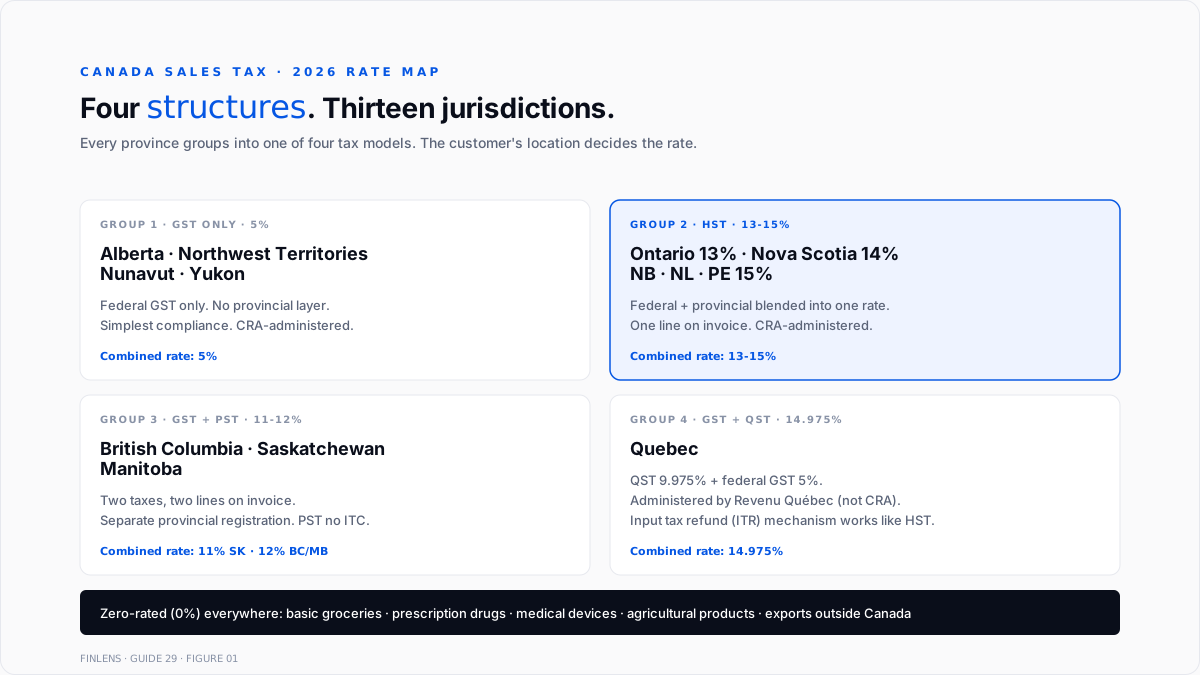
Canada has three sales tax structures across thirteen provinces and territories.
GST (Goods and Services Tax). A federal value-added tax at 5% applied to most goods and services nationwide. Administered by the Canada Revenue Agency (CRA). Applies as a standalone rate in Alberta, Northwest Territories, Nunavut, and Yukon.
HST (Harmonized Sales Tax). A blended tax combining the 5% federal GST with a provincial component into a single rate. Administered by CRA on behalf of participating provinces. Applies in Ontario (13%), Nova Scotia (14%), New Brunswick, Newfoundland and Labrador, and Prince Edward Island (all 15%).
PST (Provincial Sales Tax). A separate provincial retail sales tax charged on top of the 5% GST. Administered by the province. Applies in British Columbia (7%), Saskatchewan (6%), and Manitoba (7%).
QST (Quebec Sales Tax). Quebec's provincial sales tax is at 9.975%, administered by Revenu Québec (not the CRA). Charged on top of the 5% GST for a combined rate of 14.975%.
The result: the exact rate charged depends on where the customer receives the supply. Place-of-supply rules are documented on the CRA GST/HST rates page.
What are the current sales tax rates by province in 2026?
The place of supply drives the rate. The province where the customer receives the good or service determines what the seller charges.
Zero-rated supplies (0% GST/HST across all provinces): basic groceries, prescription drugs, medical devices, agricultural products, and most exports outside Canada. Zero-rated is different from exempt. Zero-rated allows Input Tax Credit recovery; exempt does not.
When does GST/HST registration become mandatory?
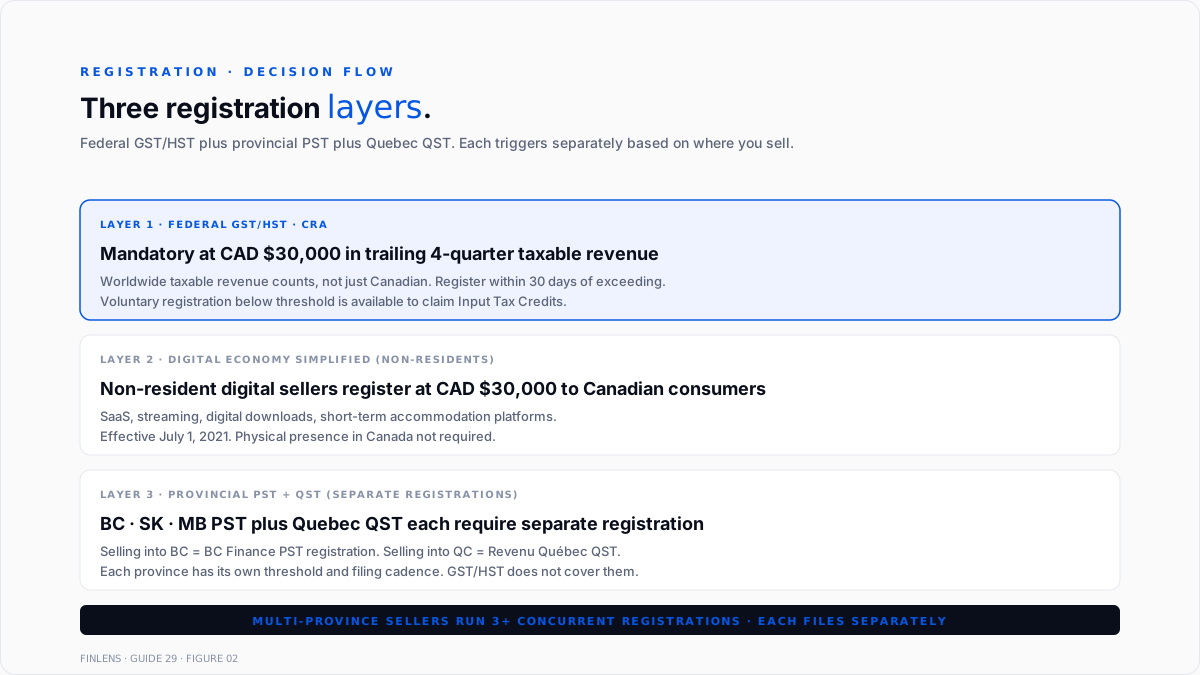
The small supplier threshold is CAD $30,000 in taxable worldwide revenue over the trailing four consecutive calendar quarters. Once total taxable revenue exceeds $30,000 in any four-quarter period, GST/HST registration becomes mandatory within 30 days.
The threshold applies to worldwide taxable revenue, not just Canadian revenue. A US business selling both into Canada and elsewhere counts total taxable sales toward the threshold. The threshold applies to a single legal entity, so multiple related entities each have their own $30,000 threshold.
Voluntary registration below the threshold. Businesses below $30,000 can register voluntarily. Voluntary registration is common for firms that want to claim Input Tax Credits on business purchases, since only registered businesses can recover GST/HST paid.
Non-resident digital economy rules. Non-resident businesses supplying digital services, digital products, or short-term accommodations to Canadian consumers must register for simplified GST/HST if annual sales exceed CAD $30,000. This rule took effect July 1, 2021, under Bill C-30 and applies regardless of whether the seller has physical presence in Canada.
PST/QST separate registration. Provincial sales tax registrations are separate from GST/HST registration and separate from each other. A business selling into BC must register with BC Finance for PST. A business selling into Quebec must register with Revenu Québec for QST. Each province maintains its own threshold and rules.
Coverage of the broader sales tax nexus framework and comparable US rules is in Finlens' sales tax nexus guide.
What is an input tax credit, and how does it work?
The Input Tax Credit (ITC) is the mechanism that makes GST/HST a true value-added tax rather than a cascading tax. Registered businesses can recover the GST/HST they paid on business purchases by claiming it back on their GST/HST return.
How it works. A business collects GST/HST on sales and pays GST/HST on business purchases. On the GST/HST return, the business remits the difference. If purchases exceed sales in a period, the CRA issues a refund.
Example. A business collects $13,000 in HST from Ontario customers ($100,000 sales × 13%) and pays $2,600 in HST on business purchases ($20,000 expenses × 13%). Net HST remittance is $13,000 − $2,600 = $10,400. The business remits $10,400 to CRA.
Documentation requirements. To claim an ITC, the business must have the supplier's GST/HST registration number on the invoice, the amount of GST/HST charged, and other invoice details specified in CRA's records requirement. CRA maintains a registration verification tool.
PST does not offer ITC. PST in BC, SK, and MB is a true retail sales tax without input credits. A business pays PST on business purchases and cannot recover it. This is a real cost that flows through to COGS or operating expense.
QST offers input tax refunds (ITRs). QST works similarly to HST with an input tax refund mechanism, administered separately by Revenu Québec.
The ITC mechanism is what makes GST/HST registration worthwhile even for firms below the mandatory threshold. Businesses with substantial capital purchases (equipment, inventory, professional services) often register voluntarily to recover the GST/HST paid.
How is Canadian sales tax configured in QuickBooks Online?
QBO Canada supports GST, HST, PST, and QST natively. Setup runs in five steps.
Step 1: Enable sales tax. In QBO, navigate to Taxes, then Sales Tax. Confirm the province of registration. This determines the default tax rates loaded.
Step 2: Register each tax agency. Enter the CRA GST/HST registration number, plus any provincial numbers (BC PST, SK PST, MB PST, Revenu Québec QST). Each agency generates a separate liability account.
Step 3: Set up tax codes for each supply category. QBO's default Canadian tax codes cover standard-rated (Ontario HST, BC GST+PST, etc.), zero-rated, exempt, and out-of-scope. Custom rates apply to zero-rated exports or PST-only supplies.
Step 4: Apply tax codes to customers and products. Every customer gets a tax code based on their province. Every product gets a tax code based on the supply type (taxable, zero-rated, or exempt).
Step 5: Configure filing frequency. GST/HST filing cadence is annual (small suppliers), quarterly (mid-size), or monthly (large filers). CRA assigns based on annual revenue. QBO's Sales Tax Center generates the return package based on the assigned frequency.
Detailed handling of book-to-tax reconciliation across jurisdictions is in Finlens' book-to-tax reconciliation guide.
What is the GST/HST filing frequency, and how are returns filed?
CRA assigns a reporting period based on the registrant's annual worldwide taxable revenue. The three cadences follow specific revenue bands.
Annual filing. Registrants with $1.5M or less in taxable worldwide revenue. Return due three months after fiscal year-end. Quarterly installment payments may be required if net tax exceeds $3,000.
Quarterly filing. Registrants with taxable worldwide revenue between $1.5M and $6M. Returns are due one month after quarter-end. Applies to most mid-size Canadian businesses.
Monthly filing. Registrants with more than $6M in taxable worldwide revenue. Returns are due one month after month-end. Applies to large businesses and high-volume sellers.
The GST/HST return (Form GST34-2 or filed electronically through My Business Account) reports total sales, tax collected, ITCs claimed, and net remittance. QBO's Sales Tax Center generates the values automatically from posted transactions.
Provincial filings run separately. BC PST files monthly, quarterly, or annually depending on volume via BC Finance's online portal. SK PST and MB RST files similarly. Revenu Québec's QST return runs on the same cadence as GST/HST filings if both are held.
Late filing penalties. CRA charges 1% of the balance owing plus 0.25% per full month unfiled (up to 12 months), plus prescribed interest on unpaid balances. Provincial penalties vary.
What are the digital economy rules for non-resident sellers?
The digital economy simplified the GST/HST regime, which took effect July 1, 2021. It changed the rules for non-resident sellers of digital products and services and for platform-facilitated cross-border e-commerce.
Non-resident digital sellers. Sellers of digital services, digital products, or short-term accommodation platforms located outside Canada must register for simplified GST/HST if annual taxable sales to Canadian consumers exceed CAD $30,000 over any trailing 12-month period. This applies to SaaS platforms, streaming services, digital downloads, and online marketplaces.
Simplified GST/HST registration. Non-residents register through a simplified online process without needing a Canadian business number. Returns and payments run through the Non-Resident Business Number portal.
Marketplace facilitator rules. Online marketplaces (Amazon, Etsy, and Shopify's platform) may be required to collect and remit GST/HST on behalf of third-party sellers whose sales flow through the platform. The marketplace facilitator becomes the registered supplier for tax purposes.
No small-supplier exemption for many cross-border B2C. In several cross-border B2C scenarios, the $30,000 threshold does not apply. Any Canadian consumer sale triggers registration. This catches many small US e-commerce sellers off guard.
Coverage of the broader international tax and VAT setup for Stripe and QBO is in Finlens' Stripe to QuickBooks international tax and VAT guide.
What are the most common Canada sales tax mistakes in QuickBooks?
Seven mistakes recur across cleanup engagements for firms selling into Canada.
Registering only for GST/HST but not for PST/QST. A US e-commerce seller registers with CRA for GST/HST and forgets that BC PST, SK PST, MB RST, and QST require separate registrations with the respective provinces. Sales into those provinces without provincial registration accumulate unpaid PST liability.
Charging the wrong rate based on business location instead of customer location. The rate is determined by place-of-supply (where the customer receives the good or service), not by where the seller operates. A Toronto-based seller charging Ontario HST on a sale to Vancouver is wrong; the correct rate is BC's 5% GST + 7% PST.
Missing the $30,000 small supplier threshold trigger. The threshold runs on a trailing four-quarter basis, not a calendar year. Sellers whose growth pushes them over $30,000 mid-year but who do not register within 30 days accumulate unregistered sales that must be reported retroactively.
Failing to claim input tax credits. Registered businesses that do not maintain proper vendor invoices with GST/HST numbers cannot claim ITCs. The cost stays on the P&L as an expense instead of being recovered on the return.
Confusing zero-rated with exempt. Zero-rated supplies (0% rate) allow ITC recovery. Exempt supplies do not. Firms selling both taxable and exempt supplies must allocate ITCs proportionally. Miscategorization overstates or understates ITC recovery.
Late remittance of collected tax. GST/HST collected is held in trust for the CRA. Late remittance triggers a 1% penalty plus 0.25% per month plus prescribed interest. Firms treating collected tax as operating cash create compounding tax debt.
Ignoring the digital economy simplified the regime. Non-resident SaaS sellers assume Canadian consumer sales are exempt because they have no Canadian nexus. The 2021 rules removed the physical presence requirement. Non-registration triggers retroactive tax liability plus penalties.
Conclusion
Finlens is a QuickBooks-compatible AI accounting platform. For firms operating in Canada or selling into Canada, Finlens automates the rate application, tracks the small supplier threshold in real time, and generates the Input Tax Credit worksheet for every GST/HST return.
Every sales transaction runs against the province of supply. The correct rate (GST, HST, PST, QST, or combination) applies automatically based on the customer's shipping or service address. Zero-rated exports flag distinctly from exempt supplies. PST-only provinces (BC, SK, MB) get separate liability tracking against the provincial registration.
The $30,000 threshold monitoring runs continuously against trailing four-quarter revenue. Firms approaching the threshold get advance notice before mandatory registration kicks in. Non-resident sellers of digital goods get the simplified regime threshold monitored against Canadian consumer sales specifically.
Input tax credit tracking runs on every business purchase. Supplier registration numbers get validated against CRA's confirmation tool. Missing or invalid registration numbers flag before the return is filed, preventing disallowed ITC claims at CRA review.
For CPA firms with clients selling into Canada, Finlens's multi-entity view consolidates GST/HST, provincial, and QST exposure across every client from a single dashboard. Detailed multi-currency handling for cross-border operations is in Finlens' best multi-currency accounting software guide.
.png)
FAQ
Does an American company need to charge Canadian GST/HST?
Yes, if the company sells taxable goods or services to Canadian customers and exceeds the $30,000 threshold, or sells digital products/services under the simplified regime. Physical presence in Canada is not required. Sales through Canadian marketplaces may shift the collection burden to the marketplace facilitator.
What is the difference between HST and GST plus PST?
HST is a single combined tax rate charged as one line on the invoice (Ontario 13%, Nova Scotia 14%, NB/NL/PE 15%). GST plus PST are two separate taxes charged as two lines on the invoice (BC 5% + 7%, SK 5% + 6%, MB 5% + 7%).
HST is administered by CRA. PST is administered by the province. The GST portion of HST works like standalone GST for input tax credit purposes.
Do voluntary GST/HST registrants have to charge tax on all sales?
Yes. Once registered, the business must charge GST/HST on all taxable supplies regardless of the customer's size or purchase amount. Voluntary registration cannot be applied selectively. The benefit is input tax credit recovery on business purchases.
How is QST different from PST?
QST is Quebec's provincial sales tax at 9.975%, administered by Revenu Québec independently of CRA. Unlike BC/SK/MB PST, QST works like HST with input tax refunds (ITRs). The registration threshold is CAD $30,000 in Quebec taxable revenue. Filing runs separately from GST/HST returns.
What happens if a business sells across multiple provinces?
The seller charges the rate applicable to the customer's location. A Toronto seller shipping to Vancouver charges BC GST + PST (12%), not Ontario HST (13%). Multi-province sellers must register for GST/HST federally plus PST in BC/SK/MB and QST in Quebec if selling into those provinces above the applicable thresholds. Each registration files separately.
Can Amazon or Shopify collect Canadian sales tax on behalf of sellers?
Yes, under marketplace facilitator rules. Online marketplaces may be required to collect and remit GST/HST on behalf of third-party sellers. The seller remains responsible for confirming the facilitator's collection and for any provincial taxes not handled by the platform. The marketplace facilitator's collection does not eliminate the seller's own registration if the seller has other direct-to-consumer channels above the threshold.
Are basic groceries subject to GST/HST?
No. Basic groceries are zero-rated across Canada, meaning the GST/HST rate is 0%. Zero-rated allows the seller to claim input tax credits on business purchases related to the sale. Snacks, prepared foods, and restaurant meals are taxable at the standard rate. The distinction between basic groceries and prepared food is specified in CRA's Excise Tax Act.
How long must GST/HST records be kept?
CRA requires records supporting GST/HST returns to be kept for six years from the end of the last taxable period to which they relate. Provincial PST/QST record retention rules run separately, generally matching the six-year federal standard. Coverage of business tax record retention is in Finlens' How Long to Keep Business Tax Records guide.

