
FIFO vs Average Cost Inventory in QuickBooks: The Practitioner's Decision and Switch Guide


The FIFO versus Average Cost decision is the most consequential inventory choice in QuickBooks accounting. It changes cost of goods sold on the P&L, inventory value on the balance sheet, taxable income on the return, and gross margin visibility on the operations dashboard.
The choice is also constrained by the QuickBooks product tier the firm uses, which is why many operators end up on a method by default rather than by decision.
This guide covers the mechanics of each method with a worked numerical example, the QuickBooks product-tier matrix that determines which methods are available, the IRS Form 3115 process for changing methods after go-live, and the decision framework for choosing the right method by business type.
What is the difference between FIFO and average cost inventory methods?
FIFO (First-In, First-Out) assumes the oldest unit in inventory is sold first. Cost of goods sold matches the earliest purchase costs. Ending inventory carries the most recent purchase costs.
Average Cost (also called Weighted Average or Moving Average) blends the cost of all units on hand into a single running average. Every sale posts at the current average cost. Every purchase recalculates the average.
Both methods measure the same physical inventory. Both produce the same total profit over the life of the inventory. The difference is timing: FIFO front-loads older costs into COGS, while average cost smooths costs across all sales in the period.
Under US GAAP (ASC 330), both methods are acceptable. Under IFRS, both are also acceptable, while LIFO is prohibited. Firms with international reporting requirements default to FIFO or average cost for consistency.
How does FIFO calculate COGS and ending inventory?
FIFO tracks distinct cost layers. Each purchase creates a new layer with its own cost basis. Sales consume the oldest layer first. Ending inventory is whatever layer remains.
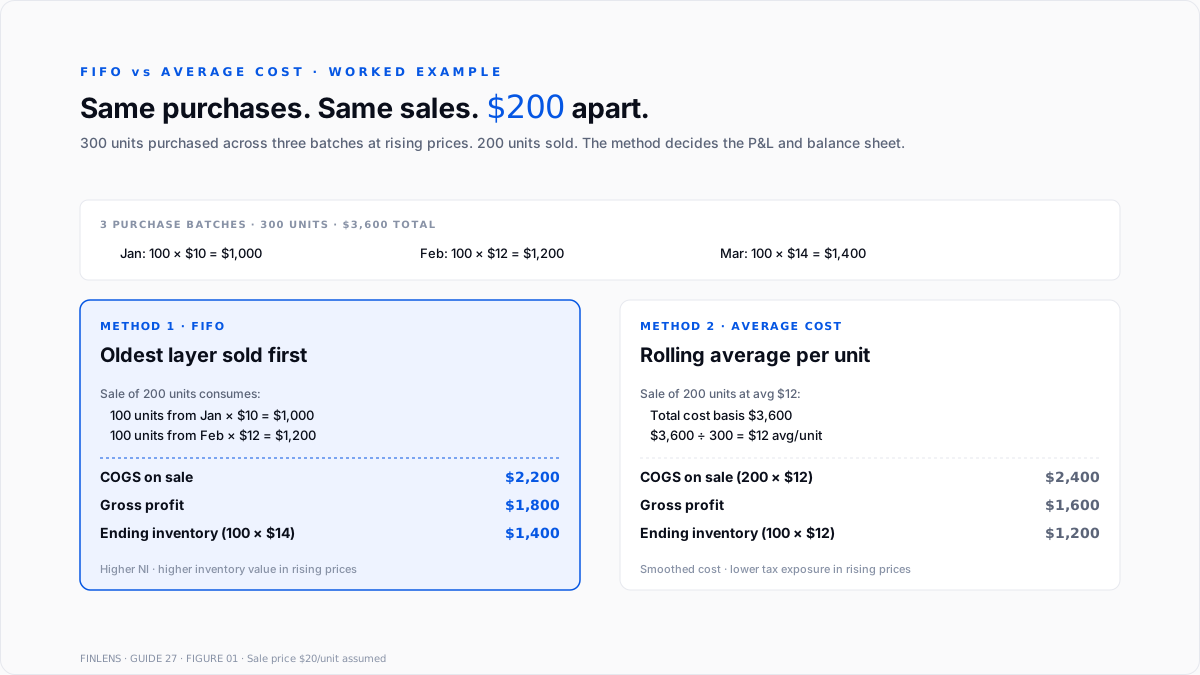
Consider a firm that buys three batches of the same SKU:
- January: 100 units at $10 each = $1,000
- February: 100 units at $12 each = $1,200
- March: 100 units at $14 each = $1,400
Total purchases: 300 units, $3,600 cost.
The firm sells 200 units in April.
Under FIFO, the sale consumes the January layer first (100 units × $10 = $1,000), then the February layer (100 units × $12 = $1,200). COGS on the sale is $2,200. Ending inventory is 100 units from March at $14 = $1,400.
How does Average Cost calculate COGS and ending inventory?
Average Cost calculates one blended per-unit cost across all inventory on hand at the moment of each sale.
Using the same three batches:
- After January purchase: 100 units at $10 avg
- After February purchase: 200 units at ($1,000 + $1,200) ÷ 200 = $11 avg
- After March purchase: 300 units at ($1,000 + $1,200 + $1,400) ÷ 300 = $12 avg
The firm sells 200 units in April at the current average of $12.
COGS on the sale is 200 × $12 = $2,400. Ending inventory is 100 units × $12 = $1,200.
What is the P&L and balance sheet impact of the two methods?
Same physical inventory. Same total purchases. Different accounting outcome.
The pattern: in a rising-price environment, FIFO produces lower COGS, higher gross profit, higher ending inventory, and higher taxable income. Average cost smooths the effect. In a falling-price environment, the pattern reverses. Broader P&L versus balance sheet framing is in Finlens' income statement vs balance sheet guide.
Broader coverage of inventory accounting methods and their P&L impact is in Finlens' inventory accounting methods guide.
Which QuickBooks products support FIFO versus average cost?
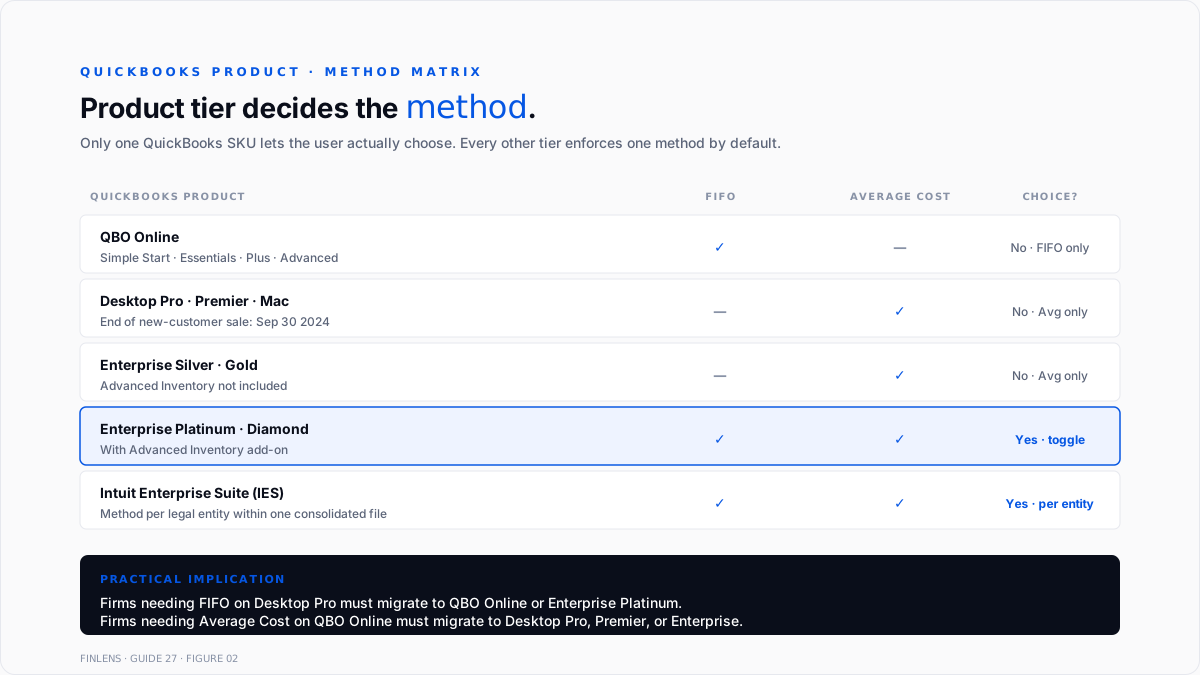
The QuickBooks product tier determines the available inventory method. This is the constraint most firms miss until after they have set up their books.
QuickBooks Online (all tiers: Simple Start, Essentials, Plus, and Advanced). FIFO only. Average cost is not available in any QBO Online tier.
QuickBooks Desktop Pro and Premier. Average cost only. FIFO is not available.
QuickBooks Desktop Mac. Average cost only. FIFO is not available.
QuickBooks Desktop Enterprise Silver and Gold. Average cost only. FIFO is not available.
QuickBooks Desktop Enterprise Platinum and Diamond with Advanced Inventory. FIFO or Average Cost. This is the only QuickBooks product where the user can choose.
Intuit Enterprise Suite (IES). Both methods are supported at the entity level, with different methods possible in different subsidiaries within the same consolidated file.
The practical implication: if the firm needs FIFO and is on Desktop Pro or Premier, migration to either QBO Online or Enterprise Platinum is required. If the firm needs average cost and is on QBO Online, migration to Desktop Enterprise is required.
How is the FIFO method enabled in QuickBooks Enterprise?
Enabling FIFO in Enterprise Platinum with Advanced Inventory runs in five steps. The step order matters because the effective date determines which historical transactions get restated.
- Back up the company file. Any inventory method change is irreversible without a backup.
- Navigate to Edit, then Preferences, then Items & Inventory.
- Open the Company Preferences tab. Click Advanced Inventory Settings.
- Select the FIFO tab. Check "Use FIFO starting on" and enter the effective date.
- Click OK. QuickBooks retroactively restates COGS and inventory value from the effective date forward.
The effective date must precede any inventory transaction the firm wants restated under FIFO. Post-dating the change means recent transactions stay on average cost while future transactions run on FIFO, which creates a hybrid book that fails audit.
The Intuit warning is not optional. Talk to the accountant, run the backup, and confirm the tax implications before pressing OK. The change affects the year-end financial statements and the tax return.
What is IRS Form 3115, and when is it required?
Changing the inventory accounting method for tax purposes requires IRS Form 3115 (Application for Change in Accounting Method). This is a federal requirement that applies regardless of the QuickBooks mechanic.
Two paths exist under Rev. Pro. c. 2015-13:
Automatic method change. Most inventory method changes (including FIFO to average cost or the reverse) qualify as automatic changes. Form 3115 is filed with the return in the year of change. No IRS user fee. No advance consent required.
Non-automatic method change. Some inventory changes require advance IRS consent. Form 3115 is filed before the year of change with a user fee. This applies to LIFO adoption and certain specific identification methods.
The Section 481(a) adjustment captures the cumulative effect of the method change. If FIFO would have produced $50,000 more COGS across prior years than Average Cost did, the $50,000 adjustment spreads over four years starting in the year of change.
The LIFO conformity rule (IRC §472(c)) requires firms using LIFO for tax to also use LIFO for financial reporting. FIFO and average cost do not have this conformity constraint, so a firm can use FIFO for books and a different method for tax if the deferred tax accounting is maintained correctly.
Coverage of write-off mechanics and related expense accounting is in Finlens' How to write off business expenses guide.
When should FIFO be used?
FIFO fits five business patterns.
Perishable goods. Food, pharmaceuticals, cosmetics, and dated products physically flow FIFO. The accounting method should match the physical flow. Regulatory audits assume FIFO in these categories.
Fashion and seasonal inventory. Apparel, home goods, and holiday products cycle through selling seasons. FIFO matches the physical clearance pattern and produces realistic gross margin trends.
Technology and rapidly obsolescing products. Consumer electronics, semiconductors, and software licenses lose value over time. FIFO recognizes the older, higher-cost units first, aligning book cost with market obsolescence.
E-commerce with SKU-level tracking. Amazon FBA, Shopify, and eBay sellers running SKU-level P&L benefit from FIFO's traceability. Each sale ties to a specific purchase batch, which supports gross margin analysis by campaign and promotion.
International reporting under IFRS. Firms consolidating under IFRS cannot use LIFO. FIFO is the most common alternative because it matches physical flow in most industries.
FIFO is the default for QBO Online users, which covers the majority of small-business inventory accounting in 2026. Ecommerce operators using Amazon FBA benefit from FIFO's traceability, as documented in Finlens' Amazon FBA reconciliation guide.
When should average cost be used?
Average cost fits five business patterns.
Bulk commodities. Chemicals, oil, grain, minerals, and other physically indistinguishable inventory blend together in storage. Average cost matches the physical reality.
Manufacturing with continuous production runs. Firms producing homogeneous units at variable input costs (steel, plastic, packaging) benefit from smoothed cost per unit rather than layer-based accounting.
Businesses with volatile input prices. Firms with high input price volatility use average cost to reduce swings in reported gross margin. FIFO would create large period-to-period margin variance that misrepresents operational performance.
Simplified reporting environments. Small businesses without SKU-level margin analysis get sufficient accuracy from average cost with less setup complexity than FIFO's layer tracking.
QuickBooks Desktop Pro and Premier users. Desktop Pro and Premier only support Average Cost. Users on these products either accept the average cost or migrate to QBO Online or Enterprise Platinum.
What are the most common inventory costing method mistakes?
Six errors recur in inventory method engagements.
Choosing a method the current QuickBooks product does not support. The firm decides on FIFO on QBO Desktop Pro. QuickBooks silently applies average cost because Pro does not support FIFO. The books look correct until a CPA review catches the mismatch.
Changing methods without Form 3115. The firm switches inventory methods mid-year and adjusts the QuickBooks setting. The financial statements change. The tax return is filed without Form 3115. The IRS treats the change as unauthorized, triggering a Section 481(a) recapture at examination.
Post-dating the effective date in Enterprise. The firm enables FIFO in Enterprise Platinum but sets the effective date after existing transactions. Recent inventory stays on average cost, while future transactions run FIFO. The hybrid file cannot be reconciled cleanly at year-end.
Ignoring the LIFO conformity rule. The firm uses LIFO for tax and FIFO for financial reporting. IRS examination triggers a full LIFO recapture, which can generate a large one-time tax bill.
Missing multi-warehouse cost layers. Firms with inventory in multiple locations run FIFO globally, but stock rotates locally. The FIFO layer that physically ships may not be the layer the accounting method assigns. This surfaces as inventory shrinkage at physical count.
Not backing up before switching methods. The Enterprise setting change is not fully reversible. Firms that skip the backup step and discover a problem after go-live have to reconstruct the prior state manually.
Conclusion
Finlens is a QuickBooks-compatible AI accounting platform. For firms with meaningful inventory, Finlens monitors the cost-method application, flags anomalies at the transaction level, and produces the audit trail required for method changes under Form 3115.
Every inventory transaction runs against the configured method (FIFO or average cost) with a validation check on the calculated cost basis. Variances between the QuickBooks calculation and the expected cost layer flag immediately. Multi-warehouse implementations get a per-location cost-layer report that surfaces the difference between physical flow and accounting method assumption.
For firms considering a method change, Finlens produces the Section 481(a) impact calculation before Form 3115 is filed. The calculation shows the cumulative effect of restating prior years under the new method, so the tax adjustment is known before the filing rather than discovered at examination.
For CPA firms serving multiple inventory-carrying clients, Finlens's multi-entity view surfaces inventory method inconsistencies across the client base. Clients on QBO Online default to FIFO. Clients on Desktop Pro default to Average Cost. Clients on Enterprise Platinum could be on either.
The dashboard identifies mismatches between the firm's tax filing history and the current QuickBooks setting before it becomes an examination issue.
Related workflow: month-end inventory tie-out against the general ledger is covered in Finlens' balance sheet reconciliation guide.
.png)
FAQ
Is FIFO or average cost better for tax purposes?
Depends on the price environment. In rising prices, average cost produces higher COGS and lower taxable income than FIFO. In falling prices, FIFO produces higher COGS. The tax savings from the choice compound over years, but the choice cannot be reversed casually because Form 3115 filing and Section 481(a) adjustments apply to method changes.
Can QuickBooks Online use average cost instead of FIFO?
No. QBO Online uses FIFO in all tiers. Firms that require Average Cost must migrate to QuickBooks Desktop Pro, Premier, or Enterprise. This is the single most common reason ecommerce operators evaluate Enterprise Platinum after outgrowing Desktop Pro.
Does IRS Form 3115 need to be filed if switching from FIFO to Average Cost?
Yes. Any inventory accounting method change for tax purposes requires Form 3115, even if the change qualifies as automatic under Rev. Proc. 2015-13. Filing timing depends on automatic vs. non-automatic status. Most FIFO ↔ Average Cost changes qualify as automatic and file with the return in the year of change.
What is the difference between weighted average and moving average?
The weighted average recalculates once per period (typically monthly) using all purchases in the period. The moving average recalculates on every purchase transaction. QuickBooks uses moving averages in real time. For periodic inventory systems, weighted average is calculated at period-end. Both produce similar results in stable-price environments.
Is LIFO available in QuickBooks?
Not natively in any QBO tier. LIFO is legal for tax under US GAAP but requires manual journal entries and layer tracking outside QuickBooks. Firms using LIFO typically run a separate inventory management system alongside QuickBooks. LIFO is prohibited under IFRS.
What happens to inventory value when switching methods mid-year?
The change generates a Section 481(a) adjustment representing the cumulative difference between the old and new methods across all prior years. The adjustment spreads over four years for automatic method changes. QuickBooks itself recalculates the ending inventory value based on the new method as of the effective date.
Can different subsidiaries in one company use different inventory methods?
Yes, if each subsidiary is a separate legal entity with its own tax filing. Consolidation for financial reporting requires consistent method within a reporting entity. Intuit Enterprise Suite supports mixed methods at the entity level with consolidation logic that handles the differences.
How often should the inventory costing method be reviewed?
At least annually as part of the year-end close, and immediately after any of the following: material change in input prices, entry into new sales channels, acquisition of another inventory-carrying business, or migration between QuickBooks product tiers. Coverage of the annual close checklist is in Finlens' balance sheet reconciliation guide.

